
Background Check Services for Small Businesses

A 12-person agency hires a senior account manager after reading a polished CV and buying a cheap online screening bundle. Six months later, the owner discovers that the employment history was fabricated and a conviction that should have been disclosed never appeared in the report. The salary has been wasted, client confidence has taken a hit, and the business is left asking whether its screening process created a compliance problem as well as a hiring problem.
That situation is avoidable. The right background check services for small businesses don't begin with a standard package. They begin with four questions: who verified each claim, what lawful basis justified each check, whether the package matched the role, and whether the screening notes would withstand scrutiny from the Information Commissioner's Office.
Why Small UK Businesses Are Getting Burned by Generic Screening
The appeal of a low-cost online bundle is obvious. A small firm wants a quick answer, not a complicated investigation. But a portal can confirm that a name and address appear consistent without proving that a candidate held the senior position stated on a CV, completed the qualification listed, or gave a complete account of relevant conduct.
The owner in the example above approved the bundle because it looked complete. In reality, the process may have been little more than automated identity matching and a database sweep. Nobody called the former employer, tested the candidate's dates, or examined why a supposedly senior role couldn't be independently confirmed.
The practical question isn't whether a report says “clear”. It's what the provider actually checked before using that word.
The UK is dominated by small firms. At the start of 2024, the country had 5.5 million SMEs, representing 99.8% of the business population. That included 4.1 million businesses with no employees beyond the owner, 1.2 million micro businesses with one to nine employees, and 220,000 small businesses with 10 to 49 employees, according to the UK Government's SME evidence annex. These businesses need screening that scales sensibly. They don't need an enterprise bundle designed to sell more checks than the role requires.
The risks are practical:
Salary and onboarding waste: A poor hire can absorb management time and disrupt a small team.
Client confidence: A false CV or integrity issue can damage relationships, particularly where staff represent the business directly.
Unlawful data use: Unnecessary pre-employment vetting can fail the ICO's proportionality test.
DBS misuse: A criminal-record check can't be ordered because an employer wants extra reassurance. Standard and enhanced checks are restricted to eligible roles under specific legislation, as set out in the DBS eligibility guidance.
For a useful discussion of why complex roles need more than generic automation, read Talent Pronto's take on complex screening. The point is straightforward. Buy the checks that answer the risks of the job, then keep an audit trail showing why you chose them.
The UK Compliance Foundations Every Small Business Must Cover
Compliance starts before anyone orders a report. A small employer should build the process into the hiring workflow, rather than treating it as an optional final check.
Start with the right-to-work decision
The employer must verify that the applicant is permitted to work in the UK before employment begins. The official right-to-work process allows an employer to check original documents or an online status, keep copies, and record the date of the check. If the applicant can't show the required evidence, the employer may need to ask the Home Office to confirm the person's immigration status.
This is a legal milestone, not a premium screening feature. Record who completed the check, what evidence was reviewed, when it happened, and where the copy is stored.
Test DBS eligibility before requesting a criminal-record check
The role determines whether a DBS check is lawful. Standard and enhanced checks are available only where legislation makes the role eligible. A basic DBS check has no eligibility requirement, but the employer must still handle the information fairly and lawfully.
The ICO describes pre-employment vetting as “particularly intrusive” and says it should be used only where there's a legal obligation or a clearly identified risk, according to its guidance on pre-employment vetting of candidates. Don't order an enhanced check for an ordinary office role because a portal offers it as part of a bundle.
Give candidates a transparent privacy explanation
Your notice should explain what you'll collect, why you need it, who will see it, whether a third party is involved, and how long you'll retain it. Set out the lawful basis for each activity, usually a documented legitimate-interest assessment where appropriate, and separate that reasoning from the candidate's general employment application.
The ICO's name-blind hiring guidance also supports removing irrelevant identifying information at earlier recruitment stages where practical. It won't replace screening, but it can reduce the influence of irrelevant personal details before a candidate reaches the verification stage.
Set retention and deletion rules
Keep records only while there's a lawful and necessary reason to do so. Decide in advance what happens to reports for successful candidates, unsuccessful candidates, and withdrawn offers. A written schedule is more defensible than an inbox full of old attachments.
Your operating document should cover:
The role risk assessment.
The checks selected and their lawful basis.
Candidate notice and authorisation.
Evidence reviewed and discrepancies found.
The decision-maker and outcome.
Retention, access, and deletion.
For more detail on putting these steps into practice, use our guide to legal background screening for employers. The important point is that these foundations are the screening programme. They aren't paperwork added after the report arrives.
Which Background Checks Actually Catch Real Risk
A sensible programme follows an order. Verify identity first, test the claims most relevant to the role, and only then add checks that a documented risk assessment justifies.
UK screening data shows why that order matters. One reported UK study found that 85% of organisations experienced candidates failing background checks, with 50% of SME recruiters and 86% of mid-sized firms seeing failures, as reported by HRreview's coverage of candidate screening failures. A separate EMEA benchmark reported discrepancies involving 64% employment-history mismatches, 47% education mismatches, 22% undisclosed criminal convictions, and 19% identity-fraud incidents or uncertainty, in the same source.
Check Type | Risk Caught | Lawful Basis | Proportionate For | Investigator Value |
|---|---|---|---|---|
Identity and address verification | Synthetic identities, inconsistent personal details, false CV foundations | Legitimate interest, documented against the role | Every hire where identity must be established | A portal may flag a mismatch. An investigator can reconcile documents, addresses, and explanations. |
Employment history and gaps | Fabricated employers, inflated titles, unexplained periods | Legitimate interest where relevant to competence or trust | Senior, client-facing, financial, or specialist roles | Automated confirmation is useful. Human calls add value when HR doesn't respond or dates conflict. |
Qualifications and professional registration | Unverifiable degrees, expired registrations, invented credentials | Legitimate interest or legal obligation where relevant | Regulated, technical, or qualification-dependent work | Portals can confirm records. Manual enquiries help with vague institutions and unusual claims. |
Credit information | Financial pressure or insolvency concerns relevant to fiduciary duties | Clear, role-specific legitimate interest | Finance, cash-handling, or fiduciary roles | Automation can retrieve information. A human should assess relevance rather than treat a file as an automatic rejection. |
DBS | Relevant criminal-record information | Legal obligation or role eligibility | Roles covered by DBS legislation | A provider should first assess eligibility. Investigator input helps prevent unlawful over-screening. |
Media and adverse media | Public conduct concerns affecting senior or client-facing positions | Legitimate interest, tightly defined and documented | Senior leaders, public representatives, sensitive client roles | Search tools collect results. An investigator separates a genuine issue from mistaken identity or irrelevant commentary. |
Director and disqualified-person checks | Company-office restrictions and governance concerns | Legitimate interest or legal compliance | Directors, PSCs, and proposed officers | A portal can locate records. A human can connect the result to the individual's declared role. |
Fraud pressure makes this broader approach more important. CIFAS-linked reporting cited by the market says fraud accounted for 41% of all crime and that 217,000 cases were filed to the National Fraud Database in the first half of 2025, as discussed in Blowfish Technology's cybersecurity fraud impact guide. DBS processed just over 7.4 million checks in 2025–26, including 2,918,134 Basic checks and 3,828,877 Enhanced with Barred List(s) checks, according to the same verified market reference. Those figures don't mean every business needs a DBS check. They show why employers should match the control to the threat instead of confusing criminal-record screening with complete due diligence.
Choosing Between Online Portals and Investigator-Led Services
Online portals work well for repeatable, low-complexity tasks. They can collect candidate consent, verify identity details, run sanctions searches, and produce a basic report without much administration. For a straightforward junior role, that may be enough.
The weakness appears when the data conflicts. An automated system won't usually call a former employer repeatedly, establish whether a company changed names, assess a vague job title, or interview a referee about the candidate's actual duties. It will show a status. Someone still has to decide what the status means.
Criterion | Online Portal | Investigator-Led Service |
|---|---|---|
Speed | Fast for standard searches and digital evidence | May take longer where employers or institutions need chasing |
Cost structure | Usually lower for simple, repeatable checks | Higher where manual research and interviews are required |
Employment verification | Often depends on automated responses or supplied contacts | Can include structured telephone interviews and follow-up enquiries |
Document review | Basic upload and matching functions may be available | A trained analyst can examine inconsistencies and context |
Dispute handling | Candidate may receive a portal message or standard workflow | A human can review the source, obtain clarification, and record the reasoning |
Defensibility | Depends heavily on the employer's own interpretation | Adds a documented human assessment and audit trail |
Best fit | Low-risk roles with clear, verifiable information | Senior, regulated, customer-facing, financial, or disputed cases |
A provider offering a DBS check without first discussing eligibility should concern you. So should vague answers about retention, unclear third-party processing, and prices that hide separate charges for reference chasing or document review.
Cheap automation is useful for clean data. It isn't a substitute for judgement when the data is dirty.
A mixed model often makes sense. Use a portal for identity and routine workflow, then escalate anomalies to an investigator. Businesses comparing technology-led staff screening can also review Alignmint's staff screening features, but ask every provider the same operational questions: who handles exceptions, who speaks to candidates, and who signs off the final interpretation?
Reading Screening Results Like an Experienced Investigator
A screening report isn't a pass or fail certificate. It's a collection of evidence with different levels of confidence, relevance, and reliability.
Start with identity. A name match alone proves little where the candidate has a common name or a complicated address history. Look for consistency across the identity information supplied, right-to-work evidence, employment records, and qualifications. A minor spelling variation may be administrative. A conflicting date of birth or unexplained address pattern needs proper resolution before you rely on the report.
Separate gaps from genuine contradictions
An employment gap isn't automatically misconduct. A candidate may have taken time away for health, caring responsibilities, travel, or study. The concern is a material unexplained period where the candidate's CV implies continuous employment, particularly if the missing period overlaps with a role or event relevant to the position.
The distinction between no reference returned and a conflicting reference matters. A former employer's refusal to provide more than dates may leave the claim partly unverified. A referee who gives dates that contradict the CV creates a direct discrepancy. Record both accurately, but don't assign them the same weight.
Consider three examples:
Vague title mismatch: The CV says “senior account manager”, while the employer confirms “account executive”. Ask whether the difference reflects an internal title, expanded duties, or exaggeration.
Unverifiable academic claim: The institution can't confirm the qualification, or the course details don't exist as described. Pause the decision and give the candidate a fair opportunity to explain.
Undisclosed county court judgment: Where a finance or fiduciary role makes financial reliability relevant, an undisclosed judgment may justify withdrawing an offer after a proportionate review. The decision should rely on role relevance and documented facts, not a blanket assumption that any financial issue disqualifies someone.
Criminal-record information needs particular care. A spent conviction under the Rehabilitation of Offenders Act 1974 is treated differently from an unspent conviction, and the employer must still ask whether the check was lawful for the role and whether the information is relevant. A conviction isn't a universal “fail” marker.
Write the decision as if someone else will read it
Use a consistent risk framework. Record the discrepancy, source, candidate response, role relevance, decision, and decision-maker. If you withdraw an offer, state that the outcome followed factual findings and the agreed role criteria. Don't write insulting or speculative comments.
A structured file helps the business respond if the candidate complains to the ICO or brings an employment tribunal claim. It also prevents managers from treating similar candidates differently because one report was easier to understand than another.
Pricing Background Checks by Risk Rather Than Headline Fee
The cheapest package is rarely the cheapest decision. A low-risk junior office hire with no customer contact may need identity verification, right-to-work confirmation, and two reference calls. A person handling cash, stock, sensitive client data, or vulnerable groups may justify additional checks, but only where the role and law support them.
Don't publish a made-up per-check budget and pretend it applies universally. Providers charge differently, and the cost depends on whether a reference is automated, whether an institution responds, how many countries are involved, and whether an investigator must resolve discrepancies. The correct budget is a role-based estimate, not a headline figure copied from a portal.
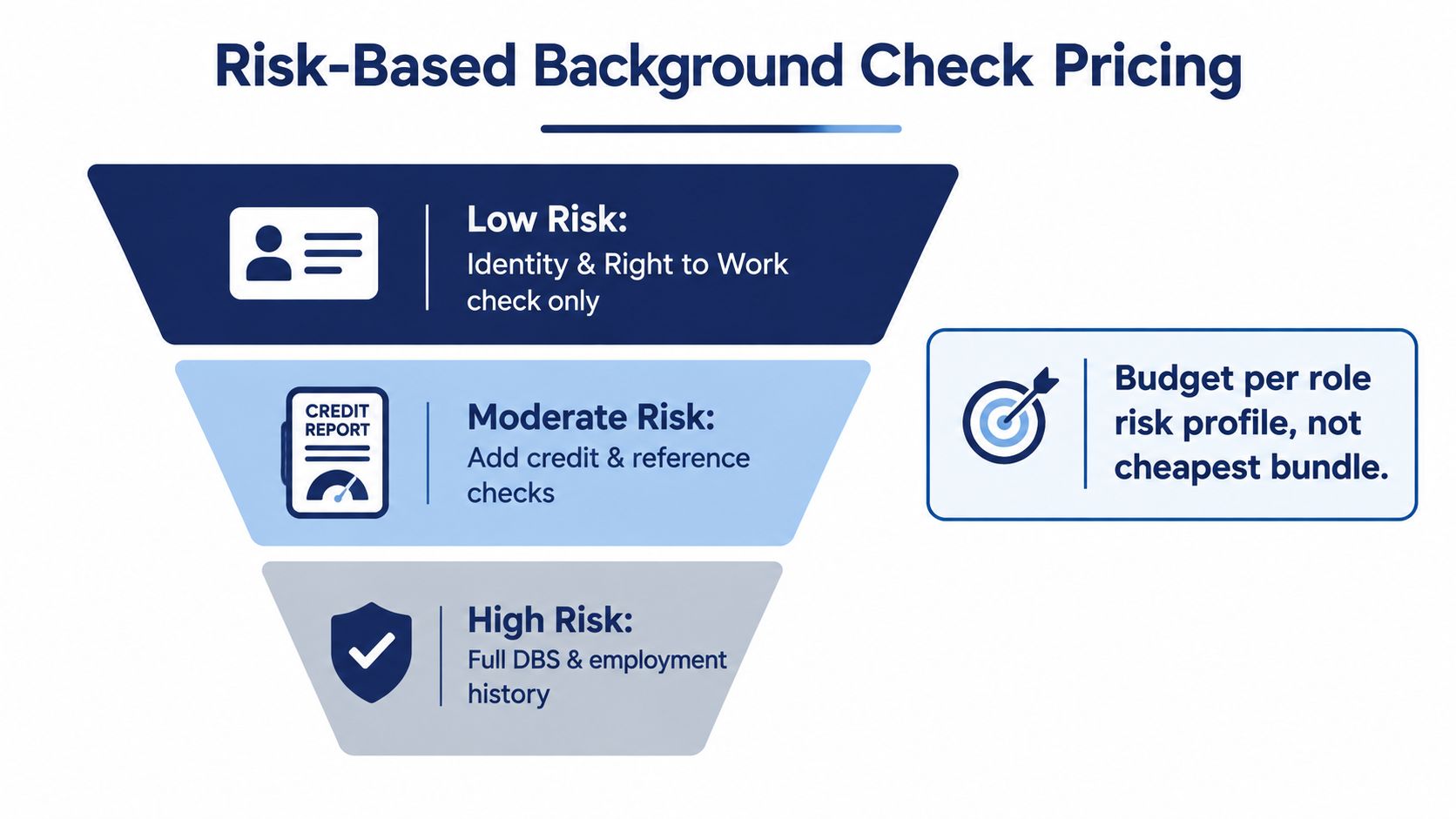
Build three internal pricing bands
Low risk: Identity and right-to-work evidence, followed by references that test attendance, dates, and core duties. Keep the process light where the role carries limited access and responsibility.
Moderate risk: Add focused employment verification, qualification checks, or a credit check where the role involves fiduciary duties or financial responsibility and the legitimate-interest case is clear. Customer-facing roles may also justify carefully defined media checks.
High risk: Consider deeper employment history, professional registration, and an eligible DBS check where the role falls within the relevant legislation. Senior hires may need investigator-led enquiries because their decisions affect clients, staff, assets, or the company's reputation.
The hidden cost sits in the exceptions. A DBS fee doesn't include the time spent chasing references, checking contradictory documents, recording the candidate's explanation, or deciding whether a result is relevant. If the owner handles those tasks personally, the business still pays. It pays in management time and exposure.
Use the factors affecting background check price to prepare a role-by-role estimate. For a small firm replacing the equivalent of five to ten staff a year, the sensible annual budget is the combined cost of the checks required for those roles, plus a reserve for disputed or manual cases. That approach keeps routine hiring affordable while avoiding the false economy of buying a cheap bundle that misses the only issue that mattered.
Your Next Step and How Sentry Private Investigators Ltd Can Help
Before next week's interviews, prepare a one-page screening brief for each vacancy. Answer five questions:
What access, authority, money, information, or responsibility will the person hold?
What evidence must every candidate provide before starting?
Which additional checks does that role justify?
What lawful basis and retention period apply to each check?
Who will investigate and interpret a discrepancy?
This brief prevents managers from ordering a DBS check because a provider makes it easy. It also exposes where a basic identity match is inadequate, such as a senior candidate's employment history, qualifications, or unexplained gaps.
Sentry Private Investigators Ltd provides corporate background checks and screening support for employers and businesses. Investigator-led support earns its place in awkward cases: an unresponsive former employer, a vague employment history, an unverified professional claim, a disputed result, a subject-access query, or an audit trail that explains the final decision.
Keep ownership of the policy in-house. A provider should not decide that every role needs the same investigation, and an investigator cannot replace your documented lawful-basis assessment. Set a named person to interpret the evidence, record the reasoning, and decide whether a discrepancy is relevant. That process keeps screening proportionate and gives the ICO a defensible explanation if the decision is questioned.
Start with the job descriptions, the access or responsibility involved, and any concerns raised during recruitment. Then contact a private investigator for discreet support. Ask for a programme mapped to the vacancies, with clear decisions on what to check, what to skip, and where human verification is justified.
If you want help building that programme, bring those documents and concerns to Sentry Private Investigators Ltd. The right advice should reduce wasted checks, expose employment-history mismatches, identity fraud, and undisclosed convictions where the role warrants investigation, and leave your business with records that explain why each check was used.