
Employee Background Checks UK: Your Complete Guide

Updated: Jul 26, 2025
Before you even think about running a background check, you need to get your head around the rules. This isn't just about ticking compliance boxes; it's about protecting your business from some pretty hefty legal trouble and respecting a candidate's right to privacy. It’s a foundational step you can't afford to skip.
Your Legal Duties for UK Background Checks
Wading through the legal side of background screening can feel a bit daunting, but it really comes down to a few key principles. The two big ones you absolutely need to know are the UK General Data Protection Regulation (UK GDPR) and the Data Protection Act 2018. These are the rulebooks for handling anyone's personal data.
First things first, you need a legitimate, lawful reason to process a candidate's information. For most background checks, this means getting the candidate's clear consent. However, for some jobs, it's a legal requirement. Think of a teacher, where you're legally obligated to check their record against a barred list. You can't just do it because you feel like it.
The Bottom Line: You can't run a background check on a whim. You must have a clear, justifiable, and legal reason that’s directly relevant to the specific job on offer.
Getting Valid Candidate Consent
Getting consent is more than just getting someone to tick a box on a form. For that consent to hold up legally, it has to be freely given, specific, informed, and unambiguous. In simple terms, you need to be completely upfront with applicants about what you're checking, why you're checking it, and what you'll do with the information.
Your consent form should spell everything out clearly. I always advise clients to detail:
Exactly what you’ll collect: Be specific. Don't just say "references"; say "verification of employment with [Company X] from [Date] to [Date]" or "a Basic DBS check."
Why you need it: Connect the check directly to the job's duties. For instance, "A credit check is required due to the financial responsibilities of this role."
How long you'll keep it: Outline your data retention policy. How many months or years will you hold onto this information?
Who will see it: If you're using a third-party screening service, you need to name them.
Being transparent right from the start is non-negotiable. A good, clear process doesn't just keep you on the right side of the law; it builds trust with the very people you want to hire. Understanding these procedures is critical, which is why we've put together a guide on the importance of conducting thorough background checks.
To help clarify these responsibilities, here's a quick summary of the core legal principles you need to embed in your process.
Key UK Legal Requirements at a Glance
Legal Requirement | What It Means for Employers | Actionable Tip |
|---|---|---|
Lawful Basis | You must have a valid legal reason (e.g., consent, legal obligation) to process personal data for a background check. | Always document your lawful basis before starting any checks. For most roles, this will be a signed consent form. |
Data Minimisation | Only collect the data you absolutely need for the specific role. Don't run a full financial history check for a junior marketing role. | Create a policy that matches specific checks to job risk levels. A one-size-fits-all approach is a legal risk. |
Purpose Limitation | The data collected can only be used for the background check purpose you stated. You can't use it for marketing or other unrelated activities. | Be explicit in your consent form about how the data will be used. Stick to it religiously. |
Transparency | You must inform candidates about what checks you're conducting, why you're doing them, and who will see their information. | Provide candidates with a clear, easy-to-read privacy notice before they consent. Avoid legal jargon. |
Accuracy | You must take reasonable steps to ensure the information you collect and hold is accurate and up-to-date. | If a candidate disputes information (e.g., a wrong employment date), have a process to investigate and correct it. |
Data Security | You are legally required to protect the personal data you collect with strong security measures like encryption and access controls. | Use a reputable screening provider with certified security credentials and restrict internal access to sensitive data. |
Following these principles isn't optional—it's the bedrock of a fair and legally sound hiring process.
Data Protection and Security
With the UK GDPR in full force, data privacy and security are more important than ever. You are responsible for ensuring all that sensitive personal data is collected, stored, and handled with the utmost care. This means using technology with strong safeguards like encryption and limiting who in your organisation can access the files. The penalties for getting this wrong can be severe, so it's a business risk you need to manage proactively.
Finally, remember that the Disclosure and Barring Service (DBS) has its own strict code of practice. This is especially true for roles involving work with children or vulnerable adults. You must ensure you only request the level of DBS check you are legally entitled to. For example, asking for a Standard or Enhanced DBS check for a basic office job that doesn't meet the eligibility criteria is against the law.
Choosing the Right Type of Employee Check

When it comes to employee background checks in the UK, a one-size-fits-all approach just doesn't work. I've seen too many businesses make this mistake. Not only is it a waste of resources, but running an overly invasive check for a role that doesn't justify it can lead to serious legal trouble.
The real secret is tailoring the check to the job. It’s all about proportionality. You simply don't need the same level of vetting for a junior marketing assistant as you do for a chartered accountant who will have access to all your company’s financial data.
Getting this right is a fundamental part of responsible hiring. Your first port of call should be to map out the different types of checks available against the specific risks tied to each role in your company. This is a non-negotiable step in https://www.sentryprivateinvestigators.co.uk/post/building-a-secure-workforce-through-ethical-hiring-practices.
Let's break down the main types of checks you'll be dealing with.
Which Background Check Is Right for Your Role?
Navigating the different checks can feel confusing at first, but it becomes much clearer when you match them to the specific demands of a role. The table below breaks down the most common checks, what they actually verify, and gives you a good idea of when you should be using them.
Type of Check | What It Verifies | When to Use It |
|---|---|---|
Right to Work Check | A candidate's legal eligibility to work in the UK. | Mandatory for all employees, without exception. |
Basic DBS Check | Unspent criminal convictions and conditional cautions. | Any role. Often used for positions of trust like office managers or cash handlers. |
Standard DBS Check | Spent and unspent convictions, cautions, and warnings. | Specific roles only, such as certain legal or financial positions. |
Enhanced DBS Check | All information from a Standard check, plus relevant police intelligence. | Roles involving regulated activity with children or vulnerable adults (e.g., teachers, carers). |
Employment History | Confirms past employers, job titles, and dates of employment. | Most professional roles, to verify CV accuracy and experience claims. |
Reference Check | Gathers qualitative feedback on performance, skills, and character. | Nearly all roles. Essential for understanding how a candidate performs in a real-world setting. |
Qualification Check | Validates academic degrees and professional certifications. | Roles requiring specific credentials, like engineers, doctors, or certified technicians. |
Remember, this is about building a complete and accurate picture of a candidate, ensuring they are who they say they are and can do what they claim they can.
The Foundations: Right to Work and Criminal Records
Before you go any further, there are some absolute basics to cover. Verifying a candidate’s identity and their legal right to work in the UK isn't just good practice—it's the law. A Right to Work check is compulsory for every single hire, and the penalties for getting it wrong are steep.
Next up are criminal record checks, which are handled by the Disclosure and Barring Service (DBS). These are tiered, and you need to know which one applies.
Basic DBS Check: This is your starting point and can be requested for any position. It flags any "unspent" convictions.
Standard DBS Check: This is more detailed and only for eligible roles, like certain positions in finance or law. It shows both spent and unspent convictions and cautions.
Enhanced DBS Check: The most thorough check, this is reserved for roles involving close work with children or vulnerable adults, such as healthcare or teaching. It includes everything from the Standard check, plus any relevant information held by local police.
Enhanced with Barred Lists Check: This goes one step further by checking if the individual is legally barred from working with children or vulnerable adults.
A Word of Warning: You cannot legally run a Standard or Enhanced DBS check just because you feel like it. The role must be eligible under the law (specifically, the Rehabilitation of Offenders Act 1974). Attempting to use these higher-level checks for an ineligible role is a criminal offence, so always be certain.
Digging Deeper: Verifying Experience and Qualifications
Beyond criminal records, you need to be sure a candidate’s professional history stacks up. This is where you build confidence in their competence and reliability.
Verifying employment history simply confirms that the job titles and dates on their CV are accurate. Reference checks, on the other hand, give you a much richer, qualitative insight into their work ethic and character. Asking the right essential reference check questions can transform a simple reference call into an incredibly valuable part of your vetting process.
Finally, don't forget to validate academic and professional qualifications, especially if the role requires a specific degree or certification. This is about making sure you’re hiring someone who genuinely has the skills to do the job safely and to a high standard.
How Technology Is Changing Background Screening

Modern screening platforms can crunch huge amounts of data in a fraction of the time it would take a person. This speed is a real game-changer. In today’s competitive hiring market, the best candidates are often snapped up in days. If you’re waiting weeks for manual checks to clear, you’re simply going to lose out on top talent.
The Rise of AI in Screening
A lot of this progress is down to Artificial Intelligence (AI). AI-powered systems can automatically scan and cross-reference a candidate's information, flagging discrepancies a human might miss. For example, if a CV claims employment dates that don’t quite line up with official records, the system instantly highlights it for a closer look.
Key Takeaway: Technology doesn't replace human judgement in hiring. Instead, it provides better, more organised information so your team can make smarter, more consistent, and fairer decisions.
This automated approach also massively cuts down on human error. It ensures every check is handled with the same level of care, which is crucial for staying fair and compliant—especially when you’re conducting employee background checks in the UK at scale.
AI is making these checks even smarter. Here in the UK, we're seeing AI transform how employers assess candidates by rapidly processing data, spotting gaps in work history, and even cross-referencing public online profiles. This leads to more precise screening and a much faster hiring cycle. You can find more on how AI is supporting the future of background checks on 321gocheck.com.
What to Look for in a Tech-Driven Provider
When you're picking a screening provider, their technology should be a top priority. Don't be shy—ask them direct questions about their platform and how it all works.
Here are a few things I always tell clients to look for:
Security Measures: How do they protect candidate data? Keep an eye out for certifications like ISO 27001, which signals a serious commitment to information security. Their data absolutely must be encrypted, both when it's moving and when it's stored.
Integration Capabilities: Does their system play nicely with your current Applicant Tracking System (ATS)? A smooth integration will save you countless hours of admin and prevent frustrating data entry mistakes.
User Experience: Is the platform easy to navigate for your team and your candidates? A clunky, confusing portal creates a poor impression of your company before your new hire has even signed a contract.
At the end of the day, the right technology partner will give you reliable, fast, and compliant results you can trust. This is how you build a stronger, more secure workforce.
Putting It All into Practice: A Framework for Your Checks
Okay, let's move from the 'what' and 'why' to the 'how'. Having a clear, repeatable process is non-negotiable when it comes to employee background checks in the UK. This isn't about a rigid, one-size-fits-all checklist. Instead, think of it as a flexible framework that keeps you on the right side of the law, ensures fairness, and treats every single candidate with respect. A solid framework simply takes the guesswork out of the equation.
Believe it or not, the process starts well before you even post a job advert. The very first thing you need is a formal, written background check policy. This document is your North Star. It should spell out exactly which checks you'll run for which roles and, crucially, why they're necessary. This ensures you’re applying the same standards to every applicant for a given job, which is your best defence against any claim of discrimination.
Getting Consent and Picking the Right Partner
With your policy in hand, your first direct interaction with the candidate on this matter is getting their consent. It has to be explicit and informed. A pre-ticked box buried deep in an application form just won't cut it. Your consent form needs to clearly state what you're checking, who is doing the checking (including any third-party providers you use), and how you'll handle their data.
Choosing a screening partner is another pivotal step. A good provider does more than just run the checks; they ensure their own methods are fully compliant with UK GDPR and other laws. They essentially become an extension of your HR team, bringing the expertise and tech you need. To make sure your checks are thorough and fit neatly into your hiring workflow, building out your own system is vital. For a great guide on this, you might want to explore a comprehensive pre-employment screening process.
This is a good visual of a simple, compliant workflow you can follow.
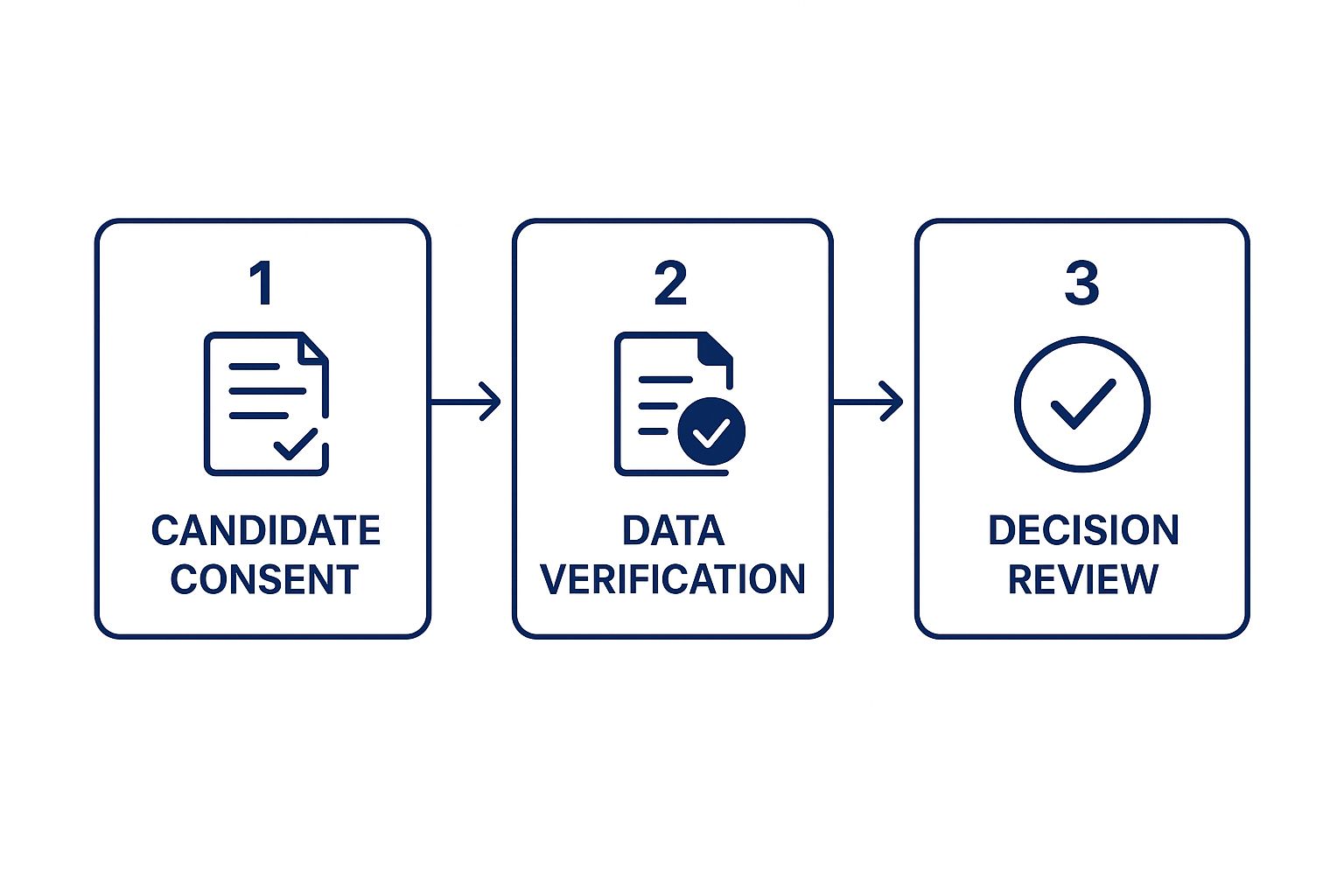
As you can see, the flow from getting consent to reviewing the final report highlights why a structured, candidate-focused approach is so important.
Reviewing the Report and Making a Fair Call
Now for the tricky part: reviewing the results. What happens if a check comes back with something negative or unexpected? The two words to live by here are context and fairness. A minor, irrelevant blip from a decade ago shouldn't be an automatic deal-breaker.
Your policy should help you here by defining what a genuine "red flag" looks like for different roles. For example, a conviction for financial fraud is obviously a major issue for a potential accountant. For a warehouse job? Not so much.
Crucial Tip: Never, ever make a knee-jerk decision based on a negative report. You are legally and ethically obligated to show the candidate the information and give them a chance to explain. Sometimes, discrepancies are just simple admin errors. Giving them the right to reply is a cornerstone of a fair process.
This conversation is absolutely essential. It allows you to get the full picture before you make that final hiring decision. Once you’ve heard their side and weighed the issue against the actual requirements of the job, you can make a choice that is objective and, importantly, defensible.
For particularly senior or sensitive positions where you might need to go deeper, understanding how private investigators conduct detailed background research can offer some valuable insights. By sticking to a framework like this, you build a process that's not just compliant, but also transparent and fair to everyone involved.
Common Screening Mistakes and How to Avoid Them

Even with the best of intentions, it's surprisingly easy to get things wrong when running employee background checks in the UK. These mistakes aren't just about a bad candidate experience; they can land your business in serious legal hot water, facing everything up to a discrimination claim. Understanding the common slip-ups is the first step to building a screening process that's both fair and legally solid.
One of the most common errors I see is inconsistency. Let's say you decide to run a credit check on one candidate for a finance role but not another who applied for the same job. Straight away, you've opened the door to accusations of unfair treatment. Your process needs to be built on a clear, written policy that applies the same checks to every single applicant for a particular role. No exceptions.
Another huge pitfall is misreading the results. A background check report isn't a simple "pass" or "fail" ticket. It's a nuanced document. Automatically rejecting someone because of old, minor, or irrelevant information without digging into the context is a massive mistake.
Avoiding Common Legal Traps
To keep your business safe, you need to steer clear of a few common but risky habits. The most tempting of these? The quick DIY social media search. It seems harmless enough to have a quick peek at a candidate's public profiles, but it’s a legal minefield. You risk stumbling across protected characteristics—like their age, religion, or even pregnancy status—which can subconsciously bias your decision and lead to a discrimination claim.
Key Insight: The point of a background check is to verify specific, job-related information, not to launch a wide-ranging personal investigation. Using a professional screening service is the best way to ensure you only see the information that’s legally permissible and actually relevant to the job.
Your best defence is documentation. Keep a clear record of your policy, the candidate's consent, the report you received, and, crucially, the reasoning behind your hiring decision. This paper trail is your proof that you followed a structured, fair, and non-discriminatory procedure.
Best Practices for a Fair Process
Building a positive and compliant screening experience really comes down to a few core principles. Transparency is absolutely non-negotiable. Applicants should know exactly what you’re checking and why, right from the get-go.
Here are a few practical tips to keep you on the straight and narrow:
Be Proportional: Only run checks that are truly relevant and necessary for the role. A deep financial history check for a junior graphic designer, for instance, is almost certainly unjustifiable.
Lock Down the Data: Treat all candidate information like gold. Make sure it's stored securely with strictly limited access, in line with your GDPR obligations.
Give Candidates a Voice: If a check turns up something negative, always give the candidate a chance to see the report and explain. There are often two sides to every story, and you need to hear theirs.
Ultimately, a well-managed background check process doesn't just protect you; it strengthens your hiring and builds trust. It signals to candidates that you're a professional and fair employer, setting the right tone before they even start. By getting it right, you create a process that's positive and legally sound for everyone involved.
Your Top UK Background Check Questions, Answered
Even with a clear process, running background checks often brings up specific questions. You've got the framework, but what about those tricky, real-world situations? Let's tackle some of the most common queries I hear from UK employers to give you the confidence to handle your screening process.
So, how far back do these checks actually go? For a typical employment history check, we usually look at the last three to five years. When it comes to criminal records, though, it’s a different story. A Basic DBS check will only show 'unspent' convictions. However, Standard and Enhanced checks can dig deeper, potentially revealing older, 'spent' convictions if they're deemed relevant to the job.
What Should I Do About Red Flags and Discrepancies?
One of the biggest questions is what actually counts as a "red flag" on a background check. The truth is, there's no single definition. It all comes down to your company's policy and the specific role you're hiring for.
A red flag isn't always a criminal conviction. It could be:
A serious conviction that directly impacts the job's responsibilities, like a fraud conviction for an accountant.
A revoked professional licence or essential certification that the job requires.
Significant, unexplained gaps in their work history or clear attempts to falsify it.
Ultimately, you’re the one who decides what's acceptable. An old, minor offence from years ago might be completely irrelevant. A more recent, serious one, however, could be a definite no-go. The trick is to evaluate everything within the context of the job itself.
A Crucial Point: Finding a red flag is the start of a conversation, not an automatic rejection. You have a legal duty to discuss any negative findings with the candidate. This gives them a fair opportunity to explain the situation or correct any mistakes before you make a final call.
What About Checks for Specific Roles, like Carers?
I get a lot of questions about roles that involve safeguarding, and rightly so. When hiring for positions like carers, there's absolutely no room for error.
So, what checks are essential? Here’s the bare minimum:
A Right to Work Check: This is a legal must-have for every single employee in the UK, no exceptions.
An Enhanced DBS with Barred List Check: This is the most thorough check available. It tells you if someone has relevant convictions and if they are legally barred from working with children or vulnerable adults.
Depending on the specifics, you might also want to verify qualifications (like NVQs in health and social care) or run a DVLA check if they'll be driving as part of their duties. For roles built on trust, your screening has to be watertight to protect your clients and meet the standards of regulators like the Care Quality Commission (CQC).
At Sentry Private Investigators Ltd, we provide comprehensive and discreet background check services to help you make informed and safe hiring decisions. Contact us today to ensure your vetting process is robust and compliant.