
A Guide to Private Investigator Services in the West Midlands

You've noticed something that doesn't fit. A partner's routine has changed, an employee's injury claim doesn't match what you've been told, or a relative has disappeared from contact. In Birmingham, Wolverhampton, Coventry and across the wider West Midlands, the right private investigator won't promise drama or instant answers. They'll establish what can be checked, explain the legal limits, give you a written cost, and collect evidence you can use.
The first decision is whether investigation is appropriate and proportionate. Sentry Private Investigators Ltd provides discreet surveillance, tracing, background checks, corporate investigations, GPS vehicle tracking and technical surveillance countermeasures for private clients and businesses. This guide explains what that work involves, what it may cost, and how to choose an investigator who treats confidentiality and lawful evidence collection seriously.
Why People in the West Midlands Hire a Private Investigator
A Birmingham business owner receives an insurer's query about a possible fraudulent injury claim. An employee has been off work for ten weeks, and the account given in the claim doesn't appear consistent with activity seen elsewhere. The owner doesn't need gossip. They need a factual record that can be passed to an insurer or solicitor.
In Wolverhampton, a parent may be facing a different kind of uncertainty. An estranged adult child hasn't been heard from for over a year, and ordinary searches have produced no useful answer. A tracing enquiry can combine database research with carefully planned field enquiries, while keeping the family's circumstances confidential.
A Walsall shop owner might have another concern entirely. Supplier conversations appear to be known by a competitor, and the owner wants to know whether a listening device is present in the premises, a vehicle or a meeting room. That calls for technical surveillance countermeasures, not a consumer detector bought online.
Common reasons for making the call
People usually contact a private investigator in the West Midlands because uncertainty has become expensive, disruptive or emotionally difficult. Typical enquiries include:
Infidelity and cohabitation: Discreet surveillance can confirm or rule out suspicions about a partner's movements and living arrangements.
Missing people and tracing: Investigators may assist with locating absent parents, estranged relatives, debtors or former partners.
Workplace fraud and theft: Businesses may need evidence concerning dishonest injury claims, unexplained losses, internal leaks or suspected moonlighting.
Background checks: A client may want verification before marriage, employment, investment or a new business relationship.
Covert surveillance concerns: TSCM work can help identify suspected technical monitoring in offices, vehicles, homes and boardrooms.
Litigation support: Process serving, address verification and evidence gathering can support solicitors and civil claims.
The useful outcome isn't always a dramatic discovery. Often it's quiet confirmation that lets you decide whether to proceed with a solicitor, insurer, employer process, mediation or no further action.
The region's scale makes these enquiries operationally significant. The 2021 Census recorded 5,950,757 residents in the West Midlands, compared with 5,601,847 in 2011, while a later estimate placed the population at 6,187,204 by mid-2024. Those figures are set out in the West Midlands Census analysis, and they help explain why tracing, surveillance and verification work often crosses several local authority boundaries.
Core Services Offered by Sentry Private Investigators
Start with the question you need answered, not the most eye-catching method. Surveillance may be appropriate where movements must be documented. A background check may be enough where identity or history needs verifying. Technical work is justified when there's a credible concern about covert recording.
Surveillance and verification
Static surveillance places an investigator at a fixed location, such as a home, workplace or meeting point. It may help verify a spouse's movements in Birmingham or establish whether an employee attends a particular address.
Mobile surveillance follows a subject discreetly as they travel. Birmingham, Coventry and Solihull can require careful route planning because traffic, public transport, city-centre footfall and sudden changes of direction all affect continuity. A deployment may last one or more days, depending on the question being investigated and the available evidence window.
For an insurer or employer, surveillance may test whether reported physical restrictions appear consistent with observed activity. The investigator must record what was seen without exaggeration. A useful report distinguishes observation from interpretation.
Tracing and technical checks
People tracing combines database enquiries with field work. It can support attempts to locate a missing debtor, long-lost relative or absent parent, but a responsible investigator won't disclose an address recklessly. The purpose, legal basis and safety implications matter.
TSCM bug sweeping examines homes, offices, vehicles and meeting rooms for signs of technical surveillance. Professional work can include RF analysis and non-linear junction detection, because a dormant or switched-off device may not transmit a useful signal. Guidance for UK firms recommends defined red zones, periodic sweeps and evidence preservation if equipment is found. A sweep is particularly sensible after renovations, contractor access or high-risk meetings, as explained in UK guidance on bug-proofing boardrooms.
Corporate enquiries cover suspected fraud, theft, internal leaks, due diligence and other malpractice. Background checks can support pre-employment vetting or online relationship verification. GPS vehicle tracking may assist with fleet misuse or asset location, but attaching a device to a vehicle the client doesn't own can create serious legal problems.
For a fuller overview of available private detective services, ask for a case assessment before choosing a method.
West Midlands Coverage Area and Why Local Matters
A local investigator can react to movement. That matters more than a postcode on a website.
Coverage commonly includes Birmingham, Wolverhampton, Coventry, Solihull, Sandwell, Dudley and Walsall, including West Bromwich, Oldbury and Smethwick. Wider assignments may reach Leamington Spa, Warwick and Nuneaton in Warwickshire, Lichfield, Tamworth and Cannock in Staffordshire, and Kidderminster, Redditch and Bromsgrove in Worcestershire.
A Birmingham-based team can begin mobile surveillance from Winson Green, arrange a same-day process serve in Coventry, or schedule a discreet weekend TSCM sweep at an office in Sutton Coldfield. Local familiarity also helps investigators adapt when a subject changes route, enters a busy shopping area or moves between boroughs.
The UK private investigator service locations provide a wider view of regional coverage. Operationally, local reach can reduce unnecessary travel and improve the chance of maintaining observation during a short window.
Area | Key Towns | Typical Same-Day Reach | Common Work |
|---|---|---|---|
Birmingham | City centre, Winson Green, Sutton Coldfield | Rapid local deployment | Surveillance, tracing, corporate investigations, TSCM |
Black Country | Wolverhampton, Dudley, Walsall, West Bromwich | Same-day urban coverage | Surveillance, process serving, absence checks |
Coventry and Solihull | Coventry, Solihull | Same-day attendance where planned | Mobile surveillance, tracing, litigation support |
Warwickshire edge | Leamington Spa, Warwick, Nuneaton | Planned regional attendance | Tracing, surveillance and background checks |
Staffordshire edge | Lichfield, Tamworth, Cannock | Planned regional attendance | Corporate and private enquiries |
Worcestershire edge | Kidderminster, Redditch, Bromsgrove | Planned regional attendance | Surveillance, tracing and process work |
An investigator unfamiliar with these routes can lose time navigating, miss short observation opportunities and increase the number of visits required. That affects both evidence quality and the final quote.
How the Investigation Process Works From Start to Finish
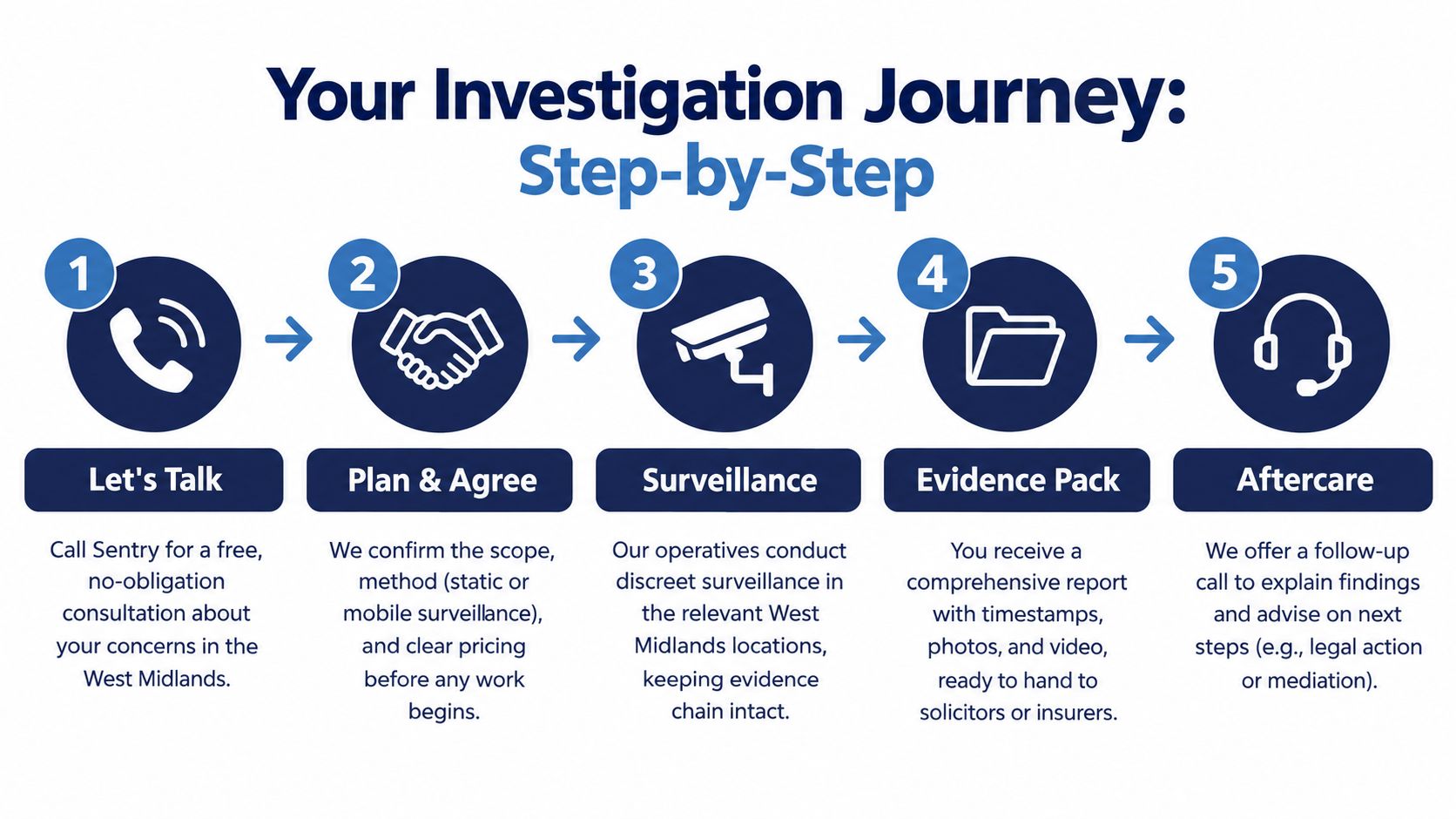
Your first call should feel practical, not theatrical. You explain what has happened, where it is happening and what you need to know. The investigator then decides whether the proposed work is lawful, proportionate and capable of answering the question.
The initial conversation
The process normally begins with a confidential enquiry and a no-obligation case assessment. You'll be asked for the relevant facts, dates, locations, identities and any immediate risks. Don't embellish the story. Clear facts help the investigator plan better and avoid unnecessary work.
The investigator should explain what they can't do. Private investigators don't have police powers, can't force entry, and can't obtain protected information just because a client wants it. If surveillance is appropriate, you should receive a written quote and terms before fieldwork begins.
Planning and fieldwork
Once instructed, the investigator prepares a target briefing. That may include photographs, vehicle details, likely addresses, known routines, safe observation points and the evidence required. Work can then take place across Birmingham, the Black Country, Solihull, Coventry or surrounding areas.
Daily debriefs should tell you what happened without compromising the operation. Evidence should be stored securely, with photographs and video linked to dates, times and locations. A good report makes it possible for a solicitor, insurer or decision-maker to understand the sequence without relying on the investigator's opinion.
Evidence hand-over and discretion
The final pack may include a written report, time-stamped photographs and video. Communication should use password-protected case files and encrypted channels where appropriate. An investigator must never confirm an assignment to someone who calls pretending to represent the subject.
You can usually pause or cancel work at short notice once the evidence you need has been captured, subject to the written terms and work already completed. That flexibility matters. You shouldn't keep paying for surveillance that has already answered the question.
Practical rule: Agree the stopping point before the first operative goes out. It keeps the investigation focused and prevents an open-ended assignment.
Understanding the Costs of Hiring a Private Investigator
A reputable firm won't hide behind a vague “starting from” figure. The quote depends on the method, time, staffing, travel, urgency and reporting required.
Surveillance is commonly priced by an hourly rate or day rate, with operatives billed in minimum blocks. Some firms use minimum blocks of two or four hours, while evening, weekend and bank-holiday work may carry a premium. Travel time and mileage can also affect work between Birmingham, Coventry, Wolverhampton, Solihull and outlying towns.
A single background check or process serve is usually less involved than multi-day infidelity surveillance or a long-distance people-tracing assignment. Database searches, court-ready report production and expert witness attendance may sit outside the core fieldwork quote, so ask directly.
Cost Factor | Typical Impact on Quote |
|---|---|
Surveillance duration | More hours or days increase operative time and evidence handling |
Number of operatives | Complex mobile work may require additional staff |
Location and travel | Outlying towns, mileage and travel time add operational cost |
Timing | Evenings, weekends and bank holidays may attract a premium |
Investigation type | A background check is usually less involved than prolonged surveillance |
Specialist evidence | TSCM equipment, database searches and formal reporting can affect the quote |
Court involvement | Expert witness preparation or attendance may be charged separately |
Use what UK detectives charge as a starting point for understanding fee structures, but insist on a case-specific written quotation.
A low hourly figure is meaningless if the firm adds unclear travel, reporting or database charges later.
The Legal Side Surveillance Licensing and Data Protection
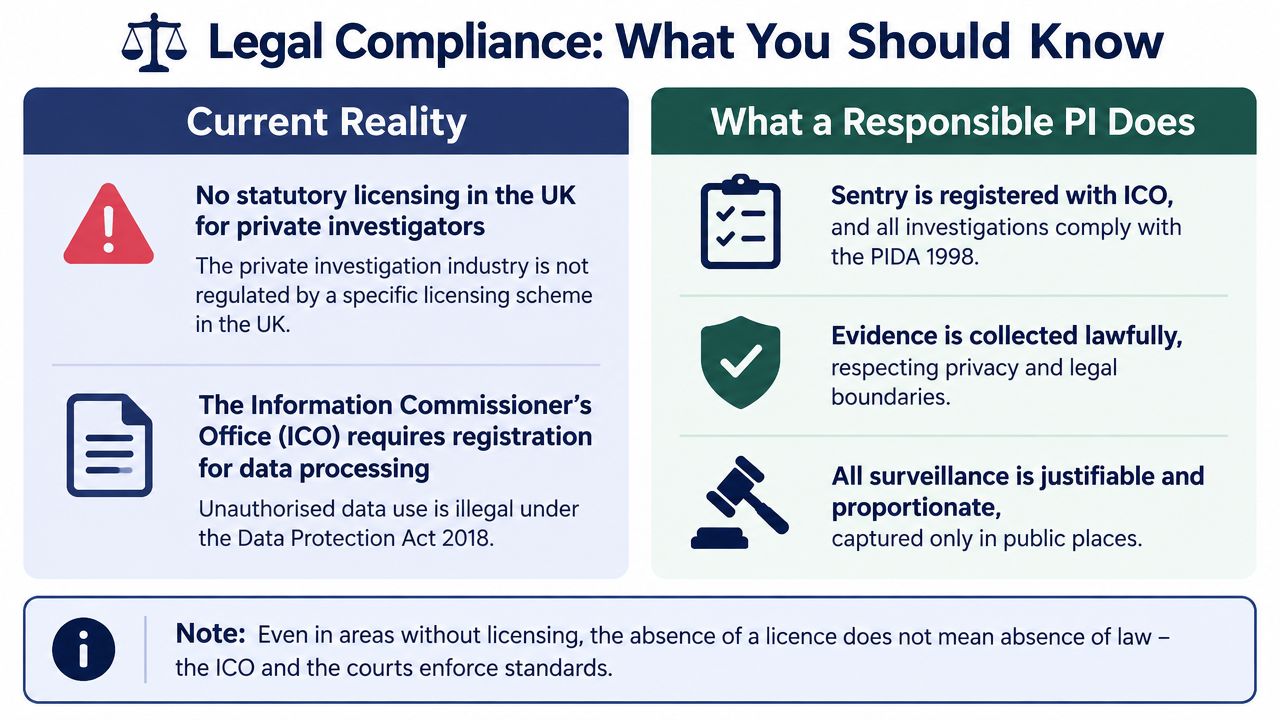
The assumption that every private investigator is licensed by the state is wrong. Parliament recorded that powers to regulate investigators under the Private Security Industry Act 2001 had not been commenced, and that UK law didn't require private investigators to hold registration or a licence. You can review that position in the Parliamentary evidence on private investigator regulation.
That absence of a statutory licensing scheme doesn't create a free-for-all. The Information Commissioner's Office has said private investigators are generally data controllers, so they must comply with data protection law when collecting, using or disclosing personal data. The ICO launched a private-investigator data protection code of conduct in November 2024 and can use prosecution, enforcement and audit powers where appropriate. The ICO's code announcement explains why privacy compliance now deserves close attention.
What lawful work requires
In practice, a responsible investigator should establish a lawful basis for processing, collect only relevant information, restrict access, follow a retention schedule and protect client confidentiality. Surveillance must also respect the boundaries imposed by privacy, harassment and computer-misuse law.
That means no trespass, no interception of private communications without consent, no impersonating police or officials, and no assumption that a client can authorise tracking on a vehicle they don't own. For general guidance on the legal position around vehicle monitoring, legal information for GPS tracker owners is a useful resource, but it doesn't replace case-specific legal advice.
The West Midlands Combined Authority's 2026 CCTV code references the Data (Use and Access) Act 2025 and covert-surveillance authorisation for public authorities, which shows how quickly the compliance environment is developing. Private investigators shouldn't present public-authority powers as their own.
Evidence collected unlawfully can damage the client's position, trigger a complaint and become unusable in court.
Choosing a Qualified West Midlands Investigator You Can Trust
Because the UK doesn't have a statutory private-investigator licensing scheme, you must do the vetting. Don't be impressed by a dramatic website or a claim that someone has “police contacts”. Ask for documents and clear answers.
The checks that matter
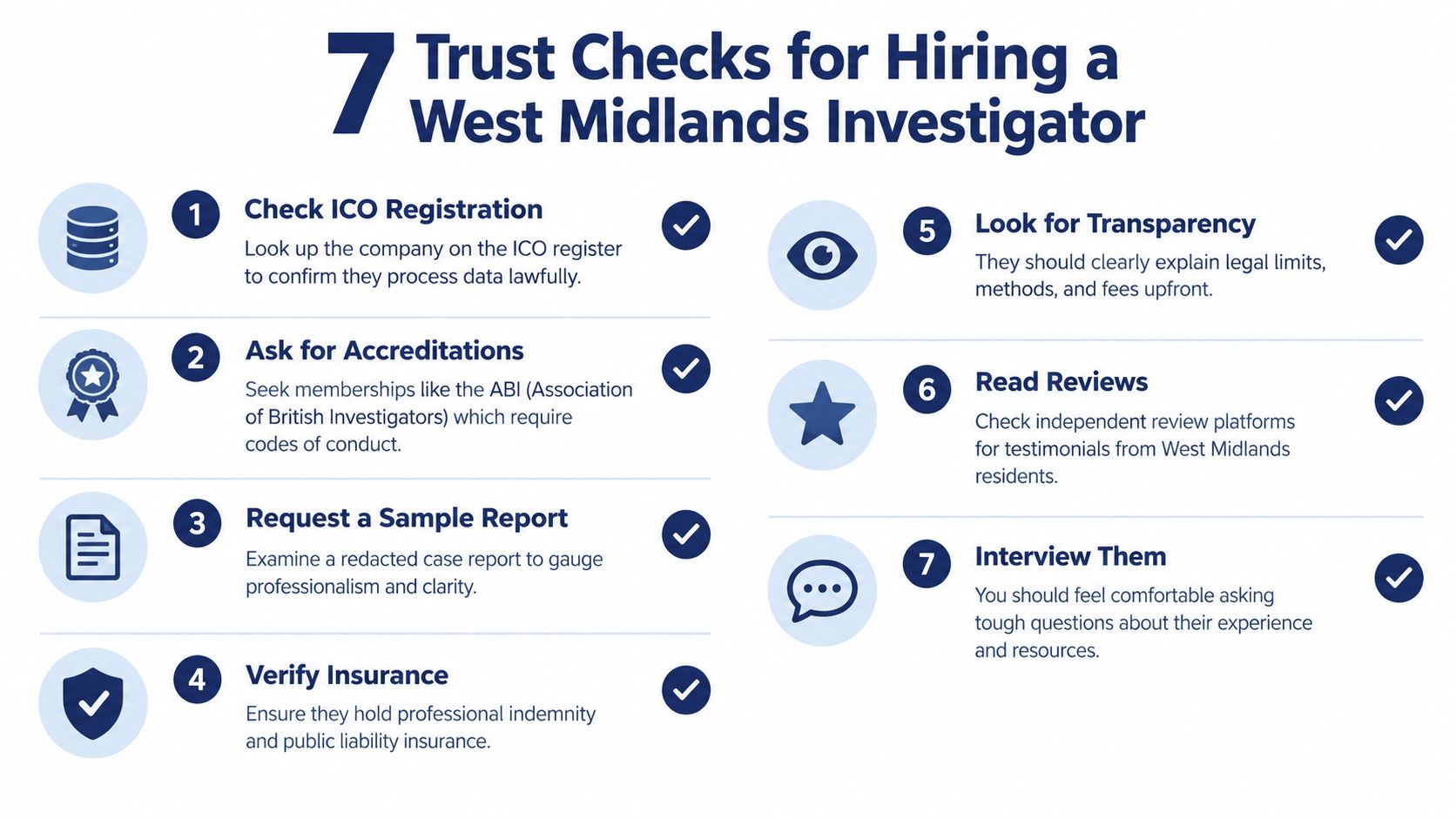
Look for active ICO registration and a published data-controller entry. Ask whether the firm carries professional indemnity and public liability insurance, and verify the company through Companies House. You should receive written terms of business, a clear data-retention policy and the name of the person responsible for your case.
Membership of a recognised professional body, such as the Association of British Investigators or the World Association of Detectives, can provide another accountability signal. Police-style background checks and DBS screening for operatives are also relevant, particularly where investigators may work around homes, families or sensitive corporate premises.
A credible firm should answer difficult questions about methods, legal boundaries and evidence handling. Warning signs include cash-only quotes, refusal to sign a contract, no named point of contact, vague explanations of how evidence is obtained and promises of access to police databases.
A practical benchmark
Sentry Private Investigators Ltd can be used as a benchmark when comparing providers. Its stated safeguards include ICO registration, insurance, ABI membership, DBS-checked field operatives and structured client confidentiality agreements. Local Birmingham, Wolverhampton and Coventry knowledge also matters because surveillance routing, process serving and rapid deployment depend on more than a generic national coverage claim.
Before instructing anyone, ask:
Can you show ICO details? Confirm who processes the information and how.
What insurance do you hold? Request evidence of professional indemnity and public liability cover.
Who will do the work? Ask about operative screening, experience and supervision.
How is evidence stored? Get a clear answer about access, retention and deletion.
What are the legal limits? A professional should explain them without being prompted.
What exactly will I pay? Require a written quote that identifies likely extras.
Can I stop the work? Understand cancellation and pause provisions before signing.
Contacting Sentry Private Investigators for a Confidential Chat
You don't need a finished case theory before calling. You need enough information for an investigator to understand the concern and assess whether lawful enquiries could help.
Sentry's contact routes include a dedicated 24/7 confidential phone line, a monitored enquiries email address and a website contact form. Use secure, professional channels rather than discussing sensitive details through mainstream social messaging. If someone else has access to your phone, email or billing address, mention that at the start.
Have these details ready
A short factual briefing makes the first conversation more useful:
Your name and callback number: Give the safest way to contact you.
The relevant location: Identify the town, borough or workplace, such as Birmingham, Wolverhampton, Coventry or Solihull.
The basic situation: Explain what you know, what you suspect and what you don't know.
Your desired outcome: You may need confirmation, a trace, evidence for an insurer or information for a solicitor.
Important dates: Mention deadlines, planned travel, court hearings or a narrow observation window.
Who knows about the enquiry: This helps the investigator assess the risk of disclosure.
Available information: Vehicle details, photographs, addresses, usernames, documents or previous correspondence may assist.
Don't send more personal data than necessary at the enquiry stage. The investigator should tell you what is relevant and what can be left out.
What the first call should deliver
Expect a calm, non-judgemental, no-obligation discussion. A professional investigator should tell you whether investigation appears appropriate, whether the proposed method is proportionate, what evidence could realistically be obtained and what limitations apply.
You should also receive a realistic cost range before deciding whether to proceed. If you instruct the firm, expect written terms, a named point of contact, discreet billing and encrypted communications where appropriate. You should never be pressured to authorise unnecessary surveillance because you're distressed.
Call, email or submit the web form with a concise summary. Speaking to an investigator costs nothing, and information shared during the enquiry should be treated in strict confidence.
If you need discreet surveillance, people tracing, corporate investigation, background checks or TSCM support across Birmingham and the wider West Midlands, contact Sentry Private Investigators Ltd for a confidential assessment, clear pricing and practical advice on the next lawful step.