
Background Check Results Explained and What to Do Next

A hiring manager receives a DBS certificate for a new care worker and sees that the result has returned. The applicant is waiting, the role needs filling, and the wording looks more technical than helpful. Is the person cleared to start, does the employer need to ask questions, or is a further document required?
That uncertainty is common. Background check results aren't a simple pass-or-fail label. Their meaning depends on the type of check, the information disclosed, the role being considered, and how recently the check was completed. A careful decision starts with reading the result accurately, not reacting to one phrase in isolation.
This guide explains what common outcomes mean, how to check for errors, when a certificate may need refreshing, and where discreet investigative support can help. If you're arranging background checks for a business, candidate, volunteer or private matter, Sentry Private Investigators Ltd can help you understand the information rather than passing on a document.
Introduction to Background Check Results and Why They Matter
A certificate is evidence from a particular screening process. It isn't the decision itself.
That distinction matters because two people can receive different results from checks that are both described informally as “background checks”. A Basic DBS check may show only unspent convictions and cautions, while a more advanced check can disclose information permitted for an eligible role. The same record can therefore have different significance depending on the check level and the work involved.
An employer also needs to separate a disclosed fact from a conclusion about suitability. A conviction, caution, employment gap or identity discrepancy may require clarification, but it doesn't automatically answer whether someone can perform a particular job safely and fairly. Context, relevance, dates and supporting evidence all matter.
Why the wording can cause confusion
People often expect a result to say “pass” or “fail”. UK screening documents usually provide information instead. A clear result can mean that no further action is needed for that particular check, provided the rest of the recruitment process is complete. A result that refers the reader to a paper disclosure has a different practical consequence, because the paper document must be reviewed with the applicant.
The timing also affects interpretation. A DBS certificate has no official expiry date, but it records information available when the check was carried out. A certificate can remain genuine while becoming less useful for a role involving continuing trust or safeguarding responsibility.
The sensible question isn't “Did the candidate pass?” It's “What was checked, what does the result actually say, and what should happen next?”
The scale of the UK system shows why consistent handling matters. The Disclosure and Barring Service processed just over 7.4 million checks in 2025 to 2026, including checks for roles across different sectors and levels of risk. That volume makes clear interpretation important for large employers, small organisations and individuals dealing with a sensitive result.
Understanding the Different Types of Background Checks in the UK
There's no single UK background check that reveals everything about a person. Think of each check as a different lens. A lens designed for identity won't answer the same question as one designed for criminal record information, and neither replaces a right-to-work check.
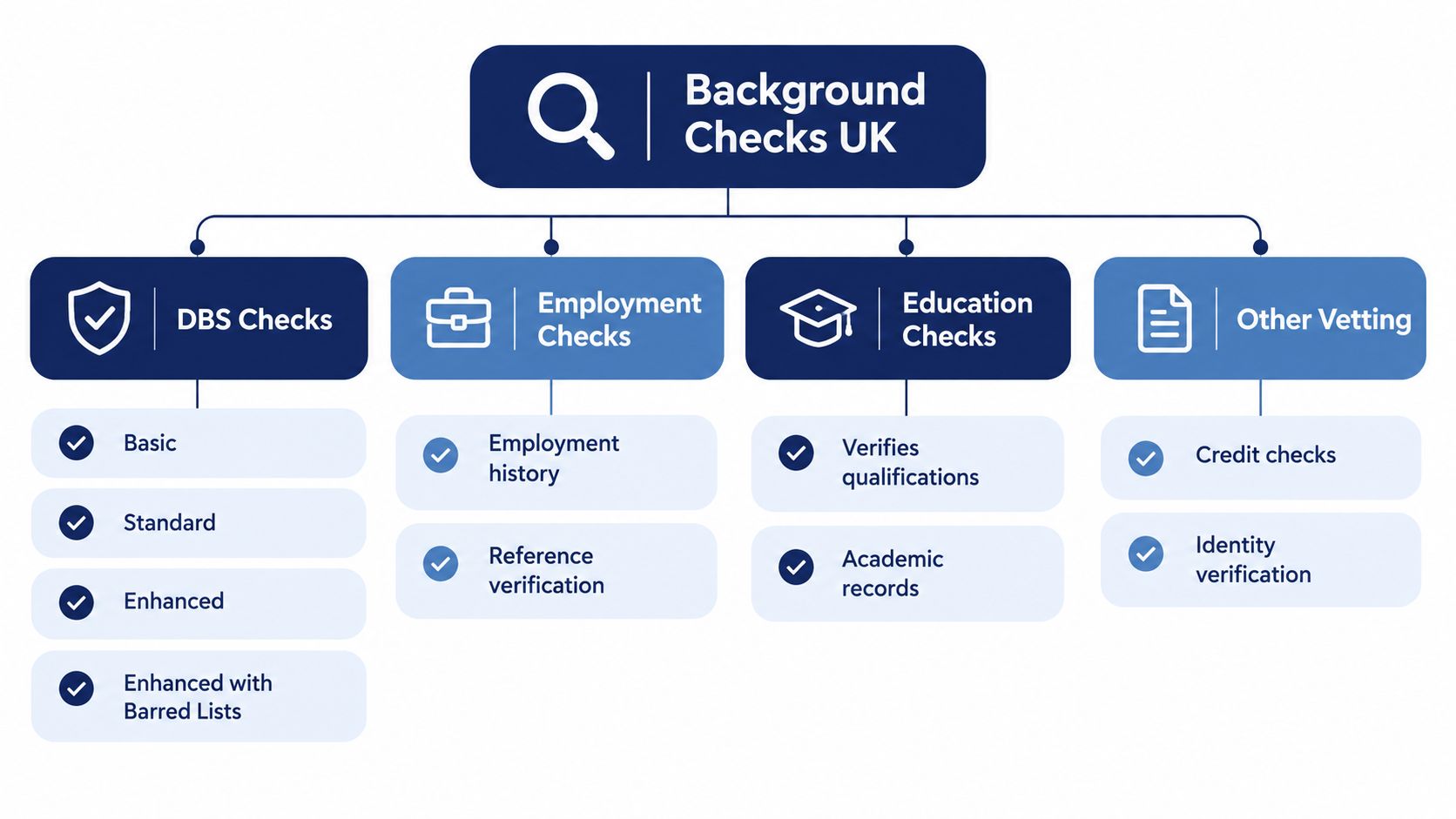
The four DBS levels
The Disclosure and Barring Service recognises Basic, Standard, Enhanced, and Enhanced with Barred List(s) checks, as confirmed by the Disclosure and Barring Service. The correct level depends on the role and its legal eligibility.
Basic: Available for any position or purpose. It shows unspent convictions and cautions recorded on the Police National Computer.
Standard: Available only for roles covered by the Rehabilitation of Offenders Act 1974 (Exceptions) Order 1975. It can show spent and unspent convictions and adult cautions that haven't been filtered.
Enhanced: Used for eligible positions requiring a broader disclosure assessment. The result can include additional relevant information where the legal framework permits.
Enhanced with Barred List(s): Used for eligible roles involving regulated activity with children or adults. It adds a barred-list check to the enhanced process.
The level isn't a matter of choosing the most detailed option because it seems safer. Requesting a level without legal eligibility can create compliance problems and may expose information that shouldn't be considered for that role.
Other screening tools answer different questions
Employment verification can test whether job titles, dates and responsibilities match the application. Education checks can confirm qualifications with the institution that issued them. Identity verification helps establish that the report belongs to the right person, particularly where names, addresses or aliases create possible matches.
Right-to-work verification is separate again. Employers must verify a worker's date of birth and right-to-work share code through the GOV.UK online service. A DBS result doesn't replace that process.
Some assignments also require open-source research into public information, reputational concerns or adverse media. For organisations assessing this type of risk, Matil's guide to adverse media screening provides useful background on how that separate screening area is approached.
How to Interpret Common Background Check Findings
Start by reading the heading, applicant details, check level and certificate date before focusing on any disclosed information. This prevents a common error, treating a familiar phrase as if it has the same meaning on every document.
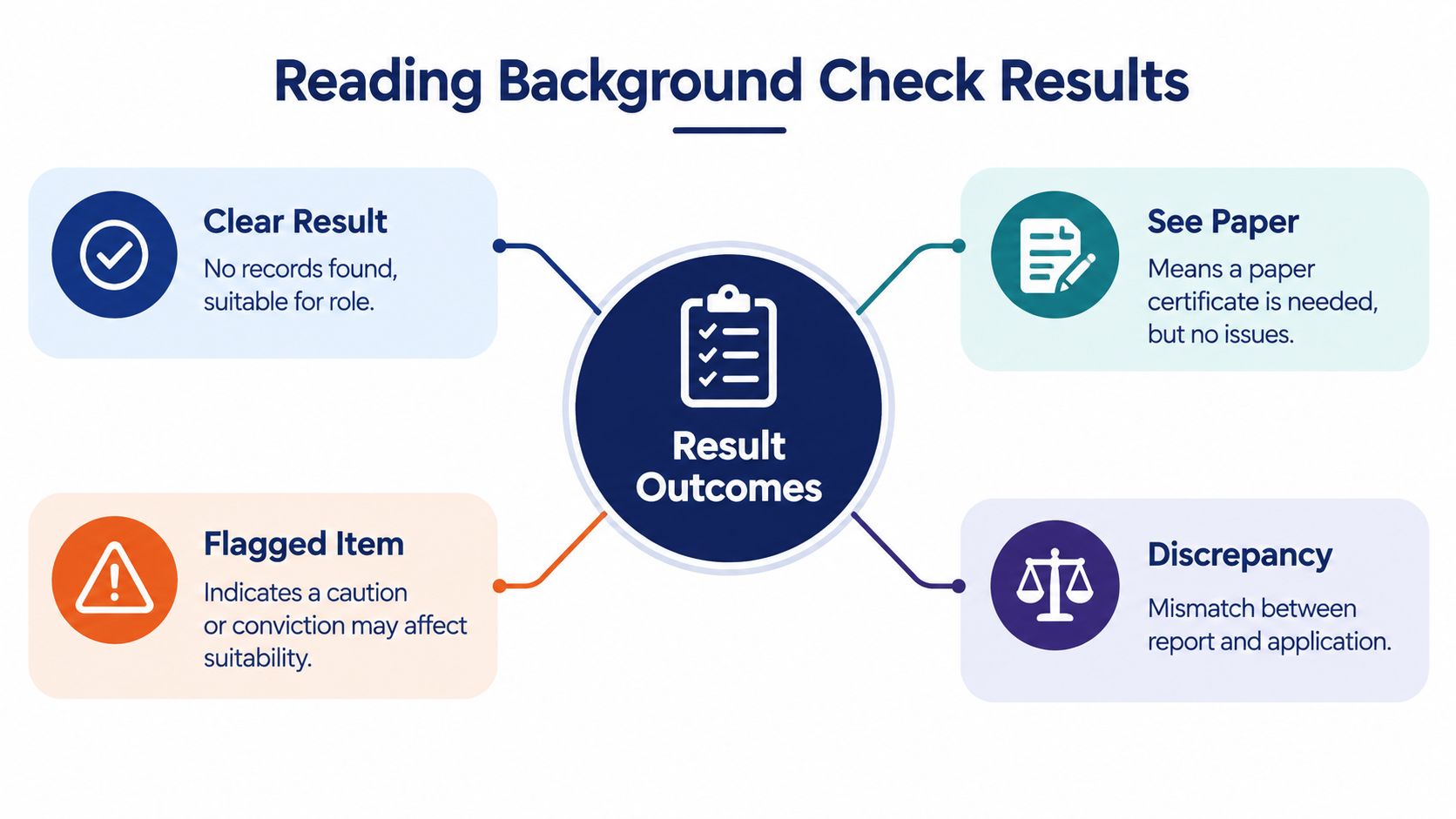
A clear result
A clear DBS result means no information requiring disclosure has been identified for that check level. It doesn't confirm every part of a person's history, and it doesn't prove that the person has never had any contact with the criminal justice system. A Basic check, for example, is limited to unspent convictions and cautions.
Where the result is clear, the employer can normally continue if other screening is complete. That might include confirming references, qualifications, identity and right to work. The result should be recorded alongside the organisation's normal recruitment decision, not treated as a universal guarantee.
See Paper Disclosure
“See Paper Disclosure” doesn't automatically mean that there's a criminal record or that the applicant is unsuitable. It means the relevant information is contained on a paper certificate and needs a separate review.
UK employer guidance explains the practical difference clearly:
A clear result means no further action is needed. “See Paper Disclosure” means the paper certificate should be obtained and discussed with the applicant before a decision is made.
The discussion should be private, factual and proportionate. Ask the applicant to explain the information, check whether it relates to the role, and consider evidence of rehabilitation or changed circumstances where appropriate.
Other flags and inconsistencies
Spent and unspent status depends on the check type and the applicable filtering rules. A filtered caution or conviction may not appear on a Standard or Enhanced certificate, while an unspent matter may appear on a Basic result. Don't assume that absence of information means the same thing as proof that no historic matter exists.
Employment gaps, inconsistent job dates and mismatched addresses are different from DBS disclosures. They may reflect an honest mistake, agency work, illness, overseas residence or incomplete records. They still deserve verification, especially where the application presents a continuous history.
For account ownership or identity-related concerns, a specialist resource such as LineVerifier's Match account recovery information can help explain how matching processes may support verification work. It shouldn't be confused with a DBS result or used as a substitute for the legally required check.
Accuracy Timing and Legal Considerations Behind Your Results
Fast results and detailed results aren't opposites, but they answer different operational needs. GOV.UK states that a Basic DBS check usually takes up to 3 days, while DBS reporting recorded 87.4% of Basic certificates issued within 2 calendar days and an average issue time of 0.8 calendar days, or 19.2 hours, in the cited reporting. These figures are specific to the Basic process and shouldn't be applied automatically to every check type.
The important safeguard is scope. A quick Basic result remains limited to unspent convictions and cautions. A longer process doesn't necessarily mean the result is more accurate, and a fast process doesn't make it more in-depth.
Check Type | Who Can Request It | What Result Shows | Typical Timing |
|---|---|---|---|
Basic | Any position or purpose | Unspent convictions and cautions from the Police National Computer | Usually up to 3 days, with the cited DBS reporting showing an average issue time of 0.8 calendar days |
Standard | Eligible roles covered by the relevant exceptions order | Spent and unspent convictions and adult cautions that haven't been filtered | Varies by application and processing |
Enhanced | Eligible roles requiring enhanced disclosure | Standard-level information plus relevant additional information where permitted | Varies according to the check and circumstances |
Enhanced with Barred List(s) | Eligible regulated activity involving children or adults | Enhanced disclosure with the relevant barred-list check | Varies according to the check and circumstances |
Accuracy is tied to identity and date
A certificate is accurate as a record of the information available when it was issued. It isn't a live monitoring service unless the employer uses a separate arrangement that supports ongoing status checking. Employers should compare the applicant's identity details carefully and resolve obvious discrepancies before relying on the result.
The legal limits matter just as much. An organisation must establish that a role qualifies for the requested DBS level. It should also explain the purpose of the check, handle personal information securely and make decisions consistently.
Right to work follows its own route
A DBS result doesn't establish someone's permission to work in the UK. Employers must use the GOV.UK process to verify the worker's date of birth and right-to-work share code. Keeping that distinction clear prevents an organisation from treating criminal record screening, identity checks and immigration status as one combined result.
How to Verify and Dispute Background Check Results Step by Step
A result that looks wrong deserves a controlled review, not an immediate accusation. Errors can arise from similar names, outdated information, data-entry mistakes or a report being attached to the wrong individual.
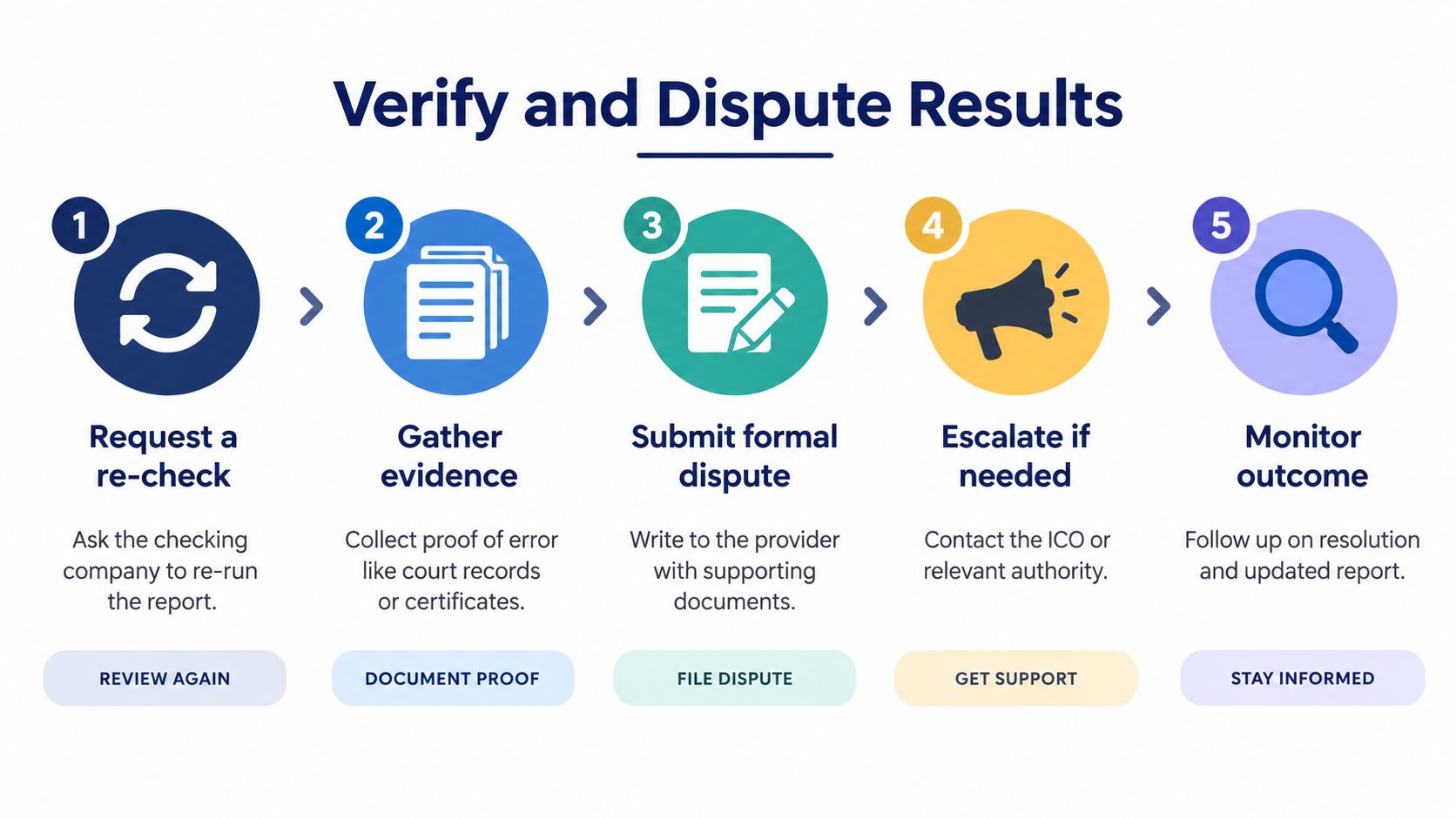
Start with the document
Check the full name, date of birth, current address and other identifying information against the original application. Don't rely on a summary email if the certificate or formal report is available. Note the exact wording, date and type of check.
Then ask the issuing organisation or screening provider to explain the finding. A provider may be able to confirm whether the information is a confirmed record, a possible match, an administrative status or a result requiring a paper certificate.
Build an evidence file
Collect documents that address the specific point in dispute. Depending on the issue, that could include a court document, an official certificate, a reference contact, qualification evidence or proof of identity. Keep a simple chronology so the reviewer can see what was checked and when.
The person affected should have a fair opportunity to respond. Employers should avoid making a final decision before considering credible evidence, particularly where the result concerns an identity mismatch or information that may be irrelevant to the role.
Request a re-check: Ask the checking company to review or re-run the report where its process allows.
Gather evidence: Organise documents that directly support the correction.
Submit a formal dispute: Send the provider a written explanation with the relevant evidence.
Escalate if needed: Consider contacting the ICO or another appropriate authority if the matter remains unresolved.
Monitor the outcome: Follow up and obtain an updated report or written confirmation of the correction.
Organisations that need broader identity verification for businesses can use a structured process to check that the person, documents and reported history correspond. That support is particularly useful when several records conflict and an employer needs an impartial review.
How Long Results Stay Valid and When to Request a Fresh Check
A DBS certificate has no official expiry date, but GOV.UK explains that the information is accurate only when the check was carried out. The employer decides when a new check is needed. In practical terms, a certificate is a snapshot, not a permanent statement about someone's current circumstances.

A sensible review framework starts with the role. Ask whether the person has ongoing access to children, vulnerable adults, confidential information, money, premises or sensitive systems. Then consider whether the organisation's policy, regulator or client contract expects periodic screening.
A practical refresh decision
Requesting a fresh check may make sense when:
The role has changed: New duties can create a different level of risk or require a different check level.
The safeguarding exposure is ongoing: Regular review may be appropriate for roles built around trust and direct access to vulnerable people.
The person's circumstances have changed: A move, new identity detail or significant employment change may justify checking the records again.
The organisation's policy requires it: A consistent internal policy helps avoid arbitrary decisions between employees.
The existing certificate is old for the purpose: There's no universal expiry date, so the employer must assess usefulness in context.
An employer shouldn't assume that rechecking is automatically necessary in every situation. The decision should be proportionate, documented and applied consistently.
High-volume organisations can manage this through a clear schedule, secure records and reminders. They should also explain to candidates why a fresh check is being requested, rather than suggesting that an older certificate was defective.
A short visual explanation can help candidates understand the difference between expiry and relevance. The certificate hasn't necessarily “expired”, but its value may have changed because time has passed.
Getting Professional Support for Complex Background Checks
Most straightforward screening decisions can be handled internally when the organisation has the right process and the result is clear. Professional support becomes more valuable when information is incomplete, identities are difficult to match, a candidate has a complex history, or the issue involves more than a standard DBS certificate.
A private investigator doesn't replace the DBS or make the employer's decision. The investigator can help gather and assess lawful information, verify identity details, examine open-source material, check employment history where appropriate, and identify unresolved inconsistencies. That distinction protects fairness. The work should clarify facts, not create a reason to reject someone without proper consideration.
When independent help can reduce uncertainty
Consider discreet support where:
Names or addresses don't align: Similar identities can produce misleading matches.
A CV contains unexplained gaps: Employment and qualification verification may help establish a reliable timeline.
A business is assessing a senior hire or partner: Due diligence can extend beyond a single criminal record check.
A private individual needs reassurance: Open-source research and people tracing may help answer questions that a DBS certificate cannot.
The matter is sensitive: An independent investigator can handle enquiries confidentially and report findings in a structured way.
Sentry Private Investigators Ltd provides investigative services for private clients and businesses, including background checks, people tracing and due diligence. Its work can support clients across the UK, from Birmingham and the West Midlands to London, Leicester and other locations, while remaining separate from the employer's formal legal responsibilities.
For a focused explanation of the process, read the Sentry Private Investigators background check guide. The right support should leave you with clearer evidence, a documented reasoning process and a proportionate next step, whether that means proceeding, asking further questions or obtaining a fresh check.
If you need help interpreting background check results, verifying identity or investigating unresolved history, Sentry Private Investigators Ltd offers discreet background checks, due diligence and people tracing for individuals and businesses across the UK. Visit Sentry Private Investigators Ltd to make a confidential enquiry about your circumstances and the most appropriate next step.