
Company Background Check: A Practical UK Guide

You're reviewing a quote this afternoon. The supplier's website looks finished, the director sounded confident on the call, and a company number sits in the footer. None of that tells you whether the business is active, who controls it, or whether a court has already recorded unpaid debts. A company background check answers those questions from records. It doesn't turn a tidy register entry into a promise that you'll be paid.
What a Company Background Check Covers
A company background check is a structured review of a business, its owners and its directors, built from public records, financial and legal searches and, where the risk justifies it, field enquiries. Think of a house purchase. The land register names the owner of the plot. Only a survey shows the damp behind the wallpaper. No single source covers both.
Check | What it reveals | Where it comes from | What it cannot show |
|---|---|---|---|
Company status and filings | Whether the company is active, its registered office and its filing history | Companies House register | Trading quality or current ability to pay |
Director and PSC identity | Whether officers have completed identity verification | Companies House verification status | Competence or honesty |
Insolvency | Insolvency proceedings, administration and winding-up notices | The London Gazette and Companies House insolvency filings | Debts not yet filed or disputed |
County court judgments | Debts recorded by court order against the company or a director | Register of Judgments, Orders and Fines | Disputes that have not reached judgment |
Regulatory registers | Whether the business holds authorisation for regulated activity | FCA register and relevant professional bodies | Unregulated activity or work outside the register |
Property and assets | Registered property owned by the company or a director | HM Land Registry title searches | Leased assets, vehicles or assets held elsewhere |
Filed accounts | Latest accounts, period end, overdue filing and whether accounts are dormant or micro-entity | Companies House accounts filings | Cash in the bank today or debts omitted from the accounts |
Criminal records | Convictions where the role and law permit a check | DBS checks where legally eligible | Anything outside eligibility or proportionality |
Adverse media | Reported disputes, fraud cases and regulatory actions | News archives, public reports and court listings | Verified truth without corroboration |
Open the latest accounts and note the period end, whether filing is overdue, and whether they're dormant or micro-entity accounts. Those formats hide most trading detail. Tidy status plus thin or late accounts is a reason to take trade references, not proof the business can pay.
Practical rule: Agree the scope before work starts, so the file answers one decision rather than becoming a long, unfocused bundle.
Match your concern to a row. The checks below say when each one matters and how far it can be pushed.
When Businesses Need a Company Background Check
Run a company background check before any commitment where money, data, property or safeguarding is at stake. For a small, low-risk purchase, a register search is enough.
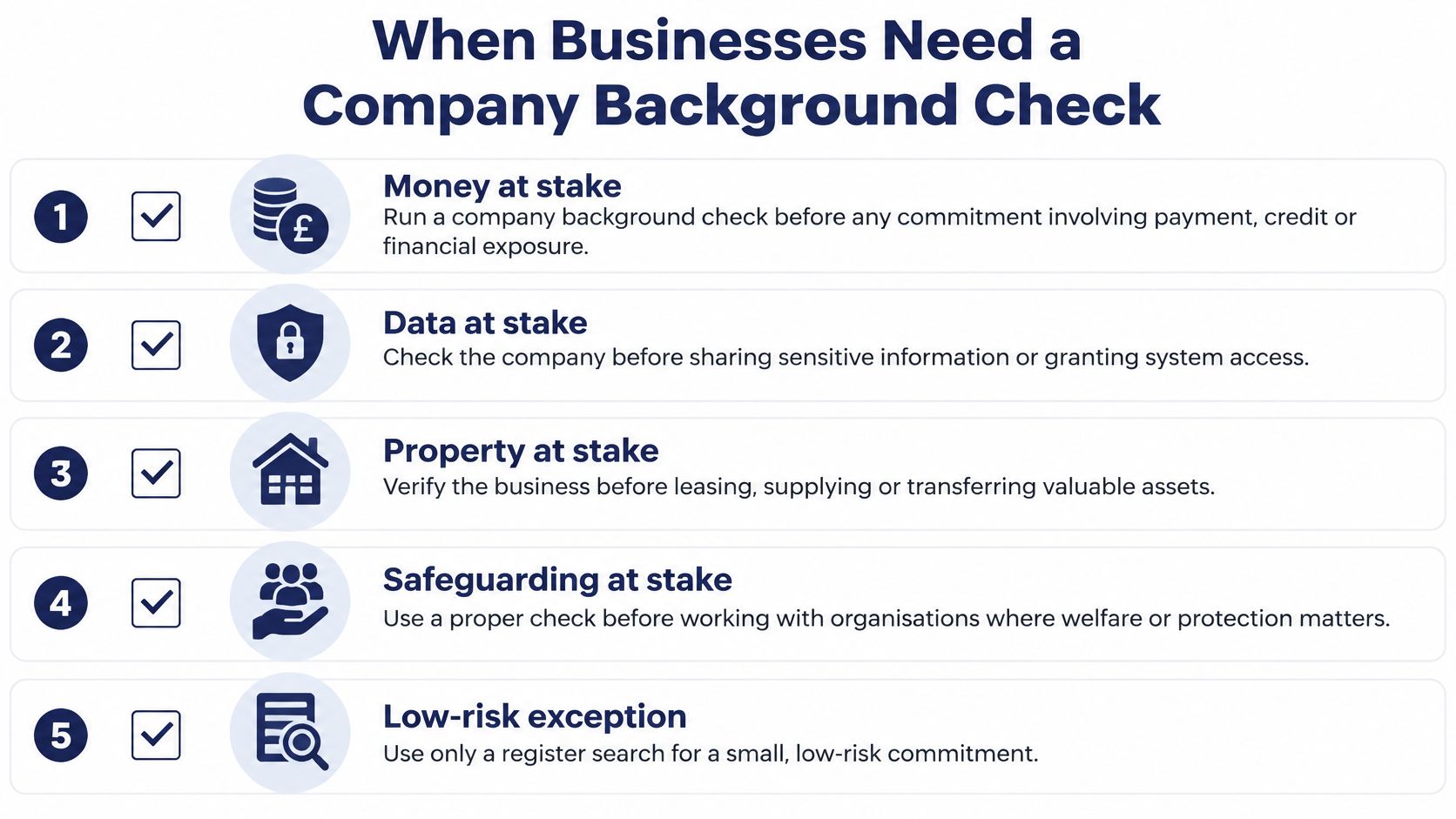
Situation | Checks to run first | Why it matters |
|---|---|---|
New supplier on a large contract | Companies House status, insolvency, county court judgments, director identity | Protects payments and continuity of supply |
Senior hire or incoming director | Director identity, directorship history, DBS where the role is eligible, references | Confirms role suitability and legal eligibility |
Commercial tenant | Company status, filed accounts, county court judgments, director identity | Reduces the risk of arrears and disputes |
Acquisition or joint venture | Filings, insolvency, litigation, adverse media, property records | Reveals liabilities before completion |
Investor or lender review | Filings, officer history, insolvency, adverse media | Supports a funding decision with sourced evidence |
A new supplier on a large contract needs status, insolvency, judgments and director identity before the first payment. A senior hire needs identity status, directorship history and references. Add a DBS check only where the role is eligible and proportionate. The Disclosure and Barring Service reported issuing more than 7.4 million checks in 2025–26, yet that volume doesn't make every check appropriate, and a clear certificate doesn't verify identity, employment history, directorships or solvency, as the DBS annual quality account makes clear.
A commercial tenant needs status, accounts, judgments and director identity if you want fewer arrears. An acquisition needs filings, insolvency, litigation, adverse media and property records before completion. An investor or lender needs filings, officer history, insolvency and adverse media.
Say a firm is about to sign a three-year supplier contract. I'd run the supplier row first, then stop if those records already show a reason not to pay. Our corporate investigations work is built around that kind of decision, not a generic download. Pick your row and take those checks into the sequence below.
How to Run a Company Background Check Step by Step
The checks run in sequence. Each stage narrows the risk, so you don't pay for searches that the first result has already made pointless.
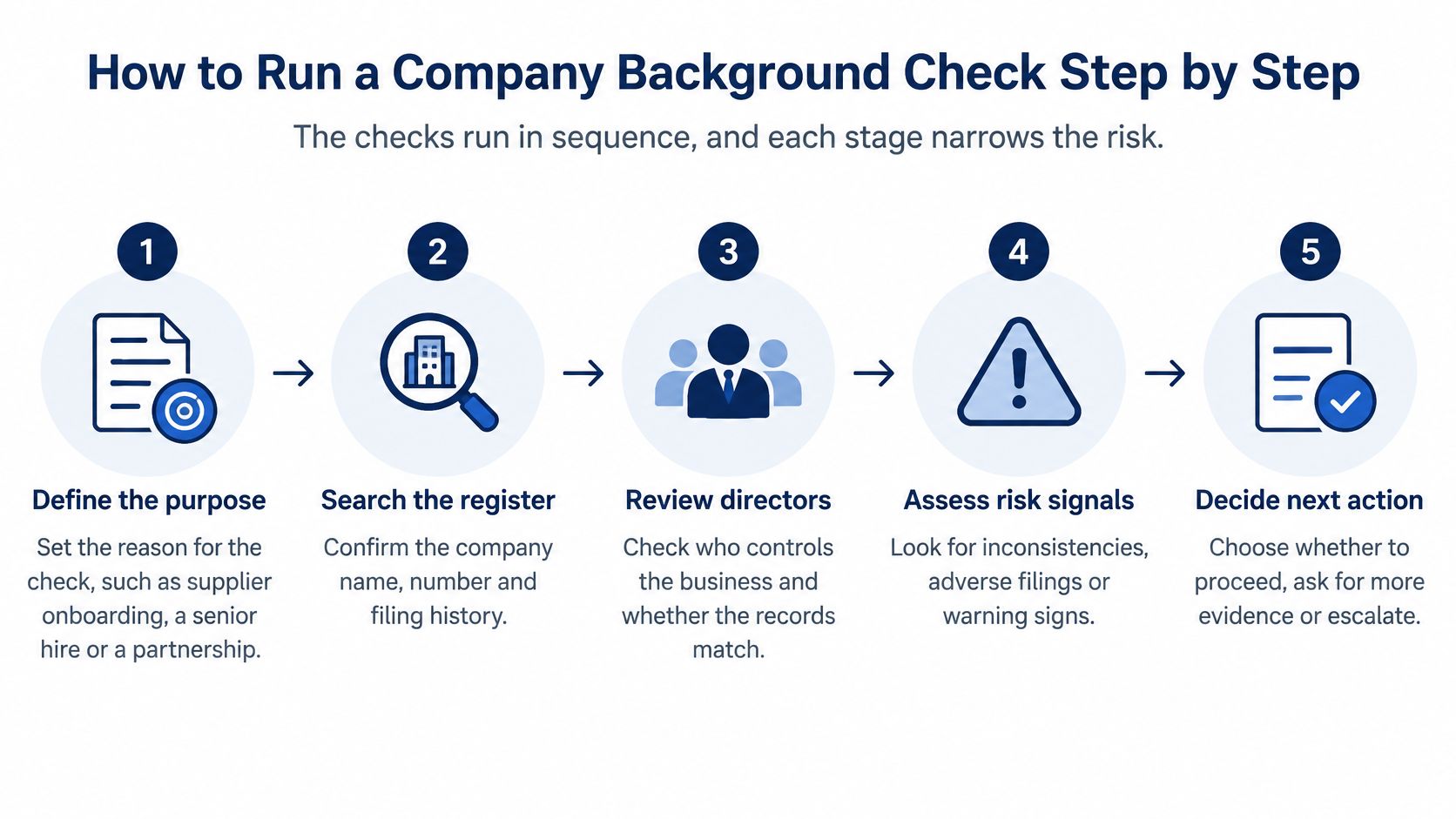
Set the question before you search
Define the purpose. Supplier onboarding, a senior hire or a property deal each need different questions. We ask for the background of the situation, dates and times, contact information and a budget, then use that initial assessment to judge whether surveillance, background checks or technical services fit the concern. The common slip is asking for "everything" and getting a file nobody can act on.
Confirm the legal entity on the Companies House register: name, number, status, registered office and filing history. A website address that doesn't match the register is a warning, not a detail to tidy later.
Review officers and people with significant control. Note identity-verification status and recent changes in directorships. A cluster of resignations across related companies deserves a question before you treat the current board as settled.
Test the claims, then write them down
Search insolvency notices and county court judgments for the company and its directors. Skipping directors is the usual miss, because the debt sometimes sits with the person, not the company name on the invoice.
Check regulatory registers wherever the business claims authorisation, such as the FCA register or the relevant professional body. A logo on a brochure isn't authorisation.
Verify the trading address and whether the activity matches what is claimed. A virtual office can be legitimate. It can't stand in for evidence that the work happens.
Search reputable news and public reports for adverse media. Record each source with its date. For a purchase, the same habit of sourced checks is set out in this guide to compliance checks for business acquisitions.
Write findings with sources, and keep verified facts apart from unconfirmed reports. A finished report is dated, sourced and plain about gaps. It says what was searched, what was found, and what still isn't known.
Verifying Company Records and Directors
Many readers assume a director is verified because the name appears on the register. It isn't. Companies House verification has two stages, and a background check should look at both.
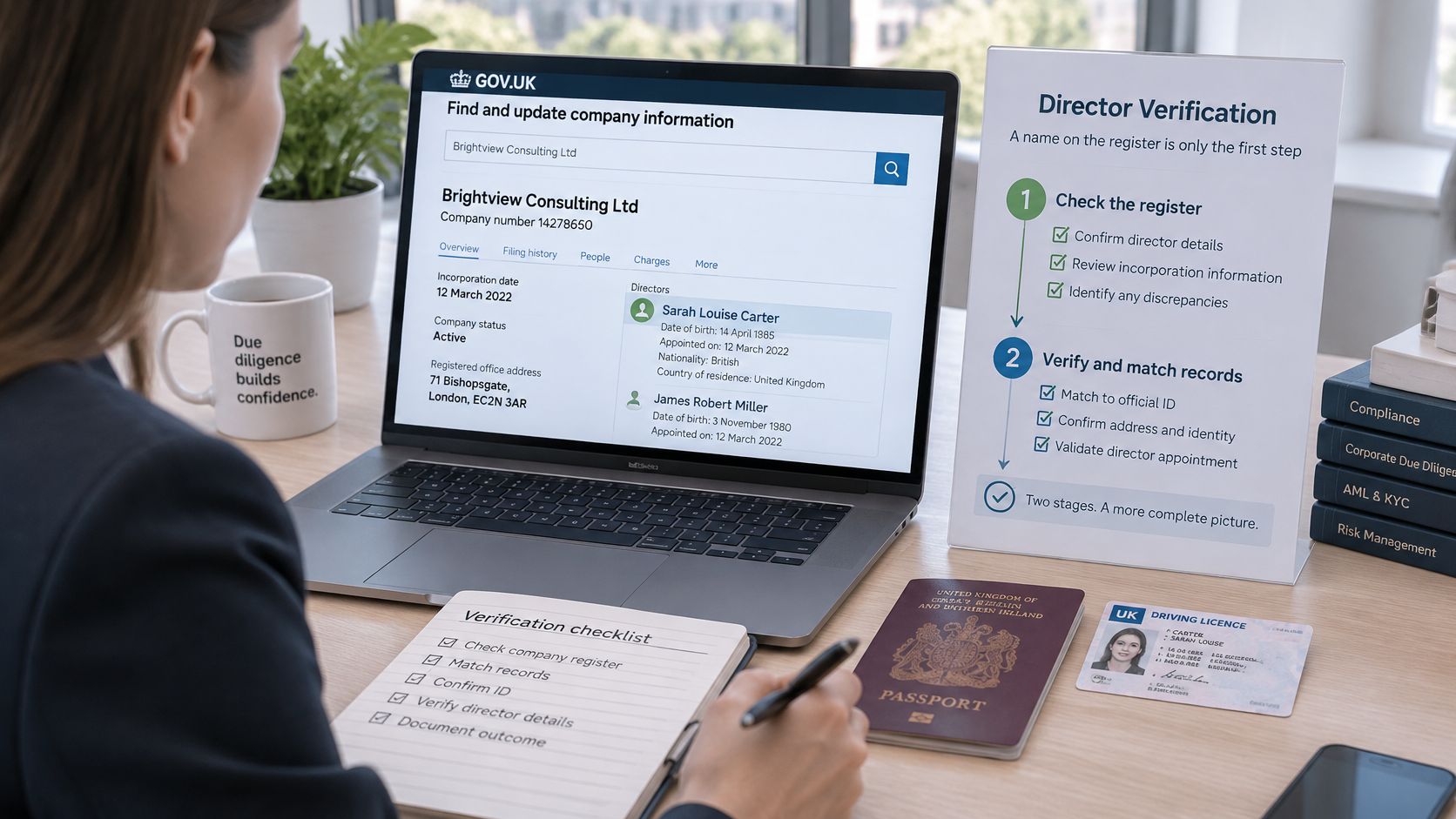
What to read on the register first
Start with the company number, status, filing history and whether confirmation statements are up to date. Then list current and former directors, with appointment and resignation dates. A pattern of frequent changes across several companies is a reason to slow down, not a reason to guess at a motive.
The Companies House guidance on when identity must be verified sets out the mechanics. First, the individual completes identity verification and receives a unique personal code. Second, they submit an identity-verification statement, including that code, for each relevant company role. A company may be unable to file its confirmation statement unless all directors are verified, and acting as a director without the required verification can be unlawful once the relevant duties apply.
What the personal code actually rests on
Photo identification is specified. Companies House accepts a biometric passport from any country, a full or provisional UK photocard driving licence, a UK biometric residence permit, a UK biometric residence card or a Frontier Worker permit, plus a current address and the year the person moved there. The direct GOV.UK One Login route is generally free. An authorised agent can verify on the applicant's behalf.
That process shows an officer has proved who they are for that role. It doesn't show they run the business well. Say a supplier's director resigned from four companies in eighteen months. I'd ask why, and I'd compare dates with what you were told at onboarding. I wouldn't treat the pattern as an automatic refusal or an automatic pass.
Record each officer's verification status with its date, then set it beside the story the company gave you. If the register and the pitch disagree, the register wins until someone produces a better record.
What a Company Check Can and Cannot Prove
A clean register search tells you the company exists, not that it will pay you.
Compulsory identity verification for UK company directors and people with significant control began on 18 November 2025. Companies House guidance on verifying identity is clear that this confirms an individual is who they claim to be. It doesn't prove the company is financially sound, or that its stated activity is genuine. By 30 September 2026, 78.03% of director appointments and 65.56% of individual PSC appointments had been identity-verified, and overall verified appointments stood at 72.80%. Those figures show scale. They aren't a certificate of trust.
A sound check can establish:
Legal existence and status: the company is on the register and shown as active, dissolved or in another recorded state.
Director identity status: whether verification has been completed for the role you're relying on.
Filing history: accounts, confirmation statements and whether they're late.
Recorded events: judgments and insolvency notices that have been filed.
It cannot establish:
Current solvency: cash today, or debts left out of the accounts.
Quality of work: delivery, staff competence or how the last contract went.
Honesty: a verified name isn't a character reference.
Undisclosed conflicts: side interests that never reached a public filing.
A limited company with tidy filings may still owe money to HMRC or to suppliers. That often appears only later, through debt enquiries or trade references. Weigh findings by relevance. A minor dispute from years ago carries less weight than a recent insolvency. The searches that fill those gaps are court records, insolvency notices and reported allegations, handled with care about what counts as fact.
Litigation, Insolvency and Adverse Media Checks
A company can look clean on the register and still have a court record for unpaid invoices. That gap is why litigation and insolvency searches sit beside the company search, not instead of a quick glance at the homepage.
A county court judgment means a court found a debt was owed. It doesn't, by itself, mean the debt is still unpaid. People and companies pay judgments after they're recorded, and some are set aside. Insolvency notices in The London Gazette, including administration and liquidation, are a different signal. They show a formal process, not a late invoice.
How to search without turning rumour into fact
Use the full company name and known trading names. Search each director's name alongside the company, because reports often name the person. Check the date and the source of every item, and note whether a dispute was settled, dismissed or upheld. Search reputation guidance for business owners is a useful reminder that the first page of results is a mix of news, old rows and pages the business itself published.
Criminal-record information is narrower still. The Information Commissioner's Office states that organisations may keep information about criminal convictions or offences only where they have official authority or satisfy a condition in Schedule 1 of the Data Protection Act 2018. Don't infer a conviction from an online rumour, a forum post or a third-party database row. Define the purpose, restrict access and keep only what's necessary.
An unproven allegation stays an allegation. Sort every item into three piles before it reaches a decision-maker.
Confirmed: a judgment, gazette notice or official register entry you can cite.
Reported but unresolved: a credible report where the outcome isn't known.
Unverified: a claim with no traceable source.
That sort is also the point where you decide when to engage a private investigator. Desk research stops at public records. Field enquiries, witness accounts and linked companies need someone who can gather them lawfully and keep them separate from rumour.
Commission a Company Background Check with SPI
The decision is whether your own team runs the searches or a professional investigator does. In-house works when the question is narrow and the records are public. It gets thin when the matter is sensitive, crosses borders, or needs someone to test an address and a story on the ground.
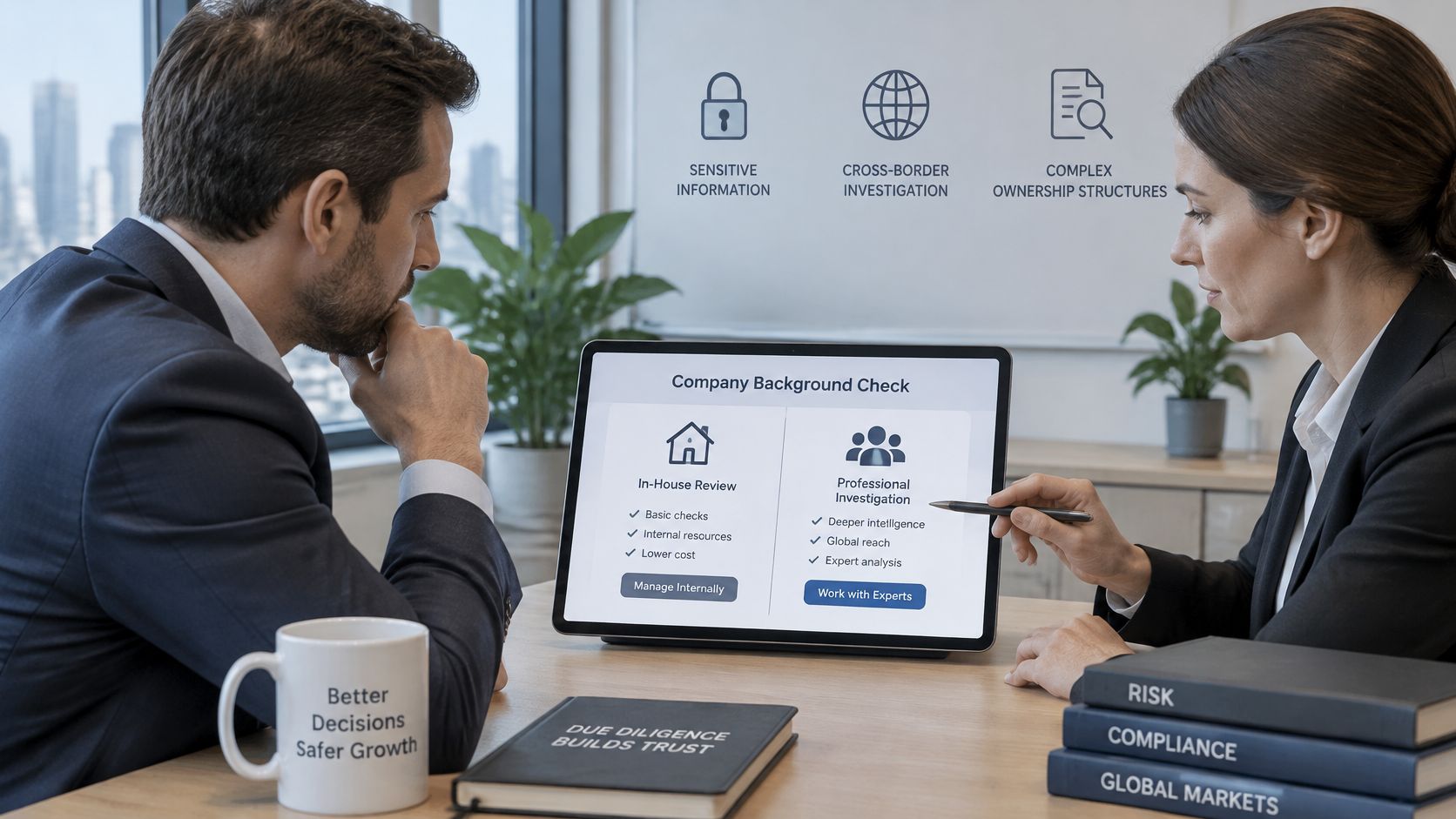
We protect business interests with factual, evidence-based reporting. The agency holds clear criminal background checks, valid public liability insurance and professional indemnity insurance. Initial consultations are free, and that conversation confirms whether desk-based checks, wider background research or another line of enquiry will answer the concern. If the worry is hidden listening devices rather than due diligence, that's a separate technical sweep, not a company search.
We're headquartered in Birmingham and work across the UK, including London, Leicester, Nottingham and Manchester. For an individual rather than a company, our background screening follows the same rule: sourced facts, stated limits, no padded file.
Gather the company name, registration number, director names, the reason for the check and a budget. Bring that to a free consultation and we'll tell you which searches are worth running.
This short briefing sets out how we approach evidence before a client commits to a wider investigation.
Sentry Private Investigators Ltd carries out company background checks that separate what public records prove from what they can't, so you don't pay a supplier, appoint a director or share data on a tidy website alone. We combine register, court and insolvency research with wider enquiries where the risk needs them, and we set the limits in writing. Visit Sentry Private Investigators Ltd to book a free consultation and tell us the company, the decision and the budget.