
Private Detective Pay in the UK: Salaries, Fees and Costs

Published estimates don't agree on private detective pay, and that disagreement is the useful starting point. PayScale reports £41,711 for a UK private detective or investigator, while other salary sites publish far lower averages. You're not looking at one market rate. You're looking at different groups, measured in different ways.
Private Detective Pay in the UK at a Glance
Published estimates put employed private detectives' annual pay between £26,691 and £48,870. Freelance rates answer a different question: Indeed's UK careers guide gives a typical range of £45 to £100 an hour, or £100 to £800 per assignment, with expenses charged separately. One figure describes an employee's pay; the other describes what a client may be billed.
The Published Salary Estimates
Findcourses reported an average UK private-investigator salary of £26,691 per year in 2025, citing Office for National Statistics data. SalaryExpert estimates average gross pay at £30,321 per year, with an estimated average bonus of £412. Its experience split puts entry-level investigators at £26,436 and senior investigators at £33,662.
Careerpilot reported an average of £37,430 in 2024, citing the Office for National Statistics, but without the underlying table or method, so treat it as indicative. At the top end, Salary.com reported an average UK private-investigator salary of £48,870 per year in 2025, equivalent to approximately £23 per hour.
Pay or fee type | Figure | Source | What it measures |
|---|---|---|---|
Employed investigator salary | £26,691 a year | Findcourses (ONS data, 2025) | Average annual salary |
Employed investigator salary | £30,321 a year | SalaryExpert | Estimated average gross pay |
Employed investigator salary | £37,430 a year | Careerpilot (ONS, 2024) | Average annual salary, indicative only |
Employed investigator salary | £48,870 a year, about £23 an hour | Salary.com (2025) | Average annual salary |
Freelance client rate | £45 to £100 an hour | Indeed UK careers guide | Billing rate, expenses charged separately |
Freelance client rate | £100 to £800 per assignment | Indeed UK careers guide | Fee per job, expenses charged separately |
How to Read These Numbers
These figures are estimates, not a single agreed pay scale. Sources may count different groups, such as employees, contractors or self-employed investigators, and may use different methods or samples. That makes the figures useful as a broad guide, but not as a precise prediction of an individual investigator's earnings or a specific case's cost.
Police detective salaries follow a separate public-sector pay scale. They are not a measure of what private investigators earn or what clients pay for investigative work.
Practical rule: If a quote looks far above or below these ranges, ask what it includes before judging it.
Why Employee Wages and Freelance Billing Differ
Think of a taxi meter. The fare on the meter is what the passenger pays. It isn't what the driver keeps after fuel, insurance, maintenance and the empty journey back.
Private investigation works the same way. A client billing rate has to cover paid case time, unpaid working time and business costs. An employee wage doesn't carry those costs directly because the employer absorbs much of them.

A Worked Example in Plain Numbers
Indeed's UK careers guide states that freelance private investigators may charge approximately £45 to £100 per hour, or £100 to £800 per assignment, with expenses charged separately. Say an investigator bills £60 an hour but only 20 hours in a 40-hour week are billable. That's £1,200 in weekly revenue, or £30 per total working hour, before vehicle, insurance, equipment and tax deductions.
The other 20 hours don't disappear. They go on work clients rarely see listed as surveillance.
Travel and preparation: Getting to a location, checking sight lines and planning safe observation points.
Evidence and reporting: Processing images, logging times, writing reports and preparing material for legal use.
Client and court time: Calls, updates, court attendance and follow-up questions.
Gaps in work: Cancellations and quiet periods without an active case.
Freelance income is irregular, and investigators fund their own vehicles, binoculars, cameras and video systems. That's why multiplying an hourly rate by 52 weeks gives a fantasy salary, not real private detective pay.
The honest formula is gross billings minus operating costs, divided by total working hours, not just hours spent watching a subject.
If you're comparing a contractor's invoice with an employee's payslip, clear wording matters. Looking at sample wording for contractor billing can help you separate labour, expenses and deliverables. Ask whether travel and report time sit inside the quoted rate or outside it.
How Location Changes Pay and Quotes
London's hourly pay estimate is about 2.60 times Birmingham's. That's the headline, and it explains why two firms can quote very differently for similar work in different places.
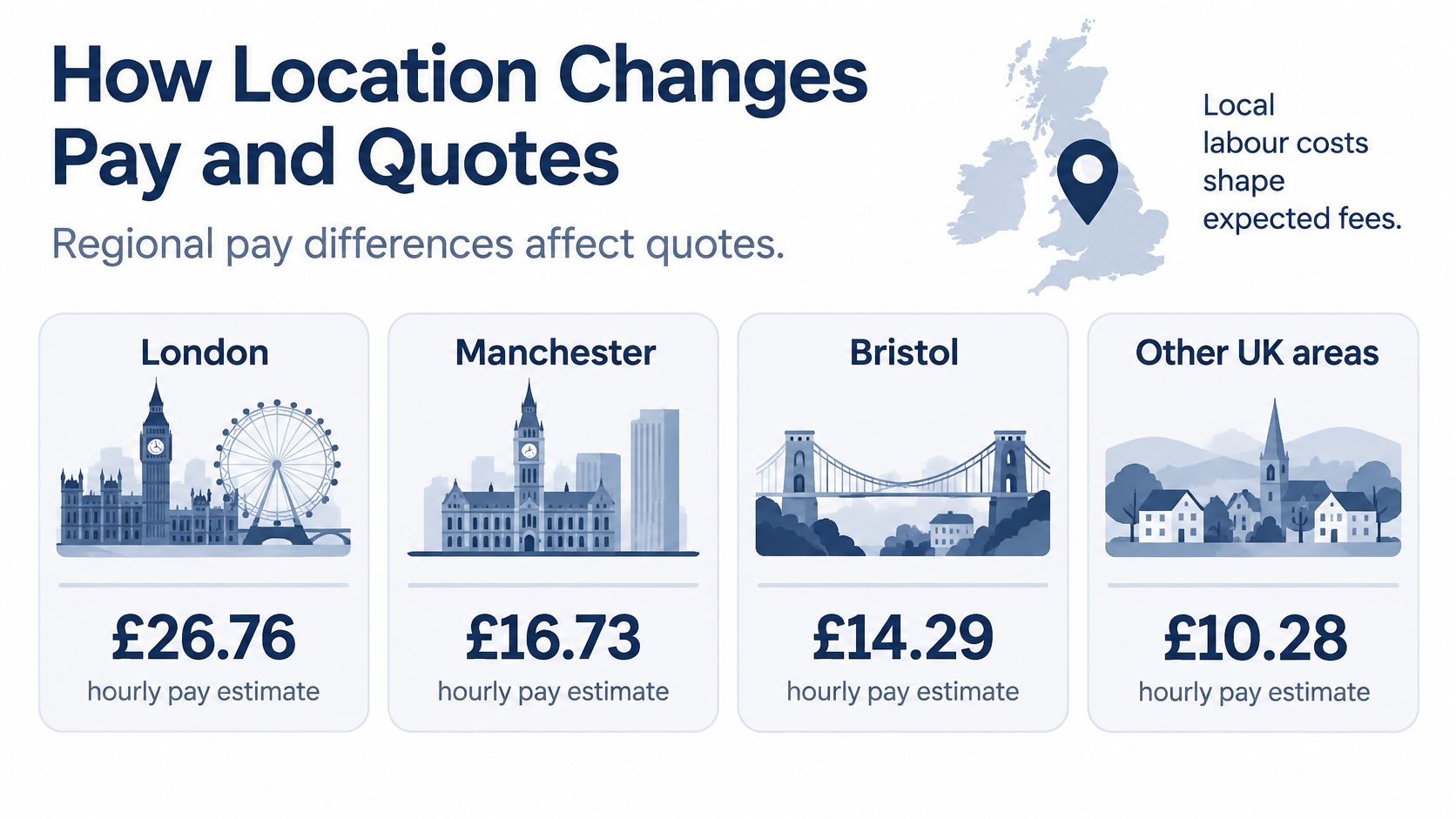
Indeed's UK salary source lists an average private-investigator rate of £18.00 per hour, with £26.76 in London, £16.73 in Manchester, £14.29 in Bristol and £10.28 in Birmingham. These figures come from reported salary data rather than a government survey, so read them as direction, not guaranteed rates.
Location | Hourly pay estimate | Compared with Birmingham |
|---|---|---|
London | £26.76 | About 2.60 times |
Manchester | £16.73 | About 1.63 times |
Bristol | £14.29 | About 1.39 times |
Birmingham | £10.28 | Baseline |
National average | £18.00 | About 1.75 times |
Why the Gap Matters to a Client
Larger cities tend to bring higher operating costs and stronger demand. Travel adds another layer. An investigator based near the subject may bill fewer travel hours than one driving across the region, even if their hourly rate looks higher at first glance.
Experience and specialism also move the figure within each area. Covert surveillance, night work and evidential reporting don't price like a short desk-based check.
If your case is based in the capital, compare like with like through private investigator services in London rather than against a West Midlands rate. Then check whether mileage, parking, congestion-related travel time and waiting time are billed separately. Those details often explain the difference between two quotes.
How Case Complexity Changes the Final Fee
The job title doesn't set the cost. Time, people, vehicles, equipment and the standard of evidence do.
The explanatory notes to the Private Security Industry Act 2001 describe covered activity as surveillance, inquiries or investigations undertaken to obtain information about a person, or about that person's activities or whereabouts. That definition covers very different tasks, which is why one hourly label can hide several kinds of work.
Type of work | Main cost driver | Cost risk |
|---|---|---|
Records check or background search | Database research and verification | Low to moderate |
People tracing | Several lookups and possible field checks | Moderate |
Planned covert surveillance | Hours on site, travel, staff, vehicles and equipment | High |
Evidential investigation with report | Investigation time plus report preparation | High |
Four Jobs, Four Cost Patterns
A records or background check is mostly desk-based. The investigator searches, verifies and summarises. If the identifiers are accurate, the time is fairly predictable.
People tracing sits in the middle. Say you have an old address and a partial date of birth. The investigator may need several lookups, then field checks to confirm the right person rather than someone with the same name.
Planned covert surveillance is resource-heavy. A three-day operation may need more than one investigator, suitable vehicles, cameras and long periods of waiting. Compare that with a one-day desk check and the cost can differ many times over, even though both sit under private detective work.
An evidential investigation adds report preparation for legal use. Timed logs, image handling and clear statements take time after fieldwork ends. That work also has to respect the legal limits on private investigations, so shortcuts can undermine the value of what you receive.
Cases overrun for ordinary reasons. A subject changes routine, a person is harder to locate than expected, or new information needs follow-up. The investigator should log hours against the estimate so you can see progress while there's still time to adjust the brief.
Ask three questions and complexity becomes visible. What exactly is being sought? How many hours are expected? What will you receive at the end?
How Agencies Build a Quote Step by Step
A firm builds a quote from scope, hours and costs, then agrees the terms before any work starts.
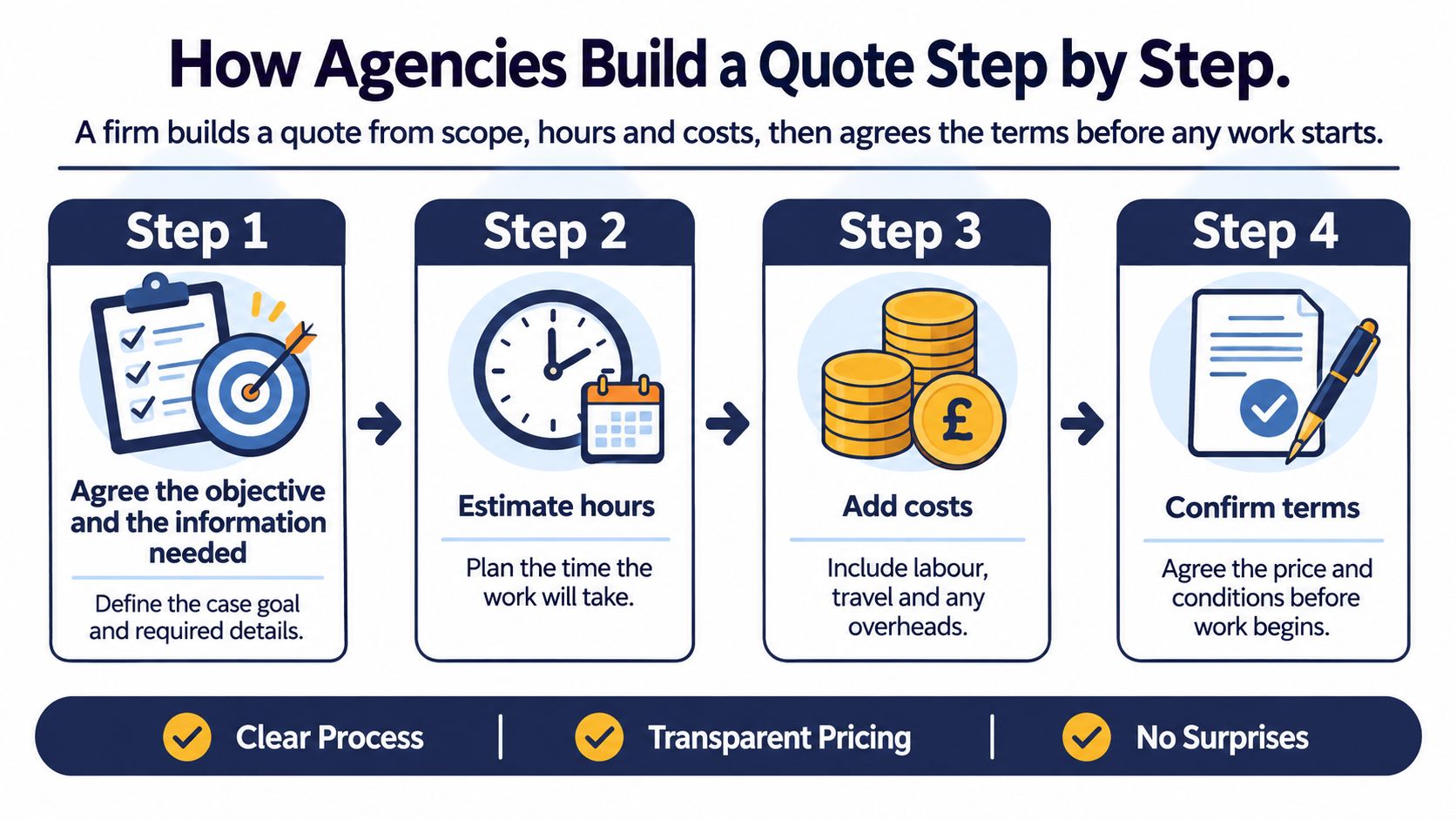
Agree the objective. We define what information you need and what decision it will support. A vague brief creates open-ended work, so the goal has to be plain and specific.
Estimate hours by stage. Research, planning, fieldwork, travel and reporting are timed separately. The common slip is pricing fieldwork carefully, then forgetting travel or underestimating the report.
Choose the pricing basis. Defined tasks suit a fixed fee. Open-ended inquiries suit an hourly rate. Longer surveillance often suits a day rate or a capped block of hours.
Add disbursements. Mileage, specialist equipment and database costs are listed, with a clear statement of whether they're charged at cost. Hiding them inside a headline rate makes comparison harder.
Set the commercial terms. The quote should state any minimum call-out charge, report fees, VAT treatment and cancellation notice. You shouldn't discover these after work begins.
Confirm everything in writing. Services must be agreed by both Sentry Private Investigators Ltd and the client before services commence. We may also carry out due diligence before starting, which may require proof of your identity and compliance with money laundering regulations in the jurisdiction where services are provided.
What a Good Quote Looks Like
A good quote reads as a plan, not a single number. You can see the objective, the expected hours, who'll do the work, what evidence you'll receive and what could change the price.
If a firm can't explain a line in its own quote, don't treat the total as firm. The number only means something when the scope behind it is clear.
Checking Credentials Before You Pay
A professional title doesn't prove a government licence. That's the assumption to drop first.
The Home Office announced in 2013 that private investigators were intended to be licensed by the Security Industry Authority, with a proposed penalty of a fine of up to £5,000 and up to six months' imprisonment for operating without a licence. However, parliamentary material stated there was no UK requirement for private-investigator registration or licensing at that time. So a pay claim or polished job title doesn't prove competence on its own.
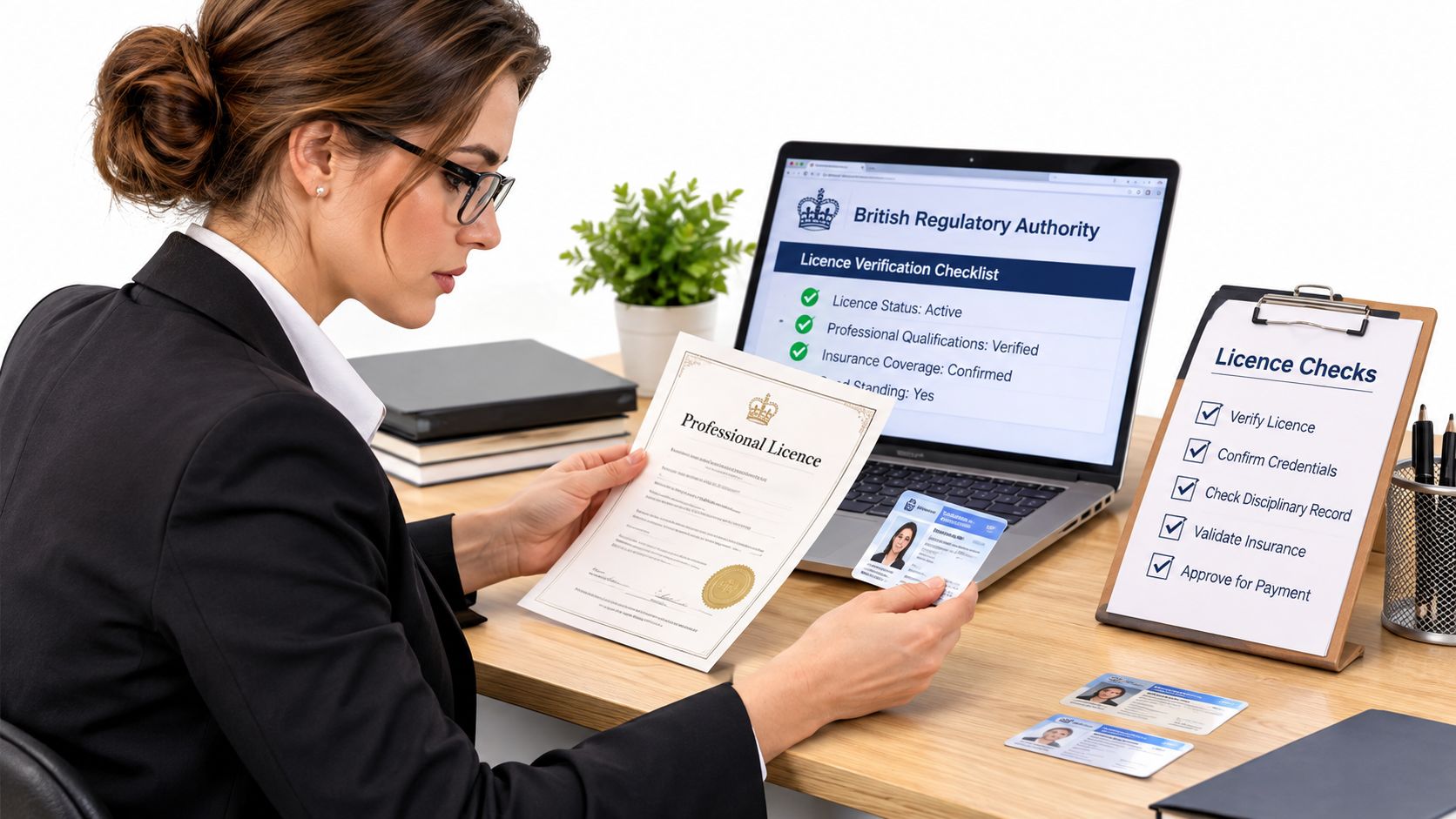
Five Checks Before Money Changes Hands
Training and experience: Ask what training the investigator holds and how many years of relevant casework they've completed.
Professional membership: Ask whether they belong to a professional body such as the Association of British Investigators or the Institute of Professional Investigators.
Data protection: Ask how personal data will be collected, stored, shared and deleted.
Insurance: Ask what cover is held and whether it fits the work proposed.
Subcontractors: Ask whether anyone else will work on your case and whether they'll be named. We notify clients of a subcontractor's details where that subcontractor isn't an Association of British Investigators or Institute of Professional Investigators member.
Good answers are specific, written down and tied to your case. Vague claims about years in the field, unnamed operatives or unexplained rates are warning signs. Reading about understanding private investigator service agreements helps you spot whether those answers have made it into the contract.
What counts most: Transparency about people, methods and handling of personal data tells you more than a headline rate ever will.
Get a Free Quote Before You Commit
No firm can give one honest price without a brief. Private investigation costs vary by service, and the cost depends on the complexity of the case and the location of the investigation. That's why a free, no-obligation quote is the practical next step.
Initial consultations with Sentry Private Investigators are free, and you'll speak directly with an experienced investigator in confidence. You can test the brief against the key cost drivers, expected hours, travel, team size, equipment and reporting, before you commit to anything.
What to Prepare Before You Call
Subject details: Names, addresses, vehicle details and photographs you already hold lawfully.
Location and timing: Where the work will happen and any dates or routines that matter.
The outcome you need: Confirmation of an address, evidence of cohabitation, workplace absence checks, or another clear result.
Evidence already held: Messages, documents or prior reports that could shorten the work.
As a reference point, our covert surveillance with one investigator starts from £349 for up to five hours. More complex work is priced by the resources it needs. You can also review our Private Investigator Birmingham page and covert surveillance service page for full service details before calling.
Call us on 0121 769 1626 or email info@sentryprivateinvestigators.co.uk for a confidential consultation and personalised quote. Bring the facts you have, even if they're incomplete. A clear brief in the first conversation usually means a clearer price.
If you want a quote built around your case rather than a generic hourly figure, Sentry Private Investigators Ltd offers free confidential consultations and specific planning for investigations across the UK. Tell us what you need to establish, where the work will take place and what outcome matters, and we'll explain the likely hours, resources and costs before any work begins.