
Private Investigator Service Agreement Guide for UK Clients

You've found an investigator, explained the problem and received a quote. The next step is often treated as paperwork, but that's a mistake. A well-written private investigator service agreement protects your position before surveillance begins, prevents a small enquiry from turning into uncontrolled work and gives you a clear record of what the investigator was authorised to do.
A private client may need discreet surveillance, a tracing enquiry or evidence relating to a relationship dispute. A company may need help with suspected workplace absence, fraud, theft, moonlighting or due diligence. In each situation, the agreement should do more than list a fee. It should define the objective, lawful methods, evidence handling, reporting arrangements, data responsibilities and the circumstances in which the work stops.
Introduction to Your Private Investigator Service Agreement
Consider a client who asks for surveillance because they suspect a partner is meeting someone else. The investigator begins with a limited instruction, but the client later asks for additional evenings, vehicle tracking and background checks. If those changes remain in messages or informal calls, both sides can later disagree about what was authorised, what evidence should have been collected and which charges were approved.
A written agreement prevents that drift. It records the original objective, identifies the methods that may be used and creates a process for changing the instructions. It also gives the client a practical way to challenge vague estimates, unexplained expenses or material that falls outside the agreed remit.
Practical rule: If a method, cost or deliverable matters to you, put it in the agreement before work starts.
The UK position makes this especially important. The Security Industry Authority guidance and Private Security Industry Act framework place private investigation activity in a legally cautious environment. The specific licensing regime for private investigators hasn't been fully brought into force, but the agreement should still identify lawful work, compliance responsibilities and any relevant credentials or professional standards.
The agreement should also reflect the investigator's data responsibilities. Private investigators and firms are generally data controllers when they collect, use or disclose personal data, as recognised in the Information Commissioner's evidence to Parliament. That affects tracing, surveillance, background checks and litigation support.
For clients in Birmingham, London or elsewhere in the UK, a professional engagement should therefore answer five basic questions:
What is being investigated?
What methods are permitted?
What will it cost, including approved extras?
What evidence and reports will be supplied?
How will personal data be secured, shared and deleted?
Sentry Private Investigators Ltd approaches enquiries discreetly, with the agreement used as a working control document rather than a formality. Read it critically before signing. A strong contract should make you feel informed about both the investigator's capabilities and the limits that keep the work lawful.
How This Reference Is Organised and How to Use It
Treat the agreement as a case handbook. You should be able to locate the instruction, understand its boundaries and trace each operational decision back to a written clause.
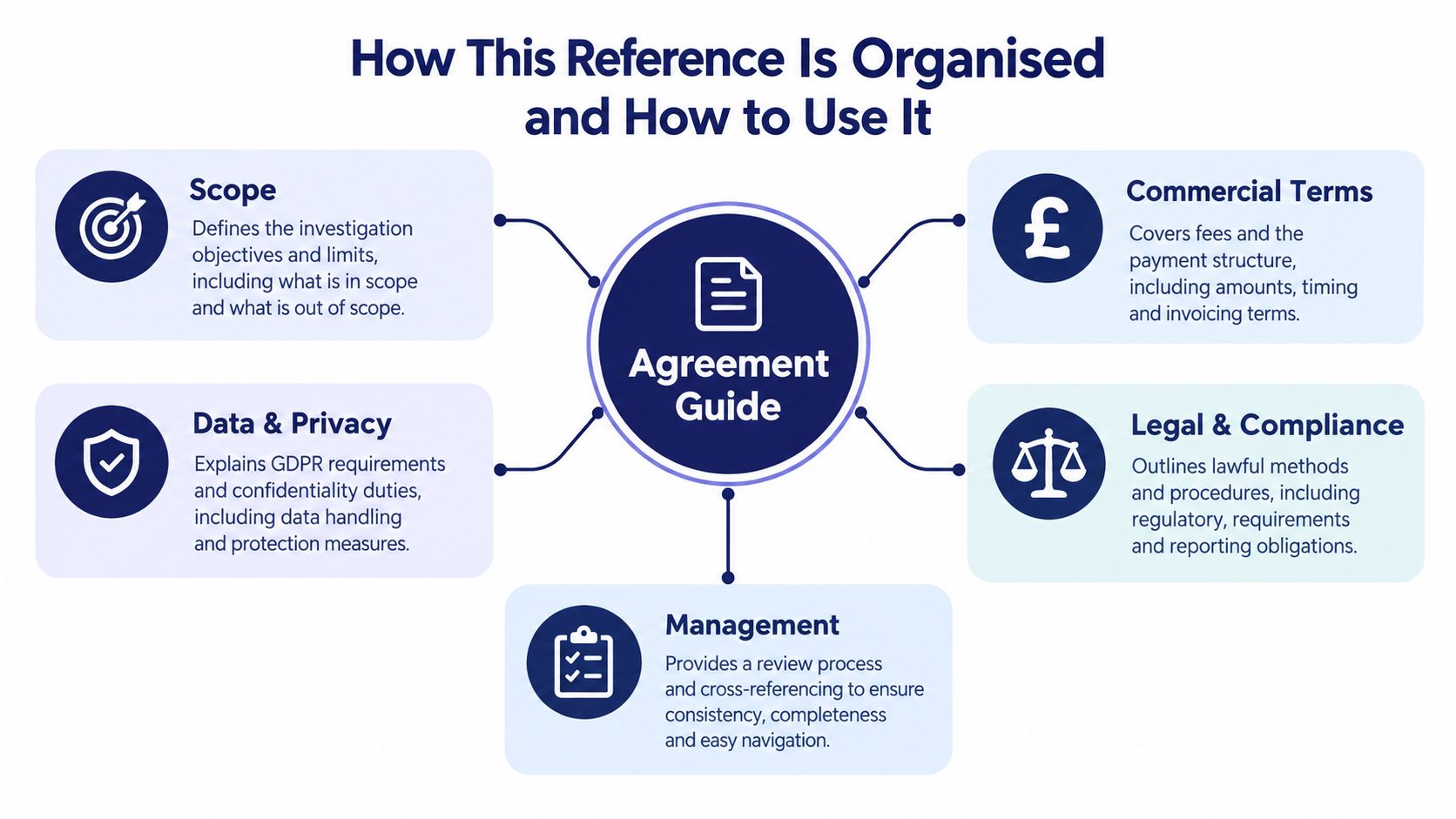
Use the document in five passes:
Scope first. Find the investigation objective, target information, geographical area, approved techniques and exclusions. If the wording says only “investigate suspected misconduct”, ask for a more precise description of the question the investigator must answer.
Commercial terms next. Check the fee model, deposit, payment date, expenses, additional hours and approval process. A quote isn't complete if it doesn't distinguish included work from chargeable extras.
Data and privacy. Identify the lawful basis, controller or processor role, security arrangements, sharing permissions, retention period and breach procedure. The agreement should tell you what happens to photographs, recordings, notes and reports after the matter closes.
Deliverables and compliance. Confirm whether you'll receive a written report, photographs, video, activity logs, witness statements or litigation support material. The legal and compliance clauses should also prohibit unlawful access, harassment and methods that exceed the client's instructions.
Management and cross-references. Review how instructions change, who can authorise extra work and how verbal directions are confirmed. A scope change can affect the fee, evidence plan and lawful basis, so it shouldn't sit in isolation.
The checklist near the end works as a final sign-off tool. Use it before you pay a deposit, then revisit it whenever the objective changes. If a corporate client has several managers involved, name the authorised decision-maker. If you're a private client, specify whether the investigator may contact anyone on your behalf and under what conditions.
A good reference doesn't replace legal advice for unusual disputes. It gives you the right questions to ask the investigator and helps ensure the final service agreement reflects the actual enquiry rather than a generic template.
Scope of Work and Lawful Methods Explained
The scope clause is the operational heart of the agreement. It should state the question the investigator is engaged to answer, not describe a broad service.

For surveillance, specify the subject, approved dates or time blocks, relevant locations, observation objectives and reporting trigger. “Monitor the subject” is weak. “Establish whether the subject attends the stated workplace during the agreed observation period and record movements visible from lawful public positions” is more useful. The agreement should also say whether the investigator may adapt the observation point, pause work for safety reasons or stop when the objective has been answered.
Tracing requires a different level of precision. Define the person or asset sought, the information supplied by the client, permitted sources and the point at which the enquiry ends. A tracing instruction shouldn't imply unrestricted access to confidential databases or private accounts. It should distinguish between locating information and contacting the person located.
Background checks need boundaries too. State which identity, address, corporate, professional or publicly available information is relevant. Don't authorise a general search for everything about an individual. The UK data-protection framework requires fair and lawful handling, and the ICO guidance on disclosures to private investigators makes clear that organisations aren't generally obliged to disclose information to a private investigator.
TSCM bug sweeping should identify the premises, rooms, inspection window, equipment scope and report format. GPS vehicle tracking needs particular care. The agreement should explain who owns or controls the vehicle, who authorises the work, what evidence is required and how tracking data will be handled. It shouldn't assume that a client's request automatically makes every tracking method lawful.
Turn instructions into operational limits
Include these points in the scope:
Objective: The factual question the enquiry must address.
Methodology: Surveillance, tracing, interviews, open-source checks, TSCM work or another agreed technique.
Location: The area covered and any restrictions on entering premises or contacting third parties.
Authority: The person who can approve changes and additional work.
Exclusions: Unlawful access, impersonation, harassment, unauthorised device access and methods outside the agreed remit.
Reporting triggers: When the investigator must provide an interim update or seek further instructions.
The scope also connects directly to fees and deliverables. More surveillance time affects cost. A litigation-ready report requires more structured records than a brief telephone update. A wider data collection exercise increases privacy risk and may require a revised lawful-basis assessment.
The integrated security system consultancy resource from Amax Fire & Security Ltd may also help businesses considering how investigative findings fit alongside wider premises and security controls. It's separate from the investigator's remit, so the agreement should say where responsibility ends.
Use the following video as a practical supplement when reviewing the scope and methods proposed for your enquiry.
Fees Payment Terms and Cost Controls
A private investigator service agreement should make the financial position predictable. The cheapest-looking quote can become expensive if it leaves surveillance hours, travel, database access, out-of-hours work and report preparation undefined.
A fixed fee suits a tightly defined task with a clear endpoint, such as a specific document review or a limited tracing enquiry. An hourly rate may be more appropriate where the work depends on what investigators discover. A capped surveillance block gives the client a ceiling while allowing the investigator to work within an agreed operational window.
The contract should state which model applies and what it includes. It should also explain whether the estimate includes planning, travel time, waiting time, photography, video processing, report drafting, secure file transfer and VAT where applicable. Don't accept “expenses as incurred” without a description of the expenses that can be incurred.
Match payment to work completed
A sensible agreement links payment to real stages of work:
Deposit: State what the initial payment funds and whether it's refundable if the enquiry can't lawfully proceed.
Operational work: Define the rate or block, the approved hours and the process for authorising more time.
Disbursements: List travel, accommodation, specialist database access, equipment hire or other external costs that may require approval.
Reporting: Confirm whether the written report is included or charged separately.
Final balance: Set the point at which the balance becomes due and identify the material supplied at that stage.
A client shouldn't have to guess whether an investigator can continue spending money after the agreed limit. Require written approval before additional hours or significant expenses are incurred, except where an urgent safety decision is necessary and the investigator records the reason.
For a broader discussion of pricing factors, read How many does a private investigator cost. Keep that information separate from the agreement itself. The contract should contain the actual rate, estimate, cap and payment timetable for your enquiry.
Termination must connect to the invoice. If the client ends the work early, the agreement should state whether payment covers work completed, committed third-party costs and the report preparation already undertaken. If the investigator stops because the instruction becomes unlawful or unsafe, the contract should explain what evidence and account information will be supplied.
A clear estimate is useful. A clear approval mechanism is what prevents cost disputes.
Ask for a written variation whenever the objective, subject, location, method or reporting requirement changes. Sentry Private Investigators Ltd can discuss the intended work and commercial terms before an enquiry begins, which gives clients an opportunity to query exclusions rather than discover them on the final invoice.
Confidentiality Data Protection and GDPR Duties
Confidentiality and data protection aren't decorative clauses. They control who can see the material, why the investigator may collect it and how the evidence remains reliable after it has been transferred to the client.
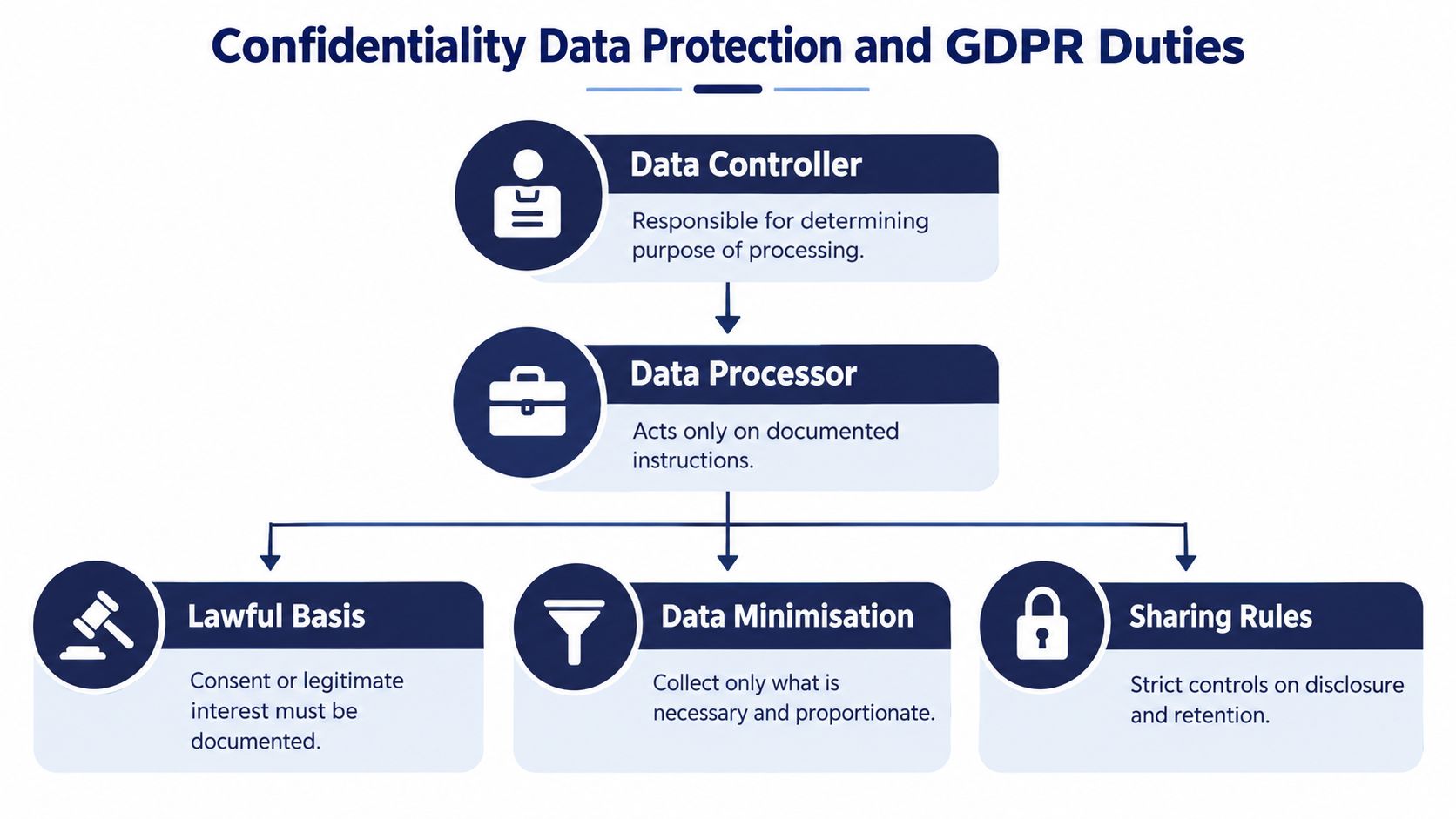
The agreement should identify the investigator's role. The ICO's evidence to Parliament states that private investigators and firms are generally data controllers when they collect, use or disclose personal data. That means the investigator commonly determines how investigative processing is carried out for the stated purpose, rather than merely acting as a technical supplier.
A data processor acts on documented instructions from a controller. If the investigator uses a subcontractor to process personal data on the client's behalf, the ABI guidance on physical surveillance and processor terms requires appropriate Article 28(3) terms where the processor relationship applies. The agreement should identify whether outsourcing is permitted, what the subcontractor may do and how the investigator remains responsible for oversight.
Put privacy duties into usable wording
A practical agreement should address:
Lawful basis: Record the basis for the processing and the investigation purpose. The client shouldn't instruct collection first and ask for justification later.
Data minimisation: Collect information that is necessary and proportionate to the objective. A suspicion about attendance doesn't automatically authorise unrelated personal data collection.
Sharing: Name the client recipients, legal advisers, insurers or other permitted recipients. Don't allow unrestricted onward disclosure.
Security: State how files, passwords, notes and physical media are protected during the engagement and transfer.
Retention: Set a review or deletion point, with an exception where material must be preserved for litigation, a complaint or another documented purpose.
Incident handling: Require prompt notification of a suspected data breach, with records of the material affected and containment steps.
The ICO says an organisation doesn't have to disclose information to a private investigator, and any disclosure must be fair, lawful and compatible with the original collection purpose. Exceptional circumstances, such as tracing a missing person, can involve crime-prevention or detection principles. The agreement should therefore prevent the client from promising access or demanding information that a third party has no lawful reason to provide.
Surveillance and worker monitoring require particular care. The ICO guidance on monitoring workers says a contract must require the investigator to collect information in a way that satisfies the client's data-protection obligations. ABI guidance also emphasises legislation, data security, remit, remuneration and documented instructions, including written confirmation of verbal instructions as soon as reasonably practicable.
For a useful comparison of privacy practices in another specialist service, review how your data is handled. The detail will differ, but the principle is relevant: clients should know what data is collected, why it's processed, who receives it and how long it remains accessible.
Deliverables Evidence Handling and Record Retention
The agreement must describe the material you'll receive, not merely promise “a report”. An investigation may produce photographs, video, observation logs, interview notes, maps, open-source findings, witness statements or a structured litigation support report. Each item has a different evidential value and should be identified before work begins.
A surveillance report should normally explain dates, times, locations, observations and the method used to record them. Photographs and video should be linked to the relevant entry in the investigator's notes. If the client needs material for legal proceedings, specify whether the investigator will provide a signed statement, exhibit references, a chronology or availability for a solicitor's review.
Protect the evidence trail
A defensible agreement should deal with:
Time records: State how observations and events are logged, including the time zone and any relevant device or system information.
Original files: Clarify whether original photographs and video are retained, supplied or both.
Chain of custody: Record who collected, stored, transferred and accessed material.
Redaction: Explain when personal data about uninvolved people may be removed and how the client will be told.
Secure transfer: Specify the delivery method, password arrangements and confirmation of receipt.
Corrections: Set a process for correcting factual errors without altering the original record.
Chain of custody isn't limited to investigations. Businesses managing devices and records can learn from secure ITAD documentation best practices, particularly the discipline of recording handovers, authorisations and final disposition.
Retention should be purposeful. The agreement can state that material is reviewed after the case, retained for a defined operational purpose and securely deleted when no longer necessary, subject to a documented litigation hold or legal requirement. Don't promise indefinite storage without explaining the security and access implications.
Define reporting expectations
Set out when you'll receive updates and what counts as an urgent notification. A client may need immediate contact if the investigator identifies a safety issue, reaches the objective or finds that the approved method won't work. The final report should separate observed facts from interpretation and identify gaps that remain unresolved.
For clients considering litigation support, the guide by Sentry Private Investigators provides relevant context about how investigative material can support legal work. The service agreement should still define your specific deliverables, because a general service description can't replace case-specific instructions.
Customising the Agreement for Private and Corporate Clients
A private client and a corporate client may use the same core contract, but they shouldn't receive the same operational wording. Personal investigations require discretion and emotional boundaries. Corporate enquiries need authority, governance and a documented connection to workplace or commercial objectives.
Clause Area | Private Client Focus | Corporate Client Focus |
|---|---|---|
Objective | Infidelity, cohabitation, estranged partner tracing or a personal concern | Fraud, absence, theft, moonlighting, workplace disputes or due diligence |
Authority | Name the client and define who may receive updates | Identify the authorised manager, legal adviser or board representative |
Contact | Set limits on contacting the subject or relatives | Set rules for HR, legal, insurers and senior management involvement |
Surveillance | Define the personal question and privacy boundaries | Align monitoring with employment policies and data-protection duties |
Reporting | Use discreet updates and an agreed delivery channel | Provide structured reports suitable for internal review or legal advisers |
Emotional safeguards | Avoid impulsive changes and unauthorised confrontation | Prevent informal instructions from multiple employees |
Closure | Explain final delivery, retention and follow-up | Record investigation findings, next actions and access restrictions |
For a private client, the agreement should avoid language that encourages confrontation. If the concern involves an estranged husband or wife, cohabitation or suspected infidelity, identify the factual issue and the evidence needed. Don't turn a distressed conversation into an open-ended authorisation to follow, contact or investigate everyone connected to the subject.
Corporate instructions need a clear chain of command. A business owner may authorise the enquiry, but HR, an insurer and a solicitor may all request updates. The contract should state whose instruction controls, how competing directions are resolved and whether the investigator can rely on information supplied by the client.
Worker monitoring needs particular discipline. The client remains responsible for ensuring its employment processes and instructions meet its data-protection obligations, while the investigator must use lawful methods and follow the documented remit. Verbal changes should be confirmed in writing before they become part of the operational plan.
When selecting private detective services, ask for a contract suited to the actual purpose. A generic template can be a starting point, but it shouldn't decide the authority, reporting line or privacy boundary for you.
Liabilities Indemnities Termination and Cancellation Rights
Risk clauses should allocate responsibility fairly. They shouldn't give the investigator unlimited protection while leaving the client responsible for every consequence, including conduct the investigator controlled.
A limitation of liability should identify the types of loss covered, any agreed cap and exclusions that cannot reasonably be transferred. The client should be responsible for the accuracy of information it supplies and for having authority to request the investigation. The investigator should remain responsible for its own personnel, methods, confidentiality duties and compliance with the agreed scope.
An indemnity can require one party to cover a defined loss caused by a particular breach. It shouldn't become a blanket promise by the client to protect the investigator from unlawful acts, careless handling of data or unauthorised methods. Ask what event activates the indemnity and whether the wording is limited to losses caused by the indemnifying party.
Make the exit route obvious
The agreement should identify:
Completion: The engagement ends when the stated objective is answered or the agreed deliverables are supplied.
Termination for convenience: Either party may end the work with the stated notice, subject to payment for work completed and approved costs.
Termination for cause: A serious breach, non-payment, unlawful instruction or safety concern may justify immediate suspension or termination.
Pause rights: The investigator can pause work while waiting for clarification, payment or a lawful revised instruction.
After termination: The parties know what happens to reports, original files, personal data, passwords and outstanding invoices.
Consumer contracts entered into at a distance have a 14-day cancellation period, running from the day after the contract is concluded, under the Consumer Contracts Regulations. If the service is fully performed before that period ends, the right to cancel can be lost. A private investigator should explain this clearly before starting urgent remote enquiries, and the contract should record any request for early performance and the client's understanding of the consequence.
Your cancellation rights, termination payment and deliverables must fit together. You shouldn't be left unsure whether ending an engagement means losing paid-for material or receiving an incomplete report with no explanation.
Quick Reference Checklist and Cross Reference Index
Use this checklist before signing and whenever the instructions change. Each item points back to the relevant part of the agreement.
Scope clarity: The objective, subject, locations, methods, exclusions and deliverables are recorded. See “Scope of Work and Lawful Methods Explained”.
Lawful methods: Surveillance, tracing, tracking, background checks and TSCM work have defined limits. Check the compliance wording before approving a variation.
Fees and terms: Rates, estimates, deposits, expenses, approval thresholds and final invoices are clear. Compare this with “Fees Payment Terms and Cost Controls”.
GDPR compliance: Controller or processor roles, lawful basis, minimisation, sharing, security and retention are addressed. Read this alongside “Confidentiality Data Protection and GDPR Duties”.
Confidentiality: Storage, access, secure transfer, subcontracting and breach notification are specified.
Reporting: Interim updates, urgent notifications, final reports, photographs, video, logs and evidence handling are agreed.
Before work begins, check that every verbal instruction has been confirmed in writing. Confirm who may approve extra hours, whether subcontractors can process data and which recipients may receive the report. If any answer is vague, ask Sentry Private Investigators Ltd to clarify it before signing rather than trying to repair the agreement after evidence has been collected.
Sentry Private Investigators Ltd provides discreet, confidential investigations for private clients, businesses and legal professionals, with agreements that set out lawful scope, costs, reporting and evidence handling before work begins. Visit Sentry Private Investigators Ltd to arrange a confidential consultation and discuss the right investigation plan for your circumstances.