
Process Serving Rules: A 2026 Guide for England and Wales

You're usually reading about process serving rules at the worst possible moment. The claim has been issued. Time is short. The defendant is evasive or has gone quiet. Someone in the file has written “served” as if that settles it.
It doesn't.
A claim can look properly served, right up until the defendant applies to set aside judgment and points to one technical failure in method, timing, address, or proof. At that point, the strength of the underlying case barely matters. The fight turns into whether service was valid at all.
Why Process Serving Rules Decide Cases Before the Merits Are Heard
A common pattern catches solicitors out. The claimant has a decent claim, the papers went out, nobody responded, and default judgment followed. Then the defendant appears and says service was defective. Suddenly the argument isn't about the debt, the contract, or the injunction. It's about whether the court should treat the proceedings as properly brought to the defendant's attention.
That's why process serving rules aren't admin. They're the gatekeeper.
The textbook version sounds simple. Pick an allowed method. Send or deliver the papers. File proof. In practice, you're dealing with bad addresses, recipients who avoid the door, business premises that have changed hands, and deadlines that don't move just because locating the defendant takes longer than expected.
What matters in the real world
Courts care about three linked questions:
Was the method permitted
Was the correct address used
Can you prove the exact step that completed service
If one of those fails, the rest of the file becomes vulnerable. A default judgment can be challenged. A response timetable can shift. A limitation problem can get much uglier very quickly.
Practical rule: If your file doesn't show method, timing, address, and evidence lining up cleanly, assume service will be challenged.
The hard lesson for junior fee earners is that “the defendant got it” isn't always enough. The legal question is narrower and harsher. Did the serving party comply with the applicable rule or court order in a way the court can verify?
Stop treating service as the end of a task
Treat service as a chain. Every link matters:
Choose the right route
Serve by the right step
Calculate the legal service date
Build proof that survives attack
That working framework is what decides whether service stands up. If you're instructing a process server, tracing agent, or investigator, those are the points you need controlled from the start. Anything looser invites avoidable satellite litigation.
The Civil Procedure Rules Framework You Are Actually Working Within
The starting point is CPR Part 6. It allows a claim form to be served personally, by first-class post or next-business-day delivery service, by leaving it at a specified place, by fax or other electronic communication under Practice Direction 6A, or by a method authorised by the court under Civil Procedure Rules Part 6.
That list is useful, but it's still too abstract for live files. In practice, you're working inside a toolkit where the method chosen drives everything else. It affects the deemed date, the evidence you need, and whether the address used is defensible.
The five routes practitioners actually rely on
Most matters turn on these five operational routes:
Method | When Typically Used | Deemed Service Trigger |
|---|---|---|
First-class post | Routine service where a reliable address is available | Controlled by the posting rule and deemed-date framework |
Leaving at the address | When physical attendance is possible but personal handover isn't necessary | Controlled by the delivery step at the permitted address |
Delivery through DX or business address | Where the recipient or firm uses document exchange or accepts service at business premises | Controlled by the exchange or delivery step used |
Electronic service | When the recipient has agreed or the court has ordered it | Controlled by the transmission rules that apply to the chosen electronic route |
Personal service | When rules, the court, or the circumstances make direct handover the safest route | Controlled by the actual act of personal delivery |
If you want the broad background first, see process serving explained by Sentry.
Method, address, proof. They rise and fall together
The trap is thinking these are separate issues. They aren't.
A permitted method served at the wrong address can fail. A correct address with poor proof can still produce a hearing you didn't want. A neat certificate won't rescue service completed by a method that was never available in the first place.
A technically important point under the CPR framework is that an address for service must include a full postcode unless the court orders otherwise, and the rules draw a sharp line between service within England and Wales and service outside the jurisdiction under the CPR service provisions on address and jurisdiction. That matters because cross-border service usually brings extra process, potential translations, and more opportunities for service to go wrong.
Use domestic assumptions on an overseas matter and you'll create your own application problem.
Court-authorised alternatives are not informal shortcuts
Where standard methods don't work, the court can authorise alternative service. That's not a casual workaround. It's a controlled remedy. You need a proper evidential basis, and the order must specify the method and the date deemed service occurs. If you're near a deadline, don't improvise. Build the evidence first, then seek the right order.
Deemed Service Dates and the Timing Rules That Catch Litigants Out
Most service errors aren't dramatic. They're arithmetic errors dressed up as admin. Someone posts the claim form and records the posting date as if that settles the deadline. Someone emails late in the day and assumes same-day service. Someone serves close to expiry and forgets that the legal date may not be the physical handover date.
That's how claims drift into trouble.
For claim forms served within the UK, the CPR generally treats service as deemed on the second business day after posting, sending by DX, delivering, faxing, or sending electronically, as summarised by the Library of Congress note on service in England and Wales. The point isn't academic. The legal service date can affect limitation, acknowledgment, and every deadline that follows.
The deemed-date framework you must calculate properly
A major operational rule in Part 6 is the deemed-date framework. A document served by first-class post is treated as served on the second day after posting, document exchange on the second day after leaving it, delivery to a permitted address on the next day, and fax on the same business day if transmitted before 4 p.m. under the deemed service provisions in the CPR regime.
Use that framework like a deadline tool, not a technical footnote.
Method of Service | Deemed Date Rule | Practical Pitfall |
|---|---|---|
First-class post | Treated as served on the second day after posting | Counting from posting instead of the deemed date |
Document exchange | Treated as served on the second day after leaving it | Forgetting DX has its own timetable |
Delivery to a permitted address | Treated as served on the next day | Assuming physical drop-off equals legal service immediately |
Fax | Same business day if transmitted before 4 p.m. | Missing the cut-off and slipping into the next business period |
Electronic service | Depends on the applicable electronic service rule and consent framework | Assuming email is automatically valid and immediate |
The four-month issue period is unforgiving
A claim form can be served within the jurisdiction for four calendar months from the date of issue, and the claimant must complete the relevant step by 12:00 midnight on the last day of that period, as explained in Gowling WLG's note on service within the jurisdiction.
That's the deadline junior solicitors underestimate most often. They leave service too late, then discover the chosen method pushes the legal service date beyond what the file can tolerate.
The practical timing mistakes
Three timing mistakes recur:
Weekend blindness: A Friday action often has a Monday or later legal consequence, not a Friday one.
Cut-off complacency: Transmission time matters. Late-day sending can move the legal date.
Last-day panic: A valid step taken too close to expiry leaves no room to correct a defect.
Deadlines in service work don't bend because the defendant was awkward. The court asks what step was completed, when it was completed, and what rule that step triggered.
Proof of Service That Will Survive a Challenge in Court
Most weak service files collapse for one reason. The person who arranged service focused on getting the papers out, not on proving exactly how service happened.
That's backwards. Service isn't finished when the envelope leaves the office or when the process server leaves the address. It's finished when the file contains proof a judge can trust.
What the proof must actually show
Your proof should make five points obvious without the court having to guess:
The method used
The date service was effected
The time and place where relevant
The document served
Who completed the service and can verify it
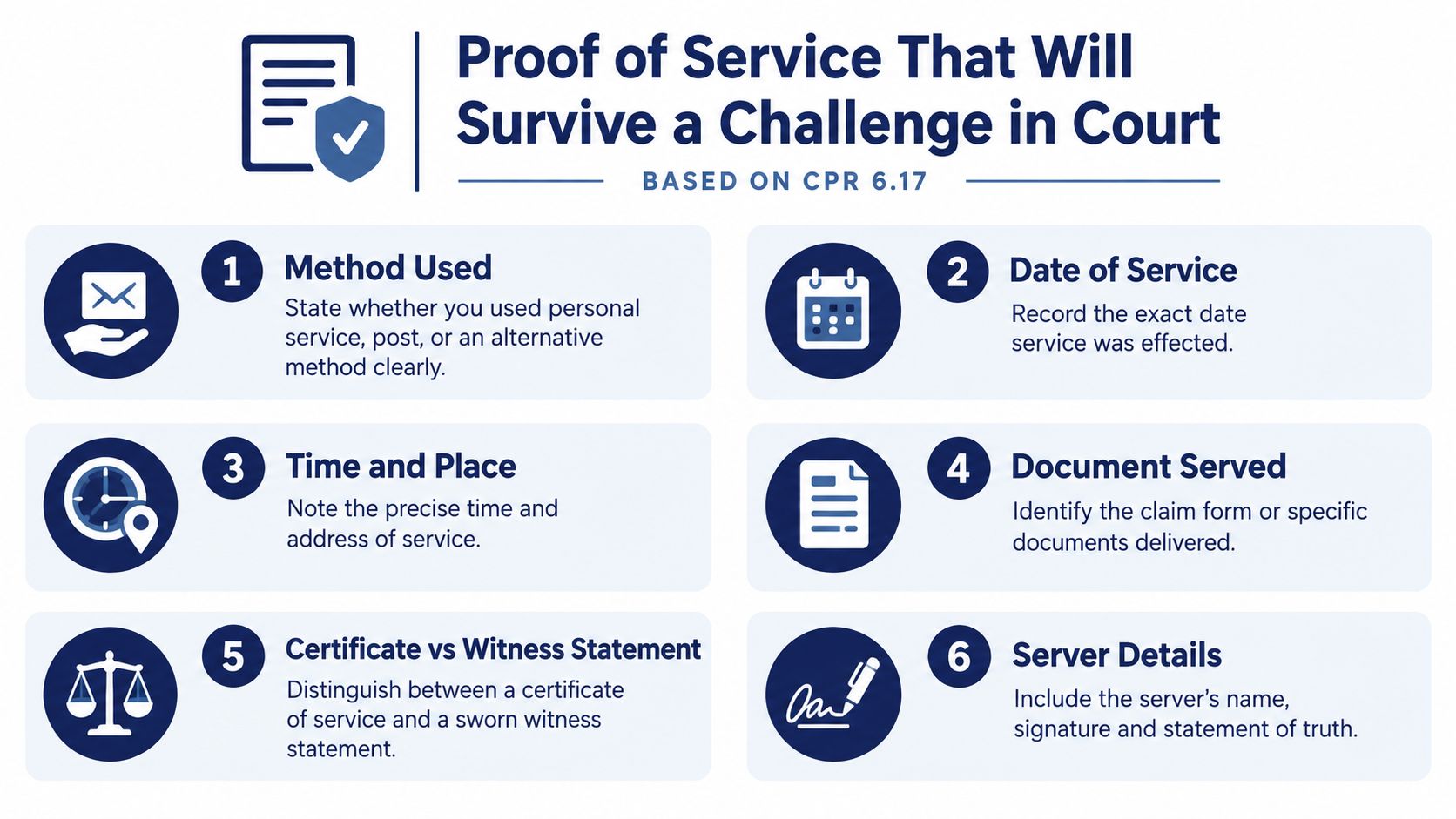
Those details sound basic until a defendant says the wrong person was approached, the wrong flat was used, or no claim form was enclosed. Then every missing detail becomes a live point.
A certificate of service is usually the standard filing document. A witness statement of service becomes important when the facts are likely to be contested or the circumstances need narrative detail. An acknowledgment of receipt may help evidentially, but don't confuse it with complete procedural compliance.
For court-facing context, a process server in court can become relevant. If service is attacked, the person who carried it out may need to explain the sequence with confidence.
What strengthens the file
The strongest service files usually include more than the bare form:
Contemporaneous attendance notes: Written at the time, not reconstructed later.
Clear recipient description: If personal service occurred, record who accepted the documents and how they were identified.
Photographic support where appropriate: Useful for proving attendance, address, and physical delivery step.
Location records: GPS-supported logs can help where attendance itself is disputed.
If your deponent can't explain the service sequence cleanly months later, the file wasn't built properly in the first place.
Keep the language precise. Don't pad the statement. Courts prefer accuracy over drama.
Practical Scenarios When the Defendant Cannot Be Found
The awkward file usually looks like this. The defendant has moved. Correspondence goes unanswered. The claimant's solicitor is close to limitation and still doesn't have a clean service address.
That isn't the moment to start guessing.

The sequence that actually works
Start with the last known address. Then test whether it still stands up. Check available records, compare recent correspondence behaviour, and look for indicators that the defendant has changed residence, employment, or trading location.
If that address is shaky, move quickly into trace work. tracing agents UK services become practical, especially when the file needs electoral, company, and other locating enquiries pulled together into something usable for service planning.
After that, attempt service where the evidence points, not where habit points. If residence is uncertain but workplace intelligence is current, the work address may matter more. If both are active, attendance at both may be necessary. Every attempt needs to be logged properly because failed attempts often become the evidence for the next application.
When standard service is no longer realistic
Sometimes the defendant is deliberately ducking service. Sometimes the address picture is fragmented. Either way, if ordinary methods aren't suitable, the answer isn't improvisation. It's an application supported by evidence.
Under the CPR, the court can authorise alternative service only where there is a good reason, the application is backed by evidence, and the order specifies both the permitted method and the date on which service is deemed to occur under the CPR rule on alternative service orders.
That's where a good process server earns their keep. Attendance notes, photographs, route history, property observations, and failed contact attempts can become the backbone of the evidence bundle.
Here's a useful video overview before making that application:
Electronic service is not the real question
A major underserved issue in UK practice is the gap between “Can I send it by email?” and “Will that method satisfy the rule and produce admissible proof?” The better question is always whether the chosen method fits the document, the rule, and the evidence position, as highlighted by the CPR framework and the continuing emphasis on certificates of service.
That's why process serving work overlaps with investigation. Finding the person, proving the address, and documenting the service path are often part of the same operational job.
Common Compliance Pitfalls and How Process Servers Prevent Them
Most service failures are preventable. They happen because someone assumes service is routine, delegates it too late, or treats proof as a formality. That attitude is expensive.
The fix is boring discipline.
The mistakes that keep causing trouble
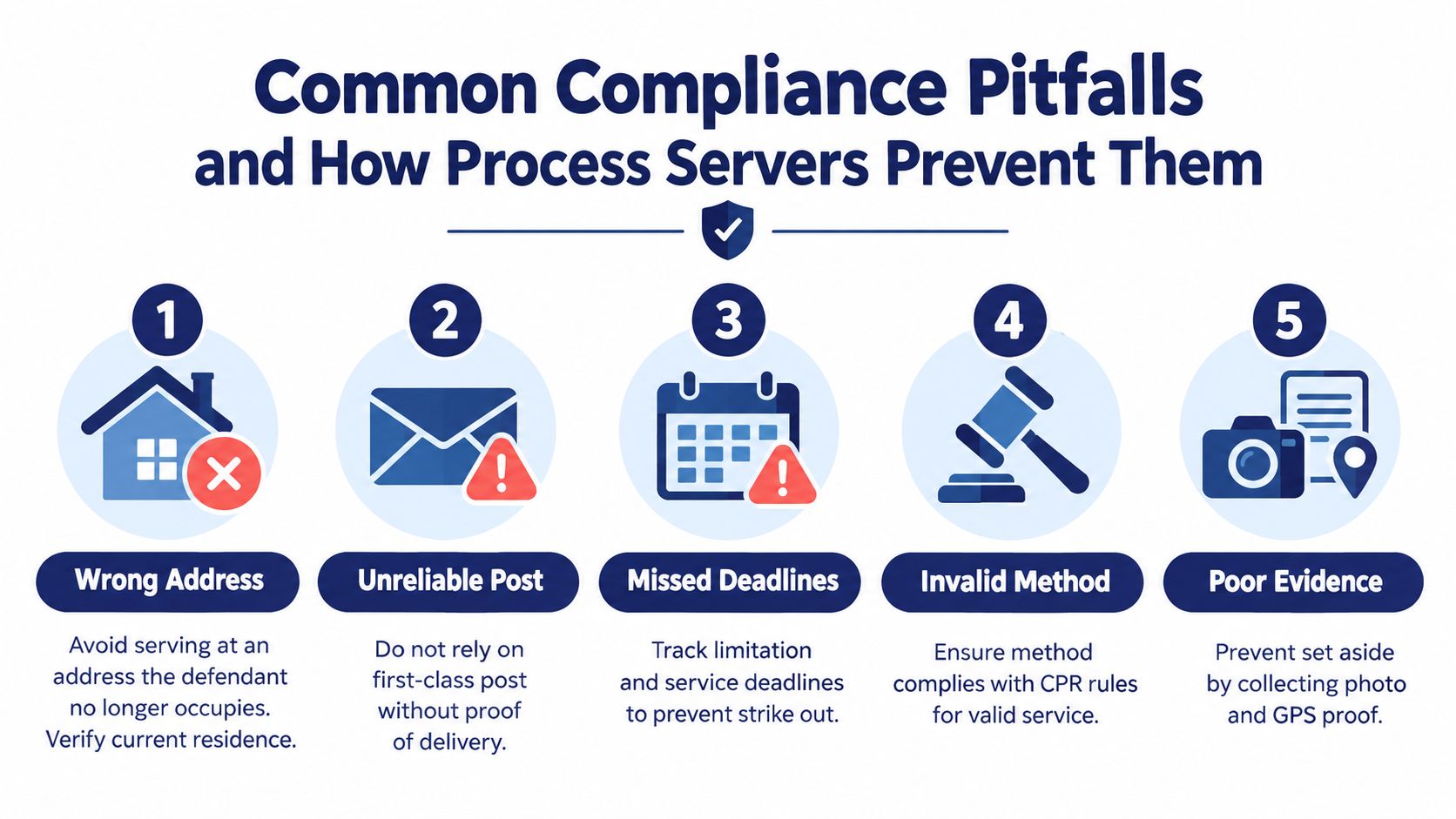
Using an old address: This is the classic own goal. If you already know the defendant no longer occupies the address, serving there invites challenge.
Relying on post without working out the legal date: Posting isn't the same as legal service. If your diary records the wrong trigger date, every follow-on step can be wrong.
Misidentifying the party served: A wrong corporate entity, wrong co-defendant, or sloppy spelling on the certificate can create unnecessary argument.
Choosing an invalid method out of convenience: Email is the usual culprit. People use it because it's easy, not because the rule position is secure.
Weak evidence retention: If there's no coherent note trail, disputed service becomes harder to defend than it needed to be.
The controls professionals apply
A good process server doesn't just attend. They apply controls before and after attendance.
Address checking before dispatch Recent occupancy indicators, matching records, and common-sense contradiction checks should happen first.
Method confirmation against the rule Pick the route because it is compliant, not because it is quick.
Identity and paperwork accuracy Party names, claim references, and document sets need checking before anyone leaves the office.
Immediate evidence capture Notes, timestamps, photographs, and outcome logs should be completed while events are fresh.
“Close enough” is how valid-looking service turns into a set-aside application.
This is one area where using an experienced provider is usually cheaper than repairing a mistake. A process-serving instruction often sits alongside tracing or investigation work. Sentry Private Investigators Ltd is one such provider offering process serving and related tracing support in England and Wales, which is useful where address certainty and service evidence need to be built together.
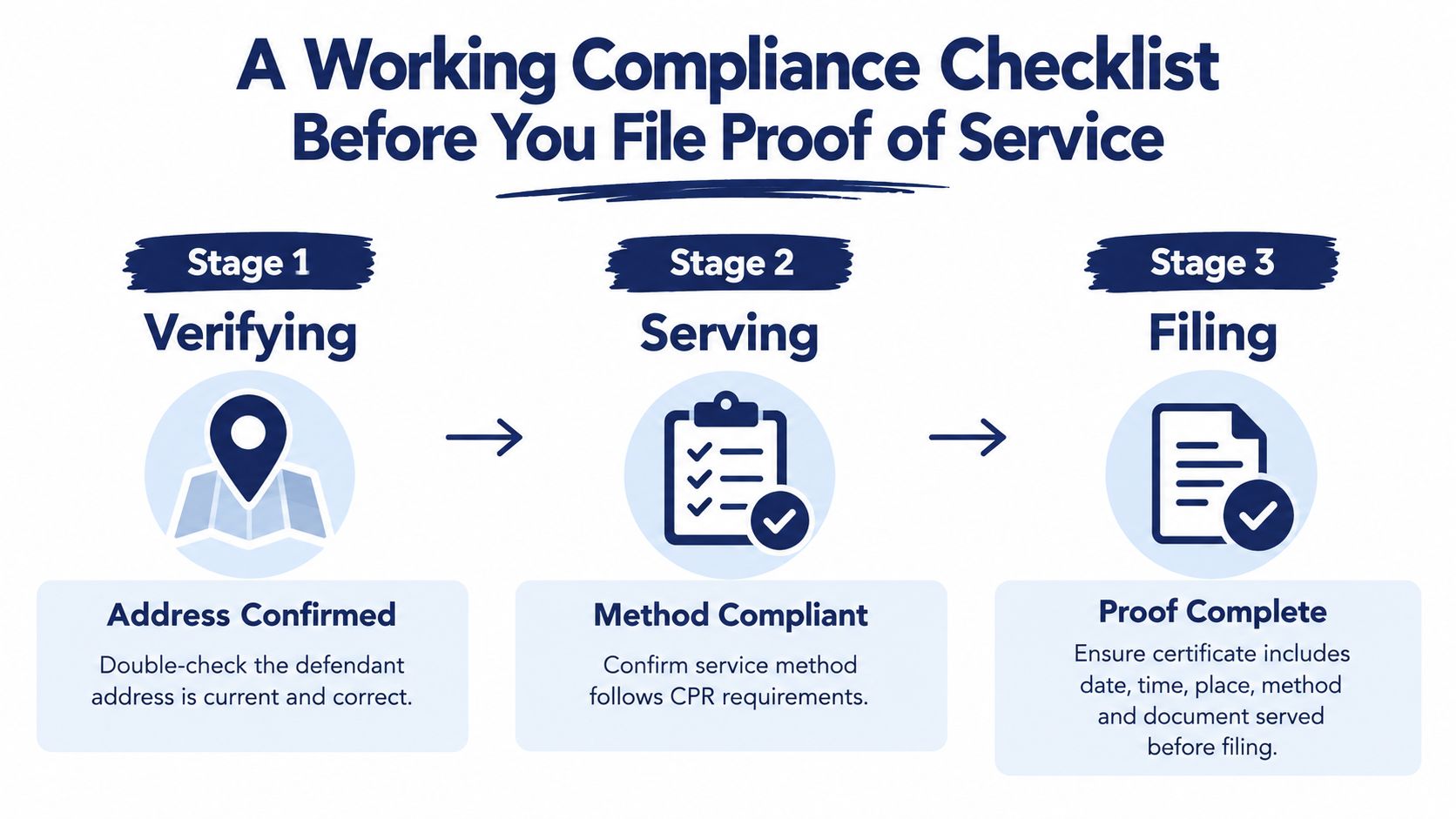
A Working Compliance Checklist Before You File Proof of Service
Before proof goes near the court file, run a final check. It should take minutes, not hours. But it needs to be done every time.
The five-minute review
Recipient verified Have you matched the defendant's name and service address against the court papers and the latest reliable information?
Method verified Did the method used fit the applicable CPR route or the wording of the court order?
Service step recorded Is the exact act completing service recorded clearly, including date, time, place, and who carried it out?
Document identified Does the proof specify what was served, without vague shorthand?
Supporting evidence retained Are attendance notes, photographs, route records, and any related communications kept with the file?
Deemed date calculated Have you worked out the legal service date correctly and diary-entered the response deadline that flows from it?
What this checklist actually gives you
It gives you a defensible file.
That's the objective. Not just “papers served”. Not just “certificate filed”. A file that still makes sense when the defendant disputes receipt, the judge asks awkward questions, or the timeline is examined under pressure.
If you build that habit, process serving stops being a recurring weak point in litigation. It becomes a controlled procedural step with fewer surprises and fewer expensive repairs.
If you need process serving handled properly, Sentry Private Investigators Ltd offers support with legal document service, tracing work, and the evidence trail needed when service is likely to be challenged. For urgent or difficult matters in England and Wales, visit Sentry Private Investigators Ltd and instruct with the rule position, timing, and proof requirements in mind from day one.