
Harassment from Neighbours: Evidence and Legal Options

You hear banging through the wall again, then a message arrives as you're getting ready for bed. You're checking who's outside before opening the door, and wondering whether reporting it will help or make things worse. When you're dealing with harassment from neighbours, the first priorities are safety, the right reporting route and a reliable record of what happened.
A useful case file doesn't need dramatic language. It needs separate incidents, preserved originals, independent support where available and clear records of how the behaviour affects your home life.
Is It Harassment or a Neighbour Dispute
26% of social-housing residents had been affected by antisocial behaviour during the previous year in a government survey conducted in 2022, representing approximately 1 million households across the sector, according to the Government's Anti-social Behaviour Action Plan. The same evidence found that 55% of residents who reported ASB to their landlord were dissatisfied with the outcome.
Those figures show you're not alone, but they don't mean every difficult neighbour is committing harassment. A boundary disagreement, inconsiderate parking and a deliberate campaign of intimidation require different responses. Describing the behaviour accurately helps the receiving officer or housing manager identify the issue rather than treating everything as a general neighbour dispute.
Ask the questions that change your route
Start with immediate danger, repetition and impact. Is anyone in danger now? Has the behaviour happened more than once? Is it changing how you sleep, work, leave home or use your property?
Police guidance explains that harassment generally involves conduct on at least two occasions, while repeated unwanted behaviour affecting daily life may also indicate stalking, according to Police.uk's stalking and harassment advice. That doesn't make an isolated assault or threat unimportant. It means the police may assess it as a different offence.
Common neighbour situations and the first step
Situation | Likely category | Act first |
|---|---|---|
Threats of violence or assault | Criminal, possibly putting someone in fear of violence | Contact police immediately; use the emergency route if danger is current |
Repeated abusive or threatening messages, calls or letters | Possible criminal harassment involving repeated incidents | Log each incident and report to police |
Persistent late-night noise or banging | Antisocial behaviour and possible civil nuisance | Report to the council noise team and to your landlord if you rent |
Filming, following or watching your home | Possible stalking or harassment, treated as a risk issue | Report to police now and keep dated records |
Damage to property, car or garden | Possible criminal damage, which may be part of a pattern | Report to police and photograph the damage before any repair |
Bin, parking or boundary dispute, or a one-off incident | Usually a civil or neighbourhood dispute | Raise with the landlord or council if it repeats, and seek advice on boundaries |
Abuse targeting race, religion, disability or sexuality | Possible hate incident or aggravated offence | Report to police, stating the identity-based element clearly |
These are working categories, not findings of guilt. A camera facing your driveway, for example, needs context before anyone can conclude that it forms part of stalking.
Write down which row best matches your situation, including any overlap. That gives you a clear starting point without forcing a legal label onto facts that still need investigating.
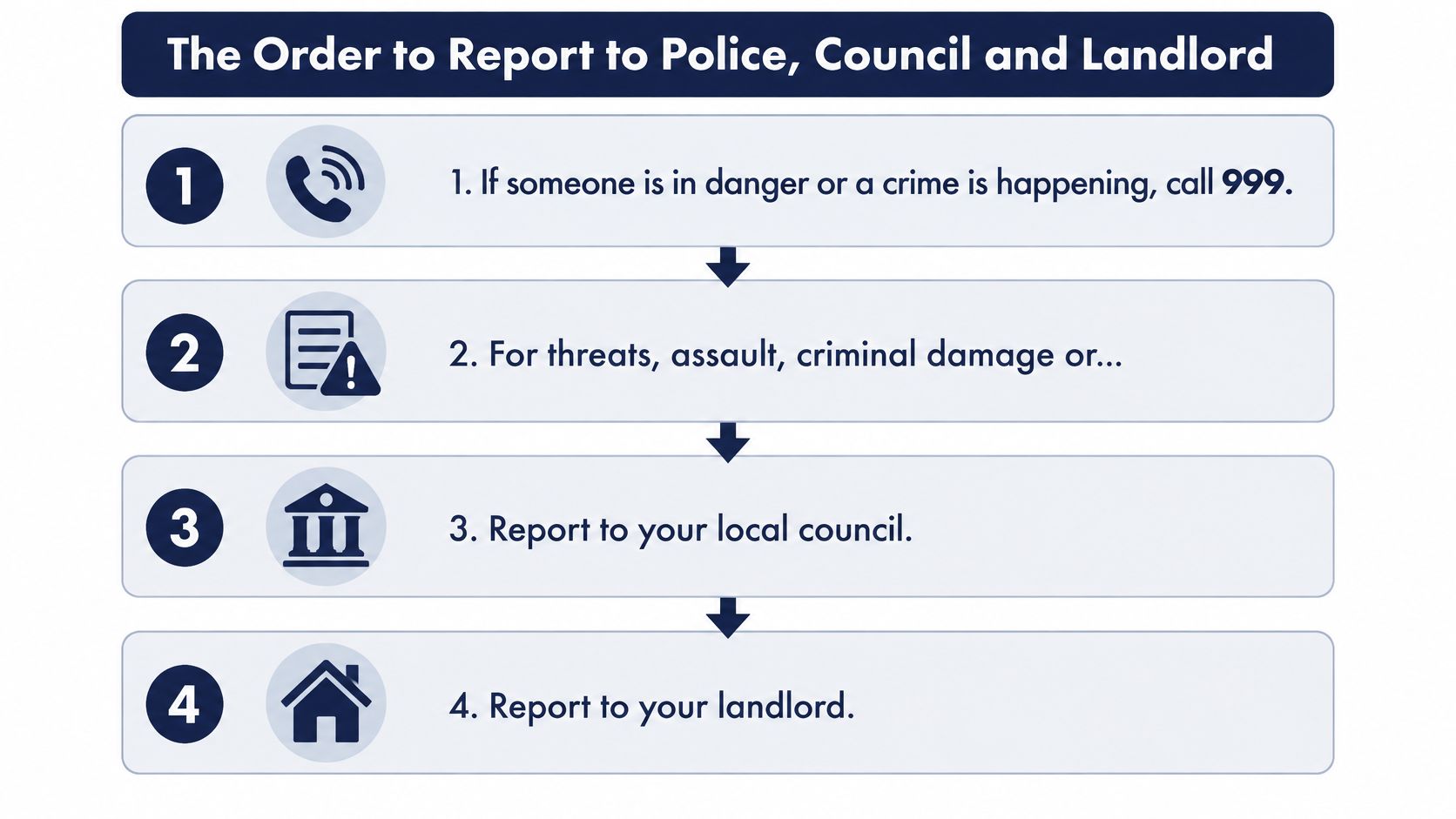
The Order to Report to Police, Council and Landlord
Report according to risk, not convenience. Sending a threatening message to a housing officer alone won't give the police an opportunity to assess the threat. Equally, a council noise team may be better placed to address persistent disturbance than a general criminal complaint.
The GOV.UK reporting guide directs criminal or threatening behaviour to police, problems affecting the local area to councils, and relevant housing complaints to council or housing-association landlords. It also cautions that bin, parking and neighbourhood disputes, and one-off incidents, may not be classed as antisocial behaviour, although they can still be reported.
Make the reports in a practical order
If someone is in danger or a crime is happening, call 999. Don't remain nearby to obtain footage or finish writing an account.
For threats, assault, criminal damage or repeated targeting without immediate danger, report to police on 101 or online. Ask for a crime reference number where a crime is recorded, or the incident reference otherwise.
Contact the council's antisocial behaviour or noise team for area-wide nuisance, persistent noise or fly-tipping. Describe the behaviour and its location rather than saying you have a bad neighbour.
If you rent from a council or housing association, also report to your landlord in writing. Keep the sent message, attachments and acknowledgement together.
Crimestoppers accepts anonymous information if you cannot give your name. Serious threats still need police attention, and anonymous information isn't a substitute for emergency assistance.
Add every police, council and landlord reference to your records. Tell each organisation about connected reports so staff can locate the relevant material.
If nothing happens, request a review by a supervisor or case manager. Use the council or landlord's complaints process, recording when you complained and what response you received.
The reporting routes below provide a quick visual reminder.
Ask who owns the case, how to submit further evidence and what change in circumstances requires urgent contact. If you fear retaliation, say so explicitly and ask how your information will be handled. Don't assume your identity can always remain undisclosed during an investigation or court proceedings.
Reporting rule: An incomplete but accurate report is more useful than a delayed report padded with assumptions.
Report even when the evidence is incomplete. You can supply further material afterwards, and the early report may help establish when authorities first became aware of the problem.
Protect Yourself While the Case Is Open
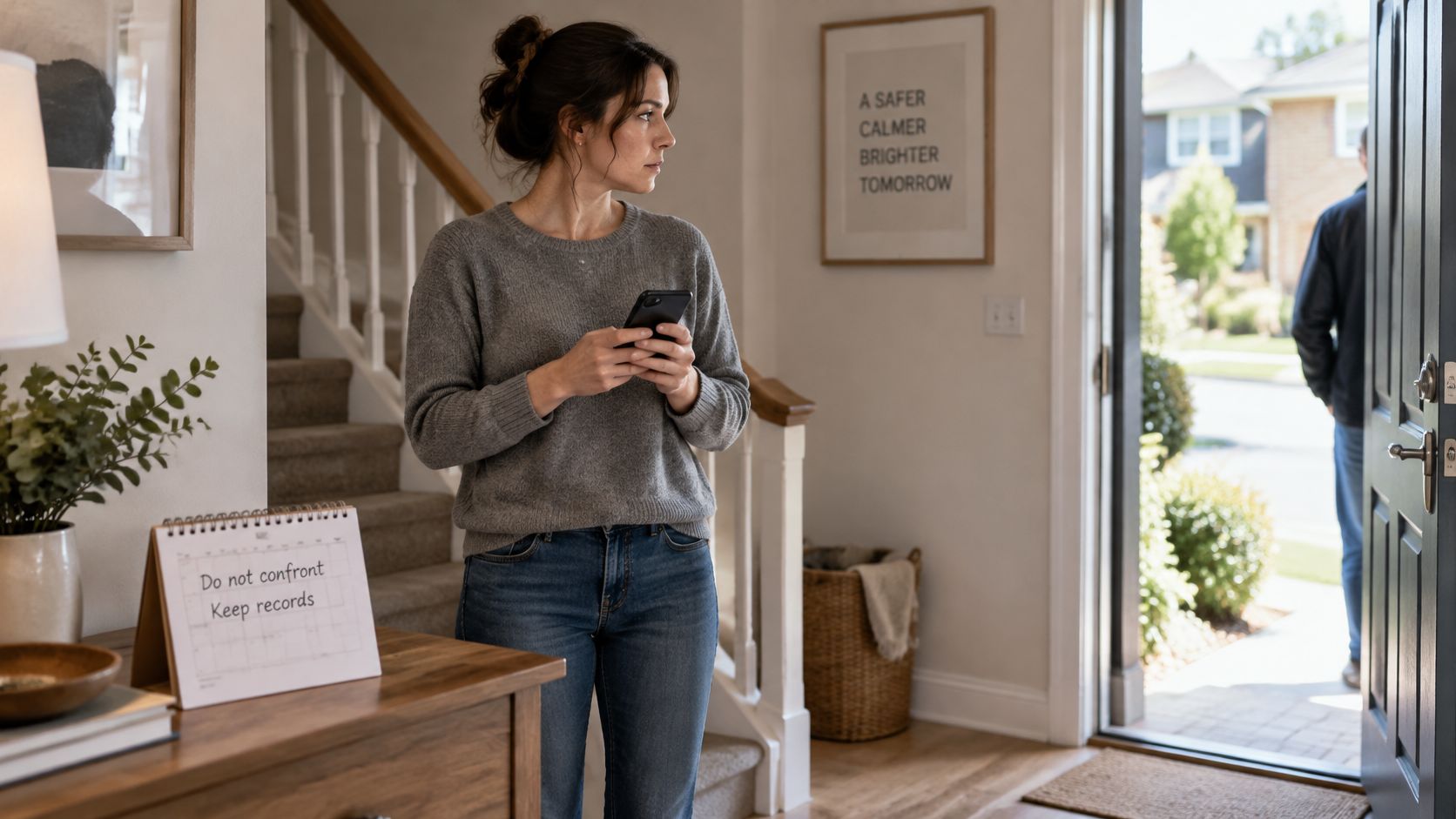
Don't confront the neighbour, retaliate or argue publicly online. A doorstep argument can increase the danger and create competing allegations that distract from the original behaviour. You don't need to win an exchange to protect your position.
Keep a safe distance when someone comes to your door.
Make a household safety plan
Choose support beforehand. Agree a safe place to go and a trusted person to contact. Keep your phone charged and accessible.
Respond to being watched. If you feel followed or monitored, tell someone when you leave for longer than usual and adjust routines where that improves safety. Don't test your suspicions by approaching the person.
Check physical security. Inspect locks, outside lighting and windows. Send repair requests to the landlord in writing.
Limit camera coverage. Aim a doorbell camera or CCTV at your own entrance, avoiding neighbours' windows and unnecessary coverage of shared spaces. Check the Information Commissioner's Office's domestic CCTV guidance before installation.
Get health support. Tell your GP or a support service if stress is affecting sleep or health. Record relevant appointments without circulating confidential medical information unnecessarily.
Where a managed development has problems with unauthorised gate entry, ask the managing agent to review access arrangements. Nimbio's residential gate access control system illustrates this type of building-level measure, but it isn't a substitute for reporting threats or a recommendation to change communal equipment yourself.
If observation or following is part of the concern, the private investigator guidance on stalking concerns can help you describe the behaviour without approaching the suspected person.
Keep any video viewing separate from the immediate task of securing your home.
Tell police promptly if threats continue, the neighbour approaches your household, or the behaviour changes. They can reassess risk and consider available protective measures; don't assume an earlier assessment covers new developments.
Mediation isn't a sensible first response where you fear violence or coercion. A safe household matters far more than securing an apology, proving a point at the door or persuading the neighbour to admit what happened.
Building a Lawful Incident Log and Evidence File
A log makes your account testable. Instead of saying the neighbour is always intimidating you, you can identify a particular event, the supporting file and someone who heard or saw it.
The GOV.UK guide to making an antisocial behaviour report says authorities may ask what happened, where, who was involved, whether anyone witnessed it, the date and time, and whether it has happened before. Its suggested evidence includes diaries, communications, witness statements, photographs, video, noise recordings and reporting-app entries.
Use the same routine for every incident
Create a separate entry. Give it a unique reference, such as NB-A, rather than adding everything to an undated account.
Record the date, exact time where known, location and what was said or done. Mark estimated times as estimates.
Identify witnesses. Note their names and contact details where they agree to provide them.
Add relevant vehicle descriptions, clothing and direction of travel. Separate what you observed from what you inferred.
Describe the practical effect. Record lost sleep, missed work, avoiding the garden or seeking medical help.
List the associated messages, call records, photographs, video and official reference numbers.
Save the entry that day where possible. Don't rewrite it later. Add a dated correction if you discover an error.
A spreadsheet works well as an index, with a separate folder for original files. Use matching filenames so an investigator or solicitor can move from an incident entry to its supporting material without guessing.
Preserve originals, not just screenshots
Export messages where the application allows it, retaining sender details and timestamps. Save emails with full headers rather than relying solely on cropped screenshots. Photograph damage before repair, taking an overall view and a close-up with a coin for scale where useful.
For noise, keep a dated diary showing its duration and effect, and ask the council whether monitoring is available. Don't present an uncalibrated phone reading as professional acoustic evidence.
Ask witnesses to write their own dated accounts in their own words. The CPS guidance on stalking or harassment identifies witness testimony, CCTV, communications, diaries and physical evidence as potentially relevant material.
Keep the original, a secure backup and a record of where each file came from.
If you need to turn paper documents into PDF files, PDFWix explains the scanning process. Keep the paper originals, check that every page is legible and avoid uploading sensitive case material to an online tool without considering its privacy terms.
Never enter the neighbour's property or place hidden devices to obtain evidence. Recording private conversations you aren't part of can be unlawful, so obtain advice before collecting audio. For the distinction between planned observation and intrusive monitoring, consult a practical guide to discreet investigations.
A hypothetical entry might read: Tuesday, 11.10 pm to 11.50 pm, forty minutes of drumming audible in the bedroom from the flat above. A neighbour in the adjoining flat also heard it and agrees to provide an account; you couldn't sleep during the disturbance and remained awake afterwards. Record how you identified the source, rather than treating your assumption as verified fact.
That detail is more useful than a long emotional account because another person can check it.
Legal Remedies Compared by Situation
Under the Protection from Harassment Act 1997, harassment includes conduct causing alarm or distress, and a course of conduct directed at a person normally requires behaviour on at least two occasions. The alleged harasser must know, or ought to know, that the conduct amounts to harassment, assessed against what a reasonable person with the same information would understand.
Repetition alone doesn't prove the claim. The content, context, targeting and available evidence matter. A solicitor needs the actual communications and incident records, not just your conclusion that the neighbour intended to frighten you.
Match the remedy to the problem
The routes below are principally relevant to England and Wales. Get jurisdiction-specific advice elsewhere in the UK, and remember that the court decides whether the applicable legal requirements are met.
Legal remedies for neighbour harassment
Remedy | Who applies or decides | What it achieves | Usual threshold |
|---|---|---|---|
Police investigation and prosecution | Police investigate; Crown Prosecution Service makes relevant charging and prosecution decisions | Charges for harassment, stalking or another supported offence | Repeated conduct for harassment; a serious threat may constitute a separate offence |
Restraining order on conviction | Criminal court | Can prohibit contact or entry to a defined area | Conviction and the court's assessment that protection is necessary |
Civil injunction for antisocial behaviour | Council, police or eligible social landlord applies; court decides | Prohibits specified conduct; breach can lead to court action | Applicable statutory ASB test, including conduct causing or likely to cause harassment, alarm or distress |
Civil claim under the Protection from Harassment Act | Victim, usually through a solicitor; court decides | Injunction and potentially damages | A qualifying course of conduct meeting the statutory harassment test |
Private nuisance claim | Person with the necessary property interest, usually through a solicitor; county court decides allocation and relief | Damages and potentially an injunction against unreasonable interference | Substantial and unreasonable interference, often supported by evidence of persistence |
Possession action against a tenant | Landlord applies; court decides | Can end the neighbour's tenancy | Applicable tenancy breach or antisocial behaviour grounds proved |
A serious threat doesn't automatically establish harassment, and a complaint doesn't automatically lead to prosecution. Similarly, an injunction needs appropriate evidence and workable terms, not a request that the neighbour behave better.
Understand who controls the next step
Police and prosecutors control criminal enforcement decisions. You can provide evidence and explain your concerns, but you can't purchase a prosecution or require a particular charge.
Civil action is different. You instruct a solicitor, consider funding and costs exposure, and decide whether to pursue the available claim. A nuisance claim seeking an injunction shouldn't be assumed suitable for the small claims track.
Tenants and homeowners don't always have identical options, particularly for property-based claims. A landlord may pursue possession where the relevant grounds are established, but a complainant cannot personally terminate the neighbour's tenancy.
Take specialist advice early, ask about legal aid eligibility, and bring the chronology, original evidence and official reference numbers. This is general information, not a substitute for advice on your circumstances.
Decide Whether to Bring in a Private Investigator
A private investigator adds value when there's a specific evidence gap. That might mean assessing lawful ways to identify an anonymous sender, obtaining an independent record of public-facing activity, or preparing a verified chronology for a solicitor.
Hiring someone to watch a neighbour without a clear objective can waste money and increase tension. The useful question is what fact needs establishing, how it can be established lawfully and who will use the result.
Agree the objective and the limits
At Sentry Private Investigators Ltd, our discreet investigative and evidence-gathering services can support recurring neighbour-harassment concerns where an independent record is needed. The Birmingham-based team operates across the West Midlands and the wider UK.
An investigator isn't the police. They have no special power to enter your home or the neighbour's property without lawful authority or permission, cannot use unlawful tracking or bugging, and cannot guarantee identification, a court order or a successful claim.
Clients are responsible for obtaining any required consents, licences or permissions from third parties, including landlords or local authorities, before our services begin, unless otherwise agreed. We provide regular updates during investigations, so you know how the agreed work is progressing.
Before hiring any firm, establish that it's UK-based and obtain:
A written scope identifying the question to be answered and the proposed methods.
Written terms and a quote showing what you're authorising and what the quoted work includes.
A clear data-handling explanation covering UK GDPR, secure storage and disclosure.
An account of prohibited methods so you understand what the investigator won't do.
Buying judgement: Pay for a defined, lawful evidence task, not a promise to make the neighbour stop.
Prepare before commissioning work
Gather your dated incident log. If the issue is repeated targeting, include the connected events rather than a summary alone. Don't delay urgent help while waiting for another incident.
Check that police or council reports have reference numbers and include any correspondence showing what action has already been taken.
Speak to a solicitor if a claim is possible. Their advice can help prevent spending on evidence that won't address the legal issue.
To discuss investigative help, call Sentry Private Investigators Ltd on 0121 769 1626, mobile 07730 695 853, or email info@sentryprivateinvestigators.co.uk.
The main website explains the wider private investigator service. For an initial discussion, have a concise description of the behaviour, the evidence already available and the gap you need help addressing.
Sentry Private Investigators Ltd offers discreet investigative support and evidence gathering for recurring neighbour-harassment concerns. Visit Sentry Private Investigators Ltd to discuss your incident record and whether a lawful, clearly scoped investigation could help your police report or solicitor's case.