
Private Investigator Glasgow: How to Hire in 2026

You already know something is off. A partner's account of late nights in the city centre no longer matches the messages. A debtor has left a Glasgow address and the invoice is still unpaid. An employee on an injury claim is doing work that does not fit the medical note sitting on the HR file. You have a suspicion. You don't yet have a file a Scottish solicitor, an HR manager or an insurer can use.
Hiring a private investigator in Glasgow is less about finding someone who will watch a person, and more about commissioning facts that can be explained later. A private investigator lawfully finds and records those facts. They don't replace Police Scotland, a solicitor or Disclosure Scotland.
What follows is the decision in front of you: match the problem to a service, test credentials on the first call, demand an evidence pack that can be tested, and stop any surveillance or tracking that has no lawful basis.
Why Glasgow Clients Instruct a Private Investigator
A relationship concern may affect a separation, a debtor may be unreachable, or an employer may need to assess a workplace allegation. In each case, suspicion alone is not enough to support a decision. A lawful enquiry can help establish whether there is evidence worth taking to a solicitor, employer or insurer.
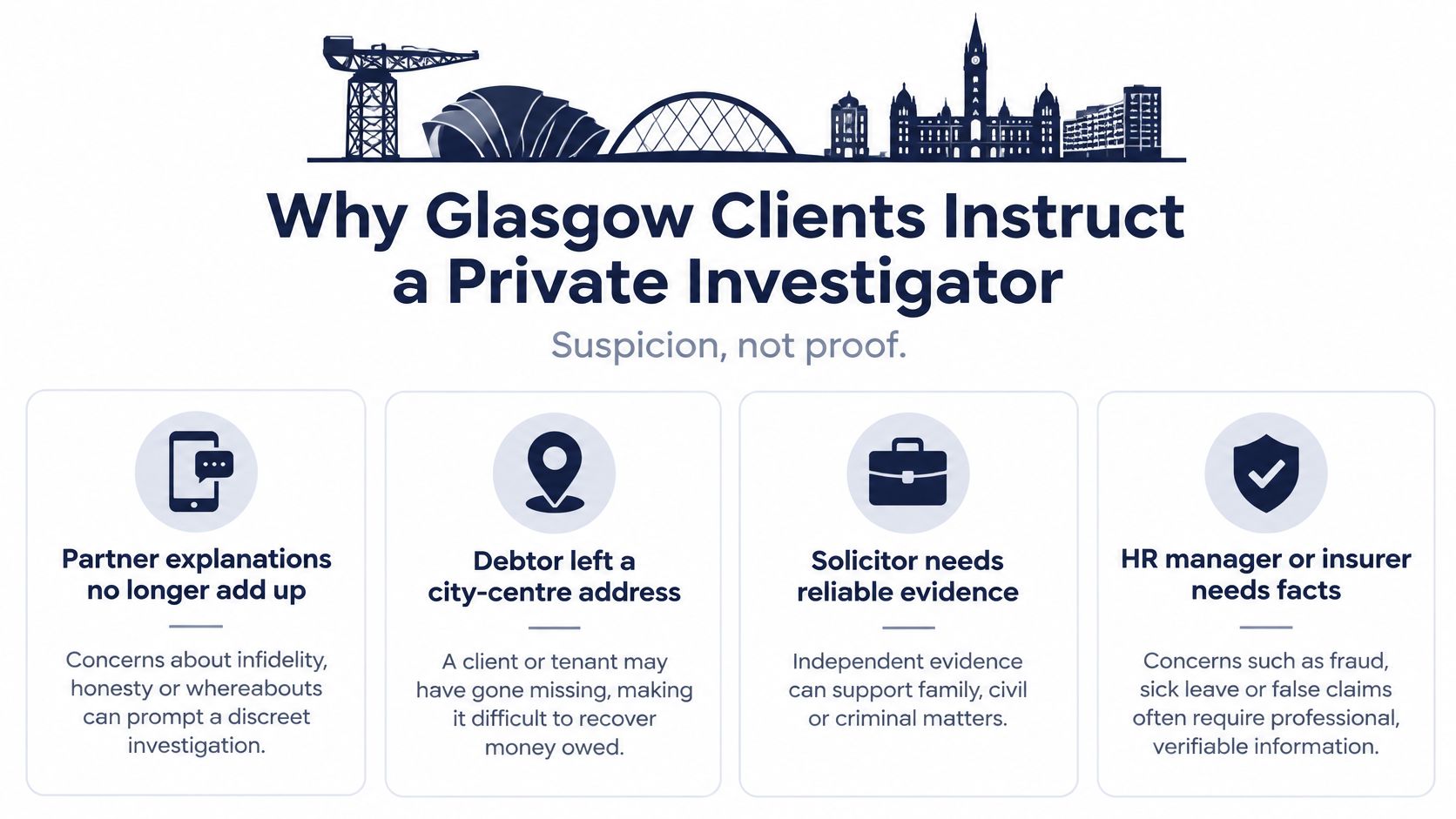
Glasgow is Scotland's largest council area by population, with 620,700 residents recorded in Scotland's 2022 Census rounded population estimates. That scale means enquiries can involve relationship concerns, tracing, background checks or business matters. The population figure does not indicate how many investigations any particular area requires.
For a Glasgow instruction, the practical question is whether the resulting evidence can support the decision at hand. Scottish solicitors, employers and insurers need a clear account of what was investigated, how information was obtained and what the findings can establish. A private investigator does not replace Police Scotland, a solicitor or Disclosure Scotland. Each has a separate role, particularly where criminal matters or regulated checks are involved.
What the instruction is for
Before commissioning work, identify the decision the findings must inform. A relationship enquiry, an unpaid debt, a workplace concern and a litigation issue call for different approaches. A focused brief helps keep enquiries relevant and gives the client a basis for deciding when the work should stop. Legal study tools such as legal AI for law students may help students practise issue-spotting, but they are unrelated to investigating a live matter and do not replace advice from a Scottish solicitor.
Sentry Private Investigators Ltd provides discreet investigative services to private clients and businesses across the UK, including Scotland, from its registered office in Birmingham. Its work includes covert surveillance, people tracing and background checks, alongside private and corporate investigations. Clients can discuss the purpose of an enquiry directly with an experienced investigator and request a free consultation and planning. Choose a firm on the relevance and lawfulness of its proposed work, not on the assumption that a local address alone guarantees useful evidence.
Practical rule: Name the decision the evidence must support before authorising an investigation.
Glasgow Services and the Evidence Each One Should Produce
Pick one row before you call anyone. A vague request to "follow someone" produces hours, not a file. The right row tells you what is worth paying for, and the point at which the job should stop.
Service | Typical Glasgow use | Evidence worth paying for | Stop if |
|---|---|---|---|
Infidelity or cohabitation | Relationship doubts or separation planning | Timed log, photographs and continuity notes | The plan would harass or intrude without a lawful purpose |
Workplace absence or injury fraud | Suspected exaggeration, moonlighting or false claim | Narrow watch tied to one allegation | There is no senior authority or DPIA for covert monitoring |
Employee theft or mystery shopping | Stock loss or on-site conduct | Defined dates, locations and named recipients | The watch would be open-ended staff monitoring |
People or debtor tracing | Estranged person or unpaid debt | Lawful trail and confidence in a current address | The brief asks for unlawfully obtained personal data |
Background research | Due diligence outside a regulated role | Open-source findings and stated limits | The client wants a full criminal history or a PVG certificate |
GPS vehicle tracking | Company or client-controlled vehicle with a purpose | Purpose, duration, access and retention record | Ownership is the only justification offered |
Process serving | Solicitor needs papers served | Proof of service and method note | No solicitor is instructing the litigation step |
Bug sweeping (TSCM) | Suspected device in home, office or vehicle | Equipment sweep plus physical inspection | The request is to plant or intercept, not to detect |
How to choose a row
Infidelity or cohabitation work supports a relationship decision or a family-law briefing. A timed log of public meetings, photographs and continuity notes can be useful. Photographs alone don't prove the allegation, and this article won't walk through how that surveillance is run.
Workplace absence, injury fraud, moonlighting and employee theft belong to an employer with one defined allegation. Mystery shopping fits a named site and named dates. If the brief turns into open-ended staff monitoring, it should stop.
People tracing and debtor tracing look for a current, lawful trail, whether the person is an estranged relative or a commercial debtor. A confident address beats a stack of old leads. If a request involves personal data that cannot be obtained lawfully, decline it.
Background research is open-source or consented fact-finding. It isn't a criminal-record product, and it isn't a PVG certificate.
GPS tracking applies only where there is a defensible purpose for a vehicle the client can lawfully monitor. Process serving supports a solicitor who is already running the litigation step. Bug sweeping, or TSCM, is a physical and technical search of a home, office or vehicle when covert devices are suspected. It detects. It doesn't plant or intercept.
Open the matching service page for infidelity, corporate investigations, tracing agents, bug sweeping or background checks when you want the method detail. Keep this choice to the row, the decision and the deadline.
A first call should name those three things, not a request to follow someone around Glasgow until something turns up.
Checks That Separate a Professional Investigator

No single UK licence makes every investigator suitable. Scotland doesn't currently require a dedicated private-investigator licence, so you judge the firm on the answers you get on the first call. Ask these seven questions, and check membership claims on the body's own register before you rely on them.
Which body stands behind the firm? We are an approved investigative service provider of the Association of British Investigators (ABI) and the Institute of Professional Investigators (IPI), and a vetted and approved ABI agency. Confirm that on the ABI and IPI registers, not from a logo on a website.
What do the other associations require? The site also lists the UK Private Investigators Network and the Corporation of Professional Investigators. Ask what membership requires, and whether the person doing your work holds it.
Who will do the Glasgow work? Ask whether any subcontractor will be named in advance. If we use a subcontractor who isn't an ABI or IPI member, we notify you of that subcontractor's details. Wherever possible, subcontractors are members of one of those bodies.
Will you identify yourself as the client? We may require proof of identity and, where relevant, compliance with money-laundering rules before work starts. A refusal to identify the client is a reason to walk away.
How will personal data be limited, stored and shared? Under UK Government data-protection guidance, processors have direct legal obligations, and controllers and processors may be fined by the Information Commissioner's Office. Both can also face private compensation claims.
Where is the written plan? It should name the allegation, locations, dates and who may see the report.
Will anyone blag, hack or use pretext calls? The answer has to be no. Those methods can wreck the file and the client's position.
Membership is a trust signal, not a licence to ignore privacy law.
You should speak directly with an experienced investigator, not a call centre script. A short confidential consultation is the right place to hear whether the plan is proportionate.
The same questions apply if you are comparing firms for a Glasgow instruction against work based in Birmingham or elsewhere in the UK. Credentials travel with the investigator. They don't change because the address is north of the border.
What a Glasgow Investigation Costs and How Quotes Work
Cost follows the work, not a menu price this article can invent. Build it in this order.
The service row: A single tracing enquiry isn't priced like a multi-day watch.
People and hours: One investigator for a defined task costs less than a team covering long days.
Travel from Birmingham: Distance to Glasgow, accommodation and overnight time sit on the expenses side when the job needs them.
Equipment and length: A sweep or a longer instruction adds kit and days. A short, closed task doesn't.
Two billing approaches cover almost every instruction. A fixed fee suits a defined task, such as one tracing enquiry or a process-serving job. A time-based instruction suits surveillance or open-ended research. For that second type, ask for an estimate and a cap before anyone starts.
Ask for an itemised quote that separates professional fees from expenses. Ask what triggers extra charges, such as a change of target address or a report that runs past the agreed scope. Our guide to PI costs sets out how that quote conversation works.
We offer a free, no-obligation quote and a free consultation. A short phone call at the start is the cheapest way to test whether the plan is proportionate. A good firm will sometimes tell you not to spend the money, for example when a solicitor's letter or the correct Disclosure Scotland check answers the question more cheaply.
What a Scottish Court or Tribunal Will Actually Want
A Glasgow instruction may be intended to support a family dispute, employment matter or criminal allegation. In each case, useful evidence depends on more than what a photograph appears to show. The investigator should be able to explain when and where an observation was made, how the material was obtained, and who handled it. A Scottish solicitor, employer or insurer needs a clear record that can withstand questions about relevance, privacy and admissibility.
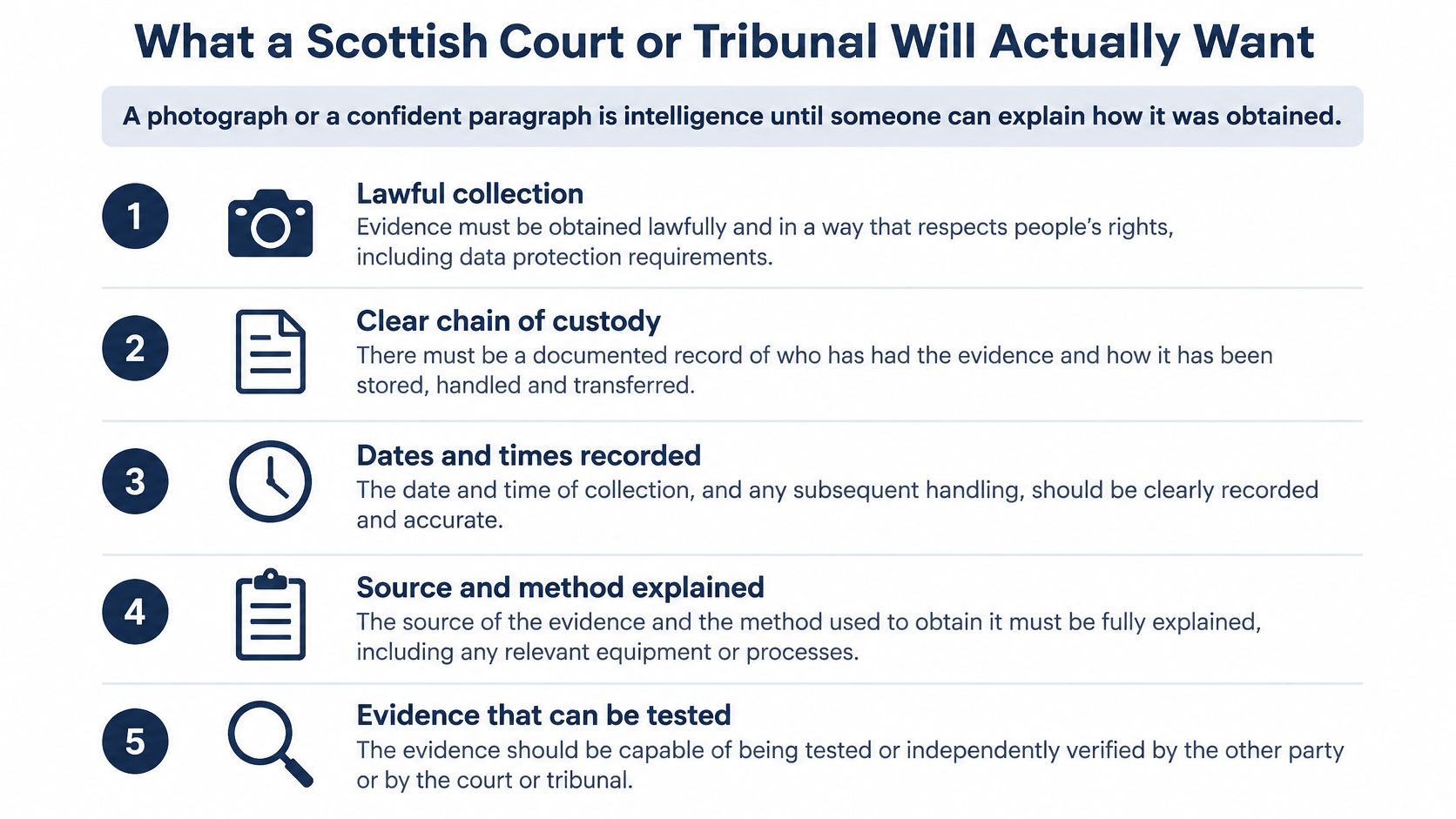
Keep all material gathered during an enquiry, including anything that does not help the client, because disclosure rules in court or tribunal proceedings can require relevant material to be produced. The guidance on giving evidence in court explains how witnesses should approach giving evidence. It does not replace advice from a Scottish solicitor about a particular case. The practical question is whether the evidence pack is accurate, complete and suitable for legal scrutiny.
Request this | Why it matters | Review first |
|---|---|---|
Contemporaneous activity log | Records times, places and observations as they happen | Client and solicitor |
Original photo and video files | Allows the material's integrity and continuity to be assessed | Solicitor or insurer |
Continuity note | Records who held the material and when | Solicitor |
Method statement | Explains how the material was collected and what equipment was used | Solicitor before any hearing |
Defined retention period | Sets an end point for storing personal data | Client and investigator |
Unhelpful material kept | Gives a fuller record, rather than a selected account | Solicitor |
Named recipients only | Limits access to sensitive personal information | Client |
What each item is doing
A contemporaneous activity log sets out the date, time, place and observed events, recorded as they happen. Reconstructing details later can leave gaps or uncertainty. Keep original image and video files intact, rather than relying only on cropped stills, so a solicitor or insurer can assess the material. A continuity note records who handled it, while a plain method statement lets a solicitor consider whether collection was proportionate.
Keep unhelpful material alongside evidence that supports the client's position. A selective pack may be harder to defend if challenged. A defined retention period and named recipients also help control how long personal data is held and who receives it.
When to call the solicitor first
Speak to a Scottish solicitor before instructing surveillance if the purpose relates to a court order, a child-related dispute, a dismissal or a report to Police Scotland. The solicitor can help define what is relevant and how the evidence may be used. The Sentry Private Investigators litigation support guide explains how investigative work can support legal proceedings.
For example, a record of meetings in public places may be relevant to a separation dispute. Covert recording inside a private home raises different privacy concerns. In an employment matter, agree the allegation, dates and retention period before work begins.
Before paying, ask whether the investigator can explain the evidence pack to your solicitor and confirm that material that does not support your case will also be retained.
Lawful Limits on Surveillance and Vehicle Tracking
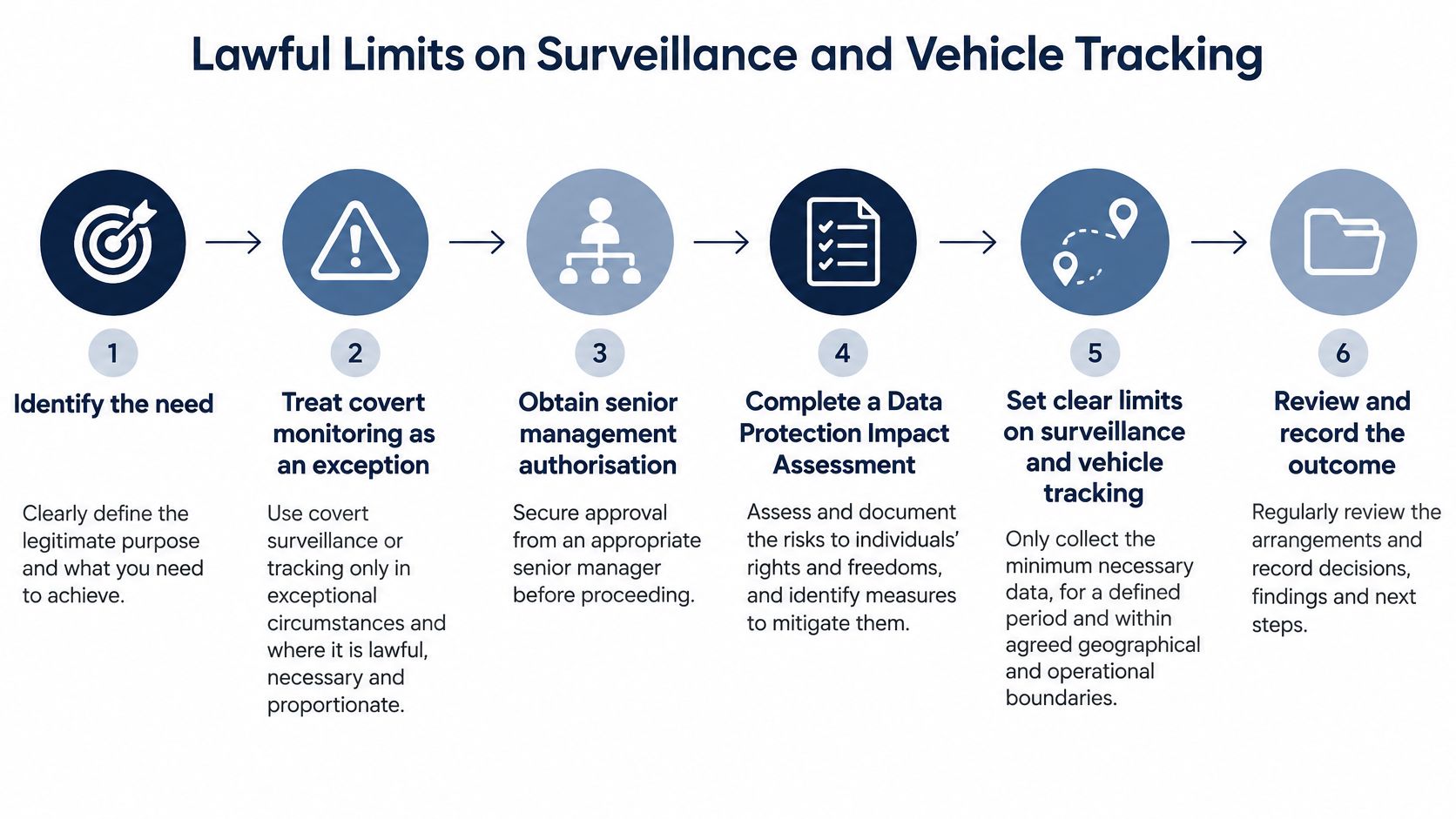
Covert monitoring is an exception, not a default. For a Glasgow employer, the evidential value of footage depends on a documented process, not on how discreet the camera was.
The UK Information Commissioner's Office states that covert monitoring should be exceptional, authorised by senior management, preceded by a Data Protection Impact Assessment (DPIA), and supported by reasonable grounds to suspect criminal activity or equivalent gross misconduct. The ICO's monitoring-workers guidance also says the monitoring should be narrowly targeted, run only for the shortest necessary period, and end once the investigation is complete.
What the assignment sheet must name
Before deployment, the sheet should specify the allegation, subjects, locations, dates, permitted equipment, retention period and authorised recipients. The contract should require collection in line with UK data-protection obligations.
Audio or video in toilets, changing rooms or other places where workers reasonably expect privacy should not be used. Personal emails should generally be left alone. Those limits make the material easier to defend, because it is tied to one purpose rather than open-ended observation. Gathering evidence through discreet surveillance only makes sense inside that boundary.
Ownership isn't a tracking licence
A company van, a pool car, an employee's own car, a partner's car and a jointly owned car aren't the same case. Owning or managing the vehicle isn't a complete answer. Purpose, necessity, proportionality, notice or consent where appropriate, access, retention and deletion still have to be justified.
Tracking a partner without a suitable basis can create harassment and privacy risk. Government guidance treats location devices differently from more intrusive surveillance, but the classification depends on what the data reveals. The ICO's code of conduct for private investigators expects a documented lawful basis and proper handling of personal data.
Write a pre-deployment note and take legal advice. Don't fit a tracker the same day because the keys happen to be in the office.
Background Checks Disclosure Levels and PVG
A city-centre firm hiring a finance manager can ask an investigator for lawful open-source research and a consented employment history. A care service placing someone with protected adults, or a nursery hiring for regulated work with children, must use the official Disclosure Scotland route. A private report isn't a substitute.
Match the role to the row, then check eligibility on the official guidance. Nobody can obtain a complete criminal history on request.
Route | What it can show | Who it is for |
|---|---|---|
Level 1 Disclosure | Unspent convictions only | A role that doesn't need spent-conviction information |
Level 2 Disclosure | Unspent and certain spent convictions, relevant police information and other specified details | A role eligible for that higher check |
Level 2 with barred-list check | Level 2 detail plus lists barring work with children or protected adults | Roles requiring a barred-list check |
PVG membership | Membership status, barred-list consideration and prescribed civil orders, with ongoing review | Regulated work with children or protected adults |
Investigator background research | Lawful open-source or consented findings, not a disclosure certificate | Due diligence that isn't a substitute for the scheme |
Highland Council's disclosure and PVG guidance draws those levels clearly. A Level 1 Disclosure shows unspent convictions only. A Level 2 Disclosure can include unspent and certain spent convictions, relevant police information and other specified details. A Level 2 check with a barred-list check adds the lists of people barred from working with children or protected adults.
What PVG is, and isn't
PVG membership is for regulated work with children or protected adults. People who aren't doing that work aren't generally eligible to join. South Lanarkshire's description of the scheme treats it as continuing monitoring. Disclosure Scotland checks history on joining, confirms whether the person is barred, and can review membership when new police or justice information indicates a risk.
A Scottish PVG disclosure can show membership, whether the person is under consideration for a barred list, and whether prescribed civil court orders exist. It assesses suitability for a regulated role. It isn't unrestricted personal intelligence. Falkirk Council's guidance states that, except in limited circumstances, sharing PVG disclosure information with a third party is an offence.
An investigator can support due diligence around a role. The employer still applies for the correct level through Disclosure Scotland. Use the background-check service for the investigative part, and the statutory guidance for the certificate.
Brief Sentry on a Glasgow Instruction
You now have enough to enquire. You don't have enough to run the investigation yourself, and you shouldn't try.
Call an investigator on 0121 769 1626. We offer a free, no-obligation quote, and free consultations with custom planning, including for clients outside Birmingham. A Glasgow matter can be discussed before anyone is deployed. Coverage across the UK from the Birmingham office, at Studio 9, 50-54 St Paul's Square, Birmingham B3 1QS, means a Scottish instruction is a normal enquiry.
Have six points ready:
The service row you chose, so the call starts on a defined job.
The decision the evidence must support, such as a solicitor's advice, a disciplinary step or a debt claim.
Known addresses or vehicles, stated only where you can lawfully ask about them.
Dates that matter, including any hearing, return-to-work date or invoice deadline.
Who may see the report, kept to named people.
Whether a solicitor is already instructed, especially if court, children or dismissal is in view.
Identity checks may be required before work starts. We can decline a plan that would breach privacy or data-protection law. That refusal protects you as well as the person who would have been watched.
If the issue is a workplace injury claim, a tracing need, a surveillance question or a suspected device, say so on the call and we will point you to the existing page for that service. Don't ask for a method briefing on the phone. Ask whether the outcome you need can be evidenced lawfully, and whether the spend is proportionate.
Call, describe the outcome you need, and let us confirm whether the work should go ahead before any cost is committed.
Sentry Private Investigators Ltd helps individuals, solicitors and employers in Glasgow commission evidence that can be explained, rather than a watch with no lawful purpose. From our Birmingham office we handle confidential enquiries across the UK, including relationship, tracing, workplace and litigation-support instructions, and we will say when a cheaper lawful route is the better one. Visit Sentry Private Investigators Ltd to arrange a free consultation and talk through a Glasgow instruction before anyone is deployed.