
Phone Number at Address: How to Trace One Legally

You've got a number in your call history, an old tenancy file or a message from someone who's stopped responding. You need to establish where they can be contacted, but the search results promise more than they explain.
A phone number can be a useful starting point. Whether you're checking a phone number at address level for a debt, legal proceedings or a business enquiry, the useful result is a supported match, not just an address beside a name.
What a UK Phone Number Reveals About an Address
A UK phone number rarely reveals a home address on its own. A geographic landline can suggest a town or city, but it doesn't identify a street, household or current resident.
Ofcom's geographic numbering document identifies geographic numbers as beginning with 01 or 02, with examples including 020 for London, 0121 for Birmingham, 0161 for Manchester, 0115 for Nottingham and 0116 for Leicester. These areas contain many streets, businesses and households, rather than matching a single neighbourhood or local-government boundary.
Number types and what they reveal about an address
Number type | Typical prefix | What it reveals | Address link |
|---|---|---|---|
Geographic landline | 01 or 02, including the examples above | Town or city area from the area code | Possible when combined with a name and a listing |
Mobile | 07 | Usually a mobile service, with no geographic area code | No fixed premises; not tied to a location |
Non-geographic business line | 03 | Service or call-handling line | Usually a business; no home address |
Freephone or shared-cost line | 08 | Business or helpline service; charging category needs checking | Business use; no home address |
Premium-rate line | 09 | Premium-rate services | No address link |
Internet telephony | 056 | Voice over internet, not fixed to a place | Can be used from anywhere; no reliable address |
The mobile category needs care: not every number in that broad range is an ordinary mobile service. Likewise, a non-geographic business number can route calls to staff working in different locations.
Number porting and hosted telephone systems also complicate geographic checks. A business may retain an established number after moving, so the apparent town can be historical rather than current.
Practical rule: Treat an area code as location context, not evidence that someone lives at a particular property.
For mobile, non-geographic, premium-rate or internet-telephony prefixes, stop trying to derive a home address from the prefix. Any useful progress must come through lawful business and identity checks, not through a supposed geographic link.
Public Sources to Check Before You Pay Anyone
Start with information that's genuinely published and relevant to your purpose. Each source answers a different question: who advertised a number, where a company receives correspondence, or who owns a property.
A directory entry is convenient, but convenience isn't verification. The original publisher, publication date and nature of the address matter more than how prominently a search engine displays the result.
Public sources for checking a number and address
Source | What it can confirm | Limits |
|---|---|---|
Published directory listing | A landline linked to a name and address, where the subscriber opted in | Many numbers are ex-directory; listings can be years out of date |
Business directories such as Yell | A trading name, business address and business landline | Business address is not a home address |
Companies House register | Registered office and officer names for limited companies | Registered office may be a service address |
Edited electoral register | Names and addresses of electors who have not opted out | Full register is restricted to specific purposes; no phone numbers |
HM Land Registry | Registered owner and available price paid information for a property | No phone numbers; ownership details may lag changes and don't establish occupancy |
Ofcom numbering data | Whether a number range is allocated and whether an area code fits a claimed town | Doesn't show who uses a number or where they live |
Social media and company websites | Contact details a person or business has chosen to publish | Publication is not consent to contact the person |
Search the published directory first, then business listings and Companies House where there's a trading connection. Only move to electoral or property information when you have a relevant name or candidate address and a lawful reason to investigate.
Separate useful clues from copied listings
Several websites displaying identical details may all have copied the same original entry. They aren't independent confirmation, even if their layouts and company names differ.
For suspicious callers, Gini Help's phone lookup guidance for scam prevention offers supplementary reading. Keep the task focused on checking the claim, rather than engaging with someone who may be impersonating another person.
Our guidance on spotting red flags during identity checks can also help you distinguish a plausible story from a supported identity.
A short initial check can cover directories, business websites and company filings. Conflicting identities, restricted records and uncertain occupancy require more careful work, often with a qualified investigator rather than another paid lookup.
How to Trace a Phone Number to an Address Step by Step
The initial output should be a scored lead, not a confirmed resident. Establish your lawful purpose before searching, then preserve enough information for someone else to understand how you reached the result.
The process below keeps evidence collection separate from assumptions.
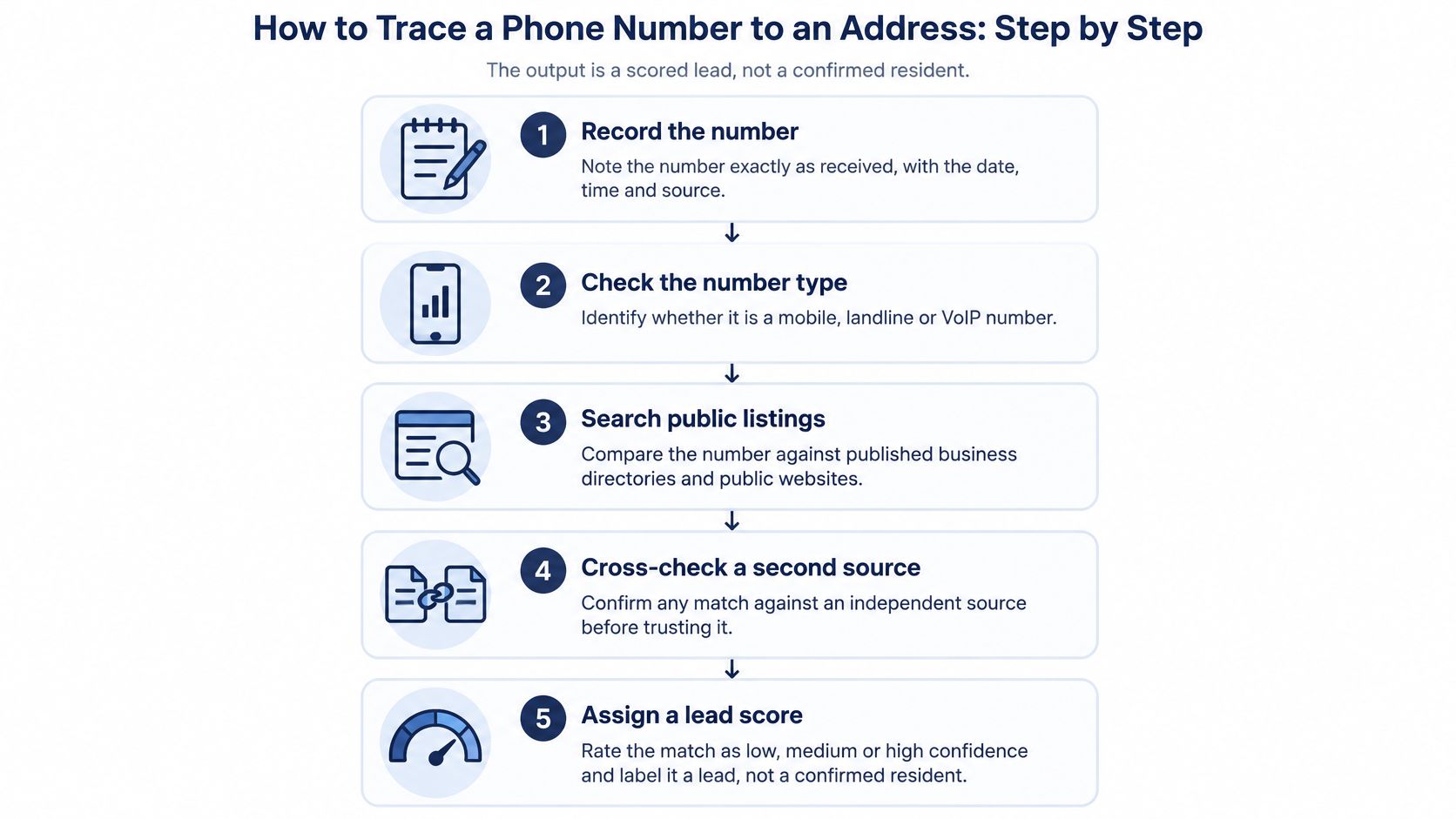
Preserve and classify the starting information
Record the number exactly as received. Retain the date, time, call log, message headers and the source of the information. Keep the original message rather than relying only on a screenshot that omits context.
Convert the number into +44 international format, replacing the initial domestic zero, and classify it as geographic, mobile, non-geographic or premium-rate. Ofcom's numbering and allocation resources support technical checks on whether a range is plausible and consistent with its claimed allocation.
Stop the geographic address route for mobile or non-geographic numbers. There's no premises to infer through that route. A separately published business association may still be relevant, but it needs its own evidence.
For a geographic number, compare the area code and allocation information with the claimed town. Record whether they're consistent, without turning that consistency into an identity finding.
Build and assess the candidate match
Search published directory and business listings. Search the complete number, including alternative spacing, alongside any name you already lawfully hold. Save the relevant entry and access date so you can distinguish the original record from later changes.
Cross-check the candidate name and address against an independent source. Companies House may support a company connection; the edited electoral register may support an individual's address association, where appropriately accessed.
Require at least two independent identifiers to agree before scoring a candidate address. A name and address, or a business name and registered office, can support a match when corroborated across independent sources. Agreement alone still needs interpretation: a company connection doesn't establish residential occupancy.
Label unresolved results as leads. Record the source, its apparent age, what agrees, what conflicts and when the finding should be reviewed. Use low, medium or high confidence only if you explain the evidence behind that assessment.
A useful case note distinguishes an advertised contact address from a likely current address. That wording affects what the client can safely do next, especially where legal correspondence or sensitive disclosure is involved.
A confidence rating describes the strength of the evidence. It isn't a guarantee that the person currently lives there.
The common mistakes are straightforward: treating an old directory entry as current, mistaking a business address for a home, or accepting copied listings as corroboration. A careful investigator records the uncertainty rather than hiding it behind a definitive-looking report.
Legal Limits and Protecting Your Own Number
A phone number can be personal information if it identifies someone, on its own or alongside other details. The Information Commissioner's Office guidance on personal information explains why linking a number to a name or address needs care. A number usually offers only a town-level clue, not proof of where someone lives. Treat an address as verified only when at least two independent sources support it, and document the lawful purpose for the search.

Define the purpose before searching
A landlord trying to locate a former tenant over unpaid rent has a specific objective. That purpose can be assessed against an appropriate lawful basis, but it does not automatically justify every search method or disclosure.
Using the details for an unrelated sales pitch is a separate purpose. The ICO guidance on direct marketing and electronic communications says live marketing calls generally must not be made to TPS-registered numbers unless the subscriber has specifically told that caller they do not object.
Before a professional search begins:
Record the purpose and lawful basis. State what needs to be established and why.
Limit collection. Request the necessary address or contact point, not unrelated family information.
Plan transparency. Explain relevant processing through an appropriate privacy notice.
Control access. Secure records and limit disclosure to people who need them.
Set retention arrangements. Review accuracy and securely delete information when it is no longer needed.
Protect your own details and respond safely
The ICO's 2025 privacy update, the ICO reported 44,404 nuisance-call complaints and 16,898,518 UK numbers registered with the Telephone Preference Service. Many UK phone users receive suspicious calls, so a displayed number is weak proof of identity.
Check whether your landline is publicly listed and request removal where available. Register with the TPS to reduce unsolicited marketing, and keep a log of unwanted calls, including dates, times, numbers and messages.
Report suspected scams to Action Fraud and harassment or threats to the police. Call 999 if someone is in immediate danger. If you face stalking or domestic abuse, prioritise police assistance and specialist support rather than attempting a personal trace. Read when to report stalking to police for guidance on safeguarding concerns that lookup tools cannot resolve.
Ciphar's guide to tools to keep your number private covers supplementary privacy options. TPS registration will not identify a caller or stop fraudulent and other non-marketing calls. Do not confront someone at an address based on an uncertain match.
Finding an address must serve a lawful purpose. It does not give permission to make contact.
Deciding Whether to Hire a Private Investigator
Hiring an investigator makes sense when an incorrect address match could affect a legal, personal or business decision. A basic public search may help answer a straightforward question, but a disputed debt or sensitive enquiry calls for checks that can be assessed and documented. A phone number usually offers only a town-level clue. Treat an address as verified only when it is supported by at least two independent sources and the trace has a documented lawful purpose.
The value of professional tracing lies in weighing competing explanations, recording the sources used, and being clear about what remains uncertain. Paying someone merely to repeat a directory result adds little.
Trying it yourself versus hiring a private investigator
Situation | Try yourself first | Worth hiring a private investigator |
|---|---|---|
Unknown number calling repeatedly | Block the number, log dates and times, and report suspected fraud to Action Fraud or threats to police | When an identity must be established for a legal claim |
Debtor who has moved away | Check Companies House where relevant and the court's own enforcement process | People tracing to establish and verify a current address |
Serving court papers | Check the court's guidance on service options | A trace to confirm current address information before deciding how to proceed |
Business due diligence or suspected fraud | Check Companies House and published filings | Background checks or a corporate investigation |
Suspected harassment or stalking | Keep a dated log and report to police | Evidence gathering alongside police involvement |
Personal or relationship matter | Avoid tracing alone; seek advice first | A discreet investigation with a clearly defined lawful scope |
Conflicting address results are a reason to stop relying on a basic search. So are signs that someone has moved, a need to support litigation, or a business decision that depends on verified identity and address information. A phone number by itself cannot establish who lives at an address.
Ask how a prospective investigator checks whether an address is current, documents the sources and reports inconclusive results. No responsible provider should promise that every telephone number will lead to a residential address.
Prepare a focused enquiry
Share enough information to let the investigator assess the instruction, without sending an unnecessary archive of personal data:
Known identity. Full name, aliases and reliable identifying details.
Existing address information. Last known address and when it was last confirmed.
Telephone evidence. The complete number, relevant call history and messages.
Purpose and outcome. Why the trace is needed and what decision or legal step it must support.
Sentry Private Investigators Ltd offers people tracing, tracing agent services and background checks. Its head office is in Birmingham, and it operates across the West Midlands, including Coventry, Wolverhampton and Worcester, as well as other parts of the UK. For complex enquiries, the investigation team can assess the circumstances. Its UK tracing agents provide a relevant route for enquiries about locating someone.
Begin with a confidential discussion and agree the scope and purpose before work starts. Fees are quoted once the scope is agreed, and the investigation proceeds within those boundaries. Share only information relevant to the enquiry.
Sentry Private Investigators Ltd offers discreet people tracing and investigative support when a telephone number leaves important questions unanswered. Contact Sentry Private Investigators Ltd to discuss the information you hold, the outcome you need and whether a lawful trace is appropriate.