
Office Bugging Devices and How to Detect Them

A confidential proposal is discussed in a boardroom, then details reach someone outside the business. It's natural to wonder whether someone was listening, but a leak doesn't by itself prove that an office bugging device is present. The same information could have escaped through an email account, a meeting platform, ordinary workplace monitoring or an authorised person.
The safest response is to preserve what you know, limit unnecessary discussion of sensitive matters and choose an investigation that fits the evidence. Sentry Private Investigators Ltd provides discreet investigations and technical surveillance countermeasures (TSCM) services for businesses concerned about possible eavesdropping. A considered response starts with triage, not accusation. A broader layered workplace safety approach can also help organisations consider physical security alongside access controls and staff procedures.
When an Office Surveillance Concern Needs Attention
Suppose a supplier refers to a strategy that was discussed only in a closed meeting. You notice the timing, check who received the meeting notes and ask whether anyone shared the proposal elsewhere. If no explanation emerges, the concern may deserve attention, but it still doesn't establish that a microphone or camera was planted.
A vehicle-related concern calls for the same care. If someone appears to know where a company car has travelled, there could be a tracking device, but shared vehicle access, calendar entries, location-enabled phones or routine work records might explain it too. Begin by recording exactly what happened and separating what you observed from what you suspect.
Practical rule: Treat a suspected bug as a question to investigate, not a conclusion to announce.
The distinction matters because different problems need different expertise. A technical surveillance assessment examines a physical environment and relevant equipment for signs of covert monitoring. An IT incident investigation focuses on accounts, devices, networks and access records. A workplace monitoring question may instead require review of company policy, staff notices and data-protection responsibilities.
Keep the first response proportionate
Avoid searching the office in a way that changes the scene or turns an unconfirmed suspicion into an accusation. Record the date, location and circumstances of the concern, limit discussion to people who need to know, and consider who controls the premises and systems. If there's an immediate safety issue, follow your organisation's established procedures.
A professional can help assess whether the concern calls for TSCM, cyber security support, legal advice or another response. The aim isn't to confirm a suspicion at any cost. It's to find out what the available evidence supports and protect sensitive information while that question is examined.
How Office Bugging Devices Work
Think of a hidden device as an unattended ear, eye or notebook in a place where sensitive activity happens. The comparison describes what it might do, not what it looks like. Some devices capture sound, some record images, and others may collect information through a connection to equipment or a system.
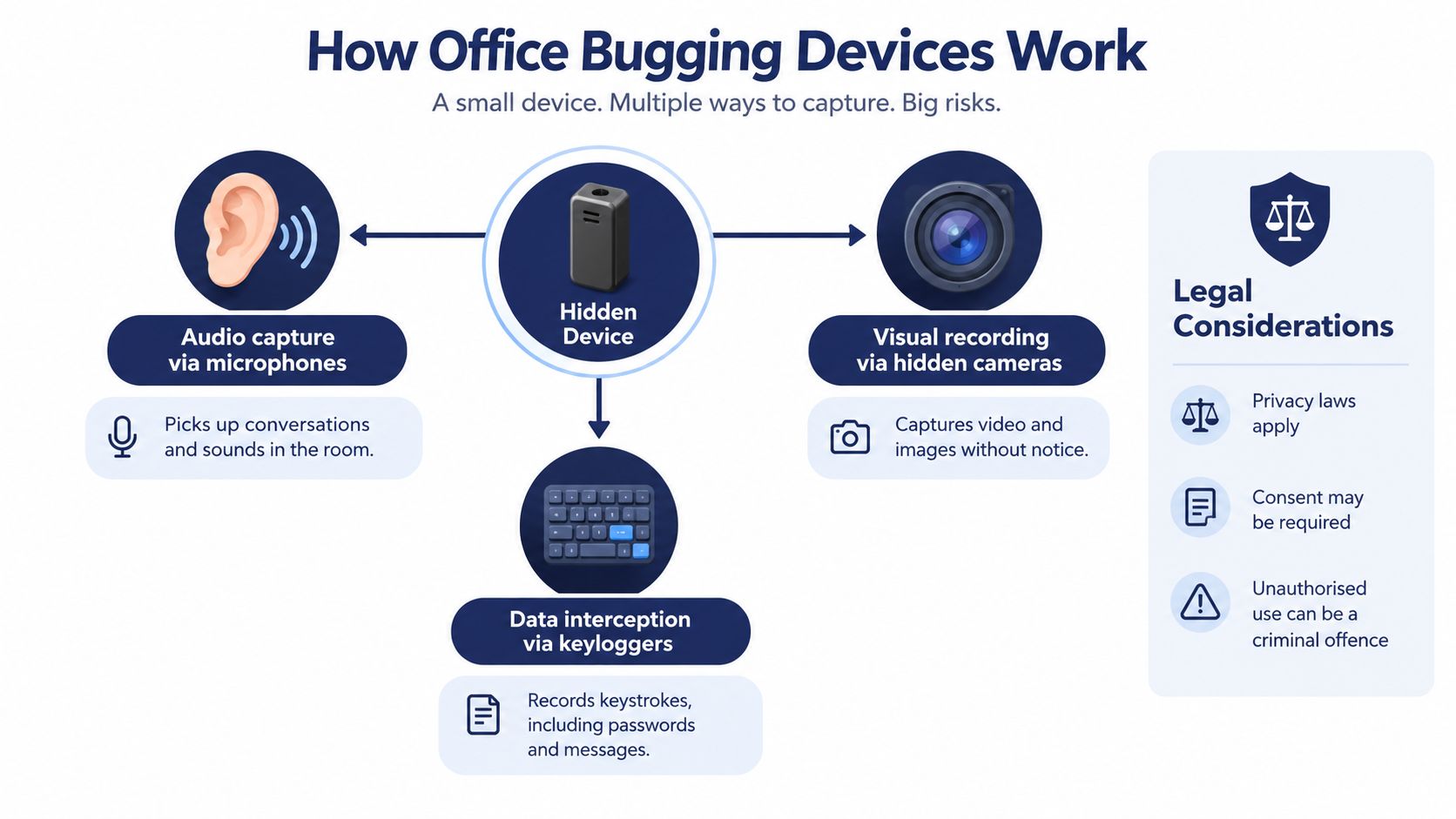
Follow the information, not the gadget
A suspected device can be considered through a simple chain. First, what information could it capture? Next, might it store that information, transmit it elsewhere, or connect to another system? Finally, how might it receive power and how could someone retrieve the information? These are questions for assessment, not a checklist for identifying a device by appearance.
A recording-only device may save information locally for someone to retrieve later. A live transmitter may send information elsewhere while it operates. Network-connected equipment may use a connection to transfer data, but an unfamiliar network device is not automatically covert surveillance. Devices vary, and their function can't be reliably determined from a casual glance.
The legal vocabulary is also based on function rather than gadget names. Under the Regulation of Investigatory Powers Act 2000, surveillance can include monitoring, observing or listening to people, their conversations, activities or communications, as well as recording information. The statutory definition of a surveillance device is technology-neutral, covering apparatus designed or adapted for surveillance. The Home Office's code of practice on covert surveillance and property interference explains the framework, including how covert surveillance concerns a subject's lack of awareness.
The presence of an unfamiliar object doesn't establish who put it there, what it captured or whether it was used covertly. Those questions require context and, where appropriate, examination that preserves the object and any evidence associated with it.
Common Types of Office Bugging Devices
The label “bug” can refer to quite different equipment. The table below is a way to clarify what someone is concerned about, not a test for deciding whether a particular object is suspicious.
Device category | What it may be intended to capture | Likely environment | Key limitation to remember |
|---|---|---|---|
Wireless microphone | Sound for later listening or transmission | Meeting rooms, offices or other spaces where conversations take place | Wireless equipment can have different power and transmission arrangements. Its presence or appearance alone doesn't prove covert use. |
GSM bug | Sound that may be transmitted over a mobile communications connection | A location where remote listening is alleged | A suspected device needs proper assessment. A phone or mobile signal nearby doesn't identify a bug. |
Hidden camera | Images or video of people and activity | Office interiors, entrances or other areas under concern | A camera may record locally or use a connection. The existence of a camera doesn't establish whether it's authorised or what it has captured. |
Wired tap | Communications carried through a relevant connection or cable | Telephone, communications or equipment infrastructure | A wire or unusual connection can have a legitimate purpose and should not be opened or disturbed to find out. |
RF or IR transmitter | Depending on its function, information sent by radio frequency or infrared means | A space or equipment environment under technical assessment | Not every device transmits continuously, and no consumer check can establish the full picture. |
GPS device in a company vehicle | Vehicle location or movement | A car or other business vehicle | Fleet equipment may be legitimate. Ownership, authorisation and access arrangements need to be understood. |
Clarify the allegation before investigating
If a colleague reports an unfamiliar item in a meeting room, write down its location and appearance without moving it. If the concern is about a vehicle, establish who is authorised to use and maintain it before assuming that any tracking equipment is covert. A professional assessment can then consider the relevant room, connection or vehicle in context.
The categories describe possible functions, not proof that a specific type of device is present. A proper investigation asks what the concern is based on, which environment might be affected and what evidence can be preserved safely.
Signs That May Suggest Technical Surveillance
Possible indicators are useful when they form a coherent, documented concern. None is proof on its own. A new charger on a desk, unexplained interference during a call or a colleague knowing about a meeting may each have an ordinary explanation.
Notice patterns, then record observations
Physical changes could include an unfamiliar object, equipment that appears to have been moved or an unexpected connection near meeting-room technology. Electronic observations might include repeated interference or equipment behaving differently than expected. Record what you notice and when, rather than describing an item as a bug before it has been assessed.
Information-handling clues deserve equal care. Ask who had access to the document, meeting, account or system involved, and whether the information was shared through ordinary business channels. For a vehicle concern, note the specific reason you suspect tracking and who can access the vehicle or its records.
False positives are common in busy workplaces. Routers, smart speakers, conference equipment, chargers and legitimate monitoring systems can be unfamiliar to staff or change position during routine work. An observation becomes more useful when it can be checked against room access, equipment ownership or a documented change.
Write down what you saw, not what you think it means.
People looking for an accessible explanation of the terminology can read this counter surveillance definition UK. In a real concern, however, a definition won't determine whether a particular space or device has been compromised. That depends on evidence and the circumstances at the site.
Why a Suspected Bug May Be Another Security Problem
Confidential information can escape without a physical device. Someone may have accessed a business account, followed a phishing link, used an authorised remote-access tool, shared a meeting invitation or exposed information through a smartphone, conferencing platform or cloud system. Those possibilities don't rule out TSCM, but they're important alternatives to examine.
The UK Government's Cyber Security Breaches Survey 2025/26 found that 43% of UK businesses experienced a cyber breach or attack in the previous 12 months, affecting an estimated 612,000 businesses. Phishing alone affected 38%. These figures provide context for digital risk; they don't show that a particular organisation has been hacked, and they don't measure how often office bugs are planted.
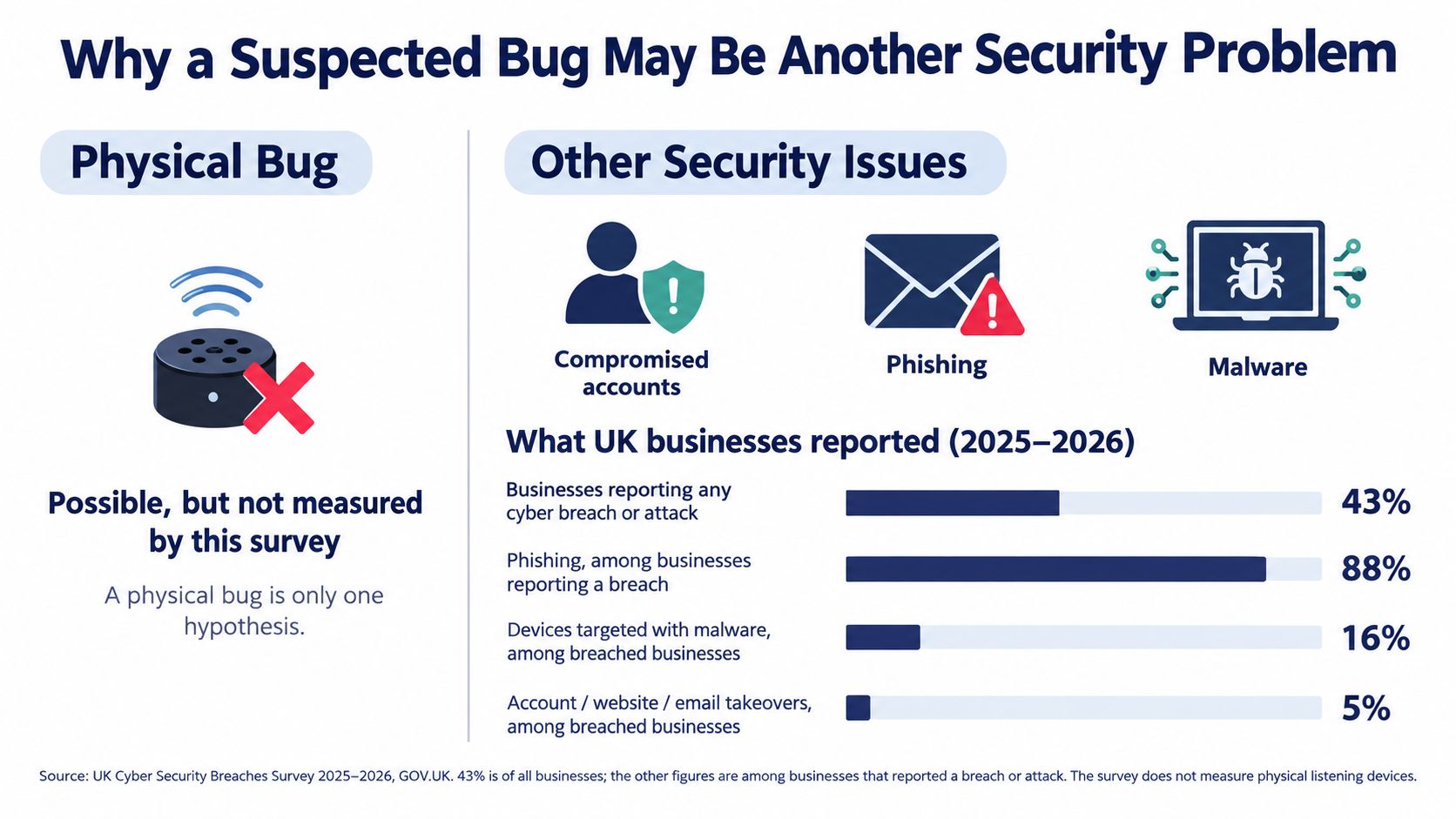
Match the investigation to the evidence
A physical TSCM assessment examines relevant spaces, equipment and communications environments for indicators of covert surveillance. A cyber investigation instead reviews digital access, devices and system records. Unfamiliar equipment may also be legitimate workplace technology, so staff should check its ownership and purpose before treating it as suspicious.
If information may have escaped through a business system, involve the appropriate IT or security personnel and ask them to preserve relevant logs and access records. Don't reset systems or remove equipment without advice, since that could erase useful context. For a useful overview of how organisations can consider both sides of the problem, see this security guidance for SMBs and schools.
Official oversight figures for state-authorised surveillance don't provide a nationwide count of privately suspected office bugs. The sensible conclusion is not that the risk is absent or widespread, but that a suspected workplace needs a site-specific assessment rather than a guess based on national figures. The oversight report describes lawful investigatory powers, not the prevalence of private workplace devices.
UK Legal and Privacy Considerations
In the UK, a covert office bug isn't treated as a separate legal technology just because it has a particular label. Under RIPA, the relevant questions include what is being monitored or recorded, whether the people affected know about it, whose property or communications are involved and who authorised or installed the equipment. The technology-neutral definition covers apparatus designed or adapted for surveillance. The Home Office code says that a relevant public authority needs authorisation for directed surveillance when it installs a device to covertly monitor, record, observe or listen to occupants of property.
That framework concerns the use of covert surveillance, not a shortcut for deciding whether a business has a device in its office. The facts and circumstances matter. Businesses should obtain legal advice on their own situation rather than treating a general explanation as a definitive opinion.
Treat recordings as sensitive personal information
The Information Commissioner's Office says covert workplace monitoring is unlikely to be justified in ordinary circumstances. It should be limited to a specific investigation into suspected criminal activity or equivalent gross misconduct, with senior-management authorisation, a data-protection impact assessment, strict limits on time and location, and an end point when the investigation concludes. The ICO's guidance on monitoring workers also stresses the need for care with workplace audio.
Audio monitoring should be rare, appropriately targeted and supported by clear notices except in exceptional circumstances. Employers should take particular care in spaces where workers reasonably expect privacy, such as toilets and changing rooms, and avoid capturing communications people expect to remain private, including personal emails. The ICO's guidance on complying with surveillance data-protection principles says continuous monitoring of particular individuals is likely to be justified only in the rarest circumstances.
A lawful inspection to identify possible covert surveillance is different from installing or operating a device to monitor staff. If an item is found, preserve its position and condition, note when it was discovered, restrict access to any recordings and seek specialist advice before powering, resetting or dismantling it. That approach helps protect both privacy and evidence.
Safe First Checks Before Calling Specialists
A safe first check is about gathering context, not taking suspected equipment apart. Start with the concern itself: what was observed, where, when and by whom? Write down facts plainly, and distinguish them from interpretations such as “someone must have planted a microphone”.
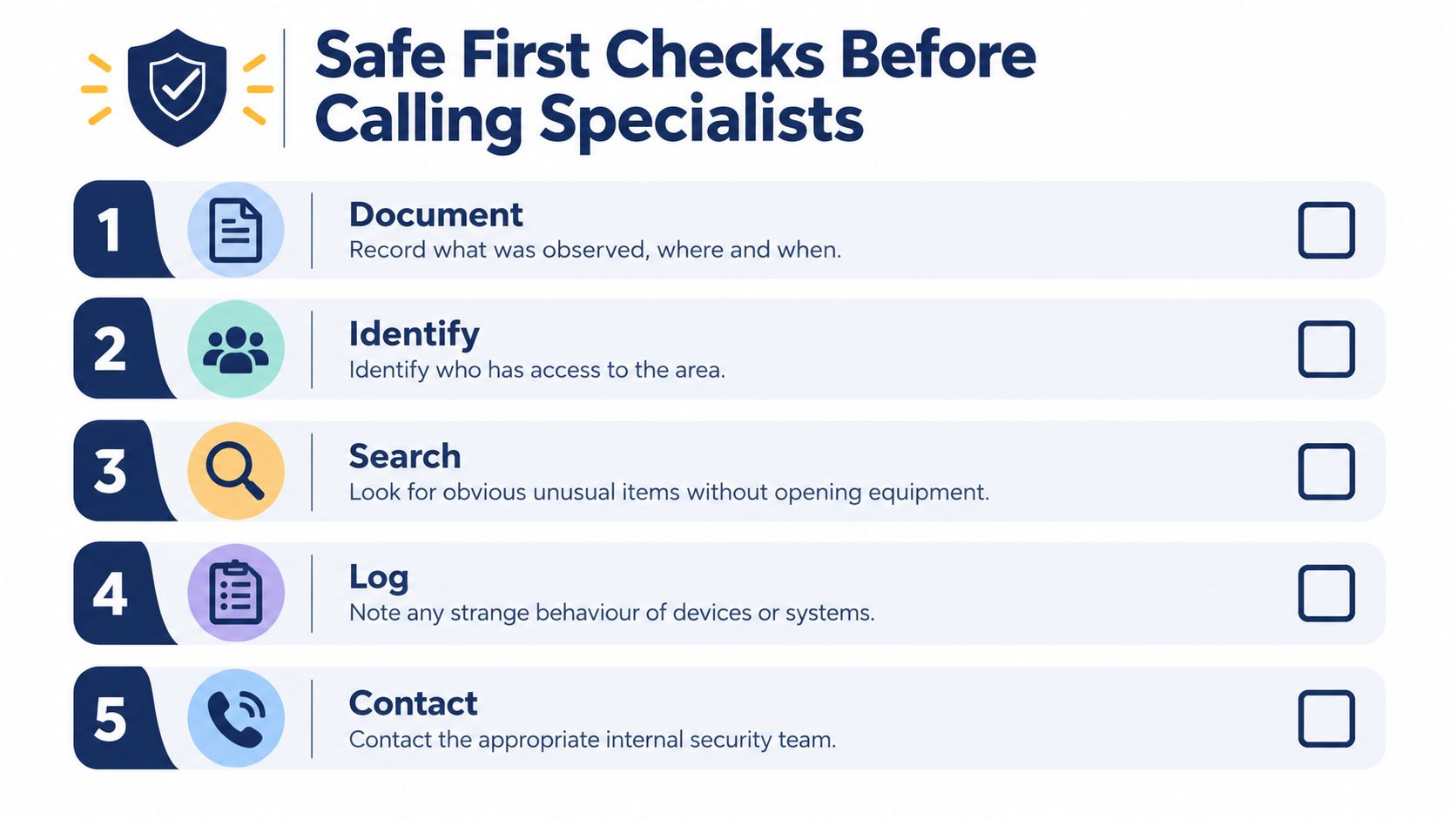
Then establish who controls the relevant environment. That might mean the office landlord, facilities team, meeting-room technology provider, vehicle manager or IT department. Limit discussion of sensitive matters while the concern is assessed, and preserve relevant access records, system logs and equipment histories where available.
Keep the scene and records intact
Document the observation. Note the location, date, time and what you saw without altering the item.
Identify authorised access. Check who controls the room, vehicle, network or equipment.
Preserve records. Ask the relevant internal team to retain logs and access information that may help explain what happened.
Avoid interference. Don't power off, reset, move, dismantle or confront anyone about a suspected item unless an appropriate specialist or adviser tells you to.
Choose proportionate help. Involve IT for a suspected digital incident and consider TSCM where the concern relates to physical surveillance.
A visual check can miss concealed equipment, while a consumer detector may produce results that are difficult to interpret. Neither a positive reading nor an absence of one proves whether a room has been compromised. Review RF detector limitations and law before relying on a consumer device as a substitute for professional assessment.
Where staff are checking rooms or equipment, they should also follow workplace safety procedures. Practical advice on electrical safety compliance for teams can help reinforce why equipment shouldn't be opened or disturbed casually. If the concern remains specific and credible after these checks, ask a specialist what scope of investigation is appropriate.
What a Professional TSCM Bug Sweep Involves
A professional TSCM inspection begins with a confidential discussion, not an assumption that a device will be found. The investigator needs to understand the concern, which locations or equipment may be relevant, who can provide access and what business operations need to continue. The scope can then be adapted to the site rather than based on a generic checklist.
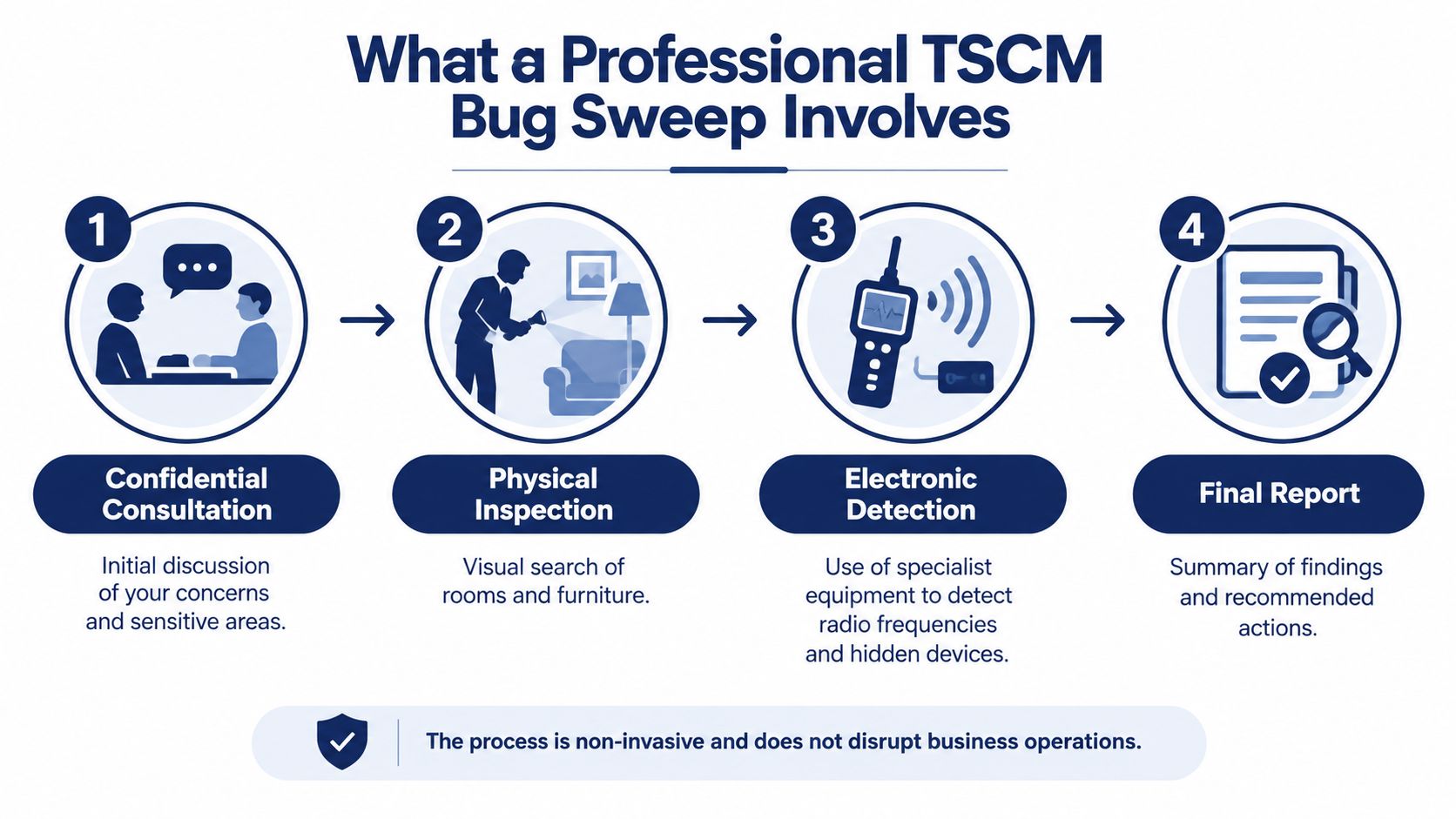
From consultation to findings
A visit may include a physical inspection of relevant rooms, furniture and equipment, followed by non-invasive technical examination suited to the concern. Depending on the site and scope, this can include checks of meeting areas, communications equipment, vehicles or access points. Sentry Private Investigators Ltd offers discreet enquiries and custom TSCM planning, inspection and reporting to help clients decide whether further legal, cyber security or law-enforcement advice is appropriate.
A report should distinguish observations from conclusions. If an object is unfamiliar, that fact alone doesn't establish that it's a surveillance device. Likewise, an online check or a generic description of bug-detection methods can't verify whether a specific office is clear. The assessment must relate to the site, the access arrangements and the concern under investigation.
The company is based in Birmingham and states coverage across the UK, including the West Midlands, London, Leicester, Manchester, Reading and Essex. Coverage, duration and cost should be confirmed during an enquiry, since they depend on the location and scope. Businesses can find out more about TSCM bug sweeping and discuss which areas need attention.
Choose the next step from the evidence: involve IT for a suspected account or system issue, seek legal advice for questions about monitoring or privacy, and consider a site-specific TSCM assessment when the concern points to physical surveillance. If there's credible evidence of deliberate criminal conduct, preserve it and seek appropriate legal or law-enforcement advice.
The right outcome may be a technical inspection, a cyber investigation, a policy review or a combination of those responses. Official oversight figures don't count privately suspected office bugs across the UK, so a TSCM assessment should be treated as an investigation of the particular site, not a conclusion drawn from a prevalence statistic. If a confidential conversation is the practical next step, ask about the concern, the locations involved and the appropriate scope before arranging any work.
Sentry Private Investigators Ltd offers discreet, site-specific TSCM assessments for businesses concerned about office bugging devices and other forms of covert surveillance. Visit Sentry Private Investigators Ltd to discuss your concern confidentially and find out whether a professional inspection is appropriate.