
Lie Detector Tests Birmingham

A partner's explanation keeps changing. Stock is missing, but nobody can pin down when it left. A disagreement with a neighbour has become a formal complaint, and every conversation makes the facts harder to separate from suspicion. If you're searching for lie detector tests in Birmingham, you're likely looking for a clear way to decide what to do next.
A polygraph can help structure a discussion, but it isn't a truth machine or a substitute for evidence. The practical question is whether testing fits your situation, what you need the result to inform, and whether a broader investigation would give you a more useful answer. Here's the UK-grounded view, without promises of certainty.
Why People in Birmingham Ask About Lie Detector Tests
People usually start looking for a lie detector test after trust has broken down or an unexplained problem has surfaced. At home, that might mean a partner's account of a particular evening doesn't add up. At work, it could be missing funds, stock discrepancies or a suspected breach of policy. A neighbour dispute may also prompt someone to seek a definitive answer, even when the underlying issue is better addressed through records, witnesses or legal advice.
It's understandable to want one clear result. But before booking a test, decide what you need to know and what you'll do with the answer. If the concern is about a specific incident, a focused examination may help clarify an account or prompt further disclosure. If you need to establish where someone went, who they met or what happened to company property, you may need evidence-gathering rather than a test.
The practical distinction: a polygraph records physiological reactions while a person answers questions. It doesn't directly detect lies.
The UK Government description of polygraph measurements says the instrument measures changes in heart rate, blood pressure, respiratory rate and sweating, comparing them with the person's normal rates. Those reactions can inform an examiner's interpretation, but they don't prove what happened.
A responsible adviser should explain that limitation before discussing a booking. For relationship concerns, private detective surveillance services may be more relevant if the question is about someone's movements or conduct rather than the truthfulness of a specific answer. For a workplace concern, records and a properly scoped internal investigation may be the better starting point.
This article sets out what a test can contribute in Birmingham, how the law treats it, and when to involve an investigator. The aim is to help you choose a proportionate next step, not to sell you certainty that no test can deliver.
How a Polygraph Actually Works
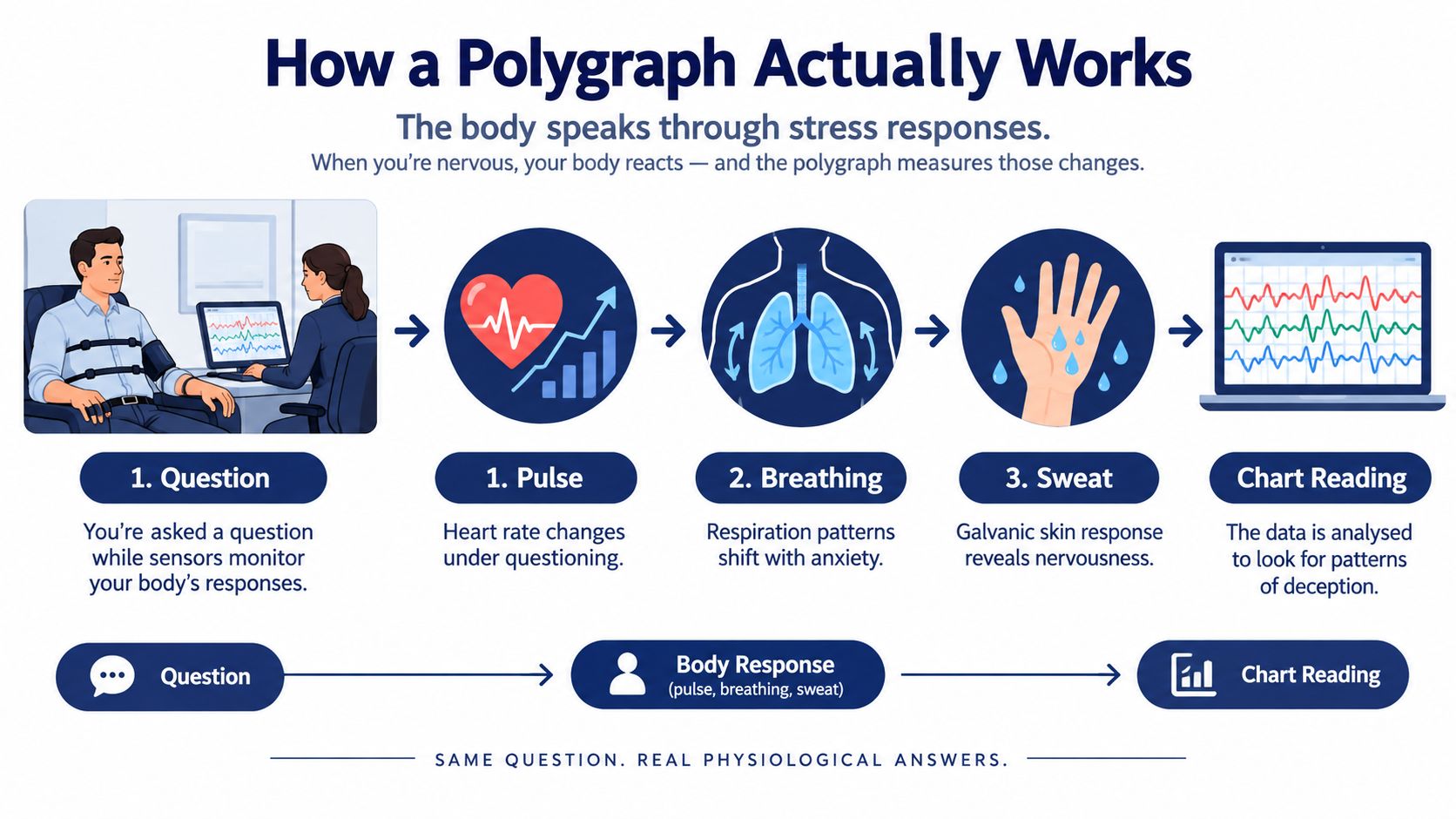
A polygraph examination combines sensors with a structured interview. Sensors record physiological activity, including changes in pulse, breathing and sweating, while the examiner asks questions. The examiner then reviews the recorded patterns in context. The chart isn't a direct readout of truth or deception; it's a record of bodily responses during questioning.
The examination usually starts before the sensors are used. The examiner discusses the issue, checks what the examinee understands and helps settle the questions that will be asked. That preparation matters: if a question is unclear, covers more than one issue or means something different to the examiner and examinee, the resulting chart is harder to interpret.
Why examiners compare different questions
A test may use neutral questions to establish how the person responds to ordinary, non-threatening material, then compare those responses with questions relevant to the matter being examined. Some formats also use comparison questions. In plain terms, these are designed to give the examiner another set of responses to consider alongside the relevant questions.
The exact structure depends on the method and referral question. A specific question about a defined incident is different from broad screening about someone's general conduct. The examiner needs to explain which format is being used and why it suits the case.
The chart reflects changes in recorded signals as the questions are asked. It doesn't label an answer “truth” or “lie”, and a single spike in a graph isn't a verdict. An examiner interprets the pattern using the testing method and the information gathered during the interview.
Questions and examiner judgement matter
A professional test depends on clear wording, an appropriate question set and a competent examiner. If the issue is too broad, or the questions are poorly framed, the examination may not answer what the client needs to know.
Treat the test as a structured conversation supported by sensors, not a machine that prints a final answer. Before agreeing to proceed, ask the provider to explain the process, the proposed questions and what the report will and won't conclude.
The UK Legal Position You Need to Understand
England and Wales have a limited statutory framework for polygraph testing. The Offender Management Act 2007 allows mandatory examinations as licence conditions for specified sexual offenders released from custody. The Domestic Abuse Act 2021 extends the regime to specified domestic-abuse perpetrators on licence. These statutory examinations are administered through HM Prison and Probation Service, not through ordinary private bookings.
For a private client, family or employer in Birmingham, the position is different. A private examination is consensual. It does not become a court-evidence procedure because a qualified examiner conducted it or produced a written report. Before arranging a test, decide what decision it's intended to inform and seek legal advice if the matter could lead to proceedings.
What legislation says about criminal proceedings
There's a specific restriction in Schedule 7, paragraph 12 of the National Security Act 2023. The provision says equipment used to measure and record physiological reactions during a polygraph session must be of a type approved by the Secretary of State. It also states that neither a statement made during the session nor the person's physiological reaction while being questioned may be used as evidence against that individual in proceedings for an offence. The legislation is available on legislation.gov.uk.
Mandatory examinations under the statutory licence-condition framework also restrict the use of statements made during those examinations in criminal proceedings against the offender. These provisions underline that polygraph testing has a defined operational role, not a general role as proof of guilt or innocence.
What this means for a private client
A test may help organise fact-finding, support a discussion or inform a personal decision. It doesn't, by itself, create proof a criminal court must accept. UK legal guidance on polygraph testing says results are generally not admitted in criminal proceedings, while consideration in civil, family, regulatory or employment settings depends on the rules and discretion of the relevant court or tribunal.
If a legal decision is at stake, speak to a solicitor before booking. The right next step may be preserving documents, gathering witness accounts or commissioning a wider investigation, rather than asking a test to carry more weight than it can.
How Accurate Lie Detector Tests Really Are
A polygraph isn't infallible, and an accuracy figure isn't a guarantee that a particular person's result will be right. A UK government factsheet, citing a review, puts deception-detection performance at approximately 80–90% of cases. UK research summaries also report roughly 80–90% for trained examiners, compared with around 50–60% for unaided people such as detectives, and note a residual 10–20% error rate. The government factsheet provides the evidence summary.
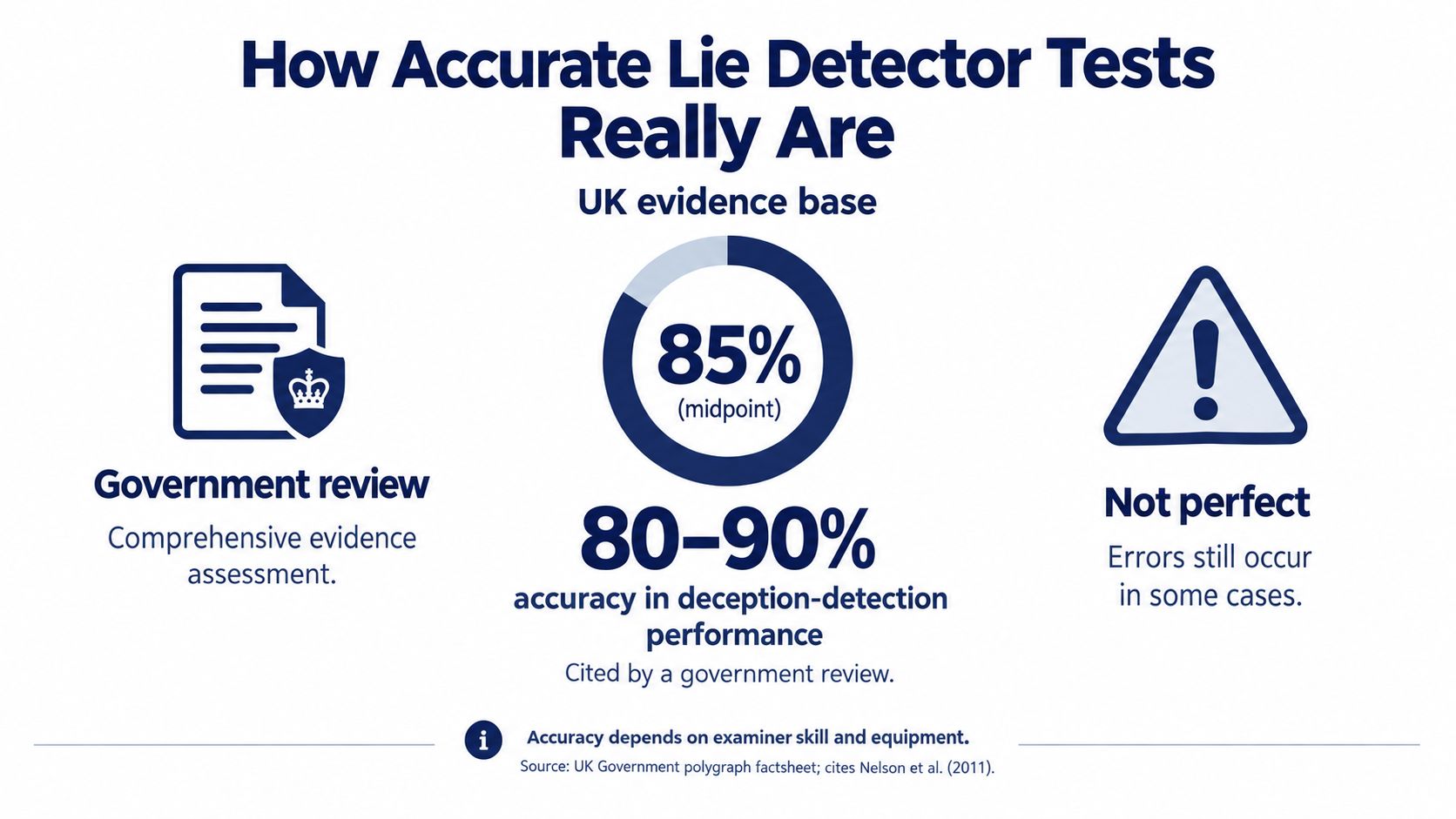
Those ranges describe performance across cases, not certainty in an individual examination. A result may be wrong, and the consequences of relying on it can be serious. For a partner, it might influence whether a relationship continues. For an employer, it could affect how a staff concern is handled. For a dispute that may reach a court or tribunal, the result could be given little or no weight.
Why one headline figure isn't enough
The Parliamentary Office of Science and Technology explains that polygraphs measure physiological responses rather than deception directly. Accuracy varies with the question format, examiner competence, context and the possibility of countermeasures. Evidence is stronger for examinations about a specific event than for broad population screening, and comparison-question testing can produce false positives.
That's why a figure in a provider's advert isn't enough to judge whether an examination is suitable. Ask what method the examiner uses, how questions are selected and how the report handles uncertainty. A responsible examiner should be willing to explain that the outcome is an indicator, not proof.
The investigator's rule
Treat the result as one investigative signal to corroborate. Check whether it aligns with other material, such as records, communications, witness accounts or independently gathered observations. If it conflicts with other evidence, don't force the evidence to fit the chart.
The test's value comes from how it contributes to a wider assessment. It may prompt a new question or help focus further enquiries. It should never be the sole basis for a serious accusation or a legal decision.
What a Polygraph Can and Cannot Do in Real Cases
A polygraph is most useful when the question is specific and the result will guide a sensible next step. It's much less useful when someone expects it to prove a crime, replace an investigation or settle a dispute by itself. In Birmingham, the practical distinction depends on what you're trying to establish.
Scenario | What a Polygraph Can Do | What It Cannot Do on Its Own |
|---|---|---|
Suspected infidelity | Structure a conversation about a defined allegation and potentially prompt disclosure. | Establish someone's movements, prove an affair or replace relevant communications and surveillance evidence. |
Workplace theft | Help focus an interview about a specific suspected incident. | Identify who took property, establish a loss or replace stock records, access logs and witness accounts. |
Suspected fraud | Provide an investigative lead about a clearly framed question. | Prove criminal intent or replace financial documents, transaction records and legal investigation. |
Family or neighbour dispute | Help clarify a particular account where participation is voluntary. | Determine legal responsibility or guarantee the result will be accepted in family or civil proceedings. |
Pre-employment concern | Address a specific, relevant question if a voluntary test is appropriate. | Provide a reliable general measure of character or substitute for references and checks. |
Match the method to the evidence you need
If you suspect employee theft, start by preserving stock records, access information, relevant communications and witness accounts. If the concern is infidelity, first clarify whether you need to test a particular account or establish a pattern of behaviour. Those are different questions and call for different evidence.
For financial concerns, review records and transaction documentation. For a dispute involving events or movements, relevant witness statements, surveillance footage or vehicle-tracking data may help, where the approach is lawful and proportionate. A polygraph can help direct those enquiries, but it doesn't collect this material for you.
UK guidance says polygraph evidence is generally not admitted in criminal proceedings, and its treatment in civil, family, regulatory or employment contexts depends on the relevant forum's rules and discretion. If you're dealing with an accusation you believe is false, this guide to defending against false accusations from Brian Hansford Law may help you consider the legal issues. Get advice from a solicitor about your own circumstances.
Practical rule: Decide what evidence would answer the question before deciding whether to test someone.
A test can be part of a responsible fact-finding plan. It can't replace that plan.
How to Choose a Reputable Birmingham Polygraph Provider
Choose the examiner as carefully as you choose the test. Private polygraph practice in England and Wales doesn't have a single statutory regulator, so clients need to ask direct questions and assess the answers. A provider who promises certainty or treats a chart as self-explanatory is giving you a reason to pause.
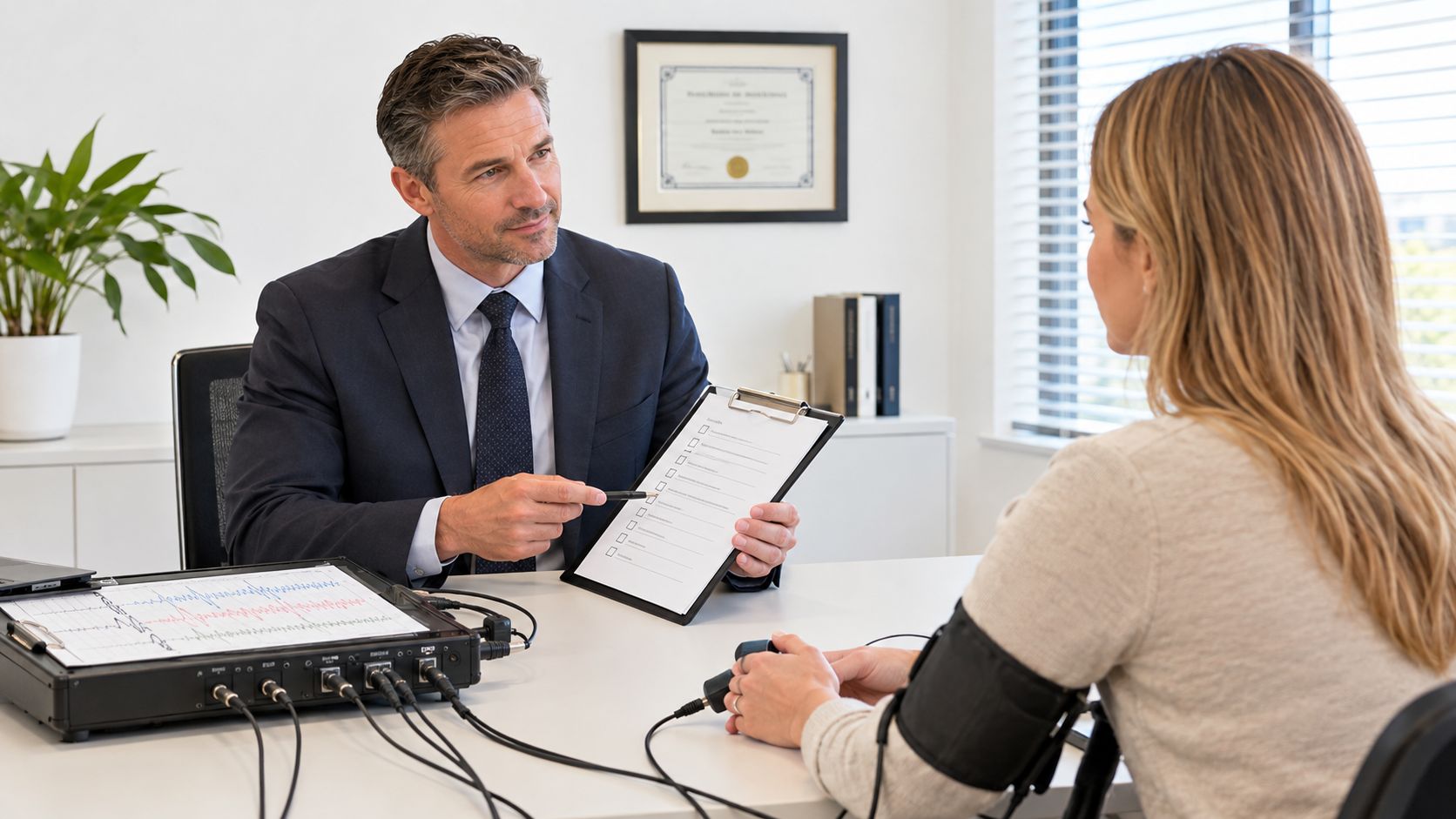
Before you agree to book, ask:
Training and experience: What training and relevant experience does the examiner have, and can they explain the method they use?
Equipment and method: What type of polygraph equipment is used, and how does the chosen method suit your question?
Pre-test interview: Will the examiner discuss the case and assess whether the proposed examination is appropriate before testing?
Question wording: Can you review and understand the questions before the examination begins?
Data handling: How will the examination data and personal information be stored, accessed and retained?
Written report: What will the report contain, and will it explain the limits of the result?
Limitations: Is the examiner willing to discuss false positives, false negatives and uncertainty plainly?
Red flags in a provider's answer
Be cautious if someone guarantees an outcome, refuses to discuss accuracy, skips the pre-test discussion or offers a result without explaining how it was reached. A provider should also be clear about the fee, what it includes and whether the report is part of the service.
Compare providers on process, not on the strength of their claims. A clear explanation of the method and its limits is more useful than confident language that promises a definitive answer. If the examiner can't explain how the test fits your case, don't proceed until you have a satisfactory answer.
When to Bring in a Birmingham Private Investigator Instead
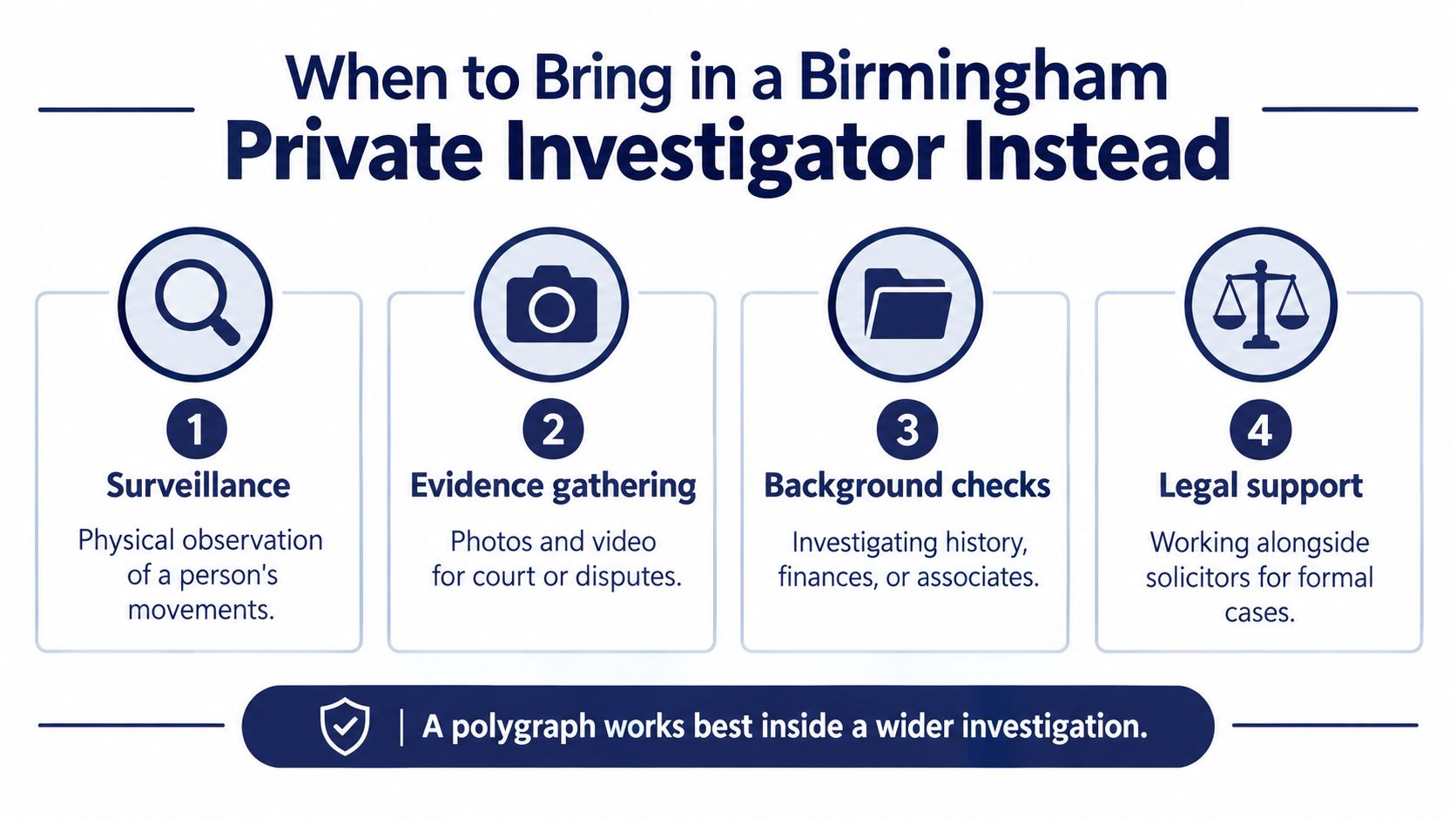
A polygraph answers one narrow question: does this person's account produce a physiological response consistent with deception? The moment your problem needs proof rather than a pointer, the test stops being the right tool. Surveillance, tracing and document gathering are what establish what someone is doing, what happened and what the records show.
The UK trial evidence supports this limited role. Polygraph-tested offenders disclosed information relevant to supervision more often than people in comparison areas, 70% compared with 14%, according to evidence cited by Parliament in this UK case study summary. The test prompted disclosure. The disclosed information still had to be assessed and followed up by people doing investigative work.
Signs the issue has moved beyond a stand-alone test
There's an alleged crime: Preserve relevant material and get legal advice. A test doesn't replace proper evidence gathering.
A workplace problem is ongoing: An investigator can examine the underlying conduct and gather material for an internal process.
A custody or financial dispute is involved: Ask your solicitor what evidence is needed and what investigative work is appropriate.
The decision has legal consequences: Clarify the purpose with your lawyer before relying on any test result.
A wider investigation may involve covert surveillance, GPS vehicle tracking, people tracing, background checks, TSCM bug sweeping, witness interviews and documentary evidence. Which of those apply depends on the issue, the law and the outcome you need, so set a clear scope before commissioning anything.
My advice is simple. If you already know a test result would leave the core question unanswered, skip the polygraph and go straight to a scoped investigation. Sentry Private Investigators Ltd is based in Birmingham's St Paul's Square and covers the West Midlands, including Coventry, Wolverhampton and Worcester, as well as wider UK locations. A Private investigator Birmingham can tell you whether your matter needs testing, evidence gathering or both, before you spend money on the wrong one.
Next Steps and Common Questions About Birmingham Lie Detector Tests
When you contact an investigator, describe the allegation plainly, identify who's involved, explain the outcome you need and mention any deadline, such as a court date or HR hearing. The first conversation should be confidential and focused on whether a test or a broader investigation fits the problem.
What does a test cost? Fees vary with the examiner, location, case preparation and whether a written report is included. Compare what each quote covers and check PI prices for investigation services.
Do both parties need to consent? A private examination is consensual. Don't assume someone can be compelled to take one.
How long does it take? The appointment includes discussion and question preparation as well as testing. Ask the provider how long the examination and written report will take for your case.
Sentry Private Investigators Ltd can assess whether a polygraph, surveillance or a broader investigation is the right fit for your Birmingham matter. Share the facts and any time constraints with Sentry Private Investigators Ltd to discuss a discreet, practical next step.