
Process Server UK Cost: A Complete Pricing Guide

UK process-server fees are usually quoted, not regulated, and a straightforward local first attempt often starts around £75 to £150 before urgency, distance, and repeat attendances push it higher. If you need service that has to land inside a civil-court deadline, you're paying for timing, evidence, and follow-through, not just a delivery run.
A solicitor chasing a defended money claim knows the pressure already. The papers are ready, the clock is moving, and the court will care far more about valid service than about the cheapest headline number.
What a Process Server Does and Why the UK Cost Varies So Much
A defended claim can stall fast if service is handled badly. A solicitor might have the right bundle, the right defendant, and the right address, but if the papers aren't served properly, the court won't treat the job as finished.
A process server does more than hand over documents. In practice, they identify the right person or address, attend in person, attempt service under the correct procedure, record the date, time, method, and outcome, then prepare the certificate of service the court expects. That is why the work sits inside formal civil procedure, not ordinary courier work, and why the price should reflect the legal consequences of getting it right.
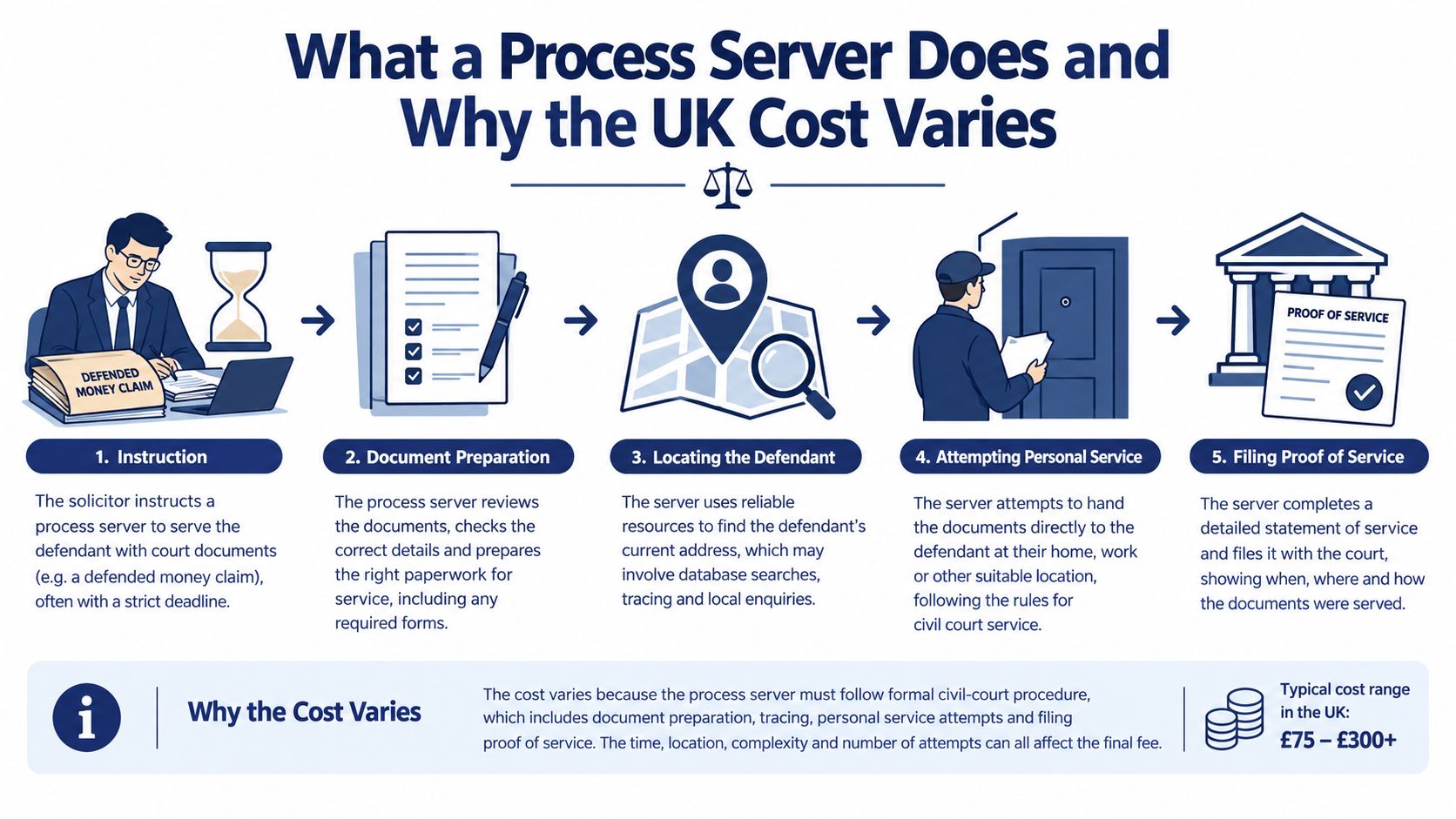
What you are really paying for
The biggest mistake buyers make is comparing a process-server quote to a parcel-delivery fee. The actual job is a mixture of attendance, procedure, and proof. That's why one instruction can be inexpensive and another, with the same provider, can need more time, more return visits, and better evidence.
Component | What it covers | Where extra cost arises |
|---|---|---|
Base attendance | A first visit to the address and an attempt at service | Urgent booking, out-of-hours attendance, or longer waiting time |
Locating the recipient | Checking the defendant's likely address or presence | Tracing work or confirming a moved address |
Personal service attempt | Direct handover where the rules require it | Repeat visits when the recipient is evasive |
Proof of service | Written evidence for the court | More detailed statements, sealing, or court-facing paperwork |
Follow-up reporting | Updating the instructing solicitor or client | Extra attendances, failed attempts, or special directions |
Practical rule: if a quote doesn't say how many attempts are included, it's not a proper quote yet.
A useful comparison is the way pricing for WordPress help is often broken into scope, add-ons, and support levels. The same logic applies here, a clean headline number means very little unless you know what it includes.
For a plain-language overview of the role itself, see process serving explained for UK businesses. That sits alongside the broader litigation-support work a solicitor needs, not separate from it.
The Five Factors That Drive Process Server UK Cost
The price moves for five reasons, and only five reasons matter most in practice. If you can spot which of these is driving the quote, you can usually tell whether the number is fair or padded.
1. Service method changes the job
Personal service costs more than postal delivery or DX because someone has to attend and make the handover. If the rules or the court direction demand face-to-face service, the provider has to plan around the recipient's location and availability, which means more time on task and more risk of failure.
2. Location affects travel and time
A local instruction is different from a rural one, and both are different again from an address that sits far from the server's base. Travel time, mileage, parking, and waiting all sit inside the price even when they aren't labelled clearly.
3. Urgency pushes the quote up
Same-day and next-day instructions are expensive because they disrupt route planning and compress the available working window. If a defendant needs serving before a deadline, the server has less room to schedule a second attempt, which usually means the provider has to charge for speed as well as attendance.
If the address is difficult and the deadline is close, you're not buying a visit, you're buying a slot in a crowded schedule.
4. Attempts are the hidden cost driver
An evasive defendant turns a one-stop job into a multi-visit instruction. That's where quotes often diverge, because one provider may price a single attendance while another includes multiple attempts, evening call-backs, or a final return after a missed contact window.
5. Evidence quality changes the workload
A basic attendance note is one thing. A court-ready statement explaining why service failed, or showing how service was completed, is more detailed and more valuable. The provider has to write for the court, not just for internal records, and that takes time.
An example from marketing services is plans for sharing portfolios and menus, where the visible price only makes sense once you know what's bundled in. Process serving works the same way, except the stakes are procedural rather than promotional.
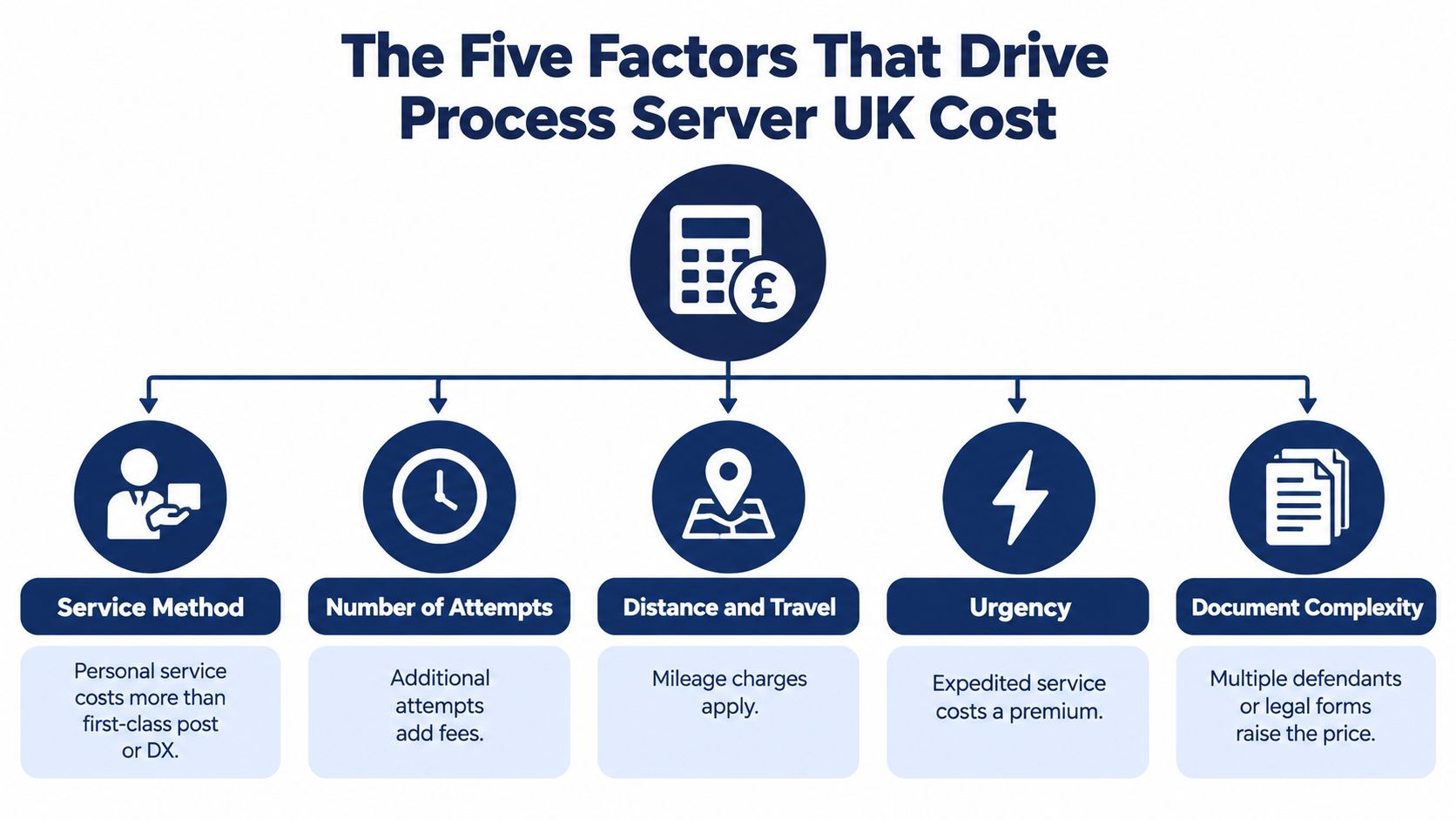
Factor | What it means in practice | Typical effect on cost |
|---|---|---|
Service method | Personal service, postal service, or DX | Personal attendance usually costs more |
Number of attempts | One visit or repeated call-backs | More attempts increase the fee |
Distance and travel | Local, regional, or longer-distance work | Mileage and time add to the quote |
Urgency | Standard, next-day, same-day, weekend | Faster turnaround commands a premium |
Document complexity | Single document or a more involved instruction | More paperwork and more evidence raise the price |
Typical UK Process Server Price Ranges in 2026
You should not expect a national tariff, because there isn't one. You should expect a quote that reflects the instruction type, and you should judge it by what's included, not by the cheapest number on the page.
Instruction type | Typical starting band | Main cost driver |
|---|---|---|
Straightforward local first attempt | £75 to £150 | One attendance, modest travel, limited follow-up |
Regional or longer-distance instruction | £150 to £250 | Travel time, mileage, and scheduling |
Urgent same-day or weekend service | £175 to £300+ | Priority booking and out-of-hours work |
Evasive defendant with multiple attempts | £200+ | Repeated attendances and stronger evidence |
Higher-risk or formal-proof instruction | Quote-based | Detailed reporting and court-facing proof |
A lower quote is not automatically better. If it leaves out repeat attempts, travel, waiting time, or the final certificate, the apparent saving can disappear quickly once the job gets difficult.
A helpful rule is to separate the private fee from any court-administered charge. The court's own fee structure sits in a different category from the process server's work, so a true comparison only works when you strip the quote down to the server's actual attendance and reporting.
For clients comparing wider service packages in a different sector, what website packages include is a useful reminder that headline prices often hide scope gaps. The same logic applies here, especially when a solicitor is comparing more than one litigation-support provider.
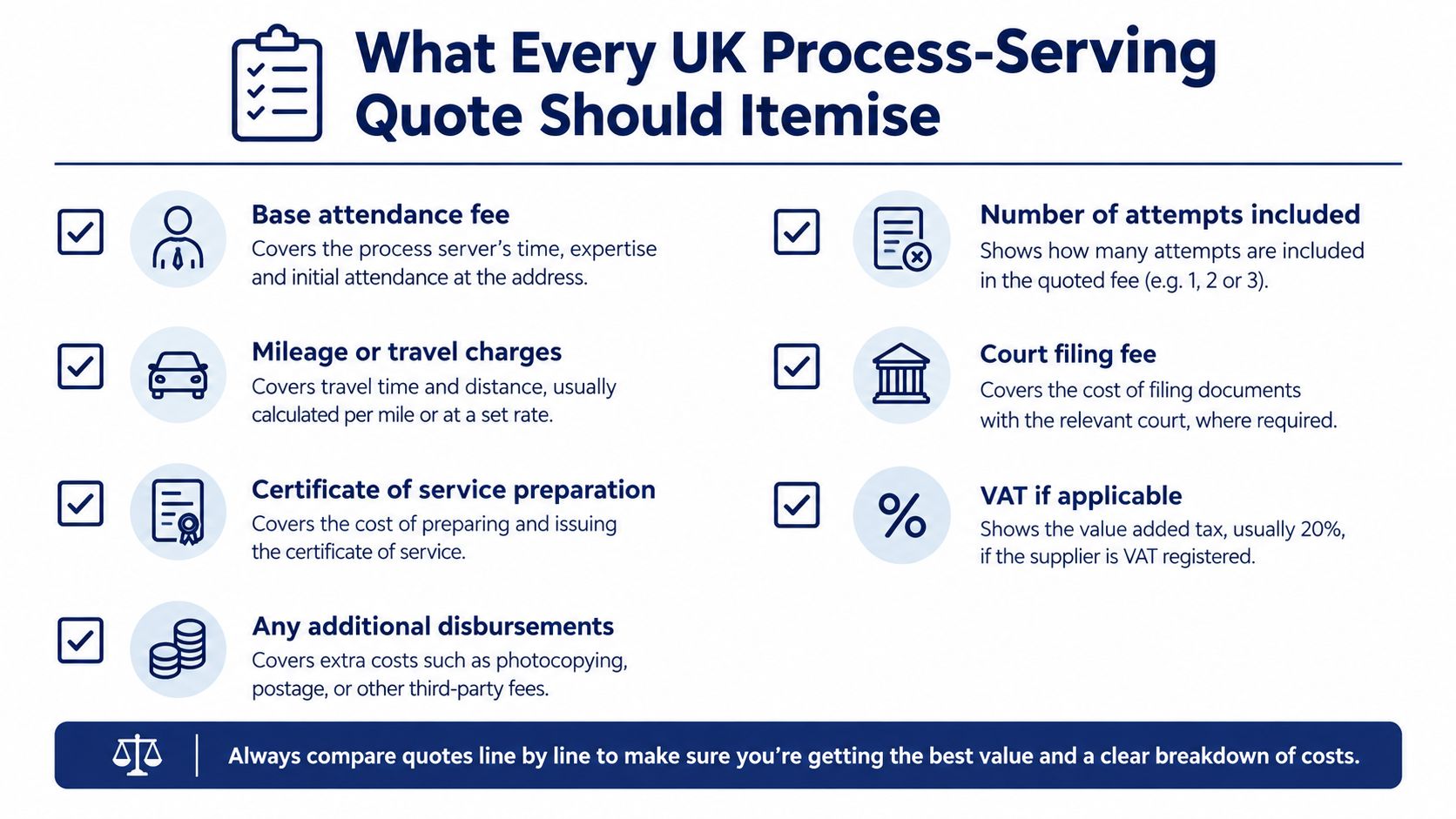
What Every UK Process-Serving Quote Should Itemise
A reputable quote should read like a schedule of work, not a vague promise to “attempt service”. If the provider can't show where the money goes, the client can't compare it properly.
The line items that should be visible
Look for these items in writing:
Base attendance fee, the first visit and initial attempt.
Number of attempts included, so you know whether one, two, or more visits are covered.
Mileage or travel charges, especially for rural or longer-distance work.
Waiting time, where the recipient is likely to arrive or leave unpredictably.
Evening and weekend surcharges, if the instruction can't be done in normal hours.
Address-tracing work, where the recipient may have moved.
Document handling, printing, bundling, collection, or delivery of papers.
Certificate or affidavit of service, the final proof the court may need.
A cheap headline price usually means one of two things, either the job is very simple or something is missing from the quote.
A proper quotation should also say whether it is fixed or estimated. If a third or fourth attempt becomes necessary, the provider should tell you what happens next instead of springing on extra charges after the fact.
A legal or compliance service that is itemised well makes comparison easier. That's a standard worth insisting on here too, because process serving is only cheap when the instruction is simple and the paperwork is already in order.
How CPR Deadlines Shape the Cost of Service
The Civil Procedure Rules decide more than most clients realise. They govern the service method, the response window, and the pressure on the server to complete the job inside a tight procedural timetable.
The claimant must complete the required step for the chosen method of service before midnight on the calendar day four months after the claim form's issue date, under Civil Procedure Rule 7.5. That deadline alone explains why late instructions cost more, because fewer working days remain and there's less room for failed attendance. Under the Ministry of Justice guidance, the defendant normally has 14 days to respond after the claim form and response pack are served, and in King's Bench Division claims there is a 14-day acknowledgement period, or 28 days to respond where particulars are served separately.
The practical effect is simple, a late instruction is a more expensive instruction. If a claimant leaves service to the edge of the four-month window, the provider may have to prioritise the job, attend at awkward times, and document everything carefully enough for the court file.
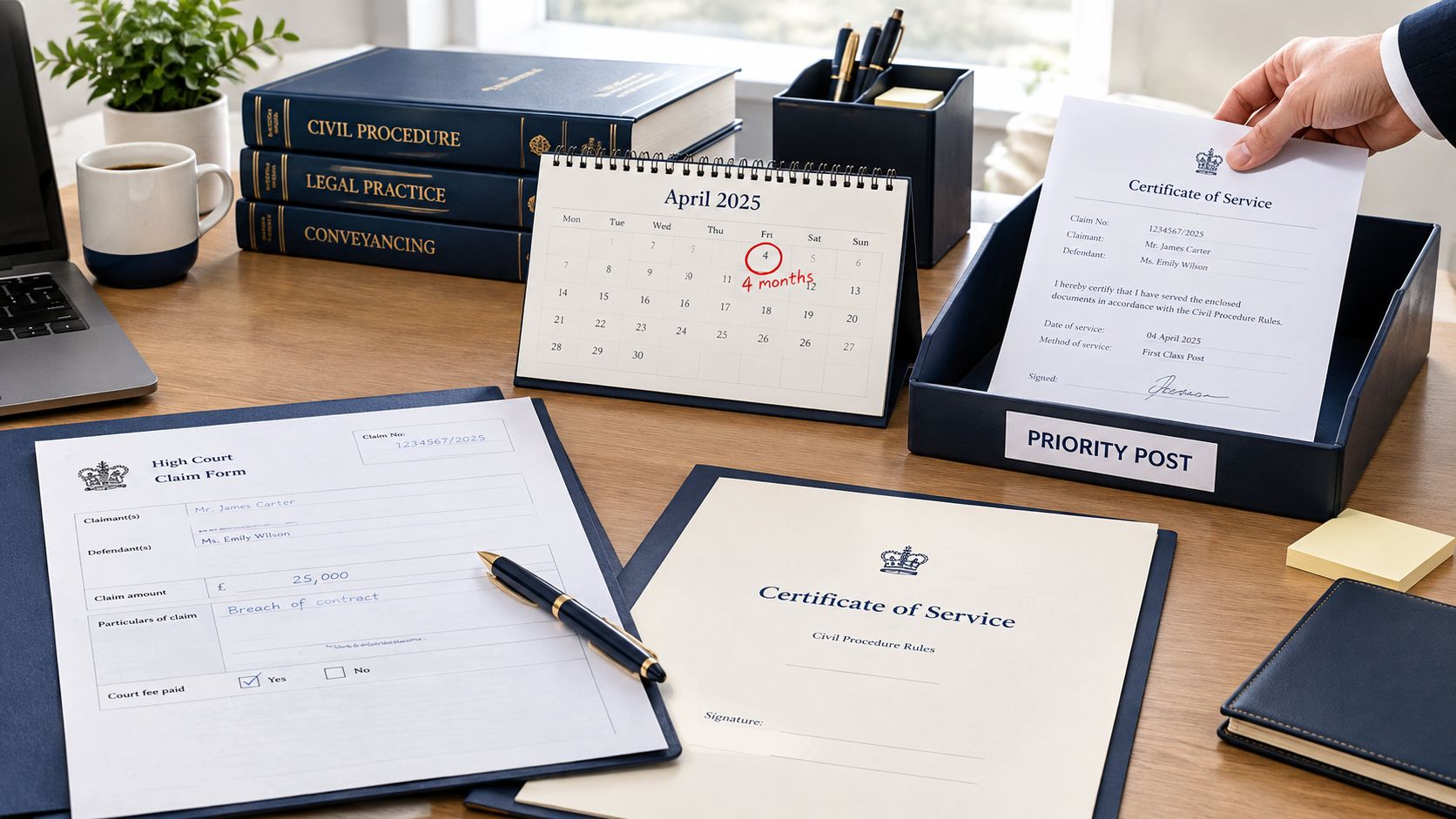
The point is not just speed, it's defensible proof. If the certificate is weak, incomplete, or late, the claimant can end up paying again for more service work or an application tied to defective service. That's why a process server's reporting quality matters as much as the attendance itself.
For the procedural background, the process serving legal requirements guide is the right place to start before you assume a simple delivery will do.
Matching the Service Package to Your Type of Claim
A money claim, an injunction, and a family document do not need the same service package. Treating them the same is how clients buy the wrong level of support and then discover the court wanted something more specific.
A straightforward money claim usually calls for standard personal service, sensible attendance timing, and a clean certificate. If the defendant is evasive, the instruction needs more than one visit and stronger reporting. A company service instruction often centres on the registered office, but the evidence still has to show who was served, when, and how the documents were delivered.
Family and cross-border matters are different again. They can require more formal proof, stricter timing, and in some cases translation or transmission work that sits outside a basic quote. An injunction or committal application can justify faster attendance because the court timetable is tighter and the consequences of delay are heavier.
A practical way to think about it is this:
Money claim, standard personal service, one or more attempts, ordinary proof.
Injunction, urgent attendance, strong evidence, rapid confirmation back to the instructing solicitor.
Family document, method depends on the procedural route, proof has to match the rule set.
Company service, service at the proper office or address, with written confirmation.
Cross-border matter, more formal handling, additional paperwork, and possible external costs.
The right package is the one that matches the document and the court direction, not the one with the lowest sticker price.
That's also why a provider's fee card should never be the final word. The same paper bundle can demand a different approach depending on the claim type, the recipient, and the deadline.
How to Choose a UK Process Server You Can Trust
Start with evidence of competence, not sales language. A provider should be willing to give you a written, itemised quote, explain the method they'll use, and tell you what proof you'll receive at the end.
Look for professional indemnity insurance, ICO registration, and real familiarity with CPR Part 6 evidence. Ask who signs the certificate, whether the same person handles the attendance and the paperwork, and how quickly they report after service or a failed attempt. If the matter is high value, sensitive, or cross-border, ask for references and confirm the turnaround in writing.
The phrases that make me wary are the easy ones, like “nationwide coverage” or “cheapest in the UK”. Those lines tell you almost nothing about attempts, reporting quality, or whether the fee covers the job after the first missed visit.
If you need support beyond a single service attempt, private detective services can also be relevant where tracing, surveillance, or address confirmation sits alongside litigation support. Sentry Private Investigators Ltd, based in Birmingham and working across the UK, handles process serving and related investigative work with the kind of documentation a solicitor can use.
If you need a process server who understands court deadlines, evasive recipients, and the difference between a cheap attempt and a usable certificate of service, speak to Sentry Private Investigators Ltd. We handle process serving and litigation-support instructions for clients who need clear pricing, proper reporting, and reliable attendance, and we'll tell you exactly what's included before you instruct us.