
Finding Address with Phone Number: UK PI Guide

Many people ask the wrong question when they want to find an address with a phone number. The underlying issue isn't whether a free site can spit out a name, it's whether that result is current, lawful, and safe to act on. In the UK, a phone number is often just a lead, and sometimes not even that.
A genuine tracing enquiry starts with evidence, not hope. Free reverse lookup tools can be outdated, incomplete, or plain wrong, and spoofing means the number you see can be deliberately misleading. That's why a professional approach matters, especially when the result could affect a debt case, a family matter, or a personal safety concern.
The Myth of the Instant Reverse Phone Lookup
A phone number rarely gives you a current address on its own. In the UK, that assumption causes more trouble than expected. Ofcom's numbering analysis shows the UK moved to an 11-digit numbering scheme from the 1980s onward, with separate ranges for mobile and non-geographic services, while the ICO treats phone numbers and addresses as personal data when they relate to a living person. Ofcom's numbering analysis and the ICO's guidance on personal data and reverse searches make that plain.
That is why many consumer sites are poor evidence tools. They often recycle partial records, stale listings, or old addresses that have nothing to do with where someone lives now. Acting on that kind of output can point you toward the wrong household, or expose the wrong person to unwanted contact.
Why the shortcut fails in practice
Scraped data is not verified data. A technical example of bulk collection, how Craigslist contact scraping works, shows how contact details can be gathered at scale, but collection alone does not prove identity, occupancy, or current residence. That gap is where reverse lookups go wrong.
Practical rule: if a site gives you a neat answer too quickly, treat it as a lead, not a finding.
For anyone doing a finding address with phone number search, the safer approach is to ask what the number proves. A professional check turns a clue into evidence by testing it against other records, not by accepting the first result a website returns.
A structured identity review, like the practical UK background check guide, shows how much corroboration a single phone number needs before it counts as evidence.
Why Phone Numbers Rarely Reveal Current Addresses
A number can look specific, but in UK telecoms it often carries far less location value than people assume. Ofcom's numbering data separates geographic numbers from mobile ranges like 071–075 and 077–079, and from non-geographic ranges such as 0843–0845, 0870–0873, and 090–091. A landline may suggest a broad historical area, but it does not prove where someone lives now. The same is even more true for mobile and non-geographic numbers. Ofcom's numbering data and analysis supports that distinction.
Spoofing, withheld CLI, and why the screen can mislead you
Caller ID is not a guarantee of identity. Ofcom identifies spoofing as the use of a telephone number that hides the caller's actual identity, and it explains that withheld CLI can block the display of a number altogether. A displayed number may be genuine, routed through another network path, or deliberately faked. Ofcom's CLI guidance and Ofcom's note on spoofing risks both make that clear.
The practical problem goes beyond nuisance calls. Ofcom's qualitative research on telephone numbering used focus groups and in-depth interviews across all four UK nations, and it examined how people read location into geographic numbers. That is the trap. People overread what a number means.
The same caution applies to call metadata. Ofcom's nuisance-call research records details such as date, time, duration, subject, and caller description, which helps with triage but does not prove identity. A phone number can support a trace, but it cannot stand in for a verified address.
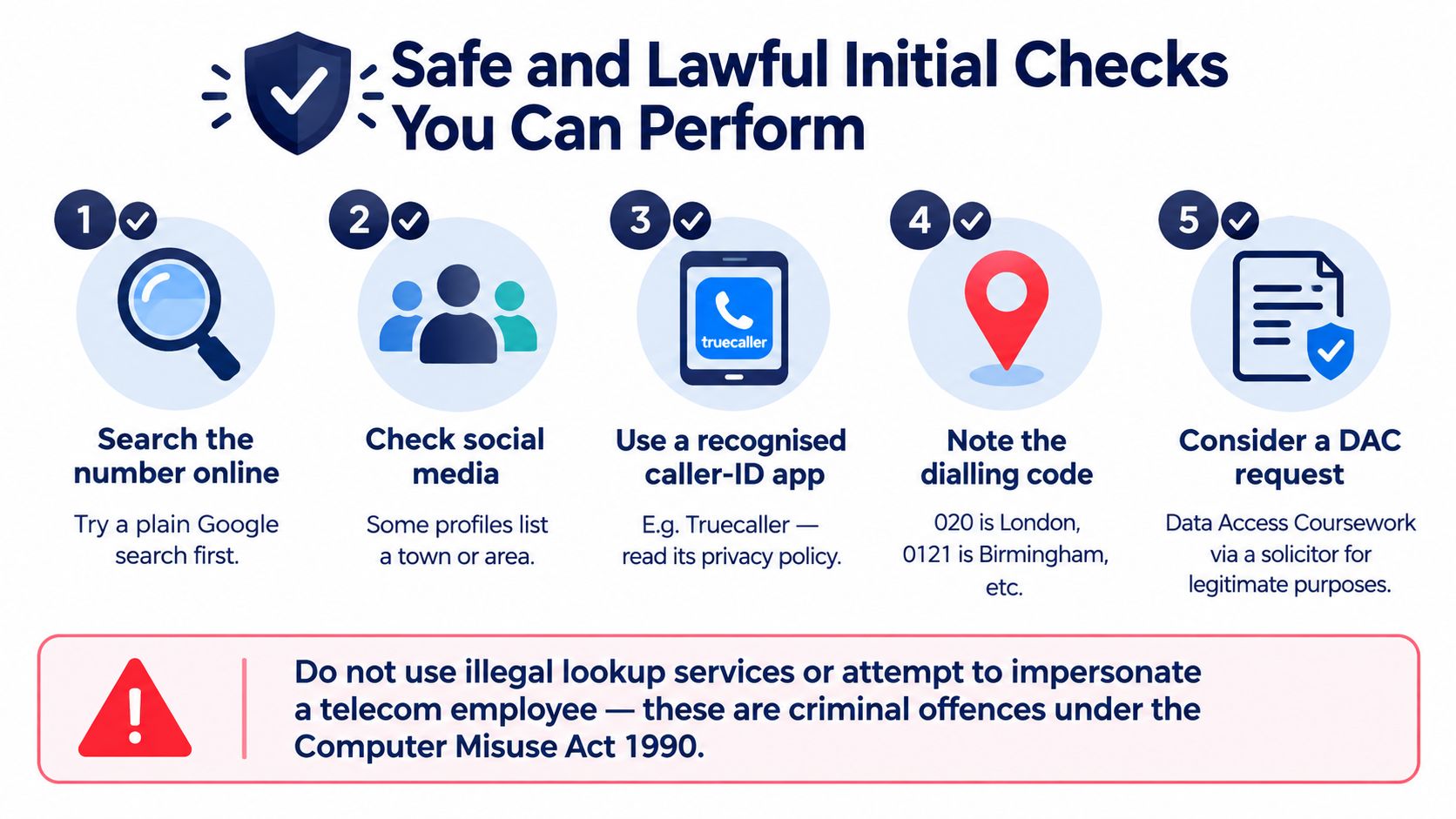
Safe and Lawful Initial Checks You Can Perform
Start with the call itself, not a search engine. Save the number exactly as shown, note the date and time, keep any voicemail or message text, and record whether the caller ID was hidden, repeated, or inconsistent. That basic discipline gives you something reliable to work from if the matter later needs escalation.
Next, test the number in places where it might legitimately appear. Public business listings, company websites, and the context of the message can tell you whether the number belongs to a firm, a service desk, or a private line. A plain search can be useful if you treat the result as context rather than proof.
Use the number to triage, not to accuse.
For open-source verification techniques, turn open data into evidence is a solid reminder that data only becomes useful when you compare sources carefully and keep the chain of reasoning intact. The same principle applies to a phone number. One trace result means very little until it lines up with a second, independent identifier.
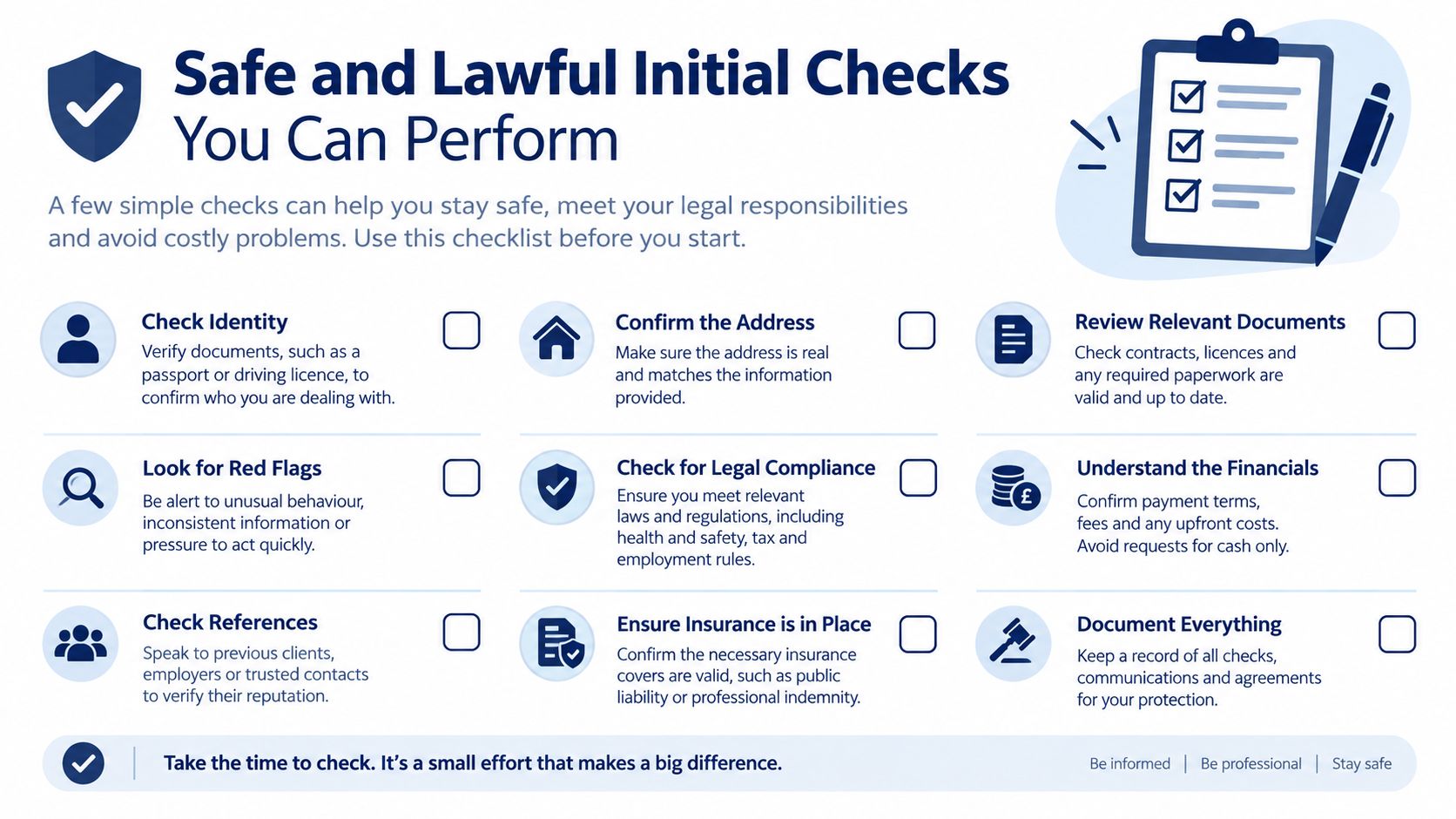
A few behaviours should stay off the table entirely.
Do not ring back aggressively. You may tip off a scammer or contact the wrong household.
Do not impersonate a telecoms employee. That crosses a legal line fast.
Do not use unregulated data brokers blindly. If the record is stale, the risk lands on you.
Do not publish the result. A suspected address can expose someone to harassment.
Do not rely on a single match. Without a second identifier, you've only found a lead.
A safe initial check tells you whether the number looks like a scam, a wrong dial, or a trace that needs professional handling. It doesn't give you permission to act as though the result is confirmed.
Consumer Data Brokers Versus Professional Tracing Agents
Paid lookup sites and professional tracing are not the same service, even if both claim to identify a caller. Consumer brokers usually package whatever they can gather from open sources and older datasets, which can produce a tidy-looking answer without showing that it is current. A professional trace starts with the number, tests the context, and then verifies the candidate against other lawful identifiers.
Feature | Consumer Data Broker | Professional Tracing Agent |
|---|---|---|
Data quality | Often mixed, recycled, or partial | Corroborated across multiple lawful sources |
Output | Usually a best guess | Verified address lead or confirmed result |
Legal usefulness | Often weak for formal action | Better suited to defensible next steps |
Risk of error | Higher, especially with spoofed numbers | Lower, because mismatches are checked |
Method | Search and aggregate | Validate, compare, document |
Handling of doubt | Usually hidden | Recorded and disclosed |
Best use | Early curiosity | Formal decision-making |
That difference matters in real disputes. A broker's report can push someone toward the wrong confrontation, but it is not the same as evidence. A professional tracing agent checks whether the number is mobile, landline, VoIP, withheld, or spoofed, and refuses to treat a first-hit database match as final.
The issue is whether the result can survive scrutiny. A site can return an address that looks precise and still fail the basic tests that matter if you need to rely on it later. The UK tracing agents page explains the service category, but the method is what separates a usable trace from a risky guess.
A clean result that cannot be defended is still a weak result.
For clients who need something usable, not just searchable, professional tracing is the safer route.
When to Instruct a Private Investigator for Address Tracing
Some cases are straightforward enough for a basic check. Others are not. If the address might be used for debt recovery, family proceedings, process serving, or a dispute that could escalate, the standard for evidence goes up immediately.
Situations that usually need professional help
Trace debtor work is one of the clearest examples. A business or landlord often needs more than a guessed address, because the next step may involve formal contact or legal action. The same applies when someone is trying to locate an estranged spouse, partner, or family member and doesn't want to make a bad situation worse.
Suspicious contact can also point to deeper issues. Repeated nuisance calls, stalking concerns, or suspected cohabitation linked to relationship or insurance matters are all situations where a phone number is only the starting point. In a corporate setting, that number may be tied to malicious calls, internal leaks, or attempted espionage.
The Private investigator services page covers the wider service range, which is relevant because address tracing rarely sits in isolation. It often sits alongside surveillance, background checks, or other forms of discrete enquiry.
Why professional handling changes the outcome
A PI doesn't just search harder. A competent investigator documents the number, classifies it, preserves call records, and tests it against other identifiers before reporting anything back. That protects the client from acting on the wrong person's details, which is especially important in emotionally charged cases.
For personal matters, that caution can prevent confrontation. For business matters, it can prevent wasted time and weak evidence. In both settings, the point is the same, a number can justify an enquiry, but it should not justify a conclusion.
Securing Verified Results Through Expert Investigation
The safest decision is usually the most disciplined one. If the number looks suspicious, keep the logs and stop there until you know whether it's worth tracing. If the result matters for debt, family, fraud, or safety, move from casual lookup to proper verification.
Before you enquire, gather the basics, the exact number, any message text, call timestamps, voicemail details, and anything else that shows how the contact happened. That gives the investigator a better starting point and reduces the chance of chasing a recycled or spoofed number. Sentry Private Investigators Ltd works from Birmingham and operates across locations including London, Leicester, and Manchester, so support is accessible whether the matter is local or further afield.
If you need a verified answer rather than a guess, Sentry Private Investigators Ltd can assess the number, preserve the evidence, and advise on the next lawful step. For a discreet conversation about your situation, visit Sentry Private Investigators Ltd and make an enquiry with the details you already have.