
Corporate Surveillance Services in the UK

Corporate surveillance services are external covert investigations commissioned by UK businesses to evidence specific misconduct such as fraudulent absence, theft, moonlighting or corporate espionage. They're lawful only when narrowly scoped, senior-authorised and proportionate.
A managing director usually reaches this decision after something inside the business has stopped making sense. A long-term sickness claim doesn't fit the employee's apparent activities. Stock keeps disappearing from a controlled area. A trusted member of staff appears to be working for a competitor during paid hours. The question isn't just whether an investigator can follow someone. It's whether the business can obtain relevant evidence without creating a larger legal and employee-relations problem.
What Corporate Surveillance Services Actually Involve
Take a warehouse business facing repeated stock losses. Internal records show that items leave the premises, but the audit trail doesn't identify who removes them. Managers suspect an employee, yet acting on suspicion alone could expose the company to an unfair disciplinary process. A properly commissioned investigation defines the allegation, identifies the relevant shifts and locations, and gathers observations that can be tested against access records, rota information and stock movements.
That's the practical meaning of corporate surveillance services. An investigator may conduct discreet mobile or static observation, record time-stamped photographs or video, and document what was seen without adding assumptions. The resulting file should help decision-makers answer a narrow question, such as whether an employee attended another workplace during certified absence, rather than inviting unrestricted scrutiny of the person's private life.
Businesses typically commission this work through a managing director, HR director, legal adviser, insurer or fraud-response team. The assignment may concern fraudulent workplace injury claims, suspicious absence, workplace theft, cash-handling concerns, moonlighting, conflicts of interest or information leakage. It's different from hiring a private investigator with an open-ended instruction to “find out what they're doing”.
The service is an evidence exercise
A credible brief connects four things:
The allegation: What conduct is suspected, and what information supports that suspicion?
The objective: What fact must the investigation establish or disprove?
The method: Why is covert observation necessary, and what less intrusive evidence has been considered?
The endpoint: When will the operation stop, and who will review the material?
The corporate investigations approach should therefore combine fieldwork with planning, privacy controls and evidence management. Surveillance may show that a person attended a location, carried out an activity or met another individual. It won't automatically prove dishonesty, breach of contract, criminal intent or financial loss. Those conclusions require corroboration and careful interpretation.
Commercial point: Footage is only useful if the business can explain why it was collected, what it shows, what it doesn't show and how the original file has been preserved.
That distinction protects the employer as well as the subject. A targeted investigation can resolve a difficult employment issue. Poorly controlled monitoring can damage trust, prompt a complaint and leave the company with evidence that is difficult to defend.
The Three Main Types of Corporate Surveillance
Most assignments fall into three connected categories. The right choice depends on the allegation, the available records and the evidence gap the business needs to close.
Physical covert surveillance
Physical surveillance observes people, vehicles, premises or relevant third parties from lawful positions. Investigators may use static observation near a location, mobile coverage while a subject travels, or a combination of both. Still images and video can establish movements, timings, meetings and activities that are directly relevant to the allegation.
This method is often suitable for suspected fraudulent absence, an alleged false injury restriction, workplace theft or moonlighting. It can show what happened in the physical world. It can't, on its own, prove who authorised a payment, who used a login or why a person took a particular action.
GPS vehicle tracking
GPS tracking can help a business understand the use of company or pool vehicles where there's a legitimate business reason. Fleet, logistics and field-sales operations may need to verify routes, unexplained mileage, unapproved stops or vehicle use outside work. The business must still establish an appropriate lawful basis, explain routine monitoring where required and restrict the data to the operational purpose.
A vehicle location record is not a substitute for observation. It may show where a vehicle was, but not necessarily who drove it, what happened at the destination or whether the journey breached a contractual obligation. Treat it as one timeline that needs to be matched with vehicle allocation, attendance data and other records.
Digital monitoring review
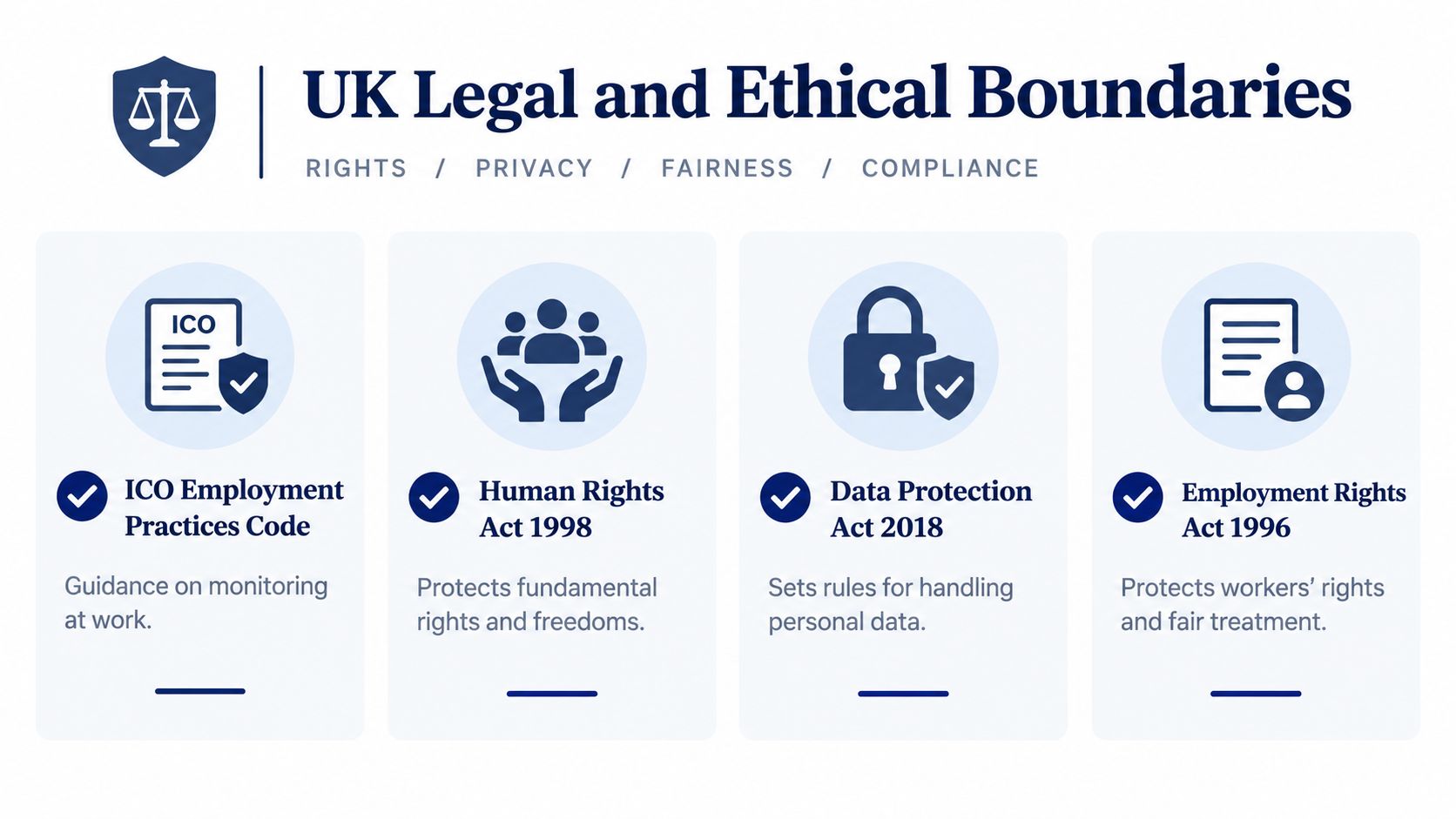
Digital monitoring review examines information the employer is lawfully entitled to access, such as relevant email records, internet-use logs, access-control information, device activity or communications metadata. The ICO treats workplace monitoring as broader than cameras, and its guidance covers telephone logs, email, internet activity, video surveillance and tracking workers' whereabouts through the employment practices code quick guide.
Digital review is particularly important in insider-risk cases. It may identify unusual access patterns, account use outside expected hours or communications connected to a conflict of interest. It still needs a defined scope. Searching everything because a manager feels uneasy is neither an efficient investigation nor a defensible monitoring strategy.
The same discipline applies to the working environment itself. If the concern is an unauthorised listening device or compromised meeting room, a business may need specialist TSCM services, rather than employee surveillance. That's a different evidence question and should be treated as one.
Digital records can be persuasive when they're relevant, complete and lawfully obtained. They become a liability when the business can't identify the authority for access, the collection period or the person who handled the material.
UK Legal and Ethical Boundaries Every Employer Must Respect
Routine workplace monitoring should normally be transparent. Government guidance on monitoring staff at work says workers should be told that monitoring takes place and why, for example through an email, staff handbook or contract. The ICO similarly says employees should normally understand the nature, extent and reasons for monitoring.
Covert monitoring is the exception, not the standard operating model. It may be considered where the employer suspects workers are breaking the law, telling them would make detection difficult, and the monitoring forms part of a specific investigation. It should stop when that investigation ends.
Four conditions should be satisfied before covert work begins
There must be a legitimate suspicion. The employer needs more than rumour or a personality clash. The suspicion should relate to criminal activity, gross misconduct or another sufficiently serious concern, and the brief should record the information that created it.
The scope must be proportionate. Define the subject, conduct, locations, timeframe and evidence required. Don't collect unrelated information about family members, neighbours or private activities. The ICO says covert monitoring should be limited to the shortest practicable period and a defined evidential purpose.
Senior management must authorise the operation. The ICO says covert monitoring should normally receive senior approval and be preceded by a Data Protection Impact Assessment. The assessment should document necessity, risks, safeguards, access, retention and the reason less intrusive methods aren't enough.
There must be a clear endpoint. An investigation shouldn't become continuous observation just because the original concern hasn't been resolved quickly. Stop when the evidential purpose has been met, the suspicion is disproved or the agreed scope expires.
The National Protective Security Authority guidance on investigating employees of concern recommends safeguards such as using traffic data rather than message contents where possible, carrying out spot-checks instead of continuous monitoring and automating monitoring where that reduces exposure to irrelevant information. Those controls reflect a straightforward principle. Gather what the case requires, not everything the technology makes available.
Personal devices, audio or video recording and screenshots are particularly sensitive. In the ICO's commissioned survey of 1,012 UK adults aged 18 and over, conducted between 1 and 3 August 2023, 70% said employer monitoring would feel intrusive, while only 19% said they'd feel comfortable taking a new job knowing monitoring occurred. Among respondents who reported monitoring by a current or former employer, timekeeping or access monitoring was the most common category at 40%, followed by monitoring emails, files, calls or messages at 25%. Screenshots or webcam footage were reported least often, at 10%. These findings are set out in the ICO workplace monitoring guidance announcement.
Personal-device monitoring was considered intrusive by 83% of respondents, audio or video recording by 78%, and screenshots or webcam footage by 77%, according to the same ICO research. Excessive monitoring can lead to an ICO complaint, employment-tribunal action or a separate data-protection dispute. It can also undermine the credibility of the evidence the employer hoped to obtain.
For businesses handling leave, absence and health information, an accessible resource such as LeaveWizard on employee data GDPR can help explain the data-protection context. It doesn't replace a case-specific DPIA or legal advice, but it reinforces why sensitive employee data needs a clear purpose, restricted access and controlled retention.
Where Corporate Surveillance Delivers the Strongest Results
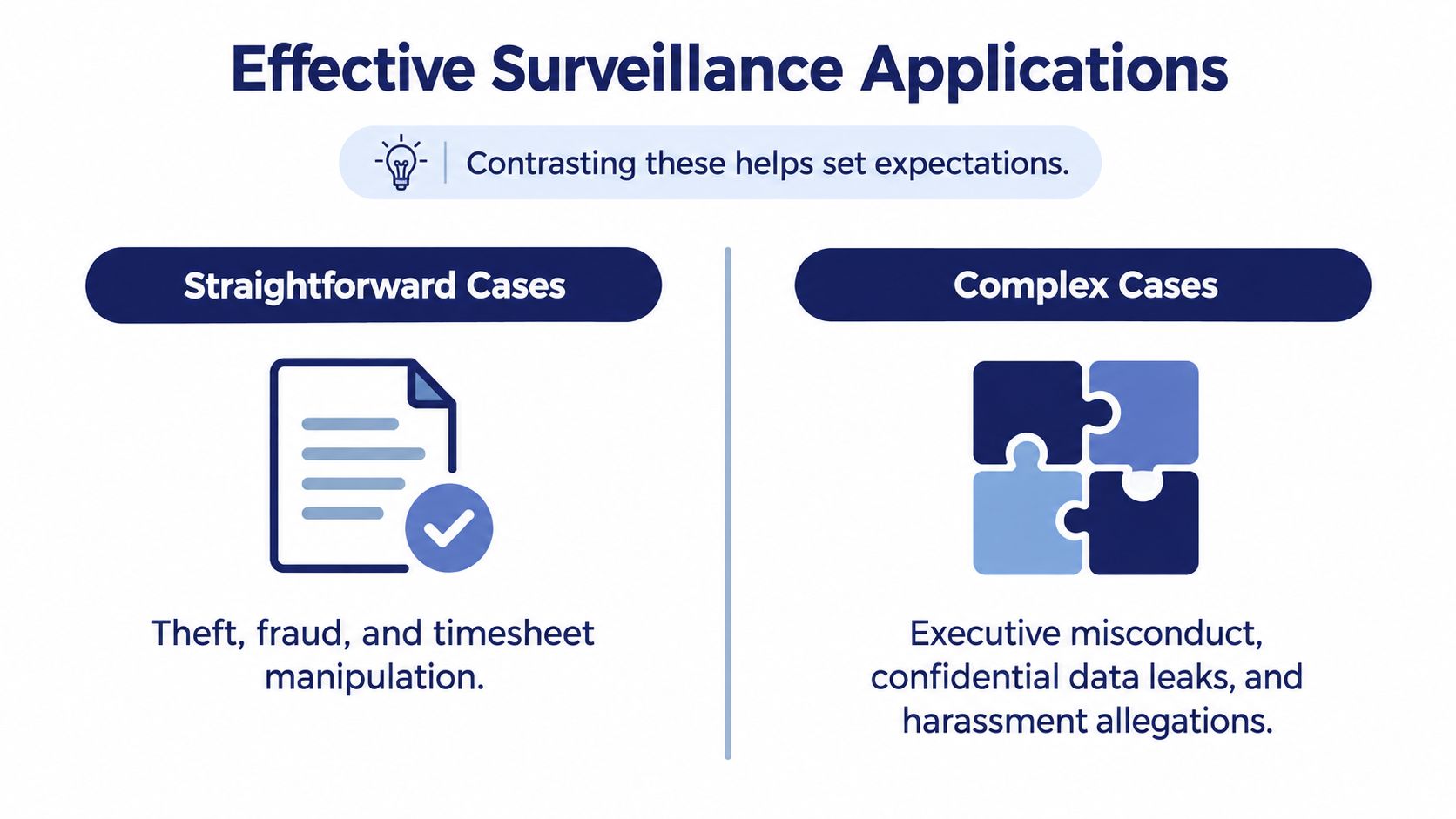
Surveillance works best when the suspected conduct is observable and the business can identify the evidence gap. It's less effective when management wants an investigator to prove a broad conclusion without defining the underlying facts.
Absence and injury claims
A prolonged absence case may involve an employee who says they can't carry out particular tasks but appears to perform similar work elsewhere. Observation can document activities, timings and physical movements. The employer should compare those observations with medical restrictions, absence records, rota data and the employee's own statements. Surveillance doesn't diagnose a medical condition, and investigators shouldn't present it as medical proof.
Fraudulent workplace injury claims need the same care. A video clip may show a movement that appears inconsistent with a claim, but context matters. The proper output is a factual record for HR, an insurer or legal advisers, not an investigator's unsupported conclusion about dishonesty.
Theft, stock loss and cash irregularities
Physical observation can be paired with stock counts, access logs, till records, delivery notes and CCTV already held by the business. A pattern becomes stronger when independent systems align. An observation of a person entering a restricted area is relevant, but it doesn't automatically establish that they removed stock or caused the loss.
Moonlighting and competitive conflicts
Unauthorised second jobs are usually easier to investigate when the contract, working hours and business conflict are clear. Timed observation, company-vehicle records and lawful review of relevant public information may show that an employee is working elsewhere during paid hours or using company resources for a competing activity.
The commercial issue is not only that someone holds another position. It could involve a contract breach, misuse of confidential data, conflicting obligations, or dishonest time tracking. The brief must clarify which point is critical.
Corporate espionage and information leakage
Information leakage is more complex because physical surveillance rarely proves the complete chain. Observation may show meetings, unusual visits or contact with a competitor. It won't establish what data was accessed, whether credentials were shared or the value of the information. That requires IT preservation, access analysis, document review and carefully sequenced interviews.
The UK Economic Crime Survey 2024 found that 27% of businesses with employees, approximately 389,000 organisations, experienced fraud during the preceding 12 months. Among affected businesses, 74% experienced more than one incident, with a mean of 16 incidents. The figures appear in the UK Economic Crime Survey 2024. The Office for National Statistics also reports a Home Office estimate of £5.2 billion as the business cost of fraud in the year ending March 2024, with fake-invoice fraud affecting 11% of businesses and mandate fraud affecting 7%.
Those figures support a practical conclusion. A suspected incident may point to a wider control failure, so surveillance should feed into a broader fraud response rather than close the case by itself.
How Investigators Build an Admissible Evidence File
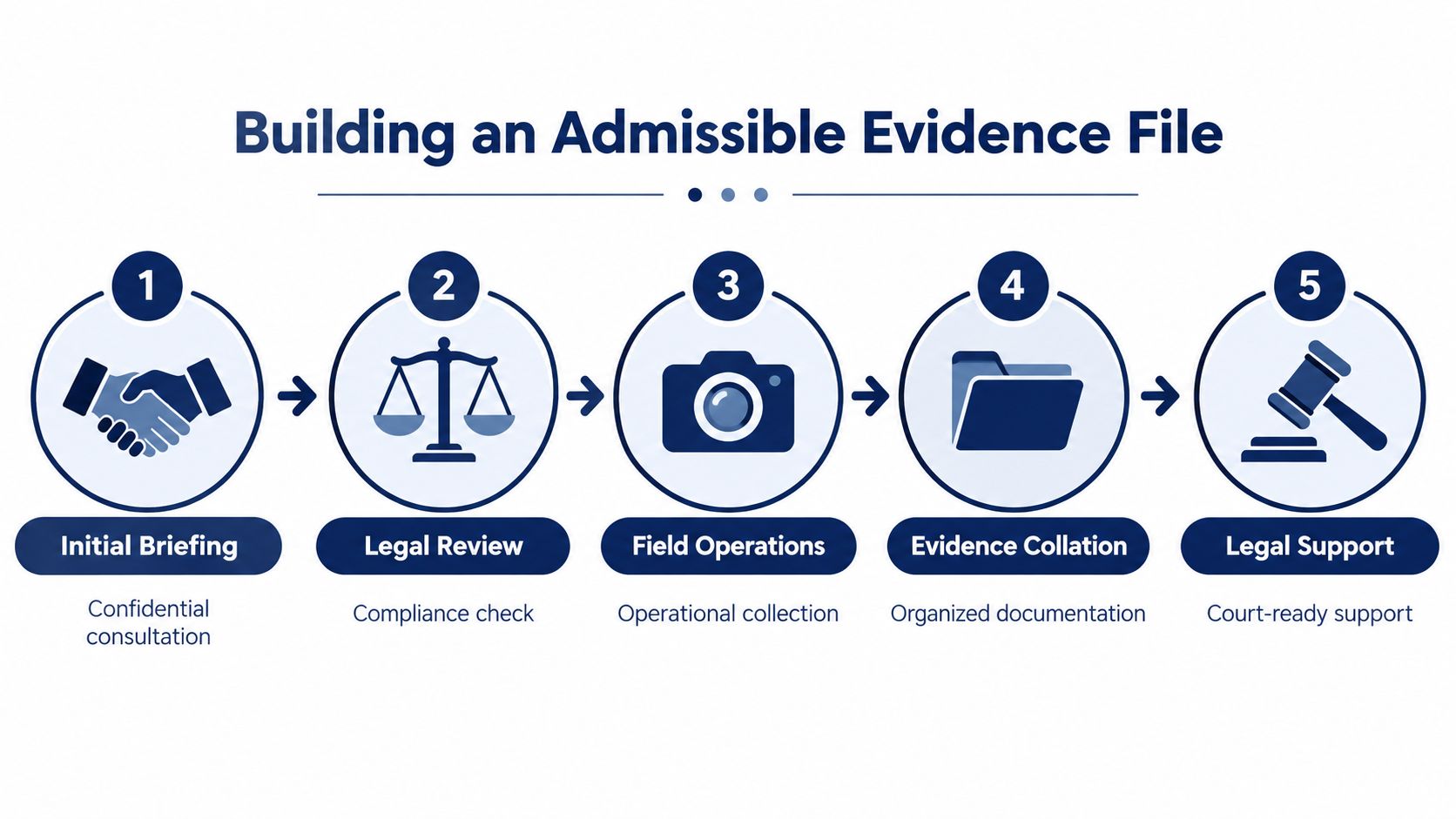
A professional assignment starts before anyone goes into the field. The investigator should take a confidential account of the allegation, identify the decision-maker, record the known facts and establish what the business needs to prove or disprove. If workplace monitoring is involved, the commissioning process should also address the DPIA, lawful basis, retention and access controls.
The operational sequence
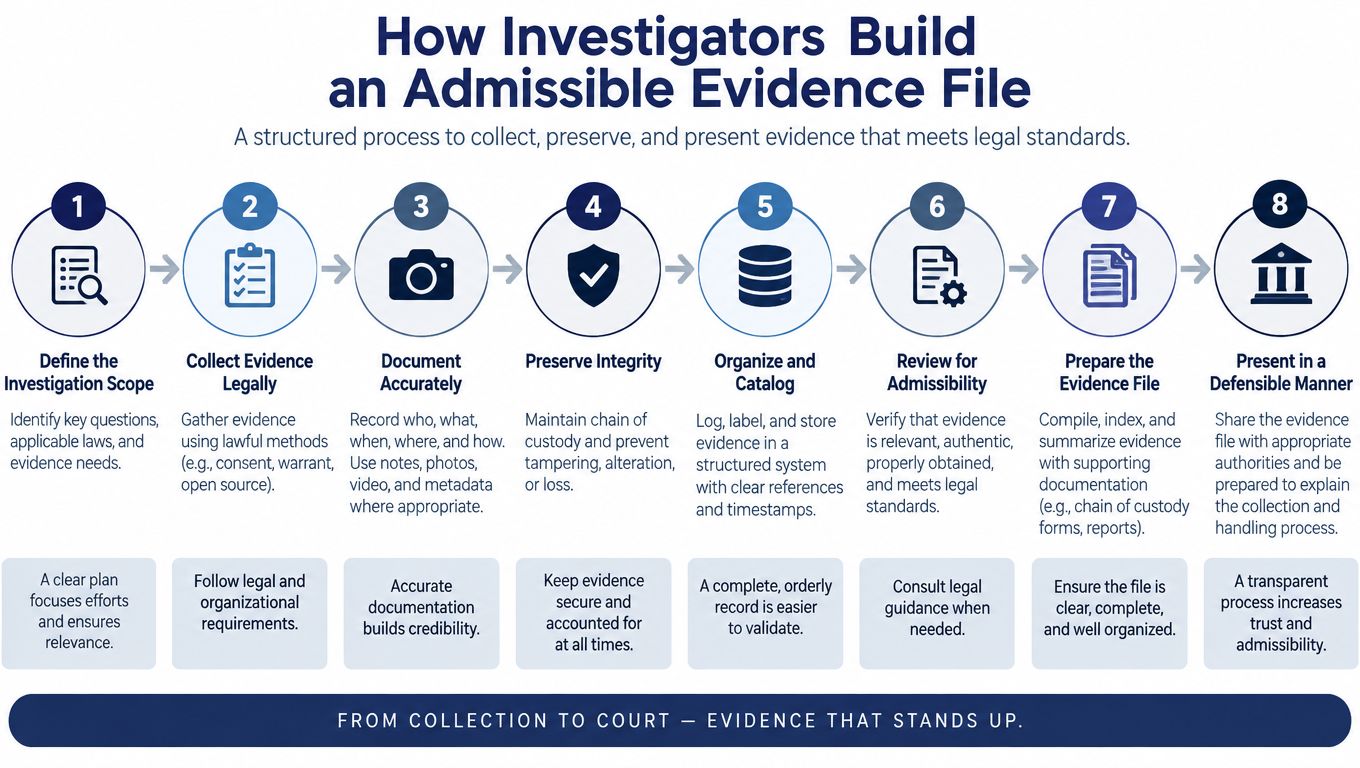
Define the allegation. Record the suspected conduct, relevant dates, locations, people and documents. Separate verified facts from assumptions.
Test necessity and proportionality. Explain why surveillance is required and why existing records or a less intrusive method won't answer the question. Set the shortest realistic operational window.
Approve the plan. Obtain senior sign-off and identify who can change, pause or end the assignment. The investigator should know the escalation route before deployment.
Plan the fieldwork. Set the subject identity, likely movements, observation points, vehicle details, equipment, safety arrangements and lawful boundaries. Avoid vague instructions such as “watch them for a while”.
Record contemporaneous notes. Investigators should document times, locations, weather or visibility where relevant, vehicle details, movements and the basis for identifying the subject. Notes should distinguish direct observation from interpretation.
Preserve original exhibits. Keep original photographs, video and digital files intact. Copies can be clipped or formatted for review, but the source material, file history and handling record must remain available.
Collate the evidence. Index exhibits against the observation log. A reviewer should be able to move from a written entry to the relevant file without guessing which clip matters.
Prepare the reporting pack. The final report should explain the instruction, scope, method, dates, findings, limitations and exhibits. It should be usable for a disciplinary hearing, insurer submission, civil claim or appropriate law-enforcement referral.
Evidence rule: Don't edit a file in a way that hides its context. Make any viewing copy clearly identifiable and retain the original.
Hashing or otherwise protecting the integrity of digital files can help demonstrate that material hasn't been altered. An exhibit log should record the collector, timestamp, location, continuity and any processing or redaction. That discipline matters because the other side may challenge not only what a clip shows, but how the business obtained, stored and presented it.
A structured pack is more valuable than a large folder of disconnected clips. The decision-maker needs a clear timeline, relevant exhibits and an honest account of limitations. A professional investigator should also flag uncertainty rather than exaggerate a result.
If proceedings are already threatened, the investigation should align with the wider legal strategy. Businesses may benefit from choosing a litigation support provider that understands document control, witness preparation and the practical demands of a disputed case.
Joining Surveillance to the Wider Fraud and Insider-Risk Picture
Physical surveillance is often only one tile in the evidence picture. It may show that an employee met a competitor, visited a second workplace or used a company vehicle unexpectedly. It can't, by itself, establish who accessed a system, whether credentials were shared or how much money the business lost.
The evidence chain should connect the observation to independent business records:
Access-control records can show entry to premises or restricted areas.
Rota and payroll data can test whether the person was working, absent or paid during the relevant period.
Vehicle and site logs can establish allocation, movement and authorised use.
Lawfully obtained communications metadata can help place activity in a defined timeline without opening message contents unnecessarily.
Financial approvals and transaction records can identify the route from conduct to loss.
Witness accounts can explain procedures, access rights and what a record means in practice.
Cifas reported in 2026 that 13% of surveyed UK employees admitted selling company logins. The survey covered 2,000 employees at organisations with more than 1,000 staff, so it isn't a direct estimate for all UK businesses. It does, however, highlight why insider-risk investigations must distinguish an ordinary policy breach from deliberate credential-enabled fraud or collusion. The findings are available in Cifas workplace fraud trends.
Sequence matters
Containment should be planned with IT, HR, legal advisers and, where appropriate, law enforcement. Preserve relevant accounts and logs before changing access, but don't allow the subject to continue avoidable exposure just to obtain better footage. The investigator's role is to help the business gather lawful evidence without contaminating the process.
Discreet enquiries can test addresses, associations, employment information or company links, subject to a proper purpose and lawful method. Interviews should usually follow the preservation of relevant records and the completion of time-sensitive enquiries. A premature confrontation can prompt deletion, coordination between witnesses or a change in behaviour.
Digital evidence can also be fragile. If a device or drive may contain relevant material, the business should use a competent specialist and maintain a documented handover. Where the issue involves damaged or inaccessible storage, guidance on how to recover data from a hard drive can help decision-makers understand why informal attempts to open or repair the device may compromise the evidence.
The strongest case joins human behaviour, system activity and financial consequence. Surveillance confirms what happened in the physical environment. Business records explain access and authority. Financial material identifies impact. Witnesses provide context. No single source should carry a conclusion it can't support.
What Sets a Professional UK Investigation Firm Apart
The difference isn't a glossy report or an impressive equipment list. It's whether the firm can turn a sensitive allegation into a controlled investigation that an HR director, insurer, solicitor or tribunal can understand.
Look for:
A named case handler: You should know who owns the brief and who can answer operational questions.
A written scope: The allegation, objective, timeframe, locations, reporting format and stop conditions should be clear.
ICO-aware practice: The firm should discuss lawful basis, proportionality, DPIA requirements and retention rather than treating privacy as an afterthought.
Evidence discipline: Original files, observation notes, exhibit logs and continuity records should be handled systematically.
Commercial discretion: The operation must avoid unnecessary disclosure to staff, customers and third parties.
Dimension | Properly Scoped Investigation | Poorly Briefed Assignment |
|---|---|---|
Objective | Tests a defined allegation | Searches for anything suspicious |
Authority | Senior approval and documented rationale | Informal verbal instruction |
Evidence | Time-stamped, indexed and preserved | Random clips with limited context |
Legal risk | Scope and retention are considered | Monitoring expands without control |
Outcome | Supports a clear business decision | Creates more uncertainty |
Sentry Private Investigators Ltd provides covert surveillance, GPS vehicle tracking, TSCM bug sweeping and corporate investigation support for businesses across the UK. The choice should ultimately be based on risk and evidence quality, not the lowest initial quote. An assignment that produces unusable material can cost more than a properly planned investigation that resolves the issue once.
Next Steps and How to Speak to Sentry Private Investigators Ltd
Before commissioning corporate surveillance services, test the instruction against three questions:
Is there a specific allegation supported by identifiable information?
Is covert observation proportionate and necessary to obtain the missing evidence?
Could the resulting file be explained and defended if the employee, insurer, solicitor or tribunal challenged it?
Prepare the relevant contract, absence or injury records, rota information, access details, vehicle records, known locations and internal approvals. Don't circulate the concern widely or confront the subject before receiving advice on evidence preservation and operational risk.
Sentry Private Investigators Ltd can discuss the matter confidentially from its Birmingham head office, with coverage across the West Midlands, London and the wider UK. Initial advice should focus on the allegation, the evidence gap and the lawful route to a proportionate investigation.
Sentry Private Investigators Ltd offers discreet corporate surveillance, GPS vehicle tracking, TSCM bug sweeping and wider fraud investigation support for UK businesses. If you need to test suspected absence, theft, moonlighting, insider activity or information leakage, visit Sentry Private Investigators Ltd to arrange a confidential discussion about the evidence required.