
Background Check Company UK: Expert Guide

The most common advice is also the most misleading: order a DBS check and you'll know whether someone is trustworthy. You won't. A DBS certificate can be an important part of a lawful screening process, but it doesn't verify a person's identity in full, confirm their employment history, test their qualifications, or uncover every commercial and personal risk.
A suitable background check company in the UK should therefore do more than process an application. It should help you define the risk, select lawful checks, investigate inconsistencies and explain what the evidence does, and doesn't, prove.
Screening need | Automated platform | Private investigation approach |
|---|---|---|
Routine Basic DBS application | Efficient for straightforward volume processing | Can arrange or interpret the check within a wider investigation |
Identity concern | Often dependent on supplied documents and database matches | Independent document, address and identity consistency checks |
Employment history | Usually dependent on employer responses | Can investigate discrepancies and pursue appropriate enquiries |
Corporate due diligence | Public-record searches may provide a useful starting point | Broader review of directorships, assets, litigation indicators and adverse information |
Contested or incomplete record | May refer the case back to the client | Human review, documented escalation and proportionate follow-up |
Discreet field enquiries | Generally unavailable | Possible where lawful, necessary and properly instructed |
The Limits of a Standard DBS Certificate
A clear DBS certificate doesn't mean that a candidate is a safe hire, a prospective partner is financially sound, or a private individual has been honest about their past. It means that the relevant DBS process disclosed the information covered by that particular level of certificate.
The distinction matters because DBS is a criminal-record disclosure service, not a universal investigation into a person's history. A Basic check, for example, has a defined scope. Standard and Enhanced checks disclose different information and can only be used for roles that meet the relevant eligibility requirements.
The scale of the system shows how important DBS checks are to UK organisations. The DBS Annual Quality Account for 2025–26 records 7,433,877 certificates issued, including 2,918,134 Basic checks, 401,195 Standard checks and 4,114,548 Enhanced or Enhanced-with-Barred-List checks. Volume, however, doesn't expand what a certificate proves.
What a DBS check can establish
A DBS certificate can disclose criminal-record information according to the level of check and the applicable rules. An Enhanced check may also include relevant local police information, while a barred-list check concerns whether an individual is barred from certain regulated activities.
That information can be essential for safeguarding and recruitment decisions. It still leaves important questions unanswered:
Identity: Is the applicant using their true identity, and does their wider identity history remain consistent?
Employment: Did they hold the roles stated on their CV, and why did they leave?
Qualifications: Are claimed degrees, licences or professional registrations genuine and current?
Financial risk: Are there signs of insolvency, undisclosed directorships or other concerns relevant to the role?
Civil matters: Has litigation or another public-record issue created a material risk?
Overseas history: What can be verified where a person has lived or worked outside the UK?
A candidate can therefore hold a clear DBS certificate while still exaggerating experience, presenting inconsistent addresses or concealing a commercial connection. A private investigation is designed to examine those wider questions, within a defined lawful purpose.
Practical rule: Treat a DBS certificate as one evidence source, not as a character certificate.
The right provider will first ask what decision you're trying to make. A regulated care appointment, a senior finance hire, a proposed business partner and a private relationship concern call for different enquiries. Paying for every available search is neither efficient nor automatically lawful. The value lies in selecting relevant checks, testing inconsistencies and producing an evidence trail that a decision-maker can understand.
Navigating UK Screening Law and Eligibility
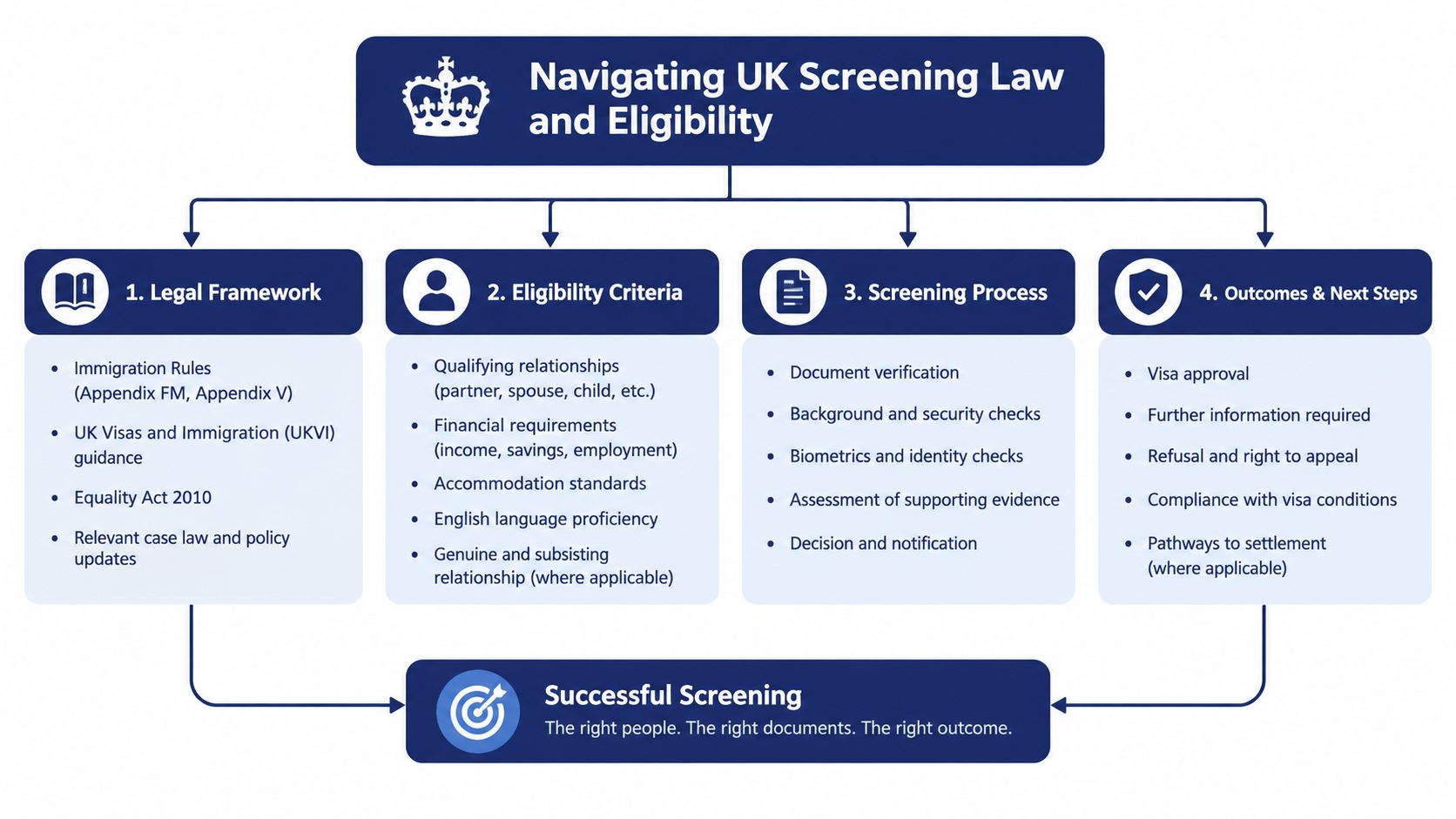
The safest screening instruction starts with the role, not with the most detailed-looking certificate. In England and Wales, anyone can request a Basic DBS check because it has no specific eligibility requirement. Standard and Enhanced checks are different. They're restricted to roles and activities covered by the relevant legal framework.
DBS eligibility guidance confirms that Standard and Enhanced DBS checks may only be requested where the particular role or activities fall within the relevant legal framework, including the Rehabilitation of Offenders Act 1974 (Exceptions) Order 1975. For Enhanced checks, applicable Police Act 1997 regulations also matter.
The organisation commissioning the check carries the responsibility
A checking provider can process an application, but it doesn't decide whether your vacancy qualifies for a Standard or Enhanced certificate. That decision belongs to the recruiting organisation. The assessment may depend on the duties, the people the worker interacts with, the place of work and how frequently particular activities occur.
Ordering an Enhanced check because it appears more thorough can create a compliance problem. A professional investigator should ask for the role description and explain the boundary between a permissible criminal-record disclosure and broader due diligence that needs a separate, proportionate justification.
Right to work is a separate workstream
A DBS certificate doesn't establish immigration permission. UK employers must carry out the prescribed right-to-work procedure before employment begins and retain the required evidence. The Home Office right-to-work guidance describes this as an employer responsibility intended to prevent illegal working.
That means an informal identity check, a passport image or a DBS result can't replace the prescribed process. A provider assisting an employer should state clearly which service it is performing, what that service proves and what remains the client's responsibility.
Criminal-record information is sensitive personal data. A compliant process therefore needs a lawful basis, a clear purpose, controlled access, appropriate retention and a consistent approach across candidates. The same screening standard should be applied to people competing for the same type of role, unless a documented risk assessment justifies a difference.
For employers needing a more detailed explanation of the distinction between disclosure products and wider enquiries, UK employer background screening provides a useful point of reference.
Automated Platforms Versus Private Investigators
Automated screening platforms are useful when the requirement is repetitive, the identity information is consistent and the risk is relatively contained. They can collect documents, send consent requests, submit routine checks and present status updates efficiently.
That model becomes less dependable when the evidence doesn't fit neatly. A historic address mismatch, a common name, an unexplained employment gap or a document that appears genuine but conflicts with other information needs a person to assess the exception. A platform may flag the problem. It won't necessarily establish what caused it or what should happen next.
Different tools for different risk levels
A business comparing providers should look beyond headline speed. Ask how the system handles manual review, what sources it uses, whether an investigator checks the result and how the final report records uncertainty.
Feature | Automated Screening Platform | Private Investigation Firm |
|---|---|---|
Routine identity matching | Fast matching against supplied information and available databases | Manual review can test whether information is internally consistent |
DBS processing | Suitable for structured applications | Can place the certificate in the context of wider due diligence |
Employment verification | Often relies on candidate details and reference responses | Can investigate unexplained gaps, conflicting dates or questionable claims |
Adverse media | May search defined databases or indexed sources | Can conduct broader open-source research and assess relevance manually |
Directorship verification | Public-record data may be presented as a match | An investigator can compare company records with identity and declared interests |
Document concerns | Automated systems may reject or flag a document | Physical or manual examination can support a reasoned exception decision |
Discreet field enquiries | Usually unavailable | Can be considered where lawful, necessary and proportionate |
Contested information | Often produces a pending or failed status | Provides human escalation, context and documented next steps |
The point isn't that software has no place. It's that automation is strongest at repetition, while investigation is strongest at ambiguity. A high-volume employer may sensibly automate routine onboarding and refer exceptions to a specialist. A private client assessing a proposed partner may need manual research from the outset.
What a serious provider should report
Request more than an average turnaround. Ask for the point at which the clock starts, how aged cases are escalated, how often manual review occurs and whether the provider distinguishes an unresolved case from a negative finding.
For employment-related work, employment screening should be defined by the role and the decision it supports. That prevents a superficial search from being mistaken for a complete investigation.
The best report may conclude that information could not be verified. That is more useful than a confident-looking pass based on weak evidence.
Building a Proportionate Screening Matrix
A one-size-fits-all package creates two problems. It can leave a high-risk appointment under-investigated, and it can collect excessive personal information from people who pose no comparable risk. A screening matrix avoids both by connecting each check to a defined decision.
Start with four questions:
What is the person being trusted to do? Consider access to money, vulnerable people, confidential information, premises, systems or company authority.
What must be established by law? Separate right-to-work obligations from DBS eligibility and from checks that are merely useful.
What claim needs testing? Examples include identity, qualifications, employment history, residential history, directorships or financial reliability.
What would change the decision? A check has little value if the client hasn't decided how relevant findings will be assessed.
Match the checks to the scenario
For a regulated care role, the process may centre on the appropriate DBS level, identity, right to work, employment references and qualification status. The legal eligibility of the role should be confirmed before an application is submitted.
For an ordinary office employee, a Basic DBS check may be relevant, but the wider assessment could focus on identity, previous employment and qualifications. The employer should avoid collecting unrelated sensitive information merely because a provider offers it.
A senior finance appointment calls for a different risk lens. Identity, right to work, employment history and qualifications may be combined with proportionate financial, directorship and adverse-information enquiries, provided the purpose and lawful basis are documented.
For a potential company director or business partner, public corporate records deserve careful attention. Companies House identity verification became compulsory for all company directors and people with significant control, or PSCs, on 18 November 2025, under reforms introduced by the Economic Crime and Corporate Transparency Act 2023, as explained in the Companies House identity verification guidance. That verification is useful, but it doesn't prove someone's entire professional or personal history.
Record the reason for every layer
A proportionate matrix should show the check, its purpose, the source, the person responsible and the action triggered by an inconsistency. It should also identify information that won't be collected because it isn't relevant.
A well-designed screening matrix tells you not only what to investigate, but what you have decided not to investigate and why.
Private clients can use the same discipline. If you're considering a joint purchase, a new business relationship or a serious concern about someone's stated identity, begin with the specific risk. A focused background investigation is usually more useful than an indiscriminate search that produces unverified fragments.
Defending Against Synthetic Identities and Fraud
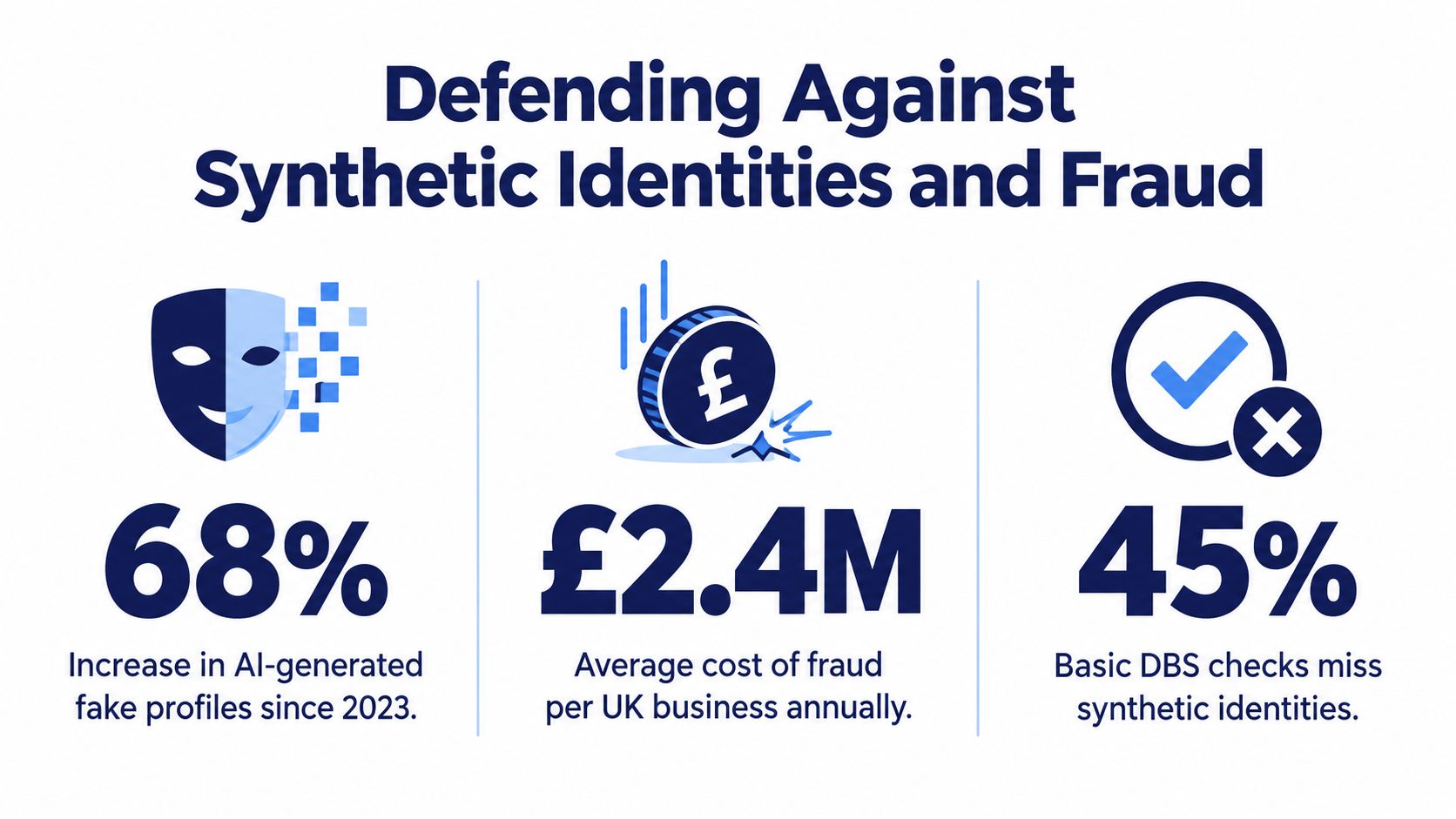
A database match can confirm that a name, address or document appears somewhere. It doesn't necessarily confirm that the person presenting those details is the legitimate individual behind them.
Synthetic identities combine genuine and fabricated information to create a profile that looks plausible. Automated systems can struggle when each individual data point appears acceptable but the overall pattern is inconsistent. A person may provide a valid-looking document, a real address and a coherent employment history, yet the connections between those elements may not withstand independent checking.
Cifas reported almost 250,000 identity-fraud filings in the UK in 2024, a 5% increase on 2023, with identity fraud representing 59% of all cases filed to the National Fraud Database. The same source reported more than 118,000 identity-fraud cases in the first six months of 2025 and warned about AI-enabled synthetic identities and fabricated profiles.
What manual review should test
A thorough identity process doesn't stop at document validation. It compares information from independent sources and asks whether the person's story remains consistent across time and context.
A provider should be able to explain how it handles:
Address consistency: Whether the declared address history aligns with independently available information.
Document anomalies: Whether names, dates, photographs and issuing details make sense together.
Duplicate identities: Whether the same contact details or identity markers appear across unrelated profiles.
Employment patterns: Whether employers, dates and job descriptions can be reconciled.
Corporate connections: Whether directorships and business interests match the person's declarations.
Exception handling: Whether a trained reviewer investigates conflicts rather than allowing an automatic pass or fail.
Physical document validation can add value where the instruction justifies it, particularly when a person's identity is disputed or the available digital evidence conflicts. It must still be conducted lawfully and proportionately. The aim isn't to pry into irrelevant personal information. It's to establish whether the individual and the claimed history belong together.
Demand meaningful performance measures
Ask a provider for its false-positive rate, manual-review rate, pass-through rate, average exception-resolution time and information-source freshness. Also ask how often cases are verified without relying solely on applicant-supplied documents.
A completion rate on its own can mislead. If a system accepts inconsistent profiles to keep applications moving, it may look efficient while increasing the client's exposure. A careful investigator is prepared to pause a conclusion, explain the missing evidence and recommend a proportionate next step.
Managing Delays and Contested Records
The test of a screening provider isn't a clean application that passes through without friction. It's the disputed record, the incomplete address history and the Enhanced check that remains unresolved while a start date approaches.
Official 2025–26 DBS performance shows that 75% of Enhanced checks met the 14-day target, while the average time to issue an Enhanced check was 12.4 calendar days, according to the DBS Annual Report and Accounts for 2025–26. Those figures show why a provider shouldn't promise that every case will follow the same timetable.
A sensible exception pathway
Suppose an employer has identified the preferred candidate for a sensitive role, but the Enhanced check is delayed or contains information the candidate disputes. The employer shouldn't treat the delay itself as evidence of wrongdoing, and it shouldn't overlook the issue.
A controlled response looks like this:
Pause or condition the appointment. Limit access or defer the start of duties where the risk requires it.
Tell the applicant what is missing. Give them a fair opportunity to provide clarification or correct inaccurate information through the appropriate route.
Separate delay from substance. An administrative referral isn't the same as an adverse finding.
Assess relevance. Consider the role, the information, its age, its reliability and its connection to the proposed duties.
Document the rationale. Record who made the decision, what evidence was considered and why the outcome was proportionate.
Escalate aged cases. Ask the provider when it will follow up, who owns the case and what information remains outstanding.
This process protects the employer and the applicant. It also gives a private investigator a clear instruction. Rather than being asked to produce a vague “all clear”, the investigator can establish what is known, what cannot be verified and what further enquiries are justified.
For clients who need help interpreting an outcome, DBS findings explained simply offers a practical explanation of how a certificate should be understood within a wider decision.
A contested record needs particular care. Don't confront someone with unverified allegations, circulate sensitive information unnecessarily or make a final decision based solely on an automated status. Preserve the evidence, restrict access and use an appropriate correction or review channel where the data appears inaccurate.
Questions to Ask Before Hiring a Provider
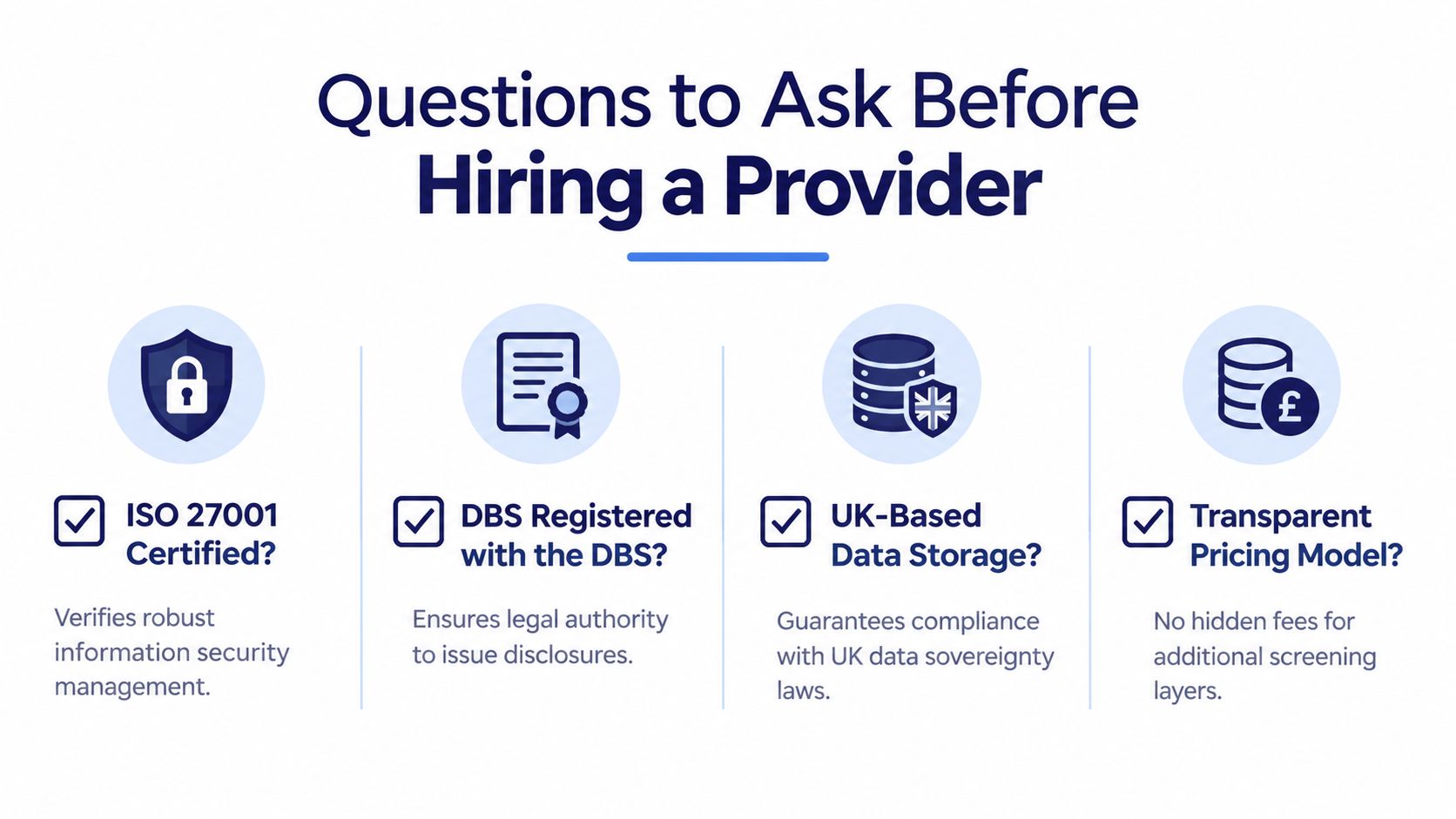
A credible background check company should welcome detailed questions. If a provider can only discuss package names and turnaround promises, you're probably dealing with an application intermediary rather than an investigative service.
Ask these before sharing sensitive information:
Which checks are you recommending, and why? The answer should refer to the role, decision and lawful purpose, not to the most expensive package.
Who decides whether a DBS level is eligible? The provider should make clear that the recruiting organisation remains responsible for the role assessment.
What happens when information conflicts? Look for manual review, documented escalation and a fair process for contested data.
How current are your sources? Ask when information was last refreshed and whether a public-record result is independently checked.
How do you obtain consent and protect data? The provider should explain its lawful basis, access controls, retention approach and reporting process.
Can you investigate beyond a database search? For higher-risk instructions, ask about employment verification, qualifications, directorships, adverse information, address enquiries and discreet fieldwork where appropriate.
What will the report say if evidence is inconclusive? A responsible investigator distinguishes confirmed facts, reasonable findings and unresolved questions.
You may also find it useful to review this background check provider overview when comparing the different types of service available. Use external comparisons as a starting point, then question each provider about its actual investigative method, reporting standards and handling of exceptions.
A serious firm should also be able to discuss related corporate risks without turning every enquiry into a generic package. Depending on the circumstances, that may include due diligence, internal fraud investigations, covert surveillance or technical surveillance countermeasures. The work should remain discreet, confidential and tied to a clearly defined objective.
Sentry Private Investigators Ltd provides discreet background investigations for private individuals, businesses and legal professionals, including identity, employment, qualification and wider due-diligence enquiries where lawful. Visit Sentry Private Investigators Ltd to discuss the concern, the evidence you already hold and the proportionate investigation needed to reach a properly informed decision.