
Missing Person Trace: A Practical Guide to Finding Someone

A solicitor has spent three months trying to serve divorce papers on a client who changed telephone numbers and left no forwarding address. Elsewhere, a daughter is trying to find her father after he moved following redundancy, with only an old address and a few names from his past. Both situations feel personal, but the practical problem is the same: the person has become difficult to locate, and guesswork isn't producing a reliable address.
A missing person trace is a structured, lawful enquiry. It combines identity checks, records research, open-source intelligence, local enquiries and, where justified, field work to establish a current address, routine or confirmed location. It isn't a substitute for reporting someone who may be at risk, and it isn't permission to harass someone who has chosen to withdraw from contact.

When a Missing Person Trace Becomes the Right Next Step
A private trace usually becomes appropriate when the objective is clear and civil rather than an immediate welfare emergency. Common examples include locating an estranged relative, finding a beneficiary, tracing a debtor, confirming where a witness lives, or helping a solicitor serve documents. The person may not be "missing" in the police sense. They may be avoiding contact, moving frequently or living under details the client no longer recognises.
The first call defines the investigation
A professional agent starts by separating what the client knows from what the client assumes. “He used to live in Birmingham” is useful background, but “his last confirmed address was a rented flat in Birmingham, and his employer was a logistics company” gives the search a stronger starting point. The agent also needs to understand why the location is required, who will receive the information and whether any safeguarding issue exists.
The UK has a substantial and complex missing-person workload. The Home Office has estimated 360,000 reports of missing people each year across the UK, representing about 200,000 different people, while estimating that 55% to 80% return within 24 hours. The same strategy highlights repeat incidents involving children, which means tracing work must distinguish a new disappearance from an ongoing welfare pattern. These figures are set out in the Home Office missing persons strategy.
Practical rule: A private trace should answer a defined question, such as “Where can documents be served?” or “Is this person living at this address?” It shouldn't become an open-ended attempt to monitor someone's life.
The work normally progresses through five stages:
Briefing: the agent records identity details, history, purpose and risk.
Desk research: databases, public records and digital clues are assessed together.
Analysis: conflicting addresses, names and associations are tested.
Field verification: an address may be checked through lawful enquiries or observation.
Reporting: the client receives evidence that distinguishes a lead from a confirmed location.
The quality of the final result depends heavily on the opening briefing. A clear written timeline, old correspondence and a recent photograph can save time, while an incomplete or emotionally filtered account often sends an investigator towards the wrong person.
What Investigators Need From You Before the Search Starts
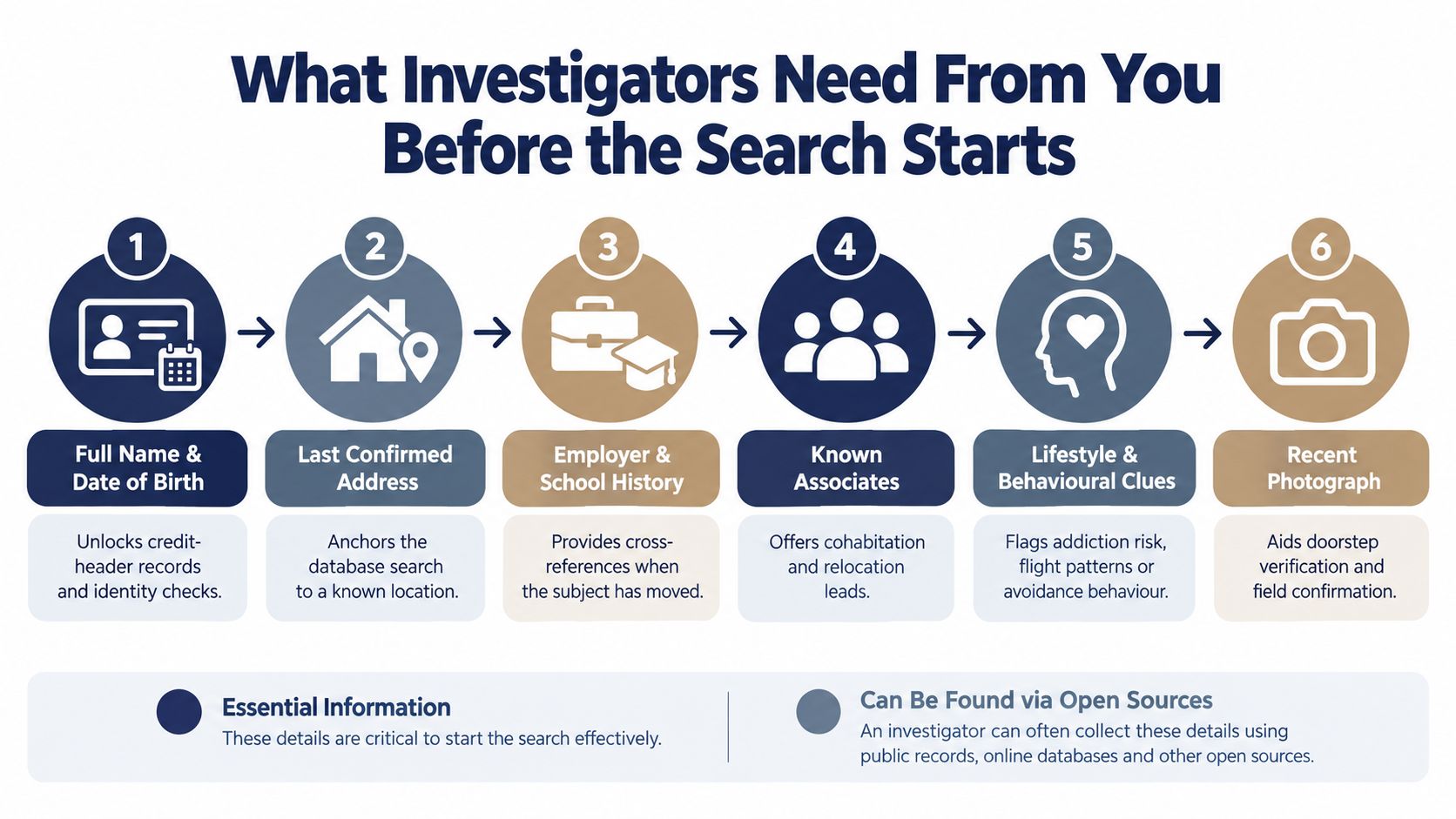
The first briefing call is more useful when the client arrives with facts rather than a general description. Start with the person's full legal name, including former names, nicknames and alternative spellings. Add the date of birth, or the closest reliable approximation, because identity matching becomes far more difficult when a subject has a common name.
Build an identity record
The last confirmed address is the anchor point. Give the complete address if possible, along with the period when the person lived there and how that information was confirmed. An old tenancy agreement, letter, court document or utility bill is more useful than a remembered postcode.
Prepare these details in writing:
Names and dates: Full name, previous names, aliases, date of birth and nationality if known.
Address history: Last confirmed address, earlier addresses, rental properties, family homes and places associated with work.
Employment and education: Employers, job titles, schools, colleges, professional memberships and business names.
Relationships: Current or former partner, relatives, housemates, close friends and known associates.
Communication details: Old telephone numbers, email addresses, usernames, websites and social media profiles.
Physical description: Height, distinguishing marks, tattoos, vehicle details and a recent photograph.
Reason for the trace: Process serving, family reconnection, debt recovery, welfare concern, inheritance or another defined purpose.
A date of birth helps separate the right person from others with the same name and may support lawful identity checks. Employer and school history create cross-references when someone has moved, while known associates can reveal cohabitation or relocation leads. Lifestyle information can also matter. A history of addiction, unstable accommodation, frequent travel or deliberate avoidance may explain why a neat address search fails, but it must be handled sensitively and never treated as proof of current behaviour.
Separate essential information from helpful information
The essential core is usually full name, date of birth, last known address and the reason for the search. A recent image, vehicle registration, employer and associate details can materially improve field verification. An investigator can often fill gaps through open sources, but missing identity data increases the risk of confusing the subject with someone else.
Don't edit out facts because they seem embarrassing or irrelevant. A former surname, a short-lived job, an unusual username or a relative's address may become the link between an old identity and a current record. Tell the agent what is confirmed, what is hearsay and what remains uncertain.
A trace brief should read like a factual timeline, not a character assessment.
Before instructing, assemble copies of relevant letters, court papers, photographs and previous search results. Note the date and location of the last contact, the person's likely reasons for moving, and any safety concerns. That preparation lets the investigator choose proportionate methods instead of spending the early stage reconstructing basic history.
Core Methods Used to Trace a Missing Person in the UK
No single database reliably reveals a current address. A sound missing person trace works by comparing several indicators and testing whether they point to the same individual and location. Each method has a useful role, but each also has a point at which it stops being dependable.
Database and identity checks
Lawful professional data sources can identify address links, previous residences and associated names. Where the legal basis and access conditions are satisfied, credit-header information may indicate that a person has recently been connected with an address. It doesn't prove that the person still lives there, and an opt-out, outdated record or shared household can weaken the result.
Identity checks work best when the briefing includes a full name and date of birth. A common name without additional identifiers can produce several plausible matches, so an agent should compare occupation, age, relatives, vehicles and address history rather than accepting the first result.
Electoral registers and local records
Electoral registers can help establish that a name has been associated with a property. The National Archives guidance on electoral registers explains that registers can help find an address where the relevant area is known, but the property used for voting qualification isn't always the person's home address. Registers are maintained locally by council electoral services teams, rather than one central national office.
Access is controlled. Public inspection arrangements are limited, people can request removal from wider availability, and councils warn that electoral registers shouldn't be used for debt collection or tracing people for any reason. The Rother District Council electoral register guidance illustrates these restrictions. Electoral data can support an enquiry, but it can't be treated as an unrestricted people-finding directory.
OSINT, social profiles and commercial footprints
Open-source research examines information that is lawfully available to the public. An agent may compare usernames, email fragments, profile photographs, public posts, business pages, professional profiles and online mentions. The value lies in connecting small clues, such as a new town mentioned in a public profile and an employer listed on a company page.
Court records, insolvency information and Companies House entries can help when the subject runs a business, acts as a director or has a visible financial footprint. These sources won't help every case. A person with little online activity, a common name or a deliberately separated digital identity may remain difficult to distinguish.
Phone, email and field intelligence
Old telephone numbers and email addresses may reveal linked accounts, historical names or service footprints. They rarely provide a complete answer on their own. People change providers, abandon accounts, use privacy settings or communicate through someone else's device.
Field enquiries become relevant when desk research produces a credible address but not enough confidence. A local enquiry, discreet observation or lawful surveillance can establish whether the subject is present, whether a vehicle is connected and whether the address is merely receiving post. The College of Policing guidance on missing-person investigations stresses proportionate investigation, risk-based decisions and the value of combining sources such as communications data, financial data, CCTV and ANPR in appropriate cases.
Police information remains important where a case is prolonged or carries risk. The College of Policing states that outstanding case details should be available after 72 hours, with the UK Missing Persons Unit notified for protracted cases so it can cross-match its national database of missing and unidentified people. A private agent can't replace that public protection function.
Field Enquiries, Doorsteps and Covert Surveillance
A database hit is a lead, not a confirmed location. Once research points towards a property, the field stage tests whether the person lives there, visits regularly, shares the address with someone else or only receives correspondence there.
Lawful local enquiries
An investigator may make discreet enquiries with people who have a legitimate connection to the location, such as a neighbour, landlord or property manager. The approach must be truthful and proportionate. An investigator shouldn't impersonate a police officer, invent an official authority or use a misleading story to obtain private information.
A doorstep visit can be a simple verification knock, particularly where the purpose is process serving or a lawful request for contact. The investigator must respect a refusal and avoid repeated approaches that could become harassment. The result should record what happened, not exaggerate a conversation into proof of residence.
For a broader overview of related investigative work, see Sentry's Private investigator services.

When surveillance adds value
Surveillance is justified when an address needs confirmation and less intrusive methods haven't resolved the question. It may establish a pattern of arrival and departure, identify a vehicle, confirm workplace travel or show whether a subject is living with another person. It shouldn't be used merely to satisfy curiosity.
A useful report gives the solicitor or client precise observations, including dates, times, locations, descriptions, vehicle details, photographs where lawful and the limits of what was seen. It should distinguish direct observation from inference. “The subject entered the building” is different from “the subject lives there”.
Consider a person who appears to receive post at a new flat. One visit may show only a delivery or a brief meeting. Repeated observations across an appropriate period can establish whether the person returns, keeps belongings there, leaves for work and follows a consistent routine. That pattern is more reliable than a single sighting, but it still shouldn't reveal more private information than the instruction requires.
Legal and Ethical Rules That Shape Every Trace
A professional trace is governed by purpose, necessity and proportionality. The investigator needs a lawful basis for handling personal data under UK GDPR, such as legitimate interests, legal claims or vital interests, depending on the circumstances. A solicitor tracing someone for service or litigation support may have a different documented purpose from a relative seeking reconnection.
The reason for the search matters because it shapes what information can be collected and how it may be used. An agent should record the instruction, assess whether the requested work is proportionate and avoid collecting unrelated personal details merely because they are available.
Electoral and credit data require care
The full electoral register isn't a general-purpose commercial search tool. Access conditions, inspection rules and opt-outs affect what an investigator can lawfully use and how a result should be interpreted. The Information Commissioner's Office guidance on electoral register choices explains that people can ask their local electoral registration officer to remove their details from wider availability.
Credit-header access also has limits. Data may be incomplete, a subject may have opted out, and a record can reflect a financial or correspondence connection rather than residence. Buying information from disreputable sources creates risks for the client, the subject and any later legal proceedings. A questionable address isn't worth undermining an otherwise valid case.
Ethical boundary: A tracing agent should refuse work intended to facilitate coercion, harassment, intimidation or harm.
The same boundary applies when a client uses a legitimate-sounding purpose to conceal a harmful one. An estranged partner's location shouldn't be disclosed where doing so could expose them to abuse. Good investigators ask enough questions to identify that risk and can recommend police or specialist support where safeguarding concerns arise.
How Long a Trace Takes and What It Costs
A straightforward UK trace can sometimes produce a result within 24 to 72 hours, particularly where the subject has a clear address history and remains resident in the UK. Older absconder cases, subjects using a common name, people who have moved overseas or individuals deliberately concealing their identity can take several weeks or longer. Surveillance adds time because each proposed address may need separate observation.
Fees depend on the method, not just the outcome. A basic desk-based trace may be offered at a fixed fee. Field enquiries are commonly priced by time, while extended surveillance can involve operative days, travel, reporting and other agreed expenses. Ask whether the quotation includes VAT, travel, database charges, photographs, written reporting and any follow-up attendance.
A “no trace, no fee” arrangement needs careful reading. It may apply only to a defined basic search and not to field work, expenses or a result that identifies a likely address without proving occupancy. Before instructing, obtain the scope and cancellation terms in writing. Sentry's information on private investigator prices can help clients understand the questions to ask about an investigation quotation.
Trace route comparison: time, cost and best fit
Route | Typical Time | Typical Cost | Best Suited To |
|---|---|---|---|
Basic private trace | Often 24 to 72 hours where records are clear | Fixed-fee desk research, subject to quotation | A debtor, witness, beneficiary or estranged adult with usable identifiers |
Field enquiry | Depends on address, travel and access | Operative time, travel and reporting | Confirming whether a person is connected with a property |
Surveillance | Several visits may be needed | Daily-rate work or an agreed package | Establishing routine, cohabitation or repeated presence |
Police response | Prioritised according to assessed risk | No private investigation fee | A vulnerable person, child, suspicious disappearance or suspected crime |
Charity support | Depends on eligibility and case circumstances | Free through eligible services | Family reconnection and support for long-term missing people |
DIY online search | Uncertain and often incomplete | Search subscriptions or personal time | Preliminary research, not reliable address confirmation |
Missing People offers a free Lost Contact service, but eligibility requires at least one year without contact, with the last contact within 50 years. Its Lost Contact service is designed for family reconnection, not every commercial or legal trace. DIY searches can produce useful clues, but they rarely test identity, occupancy and safety as a professional enquiry does.
Choosing Between a Tracing Agent, the Police and a Charity
The right route depends on risk, purpose and control.
Route | Best For | Typical Response | Cost | Main Limitation |
|---|---|---|---|---|
Tracing agent | Civil traces, estranged relatives, debtors, beneficiaries and witnesses | Private desk research with optional field work | Paid service, quoted in advance | Can't replace police safeguarding or compel cooperation |
Police | Children, vulnerable adults, suspicious circumstances or suspected crime | Risk assessment, investigation and access to police systems | No private investigation fee | Not a general civil tracing agency |
Charity | Family support and long-term missing-person cases | Advice, reconnection support and signposting | Free where the service is eligible | Strict eligibility and limited investigative scope |
Police guidance makes the distinction important. Officers assess risk and take proportionate tracing steps, but the police aren't a general service for locating someone in a civil dispute. If someone may be in danger, has disappeared unexpectedly, is vulnerable, or may be connected with a crime, report the matter to the police immediately. Don't delay a welfare report while gathering paperwork for a private enquiry.
For family reconnection, Missing People may be the sensible first contact where the service criteria are met. For a solicitor serving papers, a business tracing a debtor or a private client seeking a lawful location enquiry, a professional agent is usually better aligned with the objective. Sentry's overview of UK tracing agents explains how a private tracing instruction can be assessed.
Gather the documents, names, dates, addresses and photographs you already have. If there is an immediate welfare concern, call the police first. Otherwise, ring a regulated tracing agent for a confidential assessment of what can be searched, what may require field work and what result the evidence can realistically support.
Sentry Private Investigators Ltd provides discreet people tracing, missing-person enquiries, field verification and surveillance support for private clients, solicitors and businesses across the UK. To discuss the information you have and choose a proportionate next step, contact Sentry Private Investigators Ltd for a confidential assessment.