
Background Checks Services in the UK: A Practical Guide

A Manchester care provider has found a promising support worker. The references look positive, the interview went well, and the candidate needs access to vulnerable adults almost immediately. A Basic DBS certificate might confirm some relevant information, but it won't answer every question about identity, employment history, professional qualifications or right to work.
The same problem appears in other settings. A London landlord needs confidence in a prospective tenant, while a small agency is deciding whether a contractor should access client systems and confidential data. Background checks services are useful when they help someone make a proportionate decision about trust, access or money. They're less useful when a buyer orders the wrong check, assumes a certificate is a guarantee, or collects personal information without a lawful reason.
When a Background Check Earns Its Cost
A screening decision should start with the risk, not the price of the check. Ask what could go wrong in the role and what evidence would reasonably reduce that risk. Identity comes first. If the applicant's identity is uncertain, later searches may be linked to the wrong person and give false confidence.
The checks should then match the access and responsibility involved. A role may justify a DBS application, right-to-work confirmation, employment references or qualification checks. Someone with financial authority may also require financial or corporate due diligence. A contractor who will not handle sensitive information may need a narrower process. Ordering every available check can waste money and collect personal data without a clear purpose.
The scale of UK screening shows why organisations need a defined programme rather than a single form. The DBS issued 7,482,078 certificates in the year to 31 March 2026, including 2,918,134 Basic checks, representing 39.01% of all checks processed, according to recent DBS statistics. The figures cover a broad range of roles. They do not mean that every role needs the same level of scrutiny.
Practical rule: A check should answer a risk question. If you cannot explain which decision the result will inform, you may be collecting data without improving the decision.
Where a certificate helps, and where it stops
A DBS certificate can provide criminal-record information at the level permitted for the role. It does not prove that an applicant is honest in every situation, confirm that every former employer is genuine or identify a fabricated qualification. It also reflects information available when issued, rather than future events.
That limitation matters to voluntary organisations as well as commercial employers. Guidance on background checks for nonprofits can help trustees and volunteer managers set screening requirements by role instead of applying one process to everyone.
Higher-risk roles may justify documented rescreening or monitoring, but the reason must be clear and proportionate under UK data-protection rules. Consider whether the person retains ongoing access to vulnerable people, sensitive information, money or operational control. A blanket policy for every worker can create UK GDPR risk without producing better evidence.
Employers can also review UK background checks for employers for wider legal and practical guidance. The working sequence is straightforward: verify identity, define the role risk, choose relevant checks, assess the evidence fairly and record the reason for the decision.
What Background Checks Services Really Do
A background check service is a coordinated process for establishing whether a person is who they claim to be and whether their history supports a particular decision. It may combine identity verification, criminal-record screening, employment and education confirmation, financial checks, right-to-work evidence and a review of relevant adverse information.
The service is not the same thing as a DBS check. DBS checks are one part of the wider process, and the information they reveal depends on the level requested and the legal eligibility of the role.
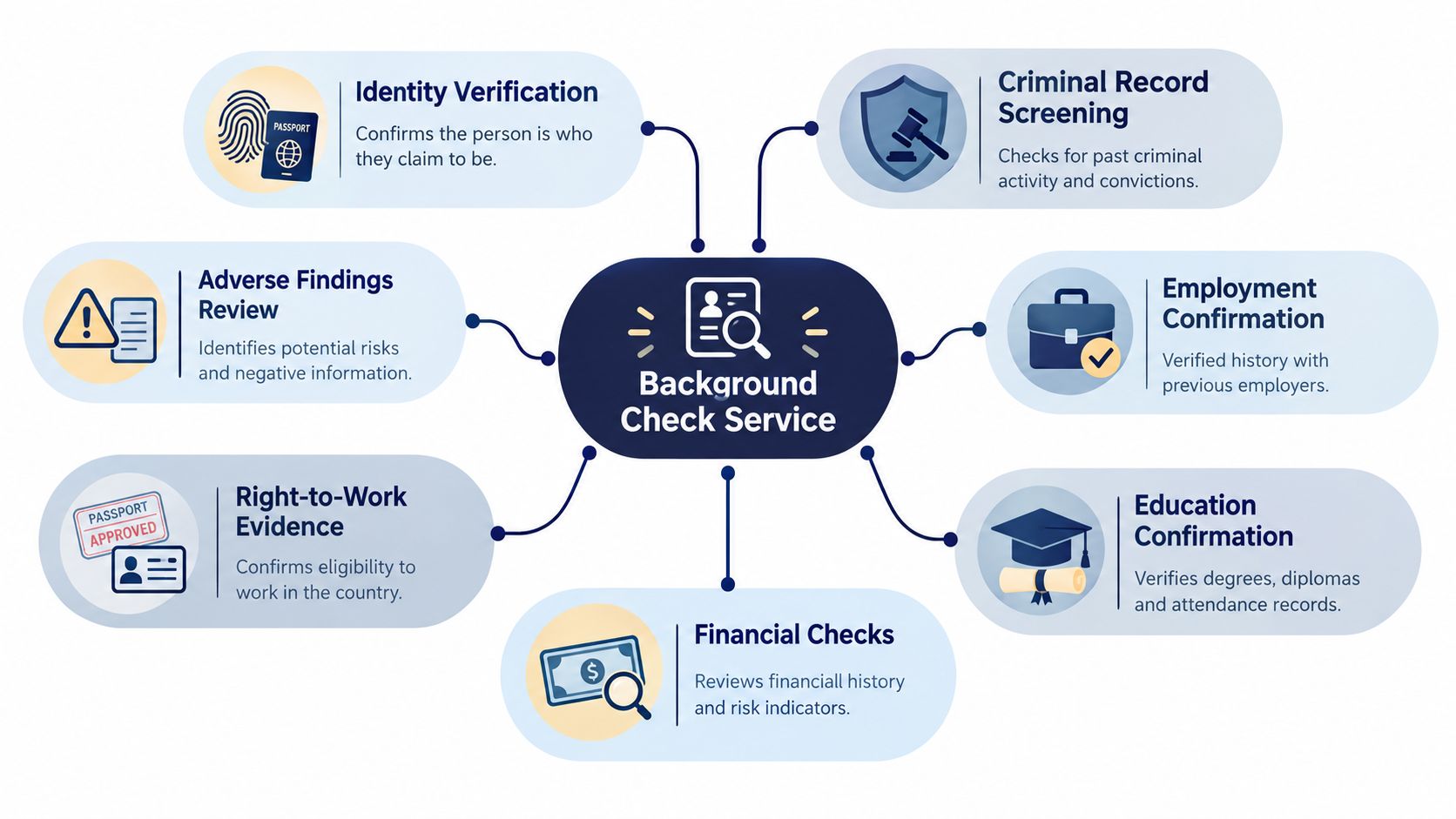
DBS and non-DBS evidence
A Basic DBS check can be used for any position or purpose and shows unspent convictions and cautions under the Rehabilitation of Offenders Act 1974. Standard checks are available only for roles listed in the relevant exceptions order, while Enhanced checks are restricted to specific eligible roles. Enhanced checks can include relevant police information, and eligible roles may also involve an Enhanced check with a Barred List search. The DBS guidance for employers sets out those distinctions.
Non-DBS work answers different questions:
Identity verification checks whether documents and personal details point to the same individual.
Employment confirmation tests whether claimed roles, dates and responsibilities can be verified with previous employers.
Education checks confirm qualifications with the awarding institution or another reliable source.
Right-to-work checks establish whether a person can legally work in the UK before employment begins.
Financial checks may be relevant to roles involving money, credit or fiduciary responsibility, subject to lawful basis and proportionality.
Corporate searches can reveal directorships, company appointments and insolvency-related information available through appropriate public records.
Adverse findings review considers credible public information, sanctions or other relevant concerns, without treating an online allegation as proven fact.
A certificate is evidence, not a guarantee. A missing conviction on a DBS certificate doesn't confirm that no concerning conduct has ever occurred, because the system applies legal disclosure rules and doesn't function as an unrestricted extract of a person's entire history. The good-practice guide on employment screening explains why disclosure levels and filtering rules must be understood before a result is interpreted.
A credible provider should therefore explain the scope of each search, the source used, the information that couldn't be verified and the limits of the conclusion. For operational leaders comparing providers, background check best practices for COOs are useful only when translated into a role-specific policy rather than a larger, indiscriminate checklist.
The Main Types of UK Background Checks
Buyers commonly use the phrase “background check” to describe several different products. A DBS application, tenant reference and corporate due-diligence investigation aren't interchangeable. Ordering the wrong one can leave a genuine gap or cause unnecessary data collection.
Four commissioning decisions
DBS screening is designed for criminal-record disclosure at a legally defined level. Basic, Standard, Enhanced and Enhanced with Barred List checks each have different eligibility rules and information yields. An umbrella body can help an organisation submit an eligible application, but it doesn't make an ineligible role eligible. A DBS result also doesn't replace identity, employment or qualification verification.
Employment screening usually combines identity, right to work, references, employment history, qualifications and professional-register checks. It can identify contradictions in a CV or an unexplained gap, but a reference may be limited by the former employer's policy and a professional register may confirm status without confirming day-to-day competence.
Tenant referencing is narrower. It may examine identity, affordability, credit information, landlord history and the applicant's permission to rent where relevant. It helps a landlord assess tenancy risk, but it isn't a full criminal-record or investigative background check and shouldn't be marketed as one.
Due diligence is appropriate when a business is considering a director, contractor, supplier, investor or high-value relationship. Companies House records, sanctions and politically exposed person screening, insolvency information, adverse media and open-source research may all be relevant. Public records can reveal corporate connections, but they may not explain beneficial ownership, undisclosed conflicts or the context behind an adverse report.
Check Type | What It Reveals | Typical UK Source | Main Limitation |
|---|---|---|---|
DBS screening | Disclosable criminal-record information at the eligible level | Disclosure and Barring Service through an eligible route | It isn't a complete criminal-history extract or general character guarantee |
Employment screening | Identity, work history, references and qualifications | Employers, awarding bodies, professional registers and identity documents | Records may be incomplete, overseas or difficult to verify |
Tenant referencing | Identity, financial suitability and rental history | Credit-reference data, landlords and applicant documents | It doesn't provide the depth of corporate or investigative due diligence |
Corporate due diligence | Directorships, corporate links, sanctions and relevant adverse information | Companies House and credible public or specialist sources | Public records can be outdated, incomplete or open to misinterpretation |
The mistakes that change the result
The most common error is selecting a check by job title rather than actual duties. A senior-sounding role may have little access to sensitive information, while a modest contractor role may involve unsupervised access to client premises. The risk assessment should drive the scope.
Another error is treating every inconsistency as evidence of dishonesty. A portfolio career, self-employment period or overseas employer may create a thin paper trail without indicating misconduct. The right response is usually to verify the original source, ask a focused question and give the person a fair opportunity to explain.
UK law also limits what an organisation can collect. The Rehabilitation of Offenders Act 1974 affects what can be asked for and disclosed, while UK GDPR and the Data Protection Act 2018 require a lawful, necessary and secure process. More searches don't automatically create more reliable screening.
How a UK Background Check Is Carried Out
A well-run screening programme follows a sequence. It doesn't begin with a database search and work backwards from whatever result appears. The provider first establishes identity, defines the role and then selects evidence that can support the decision.
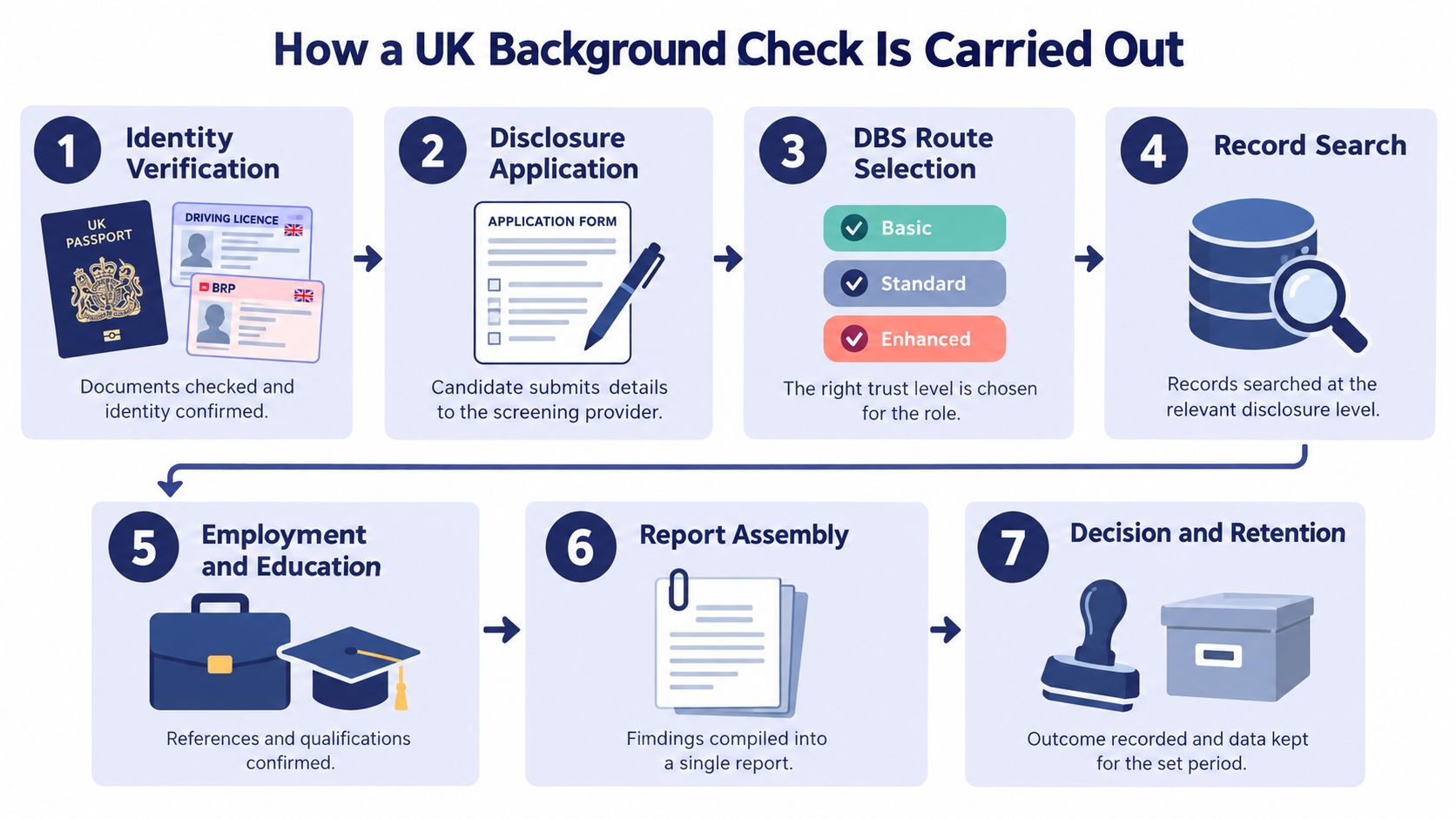
The operational sequence
Identity verification may involve a passport, driving licence, biometric residence permit or a digital identity process. The applicant's name, date of birth, address history and document details need to align. DBS guidance sets Medium as the minimum identity confidence level for a Basic check, while High is the minimum for Standard, Enhanced and Enhanced with Barred Lists checks, as explained in the DBS digital identity verification guidance.
The provider then confirms the right to work, where employment is involved, and gathers the information needed for the selected checks. An umbrella body may manage the application through an online portal, or an eligible registered organisation may submit the application on the applicant's behalf. The route matters less than whether the role qualifies and whether the identity evidence is sound.
The remaining checks are layered according to risk:
DBS route selection establishes whether Basic, Standard, Enhanced or a Barred List check is lawful and relevant.
Record searches are completed at the permitted disclosure level.
Employment and education checks contact original sources where possible, rather than relying only on documents supplied by the applicant.
Professional-register checks confirm whether licences or memberships are current where the role requires them.
Sanctions, PEP and adverse-media checks may support corporate due diligence when there's a justified need.
Online-source review is limited to lawful, relevant and reasonably reliable information. Social media should never become an informal trawl through a candidate's private life.
The provider assembles the findings, records what was verified and identifies unresolved points. The organisation then makes the decision against its written policy, not against an unexplained score. It should retain only what it needs for the stated purpose and protect the report from unnecessary access.
The DBS Update Service may support status checking in suitable circumstances, but it doesn't replace the original assessment or every other part of an employment-screening programme. Higher-risk employers may also consider repeat checks or ongoing monitoring, provided the arrangement has a clear legal basis, a defined purpose and a fair process for reviewing alerts.
The following video provides a visual explanation of the screening process.
UK Legal Rules Every Screening Programme Must Follow
Screening has to be useful and lawful at the same time. UK employers need a lawful basis under Article 6 of UK GDPR, and criminal-record information receives additional protection under Article 10. The ICO guidance on pre-employment vetting makes the central point clear: criminal-record screening should be necessary, proportionate and supported by safeguards.
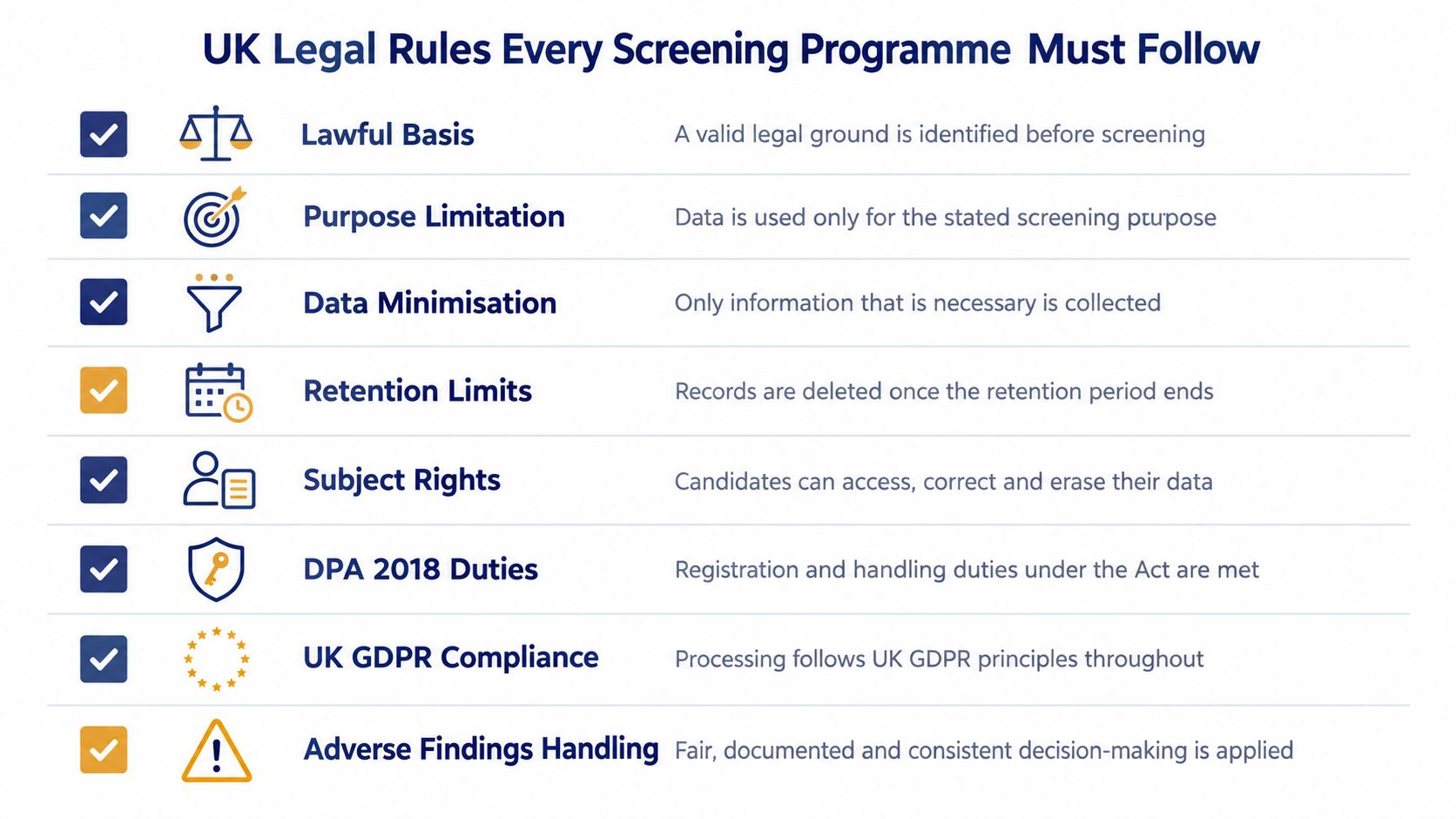
The rules that shape the decision
The Data Protection Act 2018 and UK GDPR require purpose limitation, data minimisation, accuracy, security and controlled retention. A candidate should be told what information is being collected, why it's needed and how it will be used. Consent can be relevant in some circumstances, but it isn't a universal solution. The organisation still needs a defined lawful basis and must not use consent to disguise an excessive process.
The Rehabilitation of Offenders Act 1974 affects how convictions and cautions are treated. Filtering rules mean some old or minor matters aren't disclosed on Standard or Enhanced certificates, while relevant unspent matters remain subject to the applicable disclosure rules. An organisation mustn't treat filtered or protected information as a reason to reject someone, and it should avoid asking for information the role doesn't lawfully justify.
Right-to-work verification is separate from a DBS check. UK employers must complete it before employment starts, and serious failures can lead to civil penalties of up to £60,000 per illegal worker for a first breach and up to £60,000 per illegal worker for repeat breaches, with serious cases potentially involving up to five years' imprisonment and an unlimited fine, according to government information on illegal working.
A proportionate programme should include:
Written policy: State which roles require which checks and who makes the decision.
Role assessment: Link each search to actual access, responsibility or safeguarding risk.
Lawful basis: Document the Article 6 basis and the additional safeguards for criminal-record data.
Retention schedule: Delete reports when the stated retention purpose ends.
Secure handling: Restrict access, protect transfers and avoid unnecessary copies.
Fair review: Give the subject a route to challenge inaccurate or misunderstood information.
For a practical reminder of privacy controls, practical GDPR compliance tips can complement formal ICO guidance. The organisation remains responsible for its own policy and decisions.
Costs, Turnaround and Provider Choices
A background check is priced by the question it must answer. A straightforward DBS application is relatively simple. Overseas addresses, several former employers, disputed records and corporate links require more time and manual work. The cheapest route is therefore not always the right one. A portal can process a routine application efficiently, while a private investigator is better placed to resolve contradictions or test a suspected false identity.
Turnaround depends on the disclosure level, the applicant's identity history and the responsiveness of outside organisations. Basic checks are often completed faster than Standard or Enhanced checks. References, overseas verification and manual enquiries can extend the process, so published averages should be treated as operational guidance rather than a promise for one applicant.
Check type | Indicative cost | Turnaround | Best fit |
|---|---|---|---|
Basic DBS | Typically £18–£38 through a registered body, plus any umbrella-body administration fee | Often quicker where identity and records are straightforward | Roles where a Basic disclosure is lawful and relevant |
Standard or Enhanced DBS | Commonly £40–£70, including route and administration charges where applicable | Can take longer if further processing is required | Eligible regulated or sensitive roles |
Employment screening bundle | Commonly £60–£150 per candidate, depending on reference count and qualification checks | Extends when former employers or institutions respond slowly | Employers needing a documented pre-employment review |
Tenant referencing | Often £20–£50 for a standard applicant check, with extra charges for guarantor or overseas verification | Usually follows the provider's verification process | Landlords assessing rental suitability |
Investigative due diligence | Often £150–£500 for limited enquiries, with broader work quoted separately | Depends on the depth of public-record and human enquiries | Disputed histories, corporate concerns and adverse findings |
These are indicative ranges, not fixed tariffs. The main fee drivers are the number of searches, administration, overseas verification surcharges, translation, database access and the time needed to examine inconsistent information. Ask whether VAT, certificate fees and follow-up enquiries are included before approving the work.
Three delivery models cover most requirements. A portal suits repeatable, low-complexity checks. An umbrella body provides a managed DBS route and can help confirm eligibility and administration. An investigator adds value when the issue is evidential, such as concealed relationships, identity substitution or a misleading work history.
Before commissioning a provider, ask what the report will contain, which sources will be checked and how discrepancies will be handled. Buyers considering wider enquiries can compare private detective costs. A low initial fee is poor value if the report cannot answer the decision-maker's actual question.
Using the Results and When to Bring in an Investigator
A screening result is a decision input, not a verdict. The employer, landlord or individual should compare it with the original risk assessment, check whether the information is current enough for the decision and document the reasoning. A clear record should distinguish a verified fact, an unresolved inconsistency and an allegation that hasn't been established.
Handling an adverse or disputed result
A mismatch in an address or employment date may have an innocent explanation. Names can change, businesses can close, employers can retain limited records and international verification can be slow. The fair process is to check the source, invite a response and assess the explanation consistently with the policy.
If a DBS result is inaccurate, the subject can raise the issue through the relevant application route or umbrella body and use the correction process available through the DBS. Organisations should also explain how a person can exercise data-protection rights. The Information Commissioner's Office guidance on individual rights provides the wider framework for access and correction requests.
A Standard or Enhanced certificate won't resolve every concern. It may not explain a missing employment period, an undisclosed directorship, a suspected identity substitution, a possible fraud network or a reputational issue outside criminal-record disclosure. Those are triggers for further fact-finding, not automatic proof of misconduct.
What investigative work adds
A private investigator can examine open sources in greater detail, compare corporate and personal connections, conduct lawful enquiries, trace people where appropriate and interview relevant subjects or witnesses. Surveillance may be relevant in a separate, fact-specific investigation, but it must have a lawful purpose and be proportionate. The work should produce an evidence trail that distinguishes observation, documentation and inference.
Private investigator services fit alongside screening rather than replacing it. A DBS certificate answers the disclosure question permitted by law. Investigative due diligence can address the unanswered question behind it, such as whether the identity is genuine, whether a history has been deliberately misrepresented or whether a corporate relationship creates a conflict.
Sentry Private Investigators Ltd provides background checks for private individuals and businesses, including open-source research and employee screening as part of wider corporate investigations. The right provider will first define the decision, then recommend the narrowest defensible route that can produce reliable evidence.
Sentry Private Investigators Ltd can help employers, business owners and private clients with customized background checks, open-source due diligence, identity concerns and disputed histories across the UK. Visit Sentry Private Investigators Ltd to explain the situation confidentially and discuss the evidence you need before making a high-risk decision.