
Jobs and Background Checks Explained for UK Employers

A job offer is ready to send. The candidate interviewed well, supplied convincing documents and gave positive references. Then someone asks the uncomfortable question: what has been verified, and is the level of checking suitable for the role?
That question matters whether you're hiring a classroom assistant, a finance employee, a security officer or a senior executive. Jobs and background checks aren't about collecting every possible piece of personal information. They're about checking the facts that affect a particular appointment, protecting people and assets, and making a fair decision based on evidence.
Why Background Checks Matter When Hiring for Jobs
A polished interview can leave a hiring manager confident, while still answering only part of the question. Interviews show what a candidate says and how they present themselves. Screening checks the supporting facts against independent evidence, including identity, permission to work in the UK, relevant criminal-record information and unexplained employment gaps.

The risks behind an apparently strong application
The right checks help an employer spot risks before they become costly problems:
Safeguarding risk: A role involving children, vulnerable adults or patients may require a disclosure level beyond a basic check.
Identity risk: Documents or employment history may not belong to the person who submitted them.
Reputation risk: Misconduct, undisclosed conflicts or serious integrity concerns can affect an organisation after appointment.
Compliance risk: An employer that fails to complete a valid right-to-work check may lose its statutory excuse and face enforcement action.
Operational risk: A senior employee with access to money, confidential information or systems can create significant exposure if relevant history is missed.
The scale of UK screening shows why employers treat these checks as a routine part of recruitment. The Disclosure and Barring Service, or DBS, was formed after Royal Assent of the Protection of Freedoms Act 2012, bringing together the Criminal Records Bureau and the Independent Safeguarding Authority. Its annual report records 1.2 million certificates issued in the first four months and more than 60 million Basic, Standard and Enhanced checks overall (DBS annual report).
Proportionate checks build confidence
A candidate should know what an employer plans to check and why. The employer needs enough reliable information to make a defensible appointment decision, while avoiding intrusive checks that have no connection with the role.
The process works like choosing the right inspection for a property. A standard DBS and right-to-work check may answer the main questions for one job. A position involving sensitive finances, confidential systems, unusual identity concerns or senior responsibility may justify further employment verification and discreet enquiries.
Practical rule: Match the check to the risk created by the job, not to curiosity about the applicant.
Sentry Private Investigators Ltd works with private individuals and businesses on discreet background enquiries, employment verification and wider investigative matters. That support can add value when ordinary screening leaves a specific, material question unanswered. The aim is to establish relevant facts before a preventable problem becomes more difficult and expensive to resolve.
How Employment Background Checks Work in the UK
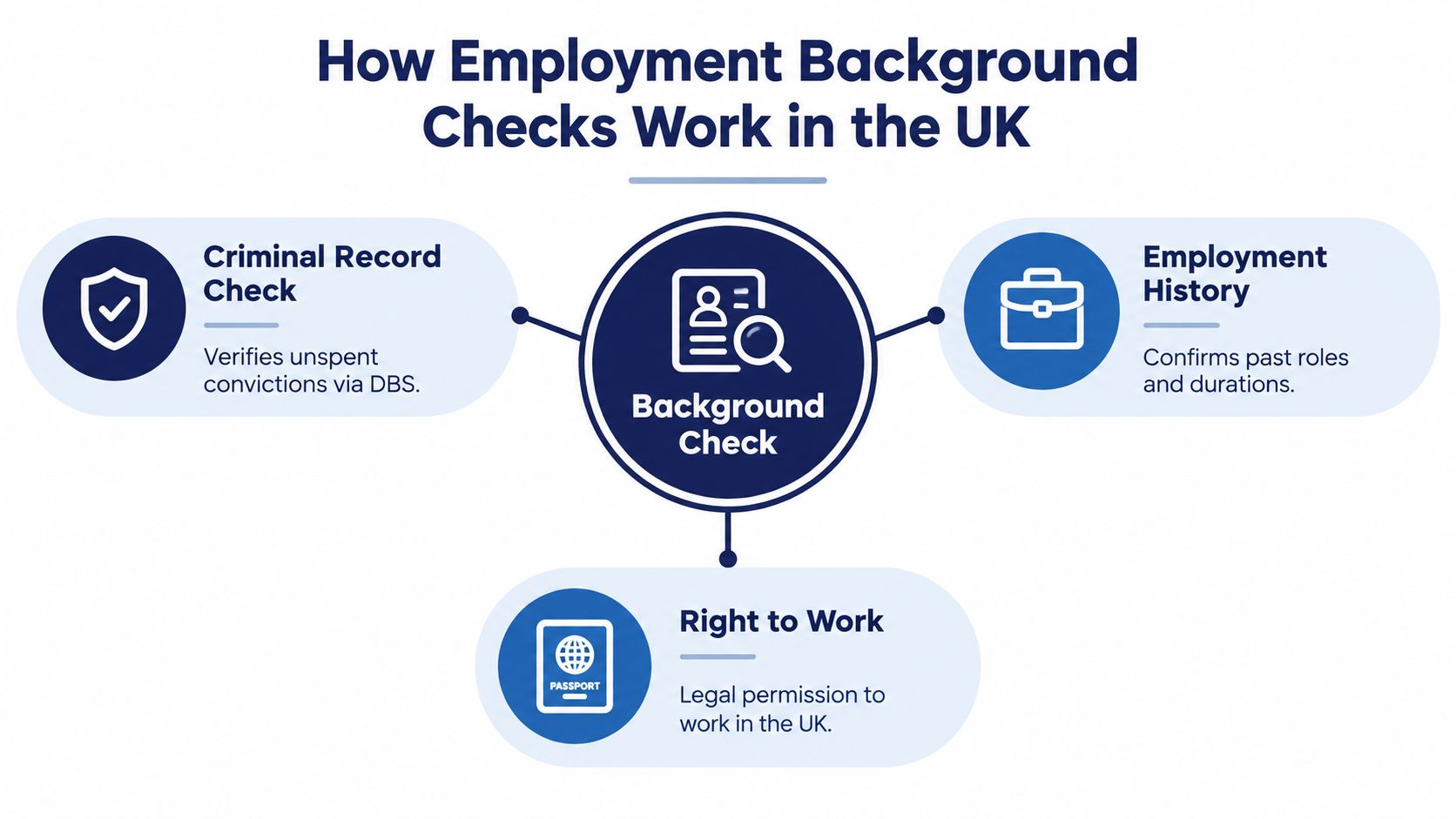
An employer hiring for an office role may need only identity, right to work and suitable references. A role involving vulnerable people, sensitive systems or valuable assets can raise different questions. Employment screening is therefore a set of targeted checks, not one universal search. Each check supplies one piece of the picture. A DBS certificate can provide criminal-record information, but it does not prove identity, employment history or immigration status.
Start with the question the role creates
Before requesting checks, define what the appointment decision needs to establish:
Who is this person? Identity verification connects the application to the individual being hired.
Can this person work legally in the UK? The right-to-work process must use the route that applies to the worker's status.
Does the stated history withstand checking? Employment verification can confirm roles, dates and employer details.
Is there relevant criminal-record information? The correct DBS level depends on the duties and the role's legal eligibility.
Does the position create additional exposure? Security-sensitive work may justify financial checks or more detailed enquiries.
A reference call answers a narrower question than a full screening process. A referee might confirm that the applicant worked for an organisation. A wider process can compare dates with the application, contact the employer through independently verified details and examine a gap that could affect suitability.
The NPSA personnel and people security guidance describes a security-sensitive baseline covering identity, employment history, right to work, criminal records and, where relevant, financial checks.
Checks should be layered, not excessive
For a lower-risk office role, identity, right to work and appropriate references may answer the main hiring questions. A regulated role, or work involving vulnerable people, may require a DBS check at a legally permitted level. A position involving sensitive assets may need further verification because dishonesty or concealment could have more serious consequences.
The aim is proportionate evidence. Ordering the most intrusive check for every applicant can create unnecessary intrusion, while relying on a basic check alone may leave material gaps. Good screening is structured, documented and tied to the actual duties.
Private investigator vetting can add value when ordinary checks leave a specific, important question unanswered. Sentry Private Investigators Ltd supports discreet background enquiries, employment verification and related investigative work for individuals and businesses. That support should supplement, rather than duplicate, standard DBS and right-to-work checks.
A short visual summary can help managers distinguish the checks before creating an internal policy.
Types of Background Checks for Jobs in the UK
A receptionist handling routine office work and a care worker supporting vulnerable adults present different hiring risks. The appropriate checks should reflect the duties, the law and the specific decision the employer needs to make. A DBS certificate is not a general character certificate, and the Enhanced level is available only where the role meets the legal criteria.
DBS disclosure levels
The UK system has four DBS levels. A Basic check shows unspent convictions and conditional cautions. A Standard check can show spent and unspent convictions, cautions, reprimands and final warnings. An Enhanced check includes relevant local police information. An Enhanced with Barred List checks certificate also searches the relevant Children's and/or Adults' Barred Lists (DBS level guide).
Check Type | What It Shows | Typical Use Case |
|---|---|---|
Basic | Unspent convictions and conditional cautions | Roles where a basic criminal-record disclosure is appropriate |
Standard | Spent and unspent convictions, cautions, reprimands and final warnings | Eligible regulated or professionally controlled roles |
Enhanced | Standard information plus relevant local police information | Eligible roles involving significant trust or safeguarding |
Enhanced with Barred List checks | Enhanced information plus the relevant barred-list search | Eligible work with children and/or vulnerable adults |
Right to work | Evidence of legal permission to work in the UK | Every appointment where the employer must establish a statutory excuse |
Employment references | Confirmation of past employment and relevant details | Most roles, especially where experience is central to the appointment |
Financial or credit checks | Relevant financial history where lawfully justified | Certain security-related posts and duties involving financial exposure |
Right to work evidence confirms permission to work, while references test whether an applicant's stated experience matches their employment history. Financial checks may be appropriate for some security-related posts, but only where the role and legal basis justify them. These checks answer different questions, so one cannot automatically replace another.
Speed doesn't remove the need for judgement
DBS processing can support prompt recruitment, but a quick certificate does not replace identity verification, references or an assessment of relevance. The certificate is one piece of evidence, like one tile in a wider picture. Employers still need to decide whether the information relates to the duties and what action is proportionate.
For small organisations, investigator-led employee screening may help where standard DBS and right to work checks leave a specific question about employment history or identity. Sentry Private Investigators Ltd can support discreet background enquiries and employment verification. That work should supplement the routine checks, not repeat them or turn every appointment into an unnecessarily intrusive investigation.
Legal Compliance and Data Protection for Background Checks
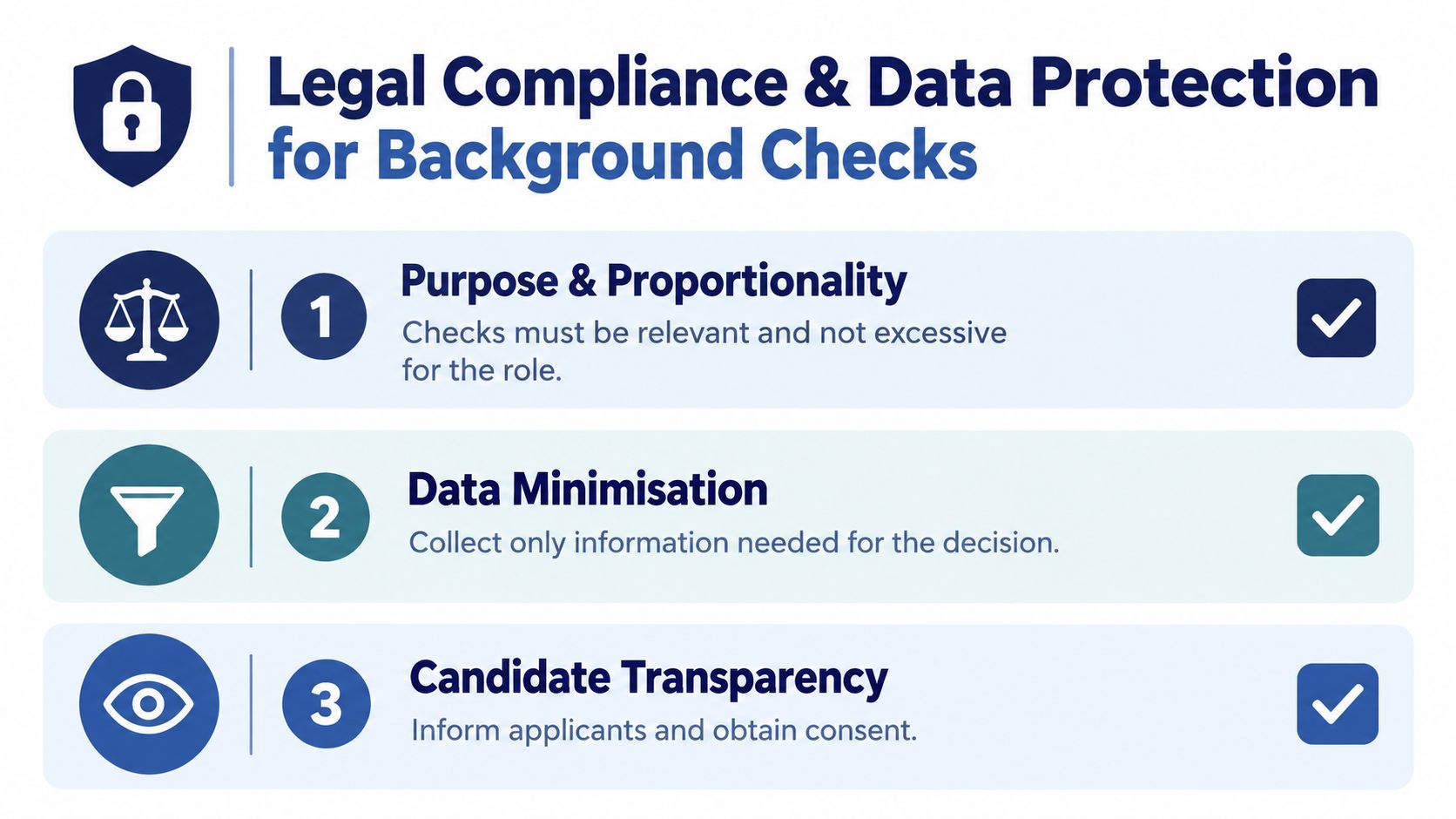
Employers need to answer two separate questions before screening. First, is this check relevant and legally available for the role? Second, can the information be handled fairly, securely and transparently? A check may be technically possible yet still disproportionate.
The Information Commissioner's Office advises employers to use vetting where there are particular and significant risks, seek information likely to reveal relevant facts and avoid collecting open-ended sensitive data. It also advises retaining vetting records for no more than 3 to 6 months after recruitment, unless a longer period is justified (ICO screening guidance).
Proportionality in practice
A proportionate policy links each check to a foreseeable risk. For example, a role handling vulnerable people may justify a permitted Enhanced check, while a lower-risk position may need only identity, right to work and employment verification. Criminal-record checks should use the recognised DBS, AccessNI or Disclosure Scotland routes rather than broad, informal collection of sensitive information.
Candidates should know what information is being requested, how it will be used and who will have access to it. Employers should also give applicants a fair opportunity to explain an apparent discrepancy, particularly where a record may be incomplete, misunderstood or unrelated to the duties.
Useful compliance questions include:
Purpose: What decision will this information support?
Authority: Is the employer legally entitled to request this level of check?
Relevance: Does the result relate to the duties and risks of the role?
Retention: When will the information be securely deleted?
Access: Which people need to see it?
For organisations building internal systems, it can also be helpful to review wider principles around compliance with self-hosting, especially where sensitive candidate information is collected, stored or transferred through digital tools.
Right to work carries a separate duty
The Home Office Code of Practice on preventing illegal working applies to right-to-work checks carried out from 13 February 2024, including follow-up checks required to maintain a statutory excuse (Home Office Code of Practice). Employers must use the correct process for the worker category and keep the required evidence.
Civil penalties can reach £45,000 per worker for a first breach and £60,000 per worker for subsequent breaches. Criminal liability may also arise where an employer knowingly employs, or has reasonable cause to believe it is employing, an illegal worker (UK hiring practices overview).
Best Practice Process for Running Background Checks
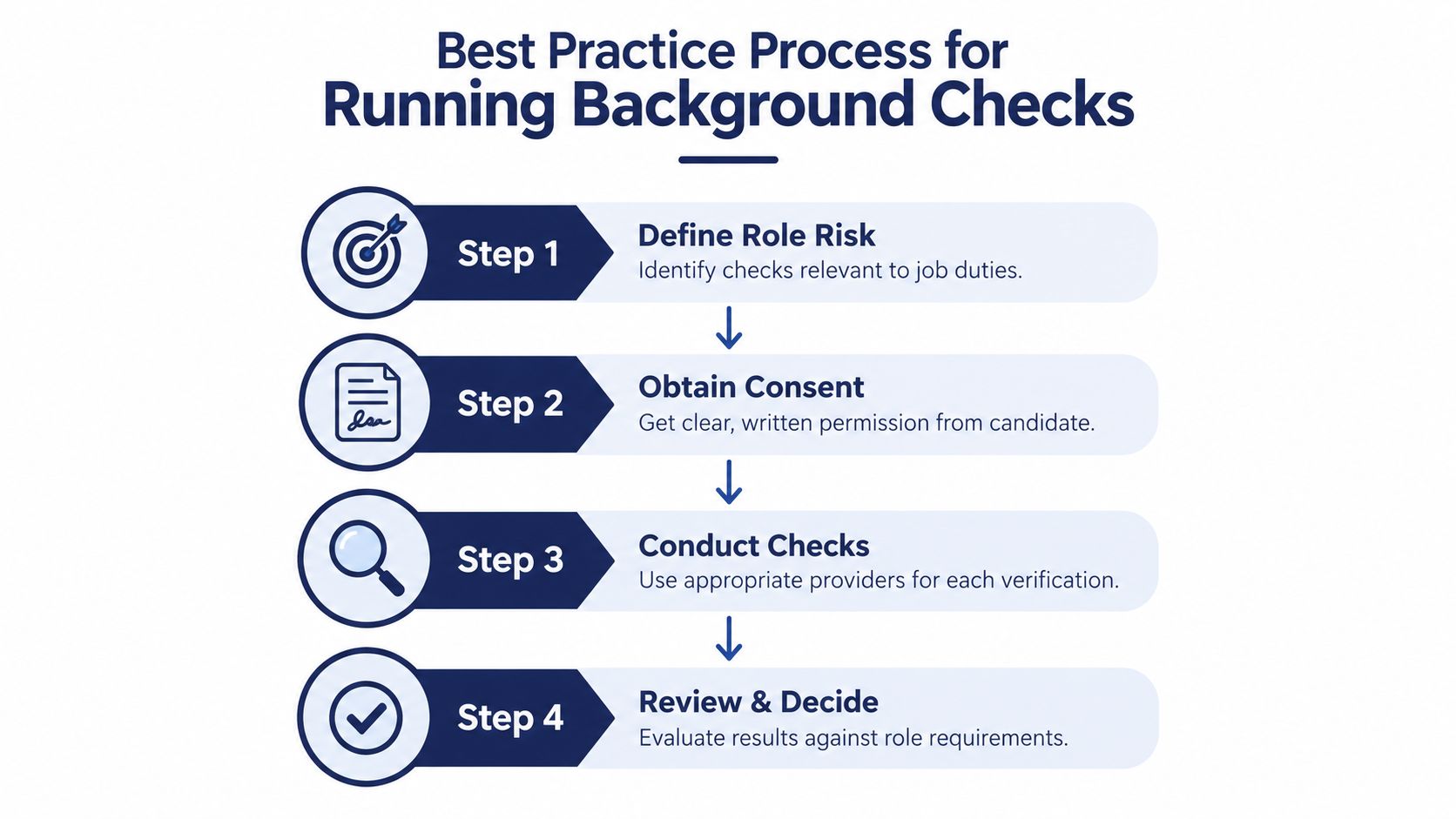
A candidate for a care role may need checks that differ from those for an office administrator. Start with the work itself, then match each check to a specific risk. This keeps routine hiring proportionate while directing deeper enquiries to roles where they can add value.
Define and explain the process
Step one, assess the role. Record whether the post involves children, vulnerable adults, money, confidential information, premises, vehicles or technical systems. A standard DBS check and right-to-work check may answer the main questions for a lower-risk appointment. A security-sensitive role may require a wider, documented review.
Step two, obtain consent. Explain what you will check, why it relates to the duties and how you will handle the information. Get the required permission before commissioning checks. Give the candidate a clear way to challenge information that appears inaccurate or incomplete.
Step three, verify the core facts. Confirm identity and use the appropriate DBS process where the role qualifies. For security-sensitive work, structured screening may cover at least three, ideally five, years of employment history, employer contact details, right-to-work evidence, criminal-record checks and, where relevant, financial checks. Record which elements apply and why, rather than ordering every available search.
Right-to-work verification follows three routes under current GOV.UK guidance:
Manual checks: Inspect and copy acceptable original documents using the prescribed process.
Digital verification: Use the relevant digital route for British and Irish citizens.
Online share-code checks: Use the Home Office online service for non-British and non-Irish citizens where applicable.
Expired physical BRPs cannot be accepted as proof of right to work. The document alone is not the answer. The method used must create the statutory excuse for that worker category.
Step four, review the result against the role. Check whether a flagged item is accurate, relevant and clear enough to support a fair decision. Record the reasoning, including why a standard check was sufficient or why further verification was justified.
Before appointing a supplier, compare its scope, process and data handling. Guidance on vendor selection for nonprofits can help organisations frame those questions. Employers developing a written workflow can also consult the Sentry Private Investigators UK guide.
When to Use Private Investigator Services for Deeper Vetting
Standard checks answer defined questions. They may not explain why an employment gap appears, whether a senior applicant's claimed business interests create a conflict or whether a CV contains a material inconsistency. Deeper vetting becomes appropriate when the unresolved issue is connected to a genuine role risk and ordinary checks can't clarify it.
Consider a finance director who claims responsibility for a business that cannot be verified through the supplied contact details. Or a contractor who has given overlapping employment dates while seeking access to confidential systems. A DBS certificate won't establish whether the professional history is complete, and a basic reference call may not be enough to resolve the concern.
Examples that justify further enquiries
A proportionate investigation may help with:
Senior appointments: Verify directorship claims, commercial associations, qualifications and significant career history.
Unexplained gaps: Establish whether a missing period reflects employment, relocation, illness, education or another relevant explanation.
CV discrepancies: Compare stated job titles, dates and responsibilities with independently obtained information.
Moonlighting concerns: Examine whether outside work conflicts with contractual duties, working time expectations or confidential information.
Sensitive access: Add discreet due diligence where the employee will handle valuable assets, trade secrets or high-value client information.
The method should remain lawful and focused. It shouldn't become a licence to intrude into irrelevant private life, contact people unnecessarily or collect information that doesn't affect the appointment. Employers considering a wider framework for data-driven HR risk management can use role-based risk assessment to decide whether deeper enquiries are justified.
What specialist support adds
A professional investigator can structure enquiries around specific questions, trace employment gaps, verify claims through independent channels and produce a clear report for the decision-maker. Confidential handling also matters where premature contact could damage a candidate's reputation or alert someone to an internal concern.
For employers that need a customized approach, private detective services can sit alongside DBS, right-to-work and reference checks rather than replace them. Sentry Private Investigators Ltd provides discreet corporate investigations and background verification support, including work for businesses dealing with due diligence, suspected misconduct or other employment-related concerns.
Making Confident Hiring Decisions With the Right Checks
Good screening isn't a race to collect the largest file. It's a reasoned decision about the information needed for a particular job.
A practical framework is straightforward:
Define the risk: Identify what the employee can access and whom the role may affect.
Select the lawful check: Use the DBS level, right-to-work route and reference process that match those duties.
Protect candidate data: Explain the process, minimise collection, restrict access and retain records only as long as justified.
Investigate genuine uncertainty: If a material discrepancy remains, consider specialist support rather than guessing.
Document the decision: Record how the evidence relates to the role and why the outcome is fair.
The DBS system's scale, the Home Office right-to-work rules and data-protection principles all point to the same conclusion. Proportionate, verifiable screening protects employers and candidates at the same time. It supports safer appointments without turning every applicant into a subject of unrestricted investigation.
For confidential help with employment verification, candidate due diligence and risk-focused background enquiries, contact Sentry Private Investigators Ltd through its Birmingham head office. The firm provides discreet support across the UK and can help employers choose a compliant, evidence-led approach before making an important appointment.
Sentry Private Investigators Ltd offers discreet employment background checks, employment verification and customised corporate investigations for UK employers. Visit Sentry Private Investigators Ltd to discuss the specific role, concern or screening decision you need to resolve.