
Radio Frequency Signal Detector: A Practical UK Guide

A business owner in Birmingham called after noticing that a confidential pricing strategy was reaching competitors before negotiations had finished. There was no proof of a leak, but a faint beep near the desk phone, unexplained battery drain on a phone left in a meeting room, and sensitive information appearing in unexpected places had changed a vague worry into an active concern.
That pattern is familiar. Suspicion alone doesn't establish that a listening device is present, yet dismissing repeated anomalies can leave a genuine problem unchecked. The sensible starting point is understanding what a radio frequency signal detector can hear, what it can't hear, and when a professional technical surveillance countermeasures, or TSCM, investigation is justified. These practical eavesdropping detection tips can help you record concerns before you decide what to do next.
When You Start Suspecting a Hidden Device
A faint click on a landline, a phone that loses charge in a meeting room, or sensitive information appearing outside its expected circle can make surveillance seem possible. Each sign also has ordinary explanations, including network activity, faulty power supplies, wireless equipment, and building noise. Treat the pattern seriously, while keeping each observation separate from the conclusion.
A professional investigator treats these details as leads to test. The aim is to preserve useful evidence and avoid actions that compromise it. Do not move furniture, open electrical fittings, dismantle phones, or confront a suspected person before taking advice. Handling an item can disturb its position, change its condition, or make its discovery harder to interpret.
Turning anxiety into a useful record
Record what happened, when it happened, and who had access to the relevant room or vehicle. Note the exact words or information that appeared elsewhere, rather than writing only that something confidential was disclosed. These practical eavesdropping detection tips can help organise those observations before deciding whether to escalate.
Useful observations include:
Unusual sounds: Record whether clicking, buzzing, or beeping occurs during a call, in silence, or at a particular time.
Unexpected information: Log what was disclosed and who could reasonably have known it.
Device behaviour: Note battery drain, unexplained heat, unfamiliar Bluetooth entries, or changes to a vehicle.
Room activity: Identify the desk, meeting room, office, bedroom, or car connected with the concern.
A radio frequency signal detector may identify an active transmitter nearby. It cannot, by itself, establish who placed the device, what information it carries, or whether an innocent wireless source caused the alert. An inactive recorder, shielded device, or transmitter operating outside the detector's coverage may produce no useful indication.
That distinction protects judgement as well as equipment. A calm record supports a proportionate assessment, whether the next step is monitoring, a basic technical check, or a professional TSCM investigation.
Practical rule: Treat suspicion as a reason to preserve observations and seek proportionate advice, not as confirmation that surveillance is taking place.
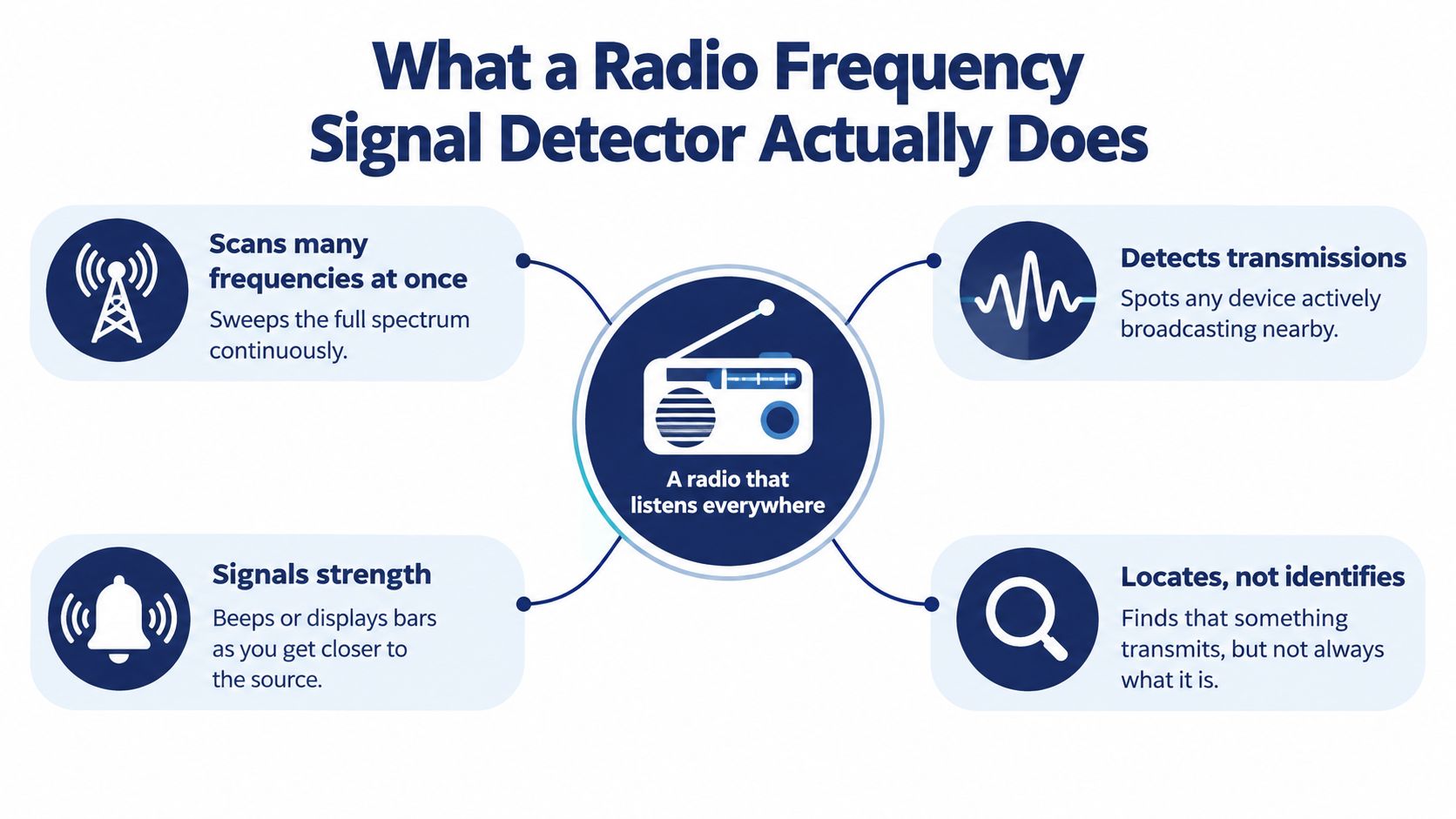
What a Radio Frequency Signal Detector Actually Does
The simplest analogy is a radio that listens across many frequencies at once. Instead of tuning to one station, an RF detector surveys a defined portion of the spectrum and alerts the operator when it encounters radio energy that may indicate a nearby transmission.
A handheld unit typically contains an antenna, receiver circuitry, signal-processing components, and an indicator such as a tone, display, or light bar. Some devices scan a broad range, while others concentrate on selected bands used by common mobile, Wi-Fi, Bluetooth, or other wireless equipment. The coverage is never unlimited, so the detector's frequency range is the first technical question to ask.
Two ways the equipment listens
Broadband energy detection looks for radio-frequency energy across a wide span. It can be quick and useful during an initial walk-through, particularly when the operator wants to notice a strong nearby transmission without knowing its exact frequency.
Frequency-specific sweeping examines selected parts of the spectrum in more detail. A spectrum analyser can show where energy appears, how wide the signal is, whether it repeats, and how its strength changes as the operator moves around the room.
Several terms appear in equipment descriptions:
Carrier: The radio-frequency wave used to carry information. A detector may register the carrier without revealing the conversation, image, or data being transmitted.
Burst transmission: A device that transmits briefly, then remains quiet. A short alert may be easy to miss if the sweep happens at the wrong moment.
Hopping spread spectrum: A transmission that changes frequency according to a pattern. A narrow detector may see only fragments, or nothing useful, if it doesn't cover the relevant range.
Signal strength: A measurement that can help indicate proximity. Stronger readings often help with locating a source, but reflections and nearby transmitters can distort the result.
The detector generally tells you that radio energy is present, not that a hidden camera or listening device is definitely responsible. Mobile phones, wireless routers, cordless phones, vehicle systems, and building equipment can all produce alerts. Identification requires controlled testing, known-device comparison, physical inspection, and suitable specialist equipment.
Strengths and Honest Limitations of RF Detection
RF detection is valuable because it can quickly expose an active transmitter. A live GSM bug, Wi-Fi camera, active GPS tracker, or wireless audio device may create a detectable emission while it communicates with another system.
It is also a useful way to understand the radio environment around a property. Ofcom's 2025-26 annual report records 1,528 interference complaints, 3,826 radio-system licence-compliance checks, 15 fixed penalty notices, and 1 prosecution for criminal spectrum activity. Those figures describe the wider enforcement environment, not a promise that a detector will find a covert device. They show why unexplained radio activity can require technical assessment rather than a product-led assumption.
What the detector can and can't tell you
A strong reading near a desk may justify isolating the area and testing nearby equipment. A weak or intermittent reading may need repeated observation, directional antennas, and a comparison with the building's normal wireless activity.
Capability | RF Detection Performance |
|---|---|
Active wireless transmitter | Often useful for identifying nearby radio energy |
Live Wi-Fi or GSM device | May produce a clear alert if within range and coverage |
Burst-transmitting equipment | Easy to miss if the timing is wrong |
Dormant audio recorder | Usually invisible while it isn't transmitting |
Hardwired device | Not detected through RF if it communicates only through a wired route |
Device outside the scanned range | Invisible to equipment that doesn't cover its frequency |
Ordinary wireless equipment | Can create false positives requiring investigation |
The important limitation is simple: RF detection finds emissions, not every form of surveillance. A dormant recorder may store audio without transmitting. A device switched on remotely may remain silent during the sweep. A hardwired bug drawing power from a target line may never create the radio signature a handheld detector expects.
These limits are why a detector can't solve every privacy or interference problem. The broader UK spectrum picture includes structured licensing, interference management, and activity across newer frequency plans. A device may transmit in bursts, hop bands, use low power, or operate outside the detector's tuned range. In a serious case, the right answer is a detection strategy that combines timing, physical searching, and technical analysis.
How Professional TSCM Bug Sweeps Use RF Detection
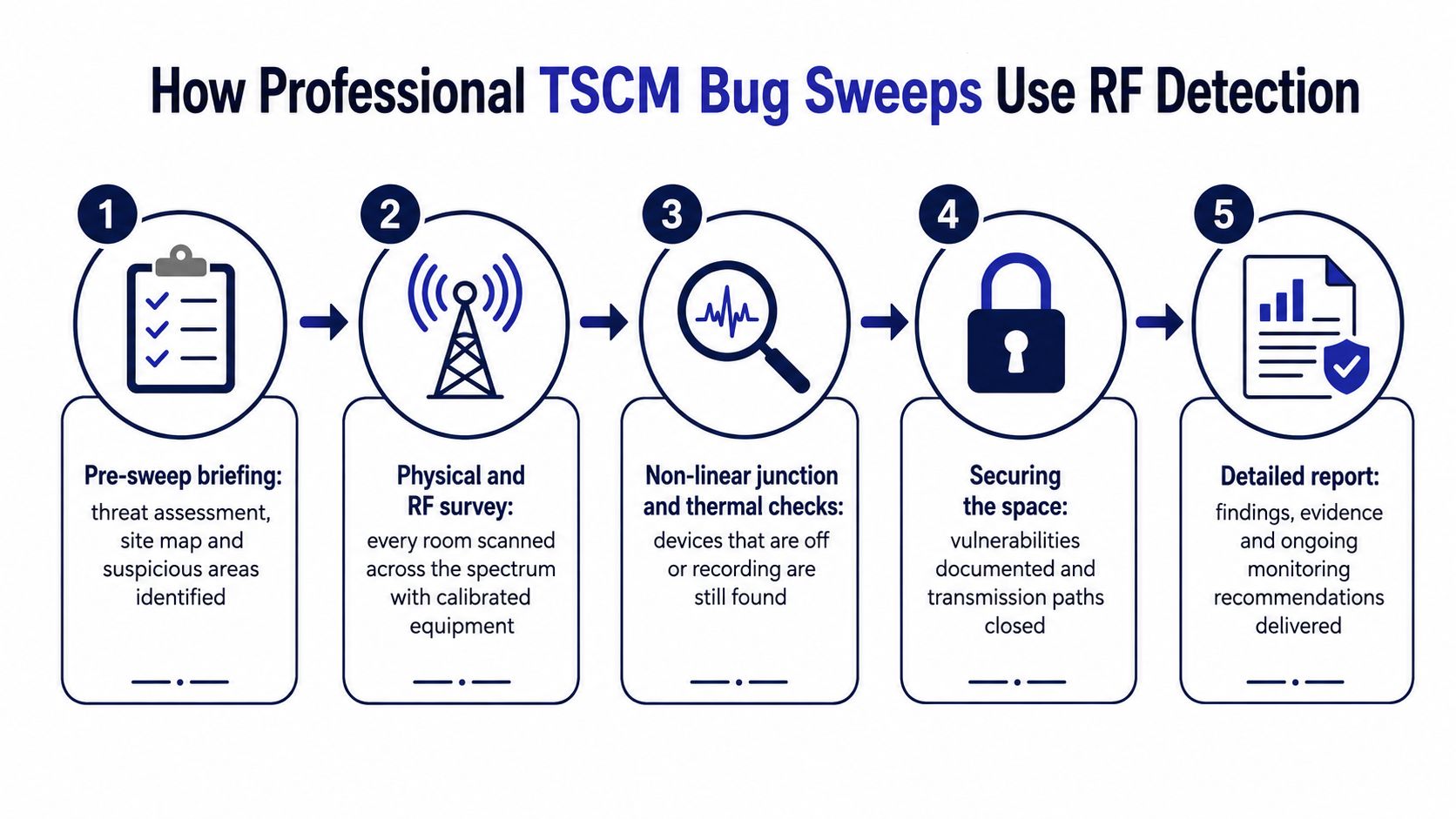
A professional sweep doesn't start with somebody walking around waving a detector until it beeps. It starts with a confidential briefing. The investigator establishes what information may be at risk, which locations matter, who has access, whether a vehicle or electronic system is involved, and whether the concern relates to a business dispute, domestic situation, litigation, or suspected criminal conduct.
The investigator then builds a baseline. A spectrum analyser records the normal radio environment in the target room, including expected network and building signals. Without that baseline, an alert may merely reflect the client's own router, a neighbouring property, a cordless phone, or a device that was already present before the concern arose.
RF scanning inside a layered search
During the active phase, the investigator sweeps relevant frequencies, isolates anomalies, and uses directional antennas to assess where a signal originates. The signal is then compared against known device signatures and the baseline survey. Own phones, routers, smart speakers, access points, and other transmitters are controlled or disabled where practical, so they don't obscure the result.
RF work runs alongside other examinations:
Physical inspection: Furniture, fixtures, sockets, chargers, vehicles, and accessible voids are examined for altered, unfamiliar, or concealed items.
Thermal inspection: Heat patterns may reveal powered equipment that isn't transmitting at the time.
Carrier-current analysis: Electrical lines can be assessed for unusual signals carried through wiring.
Non-linear junction detection: Semiconductor junctions may be located even when a device is switched off.
Repeat testing: The site may be checked at different times, after business hours, or when the suspected threat is more likely to be active.
The exact method depends on the site and the threat assessment. A boardroom with managed wireless infrastructure creates a different baseline from a family home or vehicle. The purpose of TSCM bug sweeping is to combine those layers into a reasoned finding, rather than treating one detector alert as a verdict.
A proper report should record signal logs, locations examined, anomalies, threat classification, photographs where appropriate, and remediation advice. It may also recommend changes to access control, wireless configuration, meeting practice, or a later re-sweep if the risk continues.
Consumer Gadgets Versus Professional TSCM Equipment
A high-street detector can be a reasonable first-pass tool when the concern is limited and the consequences are modest. It may alert you to a strong nearby transmission, but the result is only as useful as the equipment's coverage, sensitivity, controls, and the operator's ability to interpret it.
Professional equipment gives the investigator a more detailed view. UK-market Siretta detectors listed by RS include models covering 700 MHz to 2.6 GHz and another covering 400 MHz to 5.2 GHz. Some units are specified for operating conditions from -40°C to 85°C. Those figures illustrate why frequency coverage matters, especially when a suspected device may use a sub-GHz transmitter or a higher wireless band.
Feature | Consumer RF Detector | Professional TSCM Kit |
|---|---|---|
Frequency coverage | Often concentrated around familiar consumer bands | Selected to match the threat assessment and site |
Sensitivity | May miss low-power or intermittent emissions | Designed for controlled searching and comparative measurement |
Display | Light bars, tones, or simple numerical indication | More detailed views of strength, bandwidth, and signal behaviour |
Antennas | Usually a basic integrated antenna | Interchangeable or directional antennas for locating sources |
Logging | Often limited or absent | Signal records and observations can support a formal report |
Interpretation | Requires the buyer to distinguish ordinary devices from anomalies | Experienced operator correlates technical readings with physical findings |
False positives are common around Wi-Fi access points, DECT phones, mobile handsets, Bluetooth equipment, and neighbouring premises. Cheap equipment can also make a quiet room look suspicious just because it cannot separate signals well. A professional receiver doesn't make interpretation automatic, but it gives the operator better information.
Choosing the right level of kit
Look for a frequency range that fits the suspected threat, sensitivity suitable for low-power signals, a display that provides more than a single alert, and the ability to use the equipment in a controlled, repeatable way. If your concern involves a wireless network rather than physical eavesdropping, a separate security review may be more appropriate. For businesses dealing with rogue access points, the resource on how to turn Wi-Fi complaints into revenue offers useful context about treating network concerns as an operational issue rather than automatically labelling them a bug.
A consumer detector can support awareness. It shouldn't be presented as a substitute for a professional sweep where confidential negotiations, personal safety, legal evidence, or corporate reputation are at stake.
UK Legal and Regulatory Considerations for Detector Use
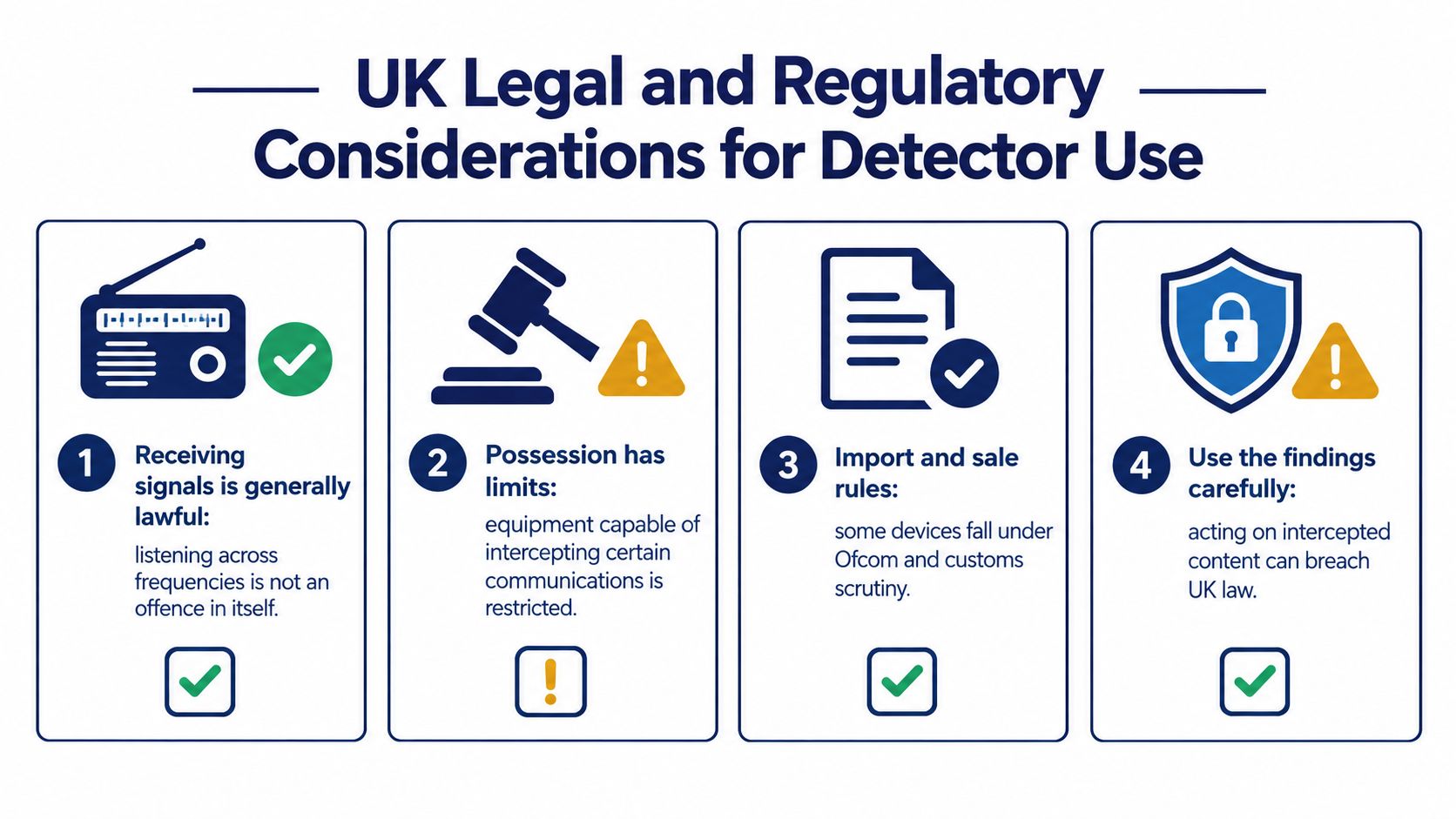
In the UK, radio equipment sits within a regulated spectrum framework. Ofcom explains that using radio communications equipment without an Ofcom licence or a licence exemption is illegal, and conviction can carry imprisonment and an unlimited fine. Most radio receivers are licence-exempt unless they're also capable of transmission, which is why a passive radio frequency signal detector is generally closer to receiving equipment than transmitting equipment. The practical starting point is Ofcom's guidance on radio equipment and the law.
The distinction matters when buying, importing, or deploying equipment. A receiver that only listens is treated differently from equipment that transmits, jams, repeats, or interferes with licensed services. The Radio Equipment Regulations 2017 govern products placed on the GB market, with Ofcom enforcing radio-spectrum compliance and Trading Standards handling other safety aspects.
Regulation is frequency-specific
The UK's approach has long relied on precise technical limits. The Wireless Telegraphy RFID Exemption Regulations 2005 came into force on 31 January 2006 and specified operation in the 865 MHz to 868 MHz band, with channel, bandwidth, interference, and power conditions. The lesson for detector users is that radio activity isn't governed by a broad permission to use anything that appears online. Frequency, power, function, and interference all matter.
Ofcom's interface requirements also show how directly spectrum decisions can affect equipment. A proposal concerning closure of the 10.675 to 10.699 GHz band gave 18 months' notice, while existing equipment could continue only if it didn't cause interference. Buyers should therefore check the current position before importing wideband or unusual equipment.
Use these practical safeguards:
Confirm function: Establish whether the device only receives or can transmit.
Check the market status: Buy equipment intended for lawful UK use and retain its documentation.
Avoid interference tools: Don't use jammers, unauthorised repeaters, or equipment designed to disrupt communications.
Protect intercepted material: A sweep can document technical findings, but listening to or sharing communications may raise separate legal issues.
Preserve evidence properly: If a finding may support employment, family, or criminal proceedings, obtain legal advice about collection, continuity, and disclosure.
When It Makes Sense to Hire a Private Investigator
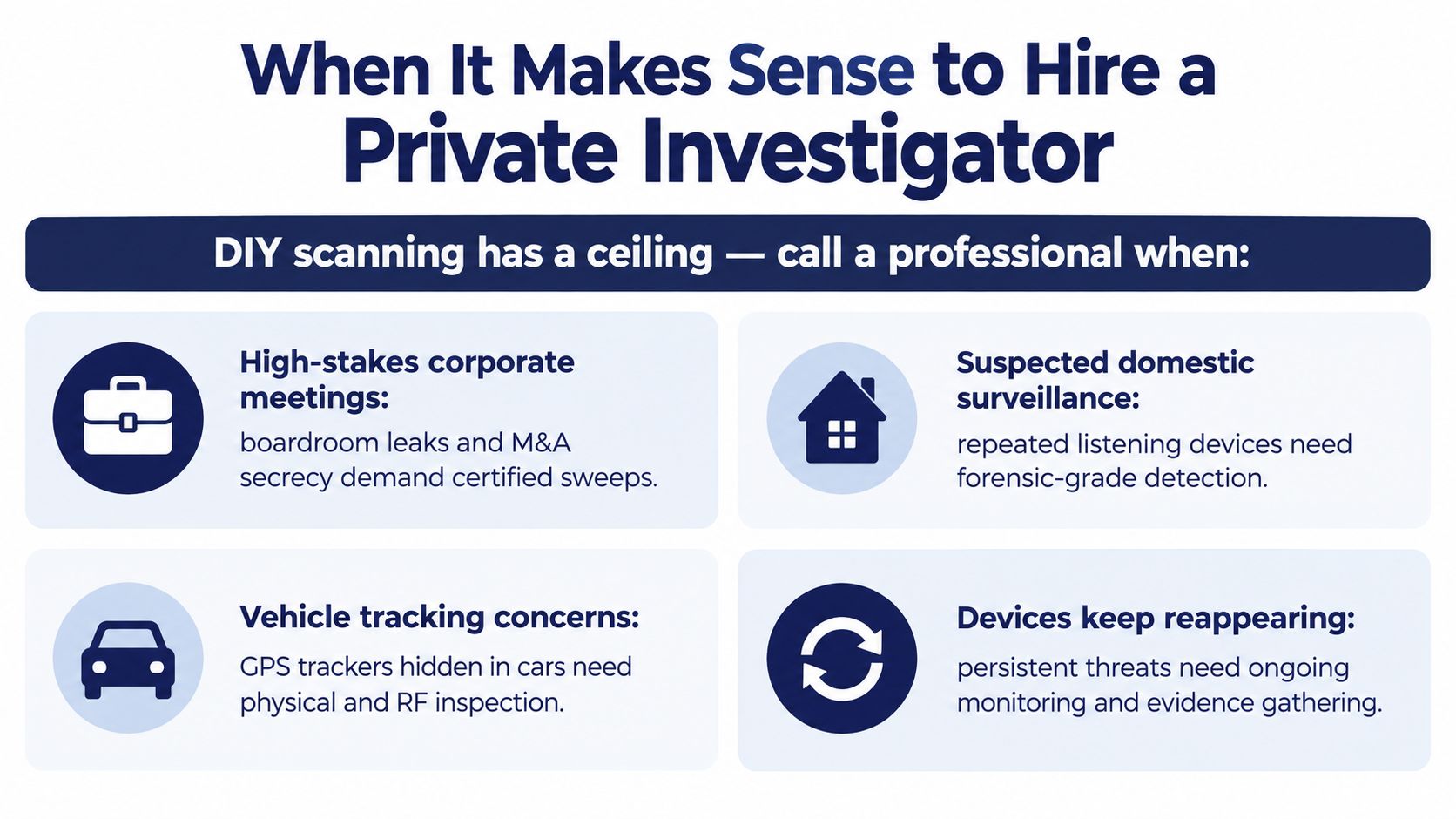
A detector alarm during a confidential meeting, an unexplained device in a vehicle, or a former partner appearing to know private conversations changes the decision. Consumer scanning may provide an early indication, but missed equipment can carry serious consequences when the device is intermittent, hardwired, dormant, physically concealed, or positioned to exploit the limits of basic kit.
Professional help becomes more valuable when you need a defensible record. A flashing handheld detector does not establish what transmitted, where it was located, or whether the signal came from a legitimate source. A qualified investigator can record photographs, signal logs, examination notes, test conditions, and the limits of the conclusion. Solicitors, HR advisers, insurers, and courts will examine how evidence was gathered, preserved, and interpreted.
Four situations that justify professional input
Corporate confidentiality: Board meetings, acquisition discussions, pricing decisions, and sensitive negotiations need more than a quick sweep. The investigator can establish the normal radio environment, control known transmitters, and examine rooms before and after important meetings.
Domestic surveillance: Repeated concerns about a former partner or another person knowing private movements or conversations should be treated as a safety matter. The work may cover the home, personal belongings, and vehicle, while preserving messages, access records, and other relevant information.
Hardwired or dormant equipment: RF scanning cannot reveal every recorder. Physical inspection, thermal checks, carrier-current analysis, and non-linear junction detection address different ways equipment can avoid radio detection.
Evidence requirements: Employment disputes, divorce matters, and court-related cases require careful documentation. The investigator should explain what the equipment showed, what testing ruled out, and what remains uncertain without overstating the result.
Professional TSCM work depends on judgement as well as equipment. Reflections, shared walls, wireless infrastructure, building services, and restricted access can distort readings or limit the examination. A suitable practitioner uses a recognised methodology, considers site-specific clearances such as NRQZ requirements where relevant, and produces reporting that a solicitor can assess.
A private investigator can coordinate technical surveillance with tracing, background checks, physical surveillance, or evidence gathering when the circumstances extend beyond a device search. Choose based on the risk, scope, reporting needs, and investigator's method, not the detector's price alone. A leaked transaction, compromised source, dismissed confidentiality claim, or continued domestic monitoring may cost far more than a properly scoped examination.
Practical Next Steps and Common Questions Answered
A sensible decision checklist is short:
Try a basic detector cautiously: This may be reasonable if you suspect an active Wi-Fi or GSM device and the consequences are limited.
Record anomalies: Use dates, times, locations, sounds, access details, and photographs. Don't dismantle suspected equipment.
Control your own signals: Note routers, phones, Bluetooth devices, cordless phones, and vehicles that may produce alerts.
Escalate proportionately: Contact a vetted UK investigator if the matter involves a business, legal dispute, domestic stalking, personal safety, or repeated unexplained findings.
Protect the scene: Avoid confronting anyone or moving a suspected device until you've obtained advice.
Questions clients usually ask
How much does a UK TSCM sweep cost?There isn't a reliable universal figure. Cost depends on the property or vehicle, the number of areas, the threat assessment, travel, equipment, reporting requirements, and whether repeat visits are needed. Ask for a written scope rather than comparing headline prices alone.
Can an RF detector find hidden cameras?It may identify a camera that is actively transmitting by radio. It won't necessarily find a camera that records locally, remains dormant, uses a wired connection, or operates outside the detector's coverage. Physical and technical inspection are still required.
Can I use my phone instead of a dedicated detector?A phone can help you note unfamiliar wireless activity or document observations, but it isn't a calibrated TSCM instrument. It won't provide the coverage, sensitivity, directional control, or independent testing needed for a serious sweep.
How long does a sweep take for a typical three-bed house?There isn't a dependable standard duration. The layout, contents, access, vehicle involvement, threat level, and depth of examination all change the work. A responsible investigator will assess the property before confirming scope and timing.
What evidence can a private investigator provide to a solicitor?Depending on the findings, this may include a written report, site notes, photographs, signal logs, equipment details, locations examined, identified devices, and remediation recommendations. Whether material is admissible depends on the facts and how it was collected, so legal advice should be obtained where proceedings are likely.
Early action usually gives you more options than late regret. Start with careful observation, avoid making claims the equipment can't support, and bring in experienced help when the risk is personal, commercial, or legal.
Sentry Private Investigators Ltd provides discreet TSCM bug sweeping using RF analysis alongside physical and technical inspection for homes, vehicles, and business premises. If you're concerned about a radio frequency signal detector alert or possible eavesdropping, contact Sentry Private Investigators Ltd to discuss a confidential, proportionate investigation.