
Private Investigator Rates UK: Pricing Explained

UK private investigator pricing commonly sits between £40 and £200+ per hour, depending on region, case type and evidence requirements, with most client work clustering around £50 to £75 per hour. The final invoice depends less on the headline rate than on how many operatives, hours, vehicles and reporting tasks your case needs.
You may be reading this because something doesn't add up. A partner's movements have changed, an employee's absence claim looks doubtful, or someone who owes you money has disappeared. You want a clear answer, but the first quote you receive may only show an hourly figure with little explanation of what happens after the clock starts.
That isn't good enough. Before you instruct a firm, you should understand what the rate covers, which choices increase the cost, and where a supposedly cheap quote can produce weak evidence. A well-scoped investigation gives you control over the invoice without compromising the result.
What You Actually Pay For When You Hire a UK Private Investigator
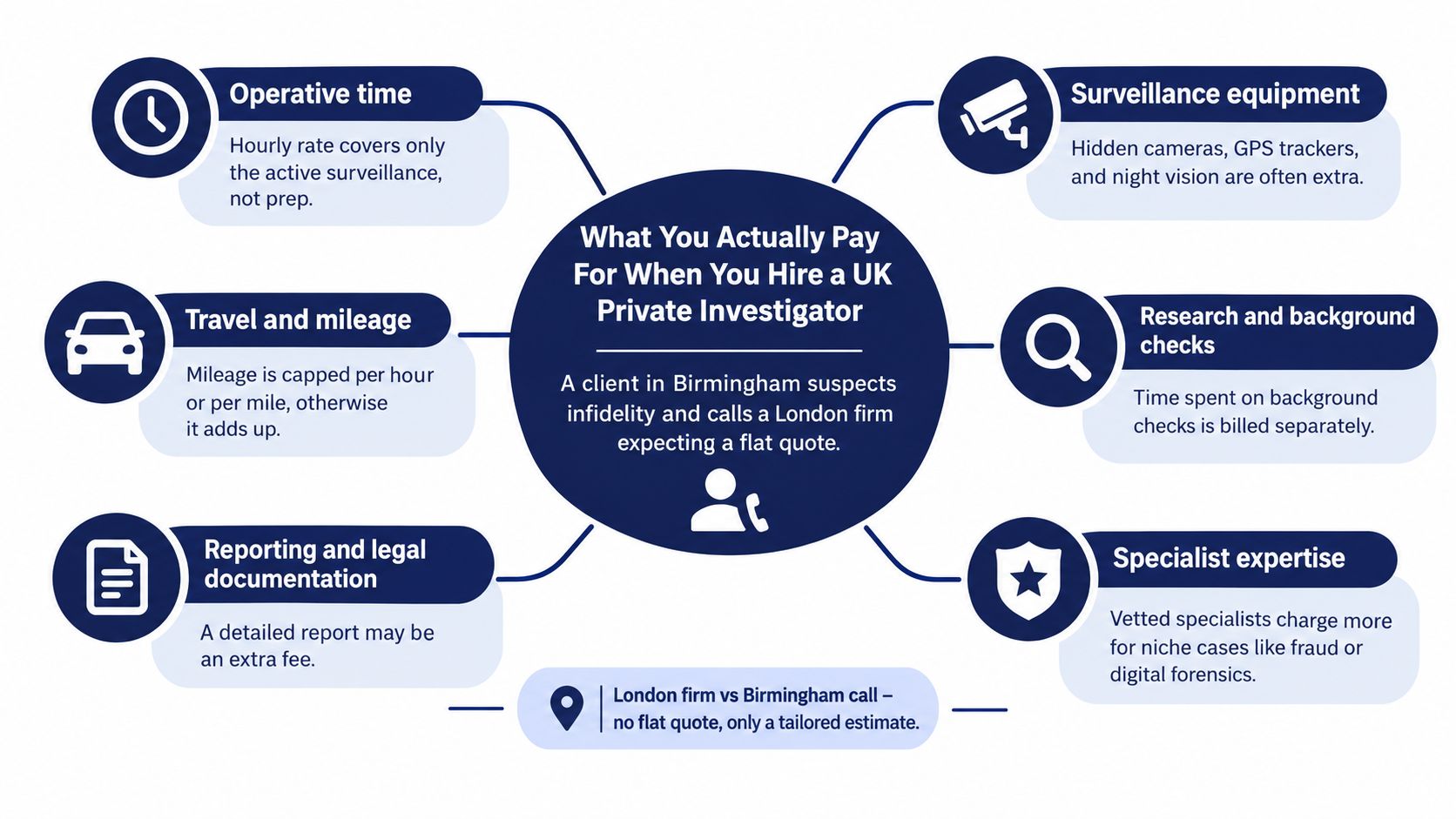
A client in Birmingham suspects a partner of infidelity and calls a London firm expecting a flat quote. The firm asks where the subject lives, what vehicle they use, when they're likely to leave home, whether they travel for work and what evidence the client needs. That isn't evasive. Those details determine the deployment.
You aren't paying someone to sit in a car. Your fee may cover:
Operative time: Surveillance hours, preparation, route planning and handovers.
Vehicles and travel: Fuel, mileage, parking, tolls and positioning near the subject.
Equipment: Cameras, long lenses, communications equipment and other case-specific tools.
Research access: Background checks, people tracing and lawful database enquiries.
Reporting: Time spent reviewing footage, selecting still images and preparing a readable chronology.
Professional protection: Insurance, administration, secure storage and compliance processes.
The private detective services you compare should explain these components before you pay a retainer. A rate that excludes report writing or travel isn't necessarily cheaper. It may move those costs into separate lines later.
Fieldwork and desk work aren't priced alike
Licensed surveillance work normally involves an operative, a vehicle, observation equipment and the risk of losing sight of a subject. A desk-based trace or background enquiry can often be completed from an office, although it still requires skilled research and lawful handling of personal data. Treating both services as interchangeable is a reliable way to misunderstand a quote.
The UK market reflects that difference. Consumer pricing is commonly reported at £40 to £95 per hour, with many agencies placing typical client rates between £50 and £75 per hour. Complex surveillance or corporate investigations can reach £120 per hour or more, while simple fixed-fee people tracing may start at about £150. See the UK private investigator cost guidance for the underlying market discussion.
Three models appear repeatedly: an hourly rate for flexible short assignments, a day rate for sustained deployment, and a fixed fee for a defined task. Your control comes from deciding the surveillance window, the number of operatives and the evidence standard before work begins.
Hourly, Day Rate and Fixed Fee Pricing Models Compared
If you need one evening check, hourly billing may keep the initial commitment low. If the subject's movements must be followed across a full day, a day rate gives you a defined operational window. A fixed fee provides the clearest budget when both the task and the final deliverable are specific.
Pricing Model | Typical UK Range | Best Suited To |
|---|---|---|
Hourly | £40 to £95 per hour, with complex work reaching £120 per hour or more | Short surveillance, urgent checks and flexible domestic enquiries |
Day rate | £500 to £1,200 per operative per day for covert surveillance | Sustained observation, complex infidelity matters and fraud investigations |
Fixed fee | From about £150 for simple people tracing, with digital investigations quoted case by case | Defined traces, background research and specified reports |
The hourly range reflects reported UK private investigator pricing. The day-rate guidance from UK surveillance cost guidance indicates that a surveillance package may cover the operative, vehicle, equipment and written evidence report. Confirm those inclusions before comparing quotes, because a lower headline rate can produce a higher invoice once travel, preparation or reporting is added.
Choose hourly for a controlled window
Hourly billing suits a short assignment with a credible time limit. Examples include an evening observation, a departure check or a brief workplace enquiry. Tell the investigator when the work should stop, then ask whether preparation, travel, waiting and abortive time are charged separately.
The main risk is an open-ended retainer. If the subject does not appear, or the enquiry produces no immediate answer, the clock can continue running.
Choose a day rate for sustained surveillance
A day rate fits cases where one short observation cannot establish a reliable pattern. Infidelity, fraud and absence investigations may require continuous coverage, vehicle planning and a clear evidence trail. The quoted day rate is usually based on each operative, so two-person coverage can double the fieldwork cost while reducing blind spots and improving continuity when a subject changes direction.
Ask whether the day ends at a fixed time and whether extra hours require approval.
Choose a fixed fee for a defined result
A fixed fee works when the investigator can state exactly what will be checked and what report will be delivered. People tracing, a specified background check and a limited corporate enquiry may fit this model. It is a poor choice for an investigation that must continue until an unknown answer appears, because the agreed scope will eventually run out.
Practical rule: Match the pricing model to the uncertainty and operational control in your case. Set the surveillance window, operative count and deliverable before accepting the quote.
What Drives the Cost of a Private Investigator Up or Down
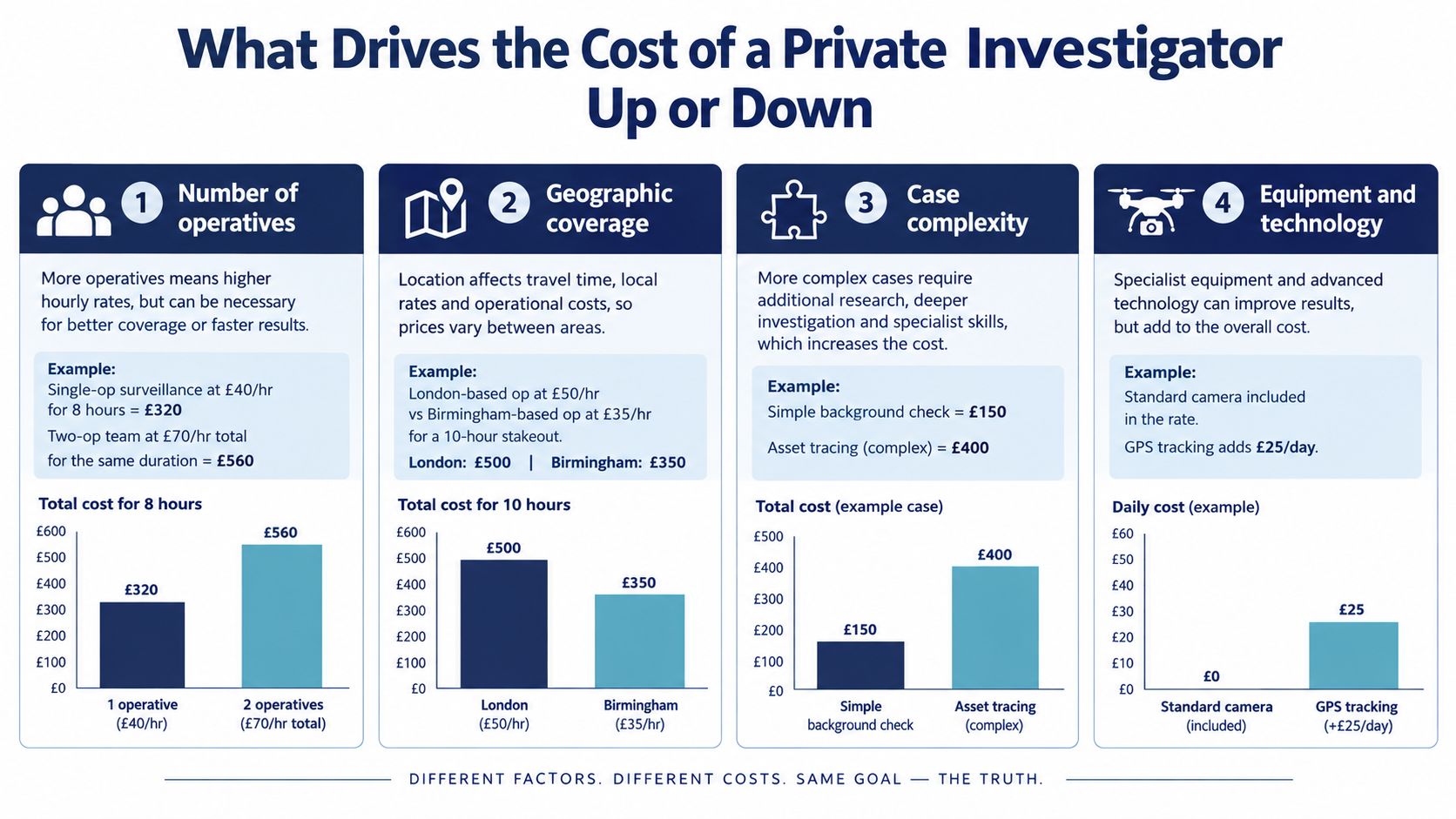
A client asking for one evening of surveillance may receive a very different invoice from a client requesting two operatives across a full weekend. The hourly rate matters, but the deployment decision controls the total. Set the coverage window, operative count and stopping point before authorising work.
The UK market commonly sits around £50 to £150 per hour, with a broader observed range of £40 to £200+ per hour. Location, case complexity and agency calibre affect the figure, as outlined in UK private investigator cost information. Treat those figures as a starting point, not a national tariff.
The levers you can control
Coverage length: A four-hour evening observation costs less than a twelve-hour weekend operation. Longer coverage demands more planning, stamina and, in some cases, a handover between operatives.
Operative count: One operative can suit a static subject and a simple route. Two operatives provide better continuity when a subject changes direction, enters a busy area or needs to be followed without losing visual contact.
Travel: Work outside the investigator's base may add mileage, parking, tolls and positioning time. Confirm whether these items are charged separately or at the investigation rate.
Equipment: A standard camera may be included. Specialist lenses, night equipment or vehicle technology can add charges when the assignment requires them.
Urgency: Same-day deployment restricts scheduling options and may carry a premium.
Reporting depth: A short factual note takes less time than a chronology with indexed stills and reviewed footage. Specify the report you need before comparing quotes.
Compare the operational choices, not just the quote
A Birmingham client needing surveillance linked to London should compare deployment plans, not just regional rates. A local operative may spend billable time travelling and positioning. A London-based operative may begin closer to the subject while charging more for the assignment. One operative over a limited window may cost less. Two operatives over a wider window may prevent repeated attempts after a failed observation.
A precise saving cannot be assessed without a written scope. Compare the same subject, dates, hours, reporting standard, travel assumptions and operative count. Change one variable at a time and the invoice becomes easier to predict.
Ask: “What deployment do you recommend, what does it include, and what event would increase the estimate?” The answer should identify the likely retainer, the approved surveillance window and the point at which extra work needs your authority.
How Region Affects UK Private Investigator Rates
Geography changes the cost because investigators have to reach, position and sometimes remain near the subject. A Birmingham-based firm can often cover the West Midlands and the M5 or M6 corridor with less dead mileage than a distant provider. The same firm may price a Manchester assignment differently from a central London operation because congestion, parking, access and positioning all affect productive time.
London's headline rate often sits towards the upper end of the UK range. The reason is not only the postcode. Dense traffic, restricted parking and complicated urban routes can force an operative to plan further ahead and use more adaptable coverage. A regional job may offer easier positioning, while a city-centre observation can require more careful logistics.
Region | Typical positioning time | Travel impact | Rate adjustment vs base |
|---|---|---|---|
Central London | Longer urban positioning because of traffic and parking constraints | Congestion, parking and extended travel may be itemised | Often towards the upper end of the firm's range |
Birmingham and West Midlands | Usually more efficient for a Birmingham-based team | Lower local mileage and easier regional deployment may reduce extras | Often closer to the firm's base rate |
M5 and M6 corridor | Depends on the subject's exact location and timing | Travel can remain manageable from a Midlands base | May use a blended travel and fieldwork estimate |
Rural or distant locations | Positioning depends heavily on access and visibility | Overnight accommodation and longer travel can apply | Quoted case by case |
The figures in this table are operational descriptions, not guaranteed time allowances. Ask the firm to state its positioning assumptions in writing. A quote that appears attractive can change if the investigator must travel before the billed observation starts, stay overnight or return after the operation.
If your case is in the capital, ask how the provider handles local deployment before you hire a private investigator in London. If the firm is based elsewhere, request a clear explanation of whether it uses its own operatives, a vetted local partner or a blended team.
Dense urban surveillance can cost more even when the observation window is shorter, because maintaining visual contact requires more planning and flexibility.
A sensible quote separates the investigator's productive work from travel and disbursements. It should also state whether regional coverage is handled by a nearby operative or by sending someone from the firm's home base.
Sample Price Ranges for Common UK Investigation Cases
A one-day surveillance quote can look straightforward until the firm asks whether one operative is enough, how long the observation window should run and what happens if the subject changes routine. Use example prices to test those decisions, not to assume every case follows the same invoice. Scope, evidence quality and deployment determine the final cost.
The market also separates employee pay from client pricing. A 2026 UK salary dataset reports an average employee salary of £32,296 per year, equivalent to £15.96 per hour, with a recorded low of £19,553 and high of £68,709. These are salary figures, not rates charged to clients, as shown by the UK private investigator salary dataset. A client rate must cover travel, equipment, reporting, insurance, administration and the risk attached to covert work.
Case example | Pricing approach | What can change the invoice |
|---|---|---|
One-day infidelity surveillance in the West Midlands | A tailored day-rate estimate | Extra hours, a second operative, difficult routes or a longer report |
Corporate due diligence | Fixed fee where the research scope is defined | Additional entities, deeper source checking or a wider report |
Traced person enquiry | Fixed fee plus any agreed database costs | Incomplete information, multiple identities or additional research |
Cohabitation evidence | Several planned surveillance deployments | Extra weekends, extended windows and the need for corroborating evidence |
For surveillance, the earlier market benchmark of £500 to £1,200 per operative per day gives a useful comparison point. Ask whether the quoted figure includes the vehicle, standard equipment and written report. Confirm whether the job needs one operative or two. Two people can protect continuity and maintain visual contact, but they also increase the fieldwork cost. A shorter, tightly targeted window may cost less than an open-ended day, provided the timing is based on reliable information.
Fixed fees suit defined research. People tracing needs a clear endpoint, such as a specified search and report, with any database costs listed separately. Broader digital investigations can range from a few hundred pounds to several thousand pounds because verification, open-source intelligence and technical analysis vary by case. The relevant ranges are discussed in privacy and private investigation guidance.
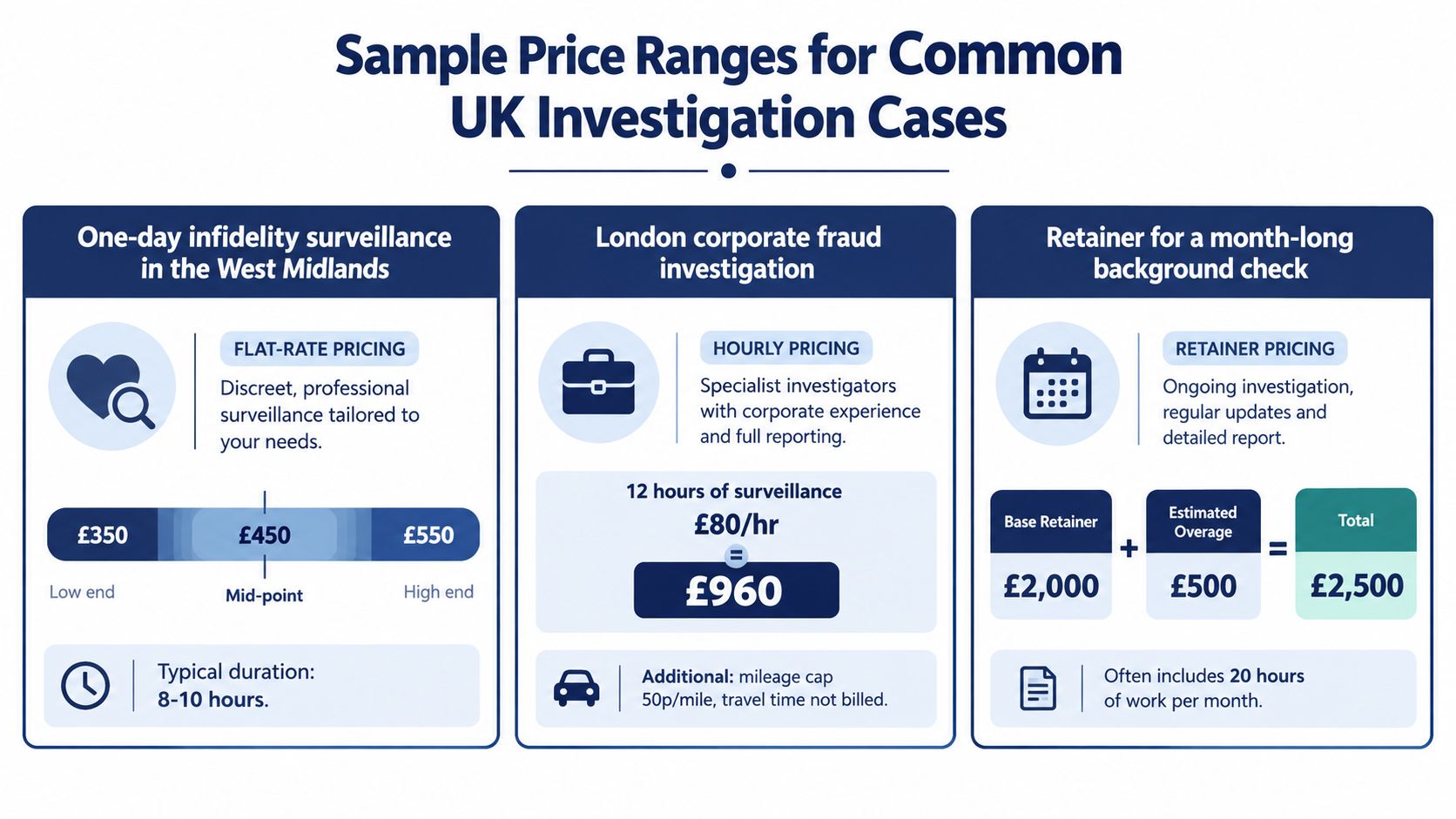
Cohabitation enquiries often need more than one deployment. The subject may change routine, or a single observation may fail to establish a reliable pattern. Corporate work can expand when initial research identifies further companies, directors or transactions. Set a stop point and require approval before the investigator extends the agreed scope.
Technical concerns require a different quote. Ask whether office bug sweep services fit the premises and suspected threat. TSCM work should specify the areas examined, equipment used and reporting delivered, rather than being priced like ordinary surveillance.
Choosing Cost-Effective Private Investigator Services Without Cutting Corners
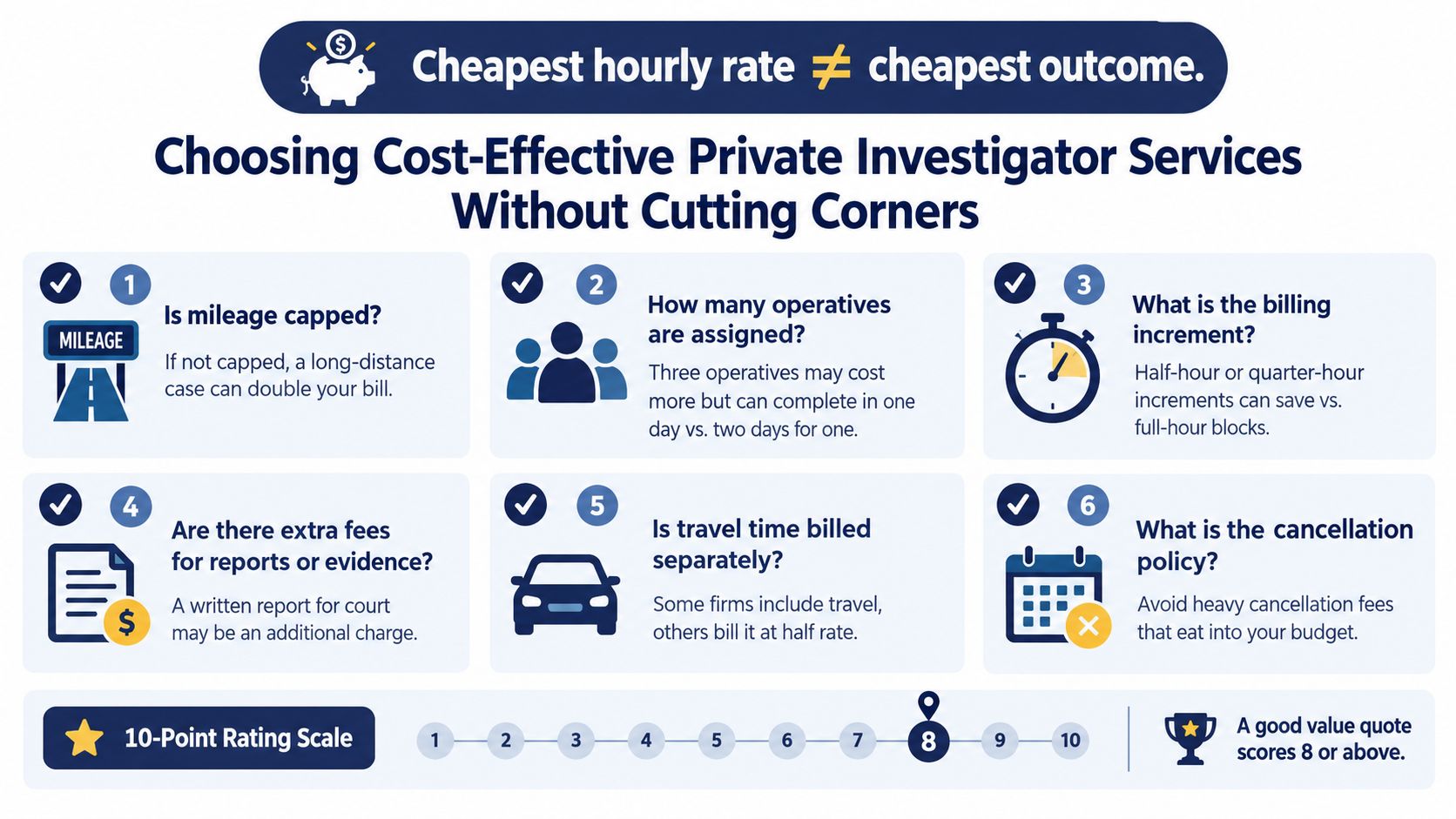
The cheapest hourly rate rarely produces the cheapest outcome. An under-scoped surveillance operation may miss the critical movement, lose the subject in traffic or produce footage without the context needed to support it. You then pay for another attempt.
Compare written estimates using the same questions each time:
Mileage: Is it capped, charged per mile or absorbed into the rate?
Day-rate trigger: Does a day rate apply after a stated number of hours, or only from the start?
Evidence: Are still images, footage review and the written report included?
Databases: Who pays for lawful database subscriptions and disbursements?
Abortive time: What happens if the subject doesn't appear or the operation is stopped?
Billing increments: Are additional hours billed in full blocks or smaller increments?
Cancellation: What notice period applies, and which costs remain payable?
You should also ask who will do the work. A local Birmingham team may reduce unnecessary travel for West Midlands cases, while a London assignment may require local deployment. The firm's operating model should appear in the retainer, not emerge as a surprise on the invoice.
Red flags that should stop the enquiry
Be cautious if a firm demands the full amount before explaining the assignment, refuses to confirm insurance, gives a vague scope or won't identify the person responsible for your case. A professional provider should explain what it can lawfully do, what it cannot promise and how it will handle information.
The Association of British Investigators UK GDPR Code of Conduct was published on 13 November 2024 and provides an industry-specific framework relevant to investigative and litigation-support services. That doesn't turn every member of the industry into a suitable provider, but it gives you a sensible compliance point to raise.
A useful quote should let you answer five questions before payment:
What question is the investigator answering?
What work is included?
What could create an additional charge?
What evidence and report will you receive?
Who authorises work beyond the estimate?
Value means a defensible result at a controlled cost, not the lowest number at the top of a webpage.
Compliance, Credentials and Next Steps Before You Enquire
A reputable firm should clear commercial and compliance checks before accepting sensitive instructions. Ask for evidence of ICO registration where applicable, public liability insurance and professional indemnity insurance. Confirm the business address, named case contact and the legal entity shown on the retainer.
The written terms should separate professional fees from disbursements. They should also explain data handling, retention, cancellation, travel, reporting and approval for additional work. If the investigation may support a solicitor, tribunal or family court matter, ask to see a redacted sample report so you can assess the chronology, image labelling and factual style.
Confirm the legal boundaries
Surveillance must be planned and conducted lawfully. The relevant framework may include the Regulation of Investigatory Powers Act, the Data Protection Act and the Human Rights Act. Covert recording is restricted, and a private investigator can't treat personal suspicion as permission to trespass, hack accounts or obtain protected information unlawfully.
Your investigator should explain the lawful basis for processing personal data and the limits of any proposed tracking or recording. A provider that promises guaranteed access to private accounts or secret records isn't offering a professional shortcut. It's creating legal and evidential risk.
Set the case up properly
Before requesting a quote, write down the question you need answered, the facts you can verify and the evidence you need. Then agree:
Budget: Set a realistic ceiling and require approval before it is exceeded.
Scope: Identify the subject, location, dates and permitted methods.
Reporting: Specify whether you need a summary, full chronology, still images or disclosure-quality documentation.
Milestones: Agree when the investigator will update you and when work may stop.
Turnaround: Confirm when reports, footage and invoices will arrive.
Contact: Record the named person authorised to make decisions.
Sentry's approach should be assessed on those same points as any other provider. The firm offers discreet investigative services for private and business clients, including covert surveillance, people tracing, background checks and technical surveillance countermeasures. Its Birmingham head office supports coverage across the West Midlands and wider UK, subject to the requirements of the assignment.
Speak with Sentry Private Investigators Ltd about your circumstances, the evidence you need and the deployment that fits your budget. Request a written scope showing operative numbers, travel, reporting and approval points before you commit to a retainer.