
When to Hire a Private Investigator: A UK Decision Guide

You've noticed something you can't explain. Your partner's account of an evening doesn't match what you know, an employee's injury claim conflicts with their public posts, or someone who owes you money has stopped answering. You want facts, but you don't want to waste money or make matters worse.
Deciding when to hire a private investigator starts with safety, not surveillance. Once you've ruled out an urgent threat, the next question is practical: what do you need to establish, and what will you do with the answer?
Situations Where a Private Investigator Is Worth It
A private investigator is worth hiring when you need evidence or information you can't lawfully obtain yourself, gathered by someone working within UK law. The purpose should be clear before you commission any work. Wanting to verify an address for legal proceedings is different from wanting to monitor someone out of curiosity.
The table sorts common concerns into three routes: hire an investigator, consult another professional first, or don't start with an investigator. The service column explains what type of work fits the question, rather than suggesting that every concern needs surveillance.
When to hire a private investigator, by situation
Situation | Hire a PI? | Typical service | Go to first |
|---|---|---|---|
Suspected infidelity or secret relationship | Yes, if you need a factual record | Covert surveillance on foot, mobile or static | Write down dates and observations you already have |
Cohabitation check | Yes, when living arrangements matter legally | Cohabitation investigation | Solicitor for family or financial advice |
Missing or estranged person | Yes, to trace a lawful current address | People tracing and open-source checks | Family contacts and public records, unless someone may be at risk |
Unpaid debt, debtor cannot be found | Yes, via a trace agent | Debtor tracing | Court or enforcement route |
Suspected fraudulent injury claim or absence | Yes, for workplace cases | Surveillance and employee absence checks | HR records and legal counsel |
Suspected employee theft or moonlighting | Yes, if an internal review cannot establish the facts | Corporate investigation | HR and legal counsel |
Legal documents to serve | Yes | Process serving | Your solicitor |
Concern about hidden listening devices | Yes, for a technical surveillance countermeasures sweep | Bug sweeping, also called TSCM | Note who has had access to the location |
Concern about vehicle GPS tracking | Maybe, after checking the vehicle's legal owner | GPS tracking check | Police if you feel threatened |
Stalking, threats or immediate danger | No, not as the first step | None initially, report instead | Police and domestic-abuse services |
Match the service to the question
Suspected infidelity usually calls for establishing observable events, not guessing someone's motives. A cohabitation enquiry has a different purpose: checking living arrangements that may matter to a financial or family-law decision. Your solicitor should identify which facts would help.
Tracing is another distinct task. An investigator may establish an address without watching someone's daily movements, while a process server needs to deliver documents and record what happened. Neither task automatically calls for prolonged observation.
Technical concerns also need careful separation. Looking for an unwanted tracker is not the same as installing one, and finding an unfamiliar device doesn't establish who placed it.
Practical rule: Choose the question first, then the investigative method. Don't buy surveillance simply because it sounds thorough.
Find the row closest to your circumstances and note the first action. Then test whether the likely answer is important enough to justify paying for professional work.
When to Call the Police or a Solicitor First
If someone is in immediate danger, call 999. Don't hire an investigator instead. A private enquiry isn't an emergency response, and gathering more information should never delay protection.
Criminal conduct, threats and harassment belong with the police. Where stalking, coercive control or domestic abuse may be involved, specialist support services can help with safeguarding and safe communication. You don't need to solve the case yourself before seeking help.
The scale of the problem matters: the Office for National Statistics estimated that approximately 1.5 million people aged 16 and over experienced stalking in England and Wales in the year ending March 2024.
Protect yourself and preserve what exists
Following the other person, confronting them or arranging covert monitoring can alert them and increase risk. Preserve material you already hold without editing the originals or attempting to access someone else's accounts.
Messages and account logs: Keep original conversations, dates and available account activity.
Tracker records: Record what you've found without experimenting with the device if doing so could compromise safety or evidence.
Camera footage: Preserve the original files and relevant surrounding footage, not just a short edited clip.
For court-facing family or financial matters, speak to a solicitor before commissioning work. They can explain what evidence is relevant and how it should be presented. If the matter involves Singapore, The Lawyer Guide offers a starting point to get confidential legal help in Singapore; it isn't a substitute for advice from a UK solicitor on UK proceedings.
A missing person's welfare also takes priority over an address search. For a non-emergency tracing enquiry, the Sentry Private Investigators tracing guide explains the investigative route.
Use this referral order
Safety: Obtain emergency or specialist safeguarding help where needed.
Crime: Report suspected criminal conduct to the police.
Evidence: Discuss any remaining private or civil evidential need with a solicitor or investigator.
SPI operates independently from law enforcement. We gather information for clients, but we don't replace police powers, criminal investigations or specialist safeguarding support.
Warning Signs and Real Cases That Justify Hiring
Suspicion becomes a stronger basis for investigation when you can identify a specific inconsistency. Repeated unexplained absences, a claim that conflicts with records, a debtor who keeps moving, an unexplained financial change or documents awaiting service each provide a question someone can investigate.
These hypothetical case examples show how to turn a concern into a useful instruction. They aren't accounts of named clients or completed SPI investigations.
An injury claim conflicts with observed activity
Say a retailer notices public social-media footage of a warehouse worker lifting heavy stock while absent with a claimed back injury. A manager also reports similar activity in the car park.
The instruction shouldn't be to prove the worker is lying. It should be to document relevant activity during a defined period and compare it with the claim through HR, medical and legal review. A photograph of lifting doesn't, on its own, establish medical capacity, dishonesty or grounds for dismissal.
A solicitor needs a reliable service address
Suppose a solicitor needs to serve papers on a man who has moved three times within a year. Letters have come back, and an old address still appears in search results.
The investigator's task is to distinguish a current address from a historical association and confirm the person's identity. The solicitor can then decide the appropriate service step using a sourced trace result rather than an unverified search-engine match.
An unfamiliar van keeps appearing
A homeowner notices the same unknown van outside each weekday but doesn't know who uses it. Start with a safety assessment, especially if there are threats, unwanted contact or signs of stalking.
If a private enquiry is appropriate, the task is to establish an observable pattern and any lawful, verifiable explanation. It isn't to assume hostile surveillance or accuse the driver based on proximity alone.
A useful investigation tests an allegation. It doesn't treat the client's suspicion as the conclusion.
For businesses, the UK Government's Economic Crime Survey 2024 reported that 11% of businesses experienced fake-invoice fraud, while 40% of businesses reporting their most recent fraud said it was cyber-facilitated. These concerns aren't confined to large corporations, and an online discrepancy may require records-based investigation rather than physical surveillance.
The buying test is straightforward: would the answer change a decision about a dismissal, a claim, a legal step or a significant personal choice? If so, there may be a clear reason to investigate.
What a Private Investigator Actually Does
Each service produces a different kind of evidence, so the first step is matching the output to the question you need answered. Surveillance gets most of the attention, yet many instructions never involve following anyone at all.
Common investigation services and what they produce
Service | What you receive | Typical use |
|---|---|---|
Covert surveillance on foot, mobile or static | Time-stamped observations, photographs or video where lawful | Infidelity, workplace absence and injury claims |
Open-source background checks and people tracing | Identifiers and the sources used, with confirmed findings kept separate from inference | Pre-employment checks and locating a person |
Vehicle GPS tracking | Location records only where lawful, such as appropriate company-vehicle cases | Fleet and business use |
Debtor tracing | Current address leads and a sourced trace report | Recovering unpaid debts |
Process serving | Proof of service for legal documents | Solicitors and litigants |
Bug sweeping, also called TSCM | Inspection report of any detected devices | Suspected hidden listening devices |
The practical difference matters. A surveillance report describes what a trained operative saw and when. A trace report points to where someone can probably be found. Asking for the wrong one wastes the budget and can still leave your question unanswered.

Sentry's services include infidelity and cohabitation enquiries, vehicle GPS tracking, debtor tracing, technical surveillance, personal injury fraud, fly tipping investigations, counter surveillance, process serving and background checks. The discreet surveillance guide for businesses gives further context for workplace enquiries.
Understand the limits before commissioning work
An investigator has no general right to enter private property, hack accounts or exercise police powers. Everything gathered has to come through lawful channels, which is precisely why it holds up later.
Vehicle tracking shows how narrow the rules are. Ownership must be checked before GPS work begins, and ownership alone is not blanket permission to monitor a driver. Company-vehicle tracking still needs a lawful purpose and appropriate privacy safeguards.
For employer monitoring, the Information Commissioner's Office guidance says employers must identify a lawful basis and, when using investigators for covert monitoring, require lawful information collection through the contract.
Overseas screening terminology can also cause confusion. VolunteerBadge's explanation of FCRA rules for volunteer screening concerns the US framework, not permission to obtain equivalent information in the UK.
The accompanying video provides another format for exploring investigative services.
All SPI evidence is legally obtained and admissible in court proceedings. That does not mean a finding guarantees a favourable judgment. Before work starts, both sides should agree the services in writing, covering the expected timeline, report structure, recording methods, and storage and deletion arrangements, so you understand exactly what you will receive.
Five Questions to Answer Before You Hire
The first check comes before questions about methods or money: could anyone be put at risk? If the answer is yes, pause the hiring decision and use the police and safeguarding route.
Use the remaining questions to turn your concern into a workable brief. Write your answers down, including when you need the result.
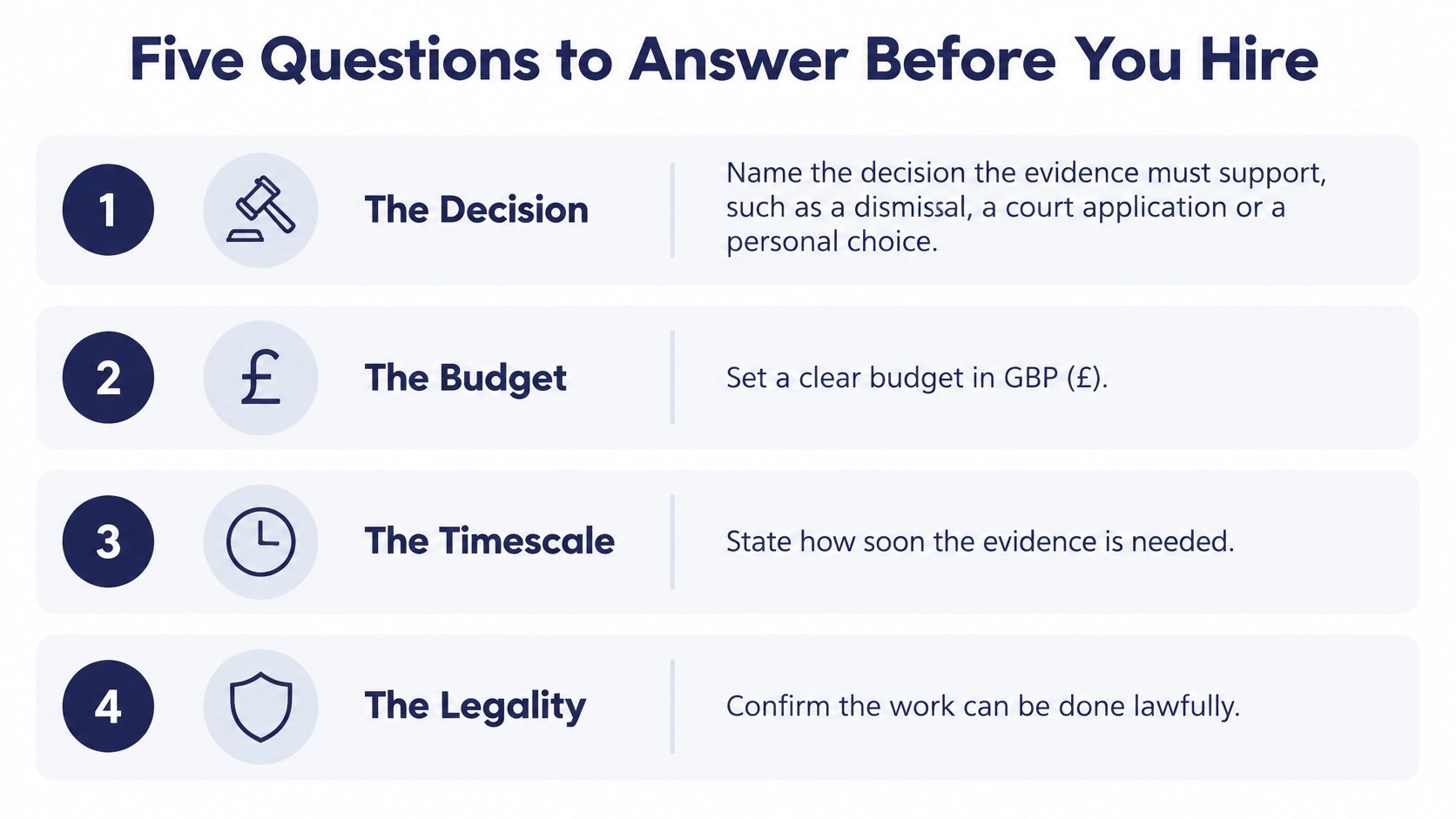
What decision will the evidence support? Name the decision in a sentence, such as whether to pursue a court application, review an employee's explanation or make a personal choice. An instruction to establish particular facts is more useful than an open-ended request to find everything.
Can existing records answer the question? Start with material you lawfully hold: payslips, your bank statements, public registers, dated notes and saved messages. Don't pay for covert work if a straightforward records review could resolve the uncertainty.
Is covert work necessary and proportionate? Identify relevant dates, places and activities, while excluding unrelated personal information. The ICO's surveillance guidance says organisations should consider less intrusive methods first and collect information that is adequate, relevant and no more extensive than necessary.
What is the outcome worth against the cost? Set a budget in pounds and explain any deadline. Our costs vary by service, case complexity and investigation location, so seek a case-specific written quote rather than treating a general price as a promise.
This visual checklist can help you organise the decision, budget, timescale and legality discussion.
Compare scope, not just price
Our guide to daily and fixed-fee investigation pricing helps frame the commercial discussion. Compare what the proposed work includes, what ends the assignment and what happens if the initial lead proves wrong.
If your enquiry also requires overseas legal representation, Fiscella Law LLC's guide to vetting a criminal defense attorney offers a separate US-focused preparation resource, not UK legal guidance.
A professional investigator should question unclear instructions before accepting them. A firm that agrees to every request without discussing purpose, safety or lawful scope is a warning sign.
How to Choose the Right Investigator
Compare firms on how they assess your enquiry, rather than on how quickly they offer to start. A useful initial conversation should establish whether the work is appropriate, whether the proposed method can answer your question and what limitations you'll face.
At Sentry Private Investigators Ltd, we're a vetted and approved agency of the Association of British Investigators, and members of both the ABI and the Institute of Professional Investigators. Those credentials give you something concrete to check alongside the proposed work.
A checklist for comparing firms
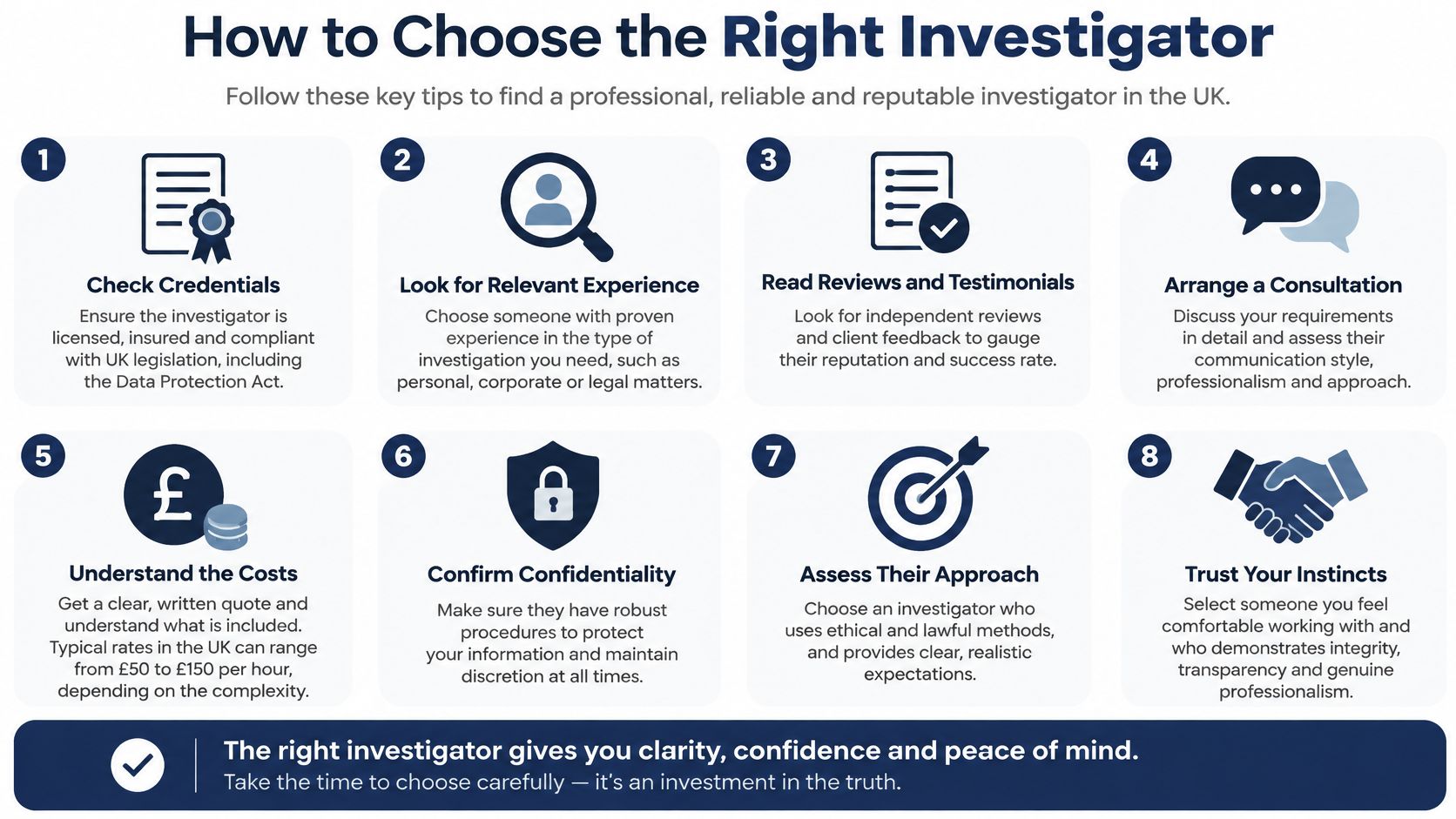
Verify professional membership. Check the firm's stated ABI or IPI credentials rather than accepting an unexplained badge or a claim of professional status.
Find out who will perform the work. Wherever possible, our subcontractors or sub-processors are ABI or IPI members, and we notify clients of the details when using a subcontractor who isn't a member of either body.
Review the written scope. It should identify the allegation, lawful basis, intended methods, report contents and any coordination needed with your solicitor, HR team or insurer.
Examine the evidence process. Request an explanation of dated notes, source records, witness statements where relevant, and how the firm preserves continuity between collection and delivery.
Reject unrealistic promises. Guaranteed findings, unexplained access to private accounts, reluctance to discuss legality and an absence of written terms are reasons not to proceed.
The visual guide offers further prompts for your comparison.
Look for a report that separates fact from inference
A trace result should distinguish a confirmed identity from a possible match. A surveillance report should distinguish what the operative observed from what the client believes it means. Ask how the firm handles contradictory findings, because evidence that challenges your suspicion matters too.
A credible investigator must be prepared to report that the evidence doesn't support the allegation.
For business clients, privacy checks should be specific rather than a general assurance about compliance. The ICO's legitimate-interests guidance requires organisations relying on that basis to identify the interest, establish necessity and balance it against the individual's rights and freedoms.
Choose the investigator whose proposal fits your decision and acknowledges its limits. A careful question at the start is more valuable than an enthusiastic promise that can't be supported.
Book a Free Consultation Before You Commit
You don't need a complete case file before making contact. You do need an honest account of what you know, what you suspect and what you want to establish. Keeping those categories separate makes the first discussion more productive.
We offer free, confidential consultations, with clients speaking directly to an experienced investigator. Our planning considers your circumstances and objectives rather than treating every enquiry as the same assignment.
Prepare for a useful conversation
Write down the decision. Explain what you'll be able to do once the question is answered, and flag any legal, employment or insurance involvement.
Gather existing material. Bring relevant dates, messages, records and documents without editing originals or obtaining information you aren't entitled to access.
Book the consultation. Explain your location, any deadline and the background to the concern so we can discuss whether investigation is appropriate.
Agree the proposed work. Compare the scope with your safety, evidence, proportionality and budget checks before authorising anything.
Services must be agreed by both SPI and the client before they commence. Use that agreement to settle the questions the assignment will answer, the lawful basis for the work and the deliverables you expect. If something in the proposal isn't clear, resolve it before committing.
Discuss your location and practical needs
Our Birmingham-based team covers the West Midlands and the wider UK. When making contact, identify where the relevant activity, person or premises is located, rather than assuming it matches your own address.
You can also use the area information on our website to identify the relevant local service. Whether your concern involves a private relationship, an address trace or a workplace allegation, the first conversation is an opportunity to establish the appropriate next step, not an obligation to purchase surveillance.
Call our Birmingham private investigators on 0121 769 1626 to discuss your circumstances and receive a free, no-obligation quote.
Sentry Private Investigators Ltd offers confidential consultations and investigative planning designed for private individuals and businesses. If you're deciding whether professional evidence-gathering is the right next step, visit Sentry Private Investigators Ltd to discuss your objective before committing to an investigation.