
Serving Court Documents in the UK: A Step-by-Step Guide

The popular advice on serving court documents is simple. Hand the papers to the person, make sure they take them, and the clock starts. That advice is wrong in the way that matters most, because a court doesn't work from the moment of handover alone.
What counts is whether you used a permitted method, served at the legally correct address, and can prove the deemed-service date. Get any of those wrong and you may have visited the right house, met the right person, and still failed to start the defendant's deadline properly. I would rather see a slower, rule compliant serve with clean evidence than a fast visit nobody can defend later.
Court Document Service Rules at a Glance
A personal serve finished at 4:45 pm is not that day's service. In civil cases in England and Wales, the defendant's response clock runs from the deemed-service date. Finish the visit after 4:30 pm, or use an address the rules do not allow, and the legal date moves even though the papers changed hands.
This guide covers civil proceedings in England and Wales. Scotland and Northern Ireland follow different procedures, so check those regimes before you reuse these timings.
Where the Rules Come From
The framework sits in the Civil Procedure Rules 1998, which came into force on 26 April 1999. Part 6 covers who may serve, personal service, addresses for service, deemed service, alternative methods, and certificates of service.
Valid service is formal notice that proceedings have started and that the defendant has a chance to respond. The court can dispense with service where the circumstances justify it. That application needs supporting evidence, and it does not stand in for a failed attempt.
The same practical discipline shows up outside this jurisdiction. A defendant still needs a clear deadline and a proper record, which is why guidance on steps after being served in Georgia stresses reading the papers and tracking the response date from service.
Valid service methods and when each is deemed served
Method | Deemed served | Condition |
|---|---|---|
Personal service | Same business day if completed before 4:30 pm; otherwise next business day | Handed to the recipient or an authorised person at the right address |
First-class post or next-business-day delivery | Second business day after posting for claim forms | Sent to a permitted address |
Document exchange | Second business day after leaving it at the exchange | Only where the recipient has a box at that exchange |
Leaving at a specified place | Same business day if left before 4:30 pm; otherwise next business day | Address must meet the CPR 6.9 rules |
Electronic communication | Only where authorised, on the date the rules or direction specify | Prior written agreement or court direction needed |
Court-ordered alternative method | As stated in the order | Court permission required before use |
The method and the address work together. Post can arrive the next morning and still be deemed later than the day it landed. Email without prior written agreement or a court direction does not start the clock at all. I would record the exact time of a personal serve and treat anything after 4:30 pm as the next business day, because that is the date the response period will be counted from.
Deadlines for Service and the Defendant's Response
The defendant's 14-day response clock starts from the deemed-service date. If that date moves by one business day, the response date moves with it, and anyone who calculated from the visit date will chase a deadline the court doesn't recognise.
Two different clocks run here. The claimant has a window to serve. The defendant then has a period to respond once service is deemed to have happened. Confusing those two clocks causes a large share of avoidable disputes.
Key time limits for civil claims in England and Wales
Requirement | Time limit | Notes |
|---|---|---|
Claim form served within England and Wales | Four months from issue | Service window counted from the date of issue |
Claim form served outside the jurisdiction | Six months | Check the rules for the country concerned |
Particulars of claim | With the claim form, or within 14 days after its deemed service | Confirm which document type applies |
Defendant's response to a claim | 14 days from the deemed service date | Pay, admit with time to pay, dispute or do nothing |
How the Defendant's Clock Works
The Ministry of Justice civil courts guidance explains that a copy of the claim form and response pack is sent to, or served on, the defendant, who normally has 14 days to respond. The same guidance reports that money claims represented more than 80% of all county-court claims in 2019, so this isn't a fringe problem. It's the daily machinery of debt and money litigation.
The four response options are to do nothing, pay all or part of the claim, admit the claim and request additional time to pay, or dispute the claim. Doing nothing is still a choice with consequences, which is why fair notice matters. A defendant who never properly received the papers shouldn't lose the chance to choose.
A technically successful visit can still leave the deadline unstarted if the address, method, or evidence is wrong.
Take a simple example. Papers are personally served at 5:00 pm on a Friday. That serve is deemed to happen on the following business day, Monday, so the 14-day count begins then, not on Friday. Anyone who diarised from Friday is already a working day out, and a bank holiday Monday pushes it further.
In practice, timescales for process serving vary depending on location, recipient behaviour and complexity. We aim to complete service as quickly as possible and keep the client updated throughout. We primarily serve documents within the UK and can coordinate with trusted partners abroad to handle international service when needed. Speed helps, but only when the date you report back is the deemed date, clearly explained.
How to Serve Court Documents Step by Step
A late-afternoon visit can look finished and still start the defendant's clock a day late. The response period runs from the deemed-service date, not from the moment the papers change hands, so a wrongly addressed or badly timed attendance moves the deadline even when someone took the documents.
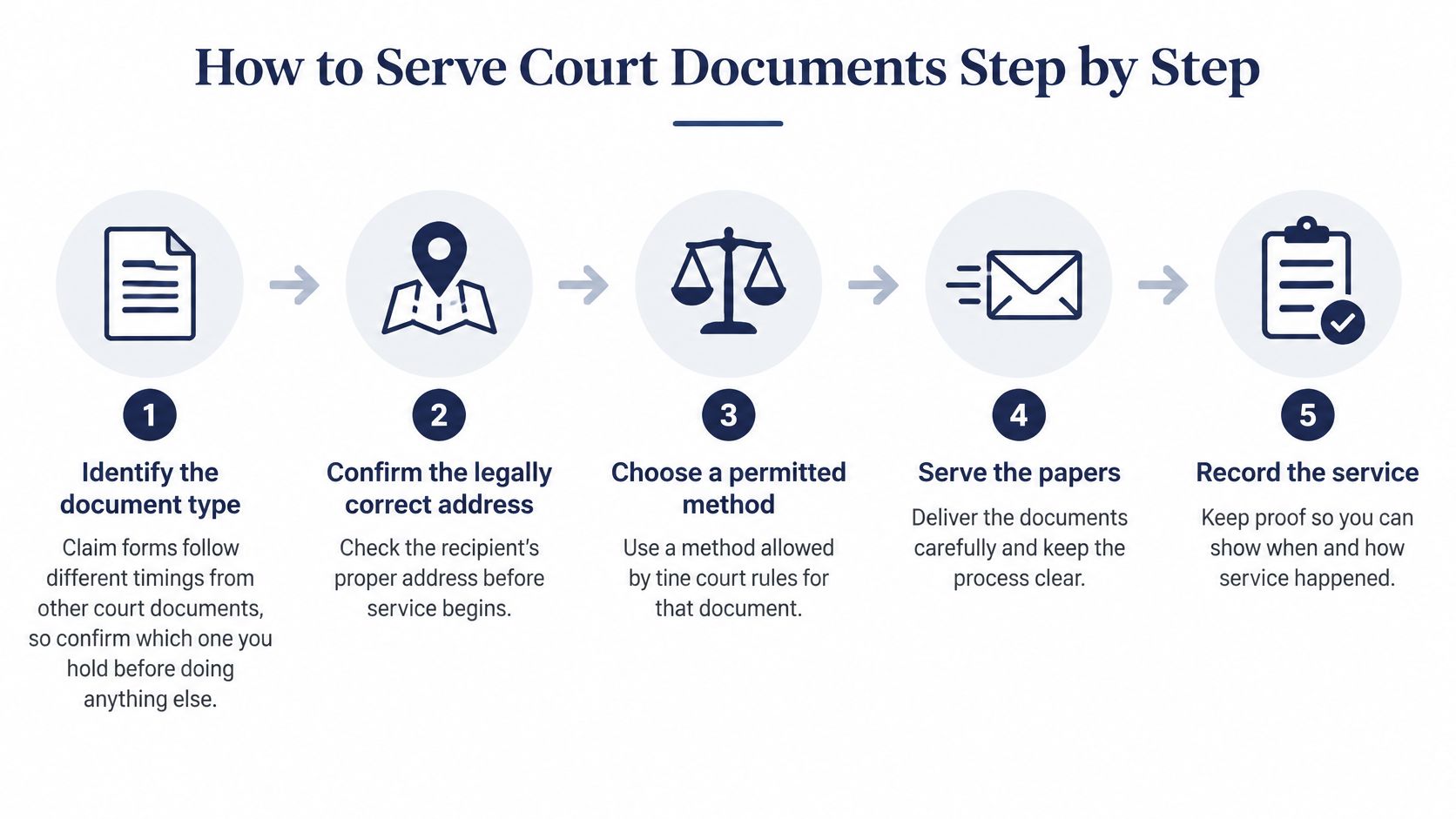
The CPR Part 6 rules require you to identify the document, confirm the service address under CPR 6.9, select an authorised method, complete the service step, and record evidence for the certificate of service. Miss an early step and the later attendance rarely fixes it.
Before the first attempt, confirm any special requirements from the instructing solicitor or the court. After receiving an instruction, Sentry reviews the legal documents and supporting information, including verifying names, addresses and any special requirements from the solicitor or court. This check prevents the most expensive error, serving the wrong version at the wrong place.
The Five Steps
Identify the document type. Claim forms follow different timings from other court documents, so confirm which one you hold before doing anything else. The document type controls the service window, the permitted method, and what else must accompany it.
Confirm the legally correct address. Use the address the recipient has given for service, or the registered office for a company, and check it before the first attempt. An old home address is a common cause of failed service, and repeated visits to a stale address prove nothing except persistence.
Choose an authorised method. Legitimate service is typically achieved by handing the documents directly to the intended recipient, and personal service usually produces the earliest deemed date. Process servers make multiple attempts to deliver in person wherever possible. Post costs less, but its deemed date falls later, and you cannot say who took the envelope. I would choose the method for what you must prove if service is challenged, not for the cheaper stamp.
Serve within the time window. A claim form served in England and Wales normally has a four-month window, with six months outside the jurisdiction. Leave margin for failed attempts and address checks. Instructing in the final week turns a routine serve into an emergency, and emergencies produce thin evidence.
Work out the deemed-service date. Count business days from the completed step, skipping weekends and bank holidays. Claim form service is generally deemed on the second business day after the CPR 7.5 step. Personal service before 4:30 pm on a business day is deemed that day. A visit after that cut-off, or to the wrong address, does not give the defendant the notebook date. Diary the calculated date.
Other legal systems break the task into the same practical stages, even though their service rules and forms differ. A reader dealing with family papers abroad will recognise the same address and proof problems in a service guide for divorcing Texans, but the CPR method and deemed date still govern an English or Welsh civil case.
What a Clean Serve Looks Like
A clean serve is a sequence someone else can reconstruct months later: the right document, the right address, an authorised method, and a deemed date that matches the rules rather than the hour of the visit. Email sent because it was convenient fails that test unless the rules allow it. Calendar-day counting fails it where the rules count business days.
Professional process serving services earn their fee at these control points, before and after the doorstep, not merely by knocking.
Proving Service with a Certificate and Statement
Open a solicitor's file after a disputed serve and you'll see what the court will ask for. It won't start with the server's confidence. It'll start with the paper record, the times, and whether the documents on file match the documents handed over.
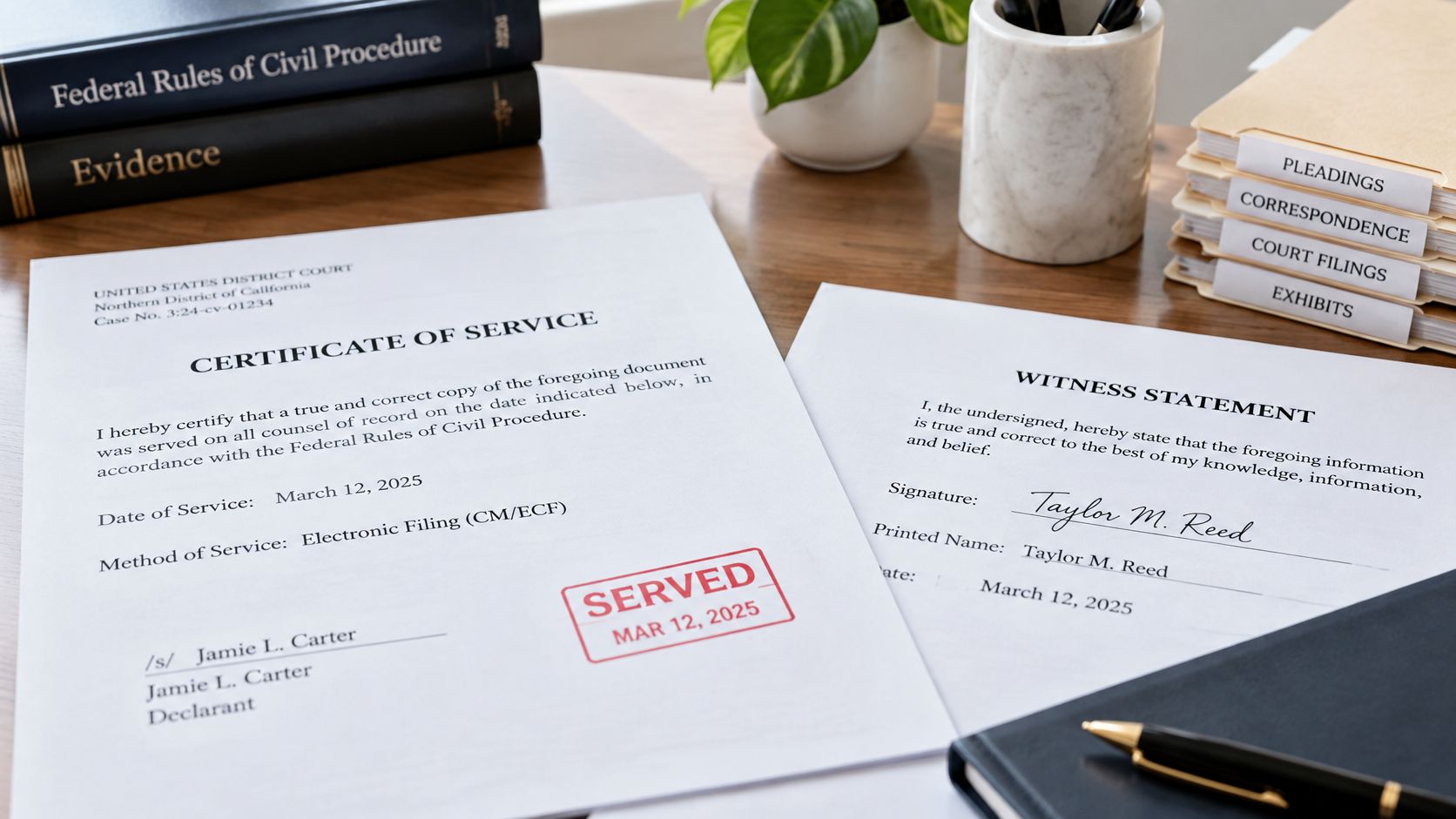
The N215 certificate of service is that formal record. It captures the document served, the method, the date and time, and the person served. Treat it as a record of service, not a replacement for it. A perfectly completed form can't rescue service that was carried out by the wrong method at the wrong address.
What to Keep on File
Exact address attended: Include flat numbers, business names, and any distinguishing detail that ties the visit to that property.
Time of each attempt: Record arrival and departure, not just the successful attendance, because failed attempts support later applications.
Description of the recipient: Note what they said their name was, how they responded, and any words of refusal.
Copies of the documents served: Keep the same version, page for page, so there's no argument about missing particulars or response packs.
Photographs or video where lawful: Use them to support location and timing, and store originals with their metadata intact.
Any written acknowledgement: File it with the notes rather than leaving it in an email inbox.
After a successful serve, or once attempts have been exhausted, we prepare a Statement of Service recording the date, time, location and circumstances of delivery. That statement turns scattered notes into evidence a solicitor can file and a judge can read quickly.
Say a defendant later tells the court they never received a claim form. The server's dated statement, attempt log, and photographs answer that claim in a way a bare assertion of delivery can't. The court can see who attended, when, what was said, and what was handed over.
Practical rule: Write the notes the same day, while times and exact words are still fresh.
If electronic service was used, keep the written agreement or court direction that authorised it with the transmission record. Save the sent time, delivery or read evidence, the exact account used, and any bounce-back. Transmission without authorisation is a weakness, not evidence.
Fixing Failed or Disputed Service Attempts
The most common failure isn't a dramatic refusal at the door. It's an outdated address that nobody checked before attendance. The fix is unglamorous. Verify the address, make repeated attempts at different times, record each one, and only then ask the court for another route.
CPR 6.26 shows why physical delivery and legally effective service aren't the same thing. First-class post is generally deemed served on the second business day after posting, delivery to a permitted address can be effective the same day if completed before 4:30 pm, and personal service before 4:30 pm on a business day is deemed effective that day. The visit, the deemed date, and the deadline calculated from it are three separate things.
Service problems, likely causes and fixes
Problem | Likely cause | Fix |
|---|---|---|
Recipient not found at the address | Outdated or incomplete address | Verify the address and make repeated attempts before applying to the court |
Method challenged by the recipient | Email or message used without authority | Obtain written agreement or court direction before electronic service |
Visit timed after 4:30 pm | Deemed date moves to the next business day | Calculate the deadline from the deemed date, not the visit |
Deadline miscounted | Weekends and bank holidays ignored | Count business days and check the bank holiday calendar |
Recipient refuses papers | Refusal at the door | Record the refusal and words used, then ask the court to rule |
No proof of service | Notes or certificate missing | Complete the N215 and keep dated notes with photographs |
Applying the Fixes
Where a recipient avoids the address, vary the attempt times and days rather than repeating the same weekday morning visit. Our process servers make multiple attempts to deliver documents in person wherever possible, and legitimate service is typically achieved by handing the documents directly to the intended recipient. If those attempts fail, your log becomes the evidence for an application for an alternative method or to dispense with service.
Electronic service needs authority before you press send. An email address found online, or a mobile number from old correspondence, doesn't by itself authorise service by that route. Get written agreement or a court direction first, then keep the authorisation with the transmission record.
A refusal doesn't end the matter, but arguing on the doorstep doesn't help it either. Record the refusal, the words used, and exactly what you did with the papers, then let the court decide whether service was effective. A calm, detailed note carries more weight than a heated exchange nobody recorded.
I would choose a slower, rule compliant method with clear evidence over an undocumented personal visit every time. The first may deem service a day later. The second may not survive a challenge at all, which costs far more than a day.
Decide Whether to Instruct a Process Server
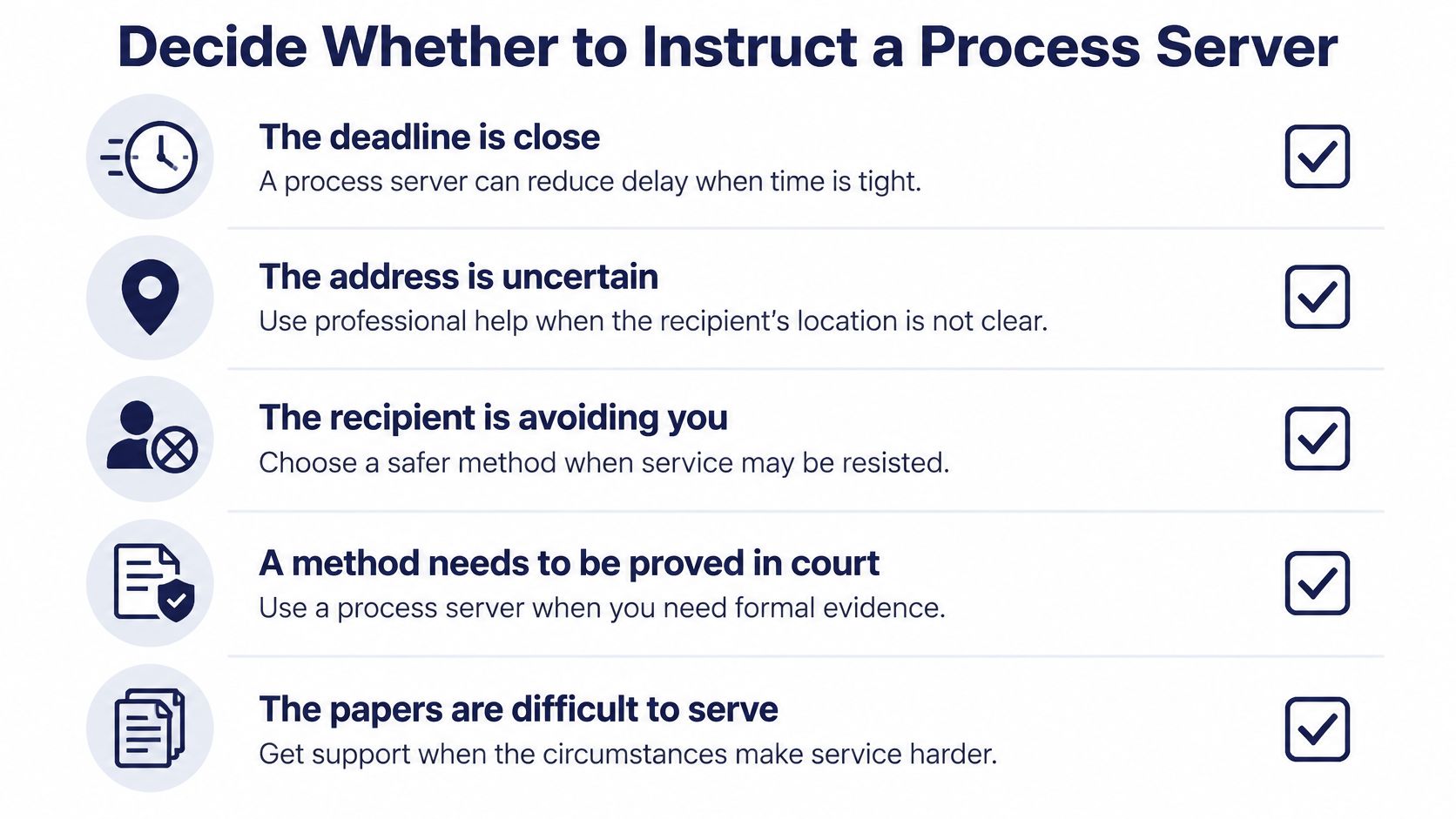
You don't need a process server for every envelope. You need one when the cost of getting service wrong is higher than the fee, and that point arrives sooner than most private claimants expect. Work through this checklist before you decide.
The deadline is close: The service window is running down and you can't absorb failed attempts or an extension application.
The address is uncertain: The recipient has moved, trades from several addresses, or the only address you hold is old.
The recipient is avoiding you: Letters go unanswered, calls are blocked, or previous attempts have been refused.
A method needs to be proved in court: The case is contested and you'll need a statement that stands up to challenge.
The papers are difficult to serve: Personal service is required, the recipient may be hostile, or attendance needs care and discretion.
What Professional Service Gives You
Process serving delivers legal documents to court requirements and provides certified proof of service for legal proceedings. We serve summonses and claim forms, court orders and statutory demands, subpoenas and witness notices, injunctions and eviction notices, and divorce papers and child custody documents. Before instructing, it helps to understand what affects process server costs, because urgency, travel, and repeated attempts all change the work involved.
Solicitors instruct servers for independence as much as attendance. A claimant who serves their own papers may struggle to give neutral evidence about a disputed handover, and their lawyer then has to repair the record. Readers who aren't sure where legal advice stops and practical litigation support begins can use an overview of what a litigation lawyer does to see how evidence gathering, filing, and service fit into the wider case.
Tracing is a separate task. If you don't have a current address, a private investigator may need to locate the recipient before a server attends, because even perfect attendance at the wrong address achieves nothing. Instruct the trace first, then serve once the address is confirmed and current.
What to Prepare Before You Call
Bring the recipient's full name, last known address, copies of the documents, the court reference, the deadline, and any special instructions from the court order. Add anything relevant to safety or timing, such as a workplace address, known hours, or a history of avoidance. The better the instruction, the fewer wasted attempts you'll pay for.
We offer a free, no-obligation consultation about a process serving case, so you can test whether professional service is worth it before committing. If your case ticks two or more boxes on the checklist, I would instruct rather than improvise. You'll spend the money once, instead of spending it later on applications to fix service that should have been clean the first time.
If a deadline is close, an address is uncertain, or a recipient is avoiding service, Sentry Private Investigators Ltd can serve your documents to court requirements and provide certified proof you can file with confidence. Send us the papers, the last known address, and your deadline for a free, no-obligation consultation, and we'll tell you plainly how we'd approach the serve. Start today at Sentry Private Investigators Ltd and let a professional server protect your timetable.