
Surveillance Investigation: A Practical Guide

You've noticed a pattern that doesn't make sense. A partner gives vague explanations about where they've been, an employee appears to be claiming sick leave while working elsewhere, or stock keeps disappearing from a business premises without an obvious cause. You may already have suspicions, but suspicion alone rarely provides a safe basis for making a personal, employment, or commercial decision.
A professional surveillance investigation is designed to replace uncertainty with properly obtained evidence. The work involves planning, discreet observation, accurate recording, legal judgment, and a clear report. It isn't about dramatic pursuit scenes or collecting random photographs. The practical objective is to establish what happened, when it happened, and whether the evidence can support the next step.
Understanding the Purpose of Surveillance
Consider a hypothetical situation involving a business owner who receives a workplace injury claim. The employee says the injury prevents ordinary activity, yet information reaching the owner suggests the person may be carrying out physically demanding work elsewhere. Acting on gossip could expose the business to an unfair disciplinary decision or weaken its response to a claim. Ignoring the concern could leave the owner without the facts needed to protect the company.
A surveillance investigator would begin with a briefing, not immediate observation. The investigator would establish the precise question to be answered, identify relevant dates and locations, assess the legal risks, and decide whether surveillance is proportionate. The resulting material might confirm the concern, disprove it, or reveal circumstances that require a different line of inquiry.
The same principle applies to personal cases. A client who suspects infidelity may not need a dramatic confrontation. They may need a reliable account of movements and meetings so they can make a private decision with greater confidence. Surveillance can also assist with cohabitation questions, disputes about a person's activities, and certain litigation-support requirements.
What professional observation actually delivers
The useful output isn't just a folder of images. A properly managed investigation can provide:
A verified sequence of events: Investigators record observations in context, rather than presenting isolated moments that may be open to misinterpretation.
Photographic and video material: Images are collected with attention to relevance, clarity, timing, and the identity of the person or location involved.
Operational records: Notes explain where the investigator was positioned, what was observed, and how the observation developed.
A decision-making basis: Clients can use the findings to speak with a solicitor, consider an employment process, respond to a dispute, or decide how to proceed privately.
Practical rule: The investigator should define the question before choosing the method. If the question is vague, the evidence usually becomes vague too.
Professional surveillance also has limits. An investigator can't guarantee that a subject will leave home, meet another person, or behave in the way a client expects. A well-run assignment reports what was observed, including evidence that doesn't support the original suspicion. That neutrality protects the client and gives the final material greater credibility.
Overt and Covert Surveillance Approaches
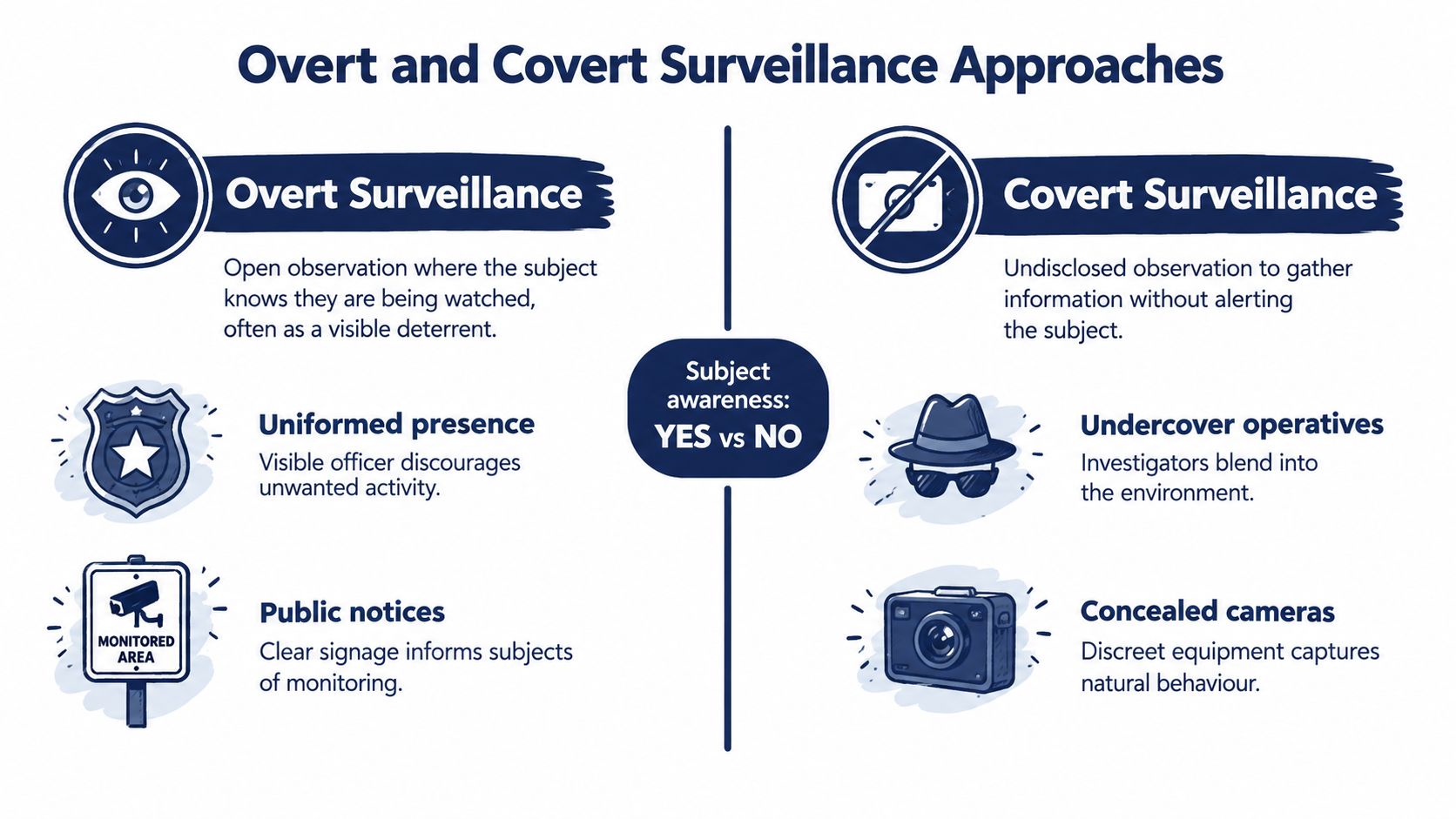
The choice between overt and covert surveillance depends on the client's objective. Overt surveillance is open. The subject knows, or can reasonably understand, that observation is taking place. Covert surveillance is conducted without alerting the subject, allowing investigators to observe behaviour that might change if the person knew they were being watched.
Neither approach is automatically superior. Overt work may be appropriate where visibility is itself useful. A clearly identified presence can deter unwanted activity at a business site, support a security audit, or make people aware that monitoring is taking place. It can also be unsuitable where the client needs to establish what happens during normal, unguarded activity.
Covert work is more commonly associated with suspected infidelity, workplace absence, employee theft, and insurance-related enquiries. It requires a careful assessment of the environment, likely movements, public access, vehicle arrangements, and the risk that the investigator will be identified. A covert plan should also account for what happens if the subject enters a private place or changes direction unexpectedly.
Comparing the practical trade-offs
Approach | Where it can help | Main limitation |
|---|---|---|
Overt observation | Visible deterrence, selected corporate audits, and situations where transparency is required | The subject may alter their behaviour or avoid the activity being investigated |
Covert observation | Establishing natural movements and conduct without advance warning | It demands tighter planning and must remain within legal and professional boundaries |
A corporate client may initially assume that visible monitoring will resolve a workplace issue quickly. In practice, that approach can alert the subject and remove the opportunity to establish their ordinary routine. Conversely, covert observation may be unnecessary where a business wants to demonstrate that a premises is monitored and discourage misconduct.
How the decision is made
An investigator should examine the purpose, the subject's expected routine, the setting, and the evidence the client needs. A single investigator may be suitable for a straightforward static observation, while a moving subject in a busy city may require a coordinated team. The plan should include clear stopping points, communication procedures, and a response if the subject enters a location where observation would become intrusive or inappropriate.
The client also needs realistic expectations. Covert surveillance isn't a licence to follow someone everywhere or obtain information by unlawful means. It is a controlled evidence-gathering method, selected because it answers a defined question while limiting unnecessary intrusion.
Core Methodologies Used in the Field
Fieldwork starts with the subject's likely routine and the physical environment. An urban operation in London or Birmingham may involve crowded pavements, public transport, one-way systems, delivery traffic, and frequent opportunities for a subject to disappear from view. A rural or regional assignment may involve longer vehicle movements, limited vantage points, and greater reliance on safe mobile observation.
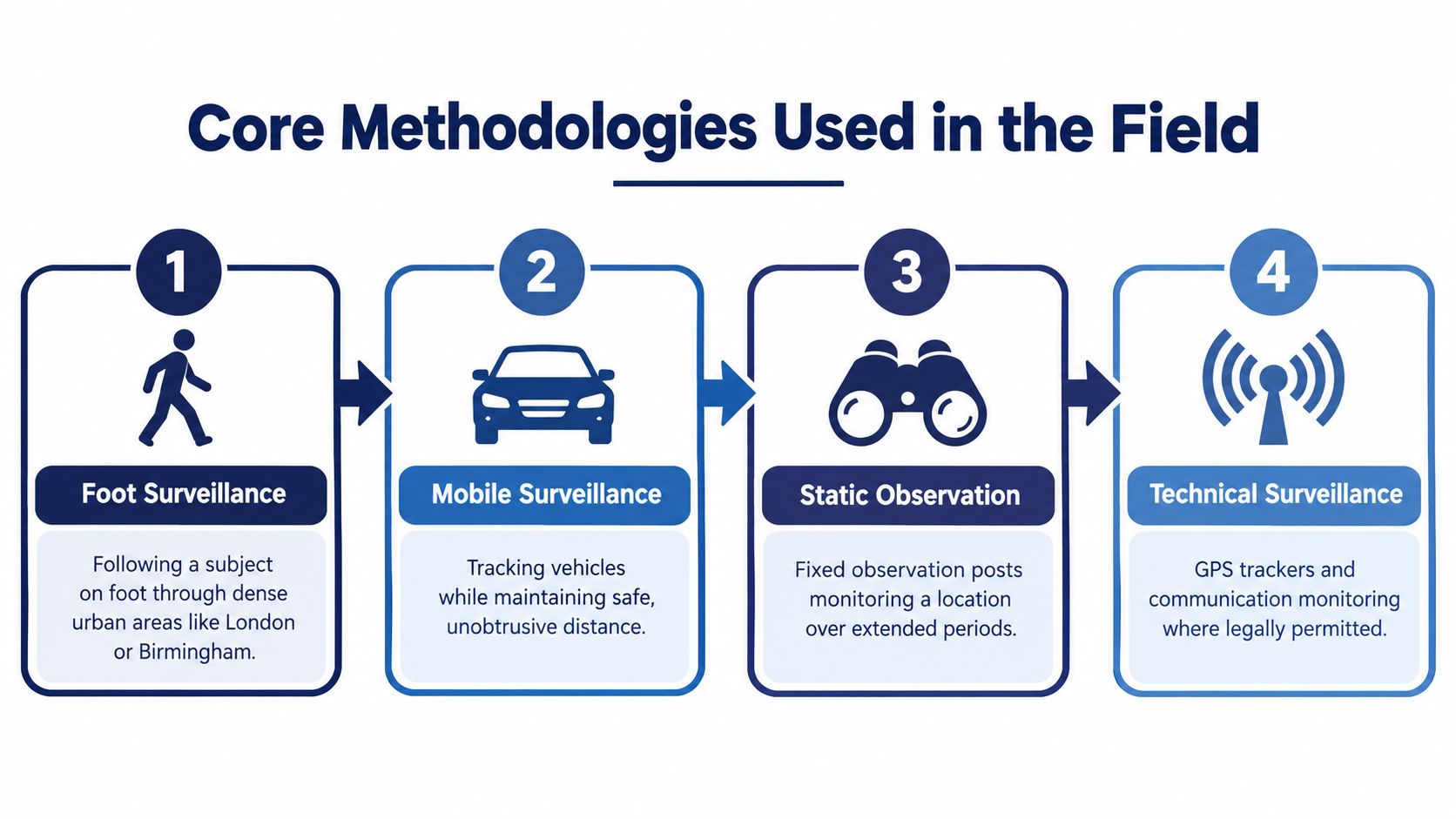
Foot surveillance involves following a subject on foot while maintaining a distance that protects the operation. The investigator must read the environment, anticipate changes in direction, and avoid obvious repetition. Dense pedestrian areas can provide cover, but they also create obstructions and make continuity difficult.
Mobile surveillance follows a subject travelling by vehicle. It requires safe driving, lawful conduct, and disciplined communication. An investigator won't take unnecessary risks to maintain visual contact. If the subject's driving becomes dangerous or the route makes continued observation impractical, safety takes priority over continuity.
Selecting the right field method
Static observation places an investigator at a lawful vantage point to monitor a location. It can be effective when the question concerns arrivals, departures, visitors, or activity around a property. The position needs to provide a useful view without creating an unreasonable intrusion into private space.
Multiple investigators may be used when the subject is likely to travel through complicated routes or when one observer can't maintain continuity. Teams can use planned handovers and vehicle changes, but those techniques don't remove the need for careful coordination. Every additional person increases the importance of clear instructions, secure communication, and consistent note-taking.
Technical work is a separate specialist discipline. Technical surveillance countermeasures, or TSCM, can help identify risks from unauthorised listening or monitoring equipment in suitable circumstances. Anyone concerned about their own domestic camera setup may also find practical configuration tips for home cameras useful, although domestic security configuration isn't a substitute for a professional TSCM inspection.
GPS vehicle tracking and other technical methods require particular legal scrutiny. A device should never be fitted because it would make observation easier. The investigator must consider ownership, consent, authority, necessity, proportionality, and the specific purpose of the assignment. Clients concerned about listening devices can review TSCM bug sweep services as a separate investigative option.
Amateur surveillance often fails because the observer becomes predictable, loses the subject, records without context, or behaves in a way that alerts the person being watched. Professional methodology is less about high-end equipment than disciplined decisions, safe positioning, and knowing when not to continue.
Navigating UK Legal Compliance and Privacy
Private investigators don't possess the same powers as public authorities. That distinction is central to lawful surveillance in the UK. A private investigator generally gathers evidence within civil and common-law boundaries, while public bodies may operate under statutory authorisation systems that private practitioners can't adopt or imitate.
The UK framework developed through successive legal responses to communications technology and privacy disputes. Academic research describes a movement from administrative secrecy before 1985, through legislative obfuscation from 1985 to 2016, to conditional transparency after 2016. The milestones include the Interception of Communications Act 1985, the Regulation of Investigatory Powers Act 2000, the Data Retention and Investigatory Powers Act 2014, and the Investigatory Powers Act 2016. The chronology and its interpretation are discussed in academic research on the history of UK surveillance law.
The scale of historical public-authority surveillance helps explain why authorisation and oversight remain important. A later academic discussion of a 2014 report records 27,115 directed surveillance authorisations between 2010 and 2012, equivalent to roughly 24 authorisations each day, or about one every hour. The Metropolitan Police accounted for 7,170, or 26%, of the total, as detailed in the research on covert surveillance authorisations in the UK. Those figures concern public-authority activity, not private investigators, and they shouldn't be used to imply that a private firm has equivalent powers.
What the legal boundary means in practice
UK guidance defines covert surveillance used for investigation as monitoring, observing, or listening to people, their movements, conversations, or other activities, with or without a surveillance device. Under the GOV.UK covert surveillance code of practice, public-authority directed surveillance must be covert, non-intrusive, connected to a specific investigation, and likely to obtain private information before it can be authorised.
That definition is a useful warning for private clients, not a source of special permission. A private investigator must avoid harassment, trespass, unlawful interception, unauthorised access to accounts, and conduct that becomes intrusive or disproportionate. Cameras and monitoring at business premises also require careful consideration of privacy, notice, purpose, retention, and access. A practical overview of business CCTV legal requirements in the UK can help business owners identify issues that should be discussed with an appropriate adviser.
Vehicle tracking carries its own risks. Before considering any device, clients should learn UK legal rules for GPS tracking and obtain advice based on the actual circumstances, rather than assuming that ownership of a vehicle answers every legal question.
Gathering and Presenting Admissible Evidence
Footage only becomes useful when another person can understand what it shows and how it was obtained. A short video without context may raise questions rather than answer them. A professional evidence package connects the recording to contemporaneous notes, identifiable times and locations, the investigator's observations, and an explanation of the assignment.
The process begins before the first observation. Investigators should record the instruction, the purpose of the work, relevant restrictions, and the planned method. During the operation, they maintain a surveillance log, preserve original files, and record significant events as they occur instead of reconstructing everything from memory later.
The evidence workflow
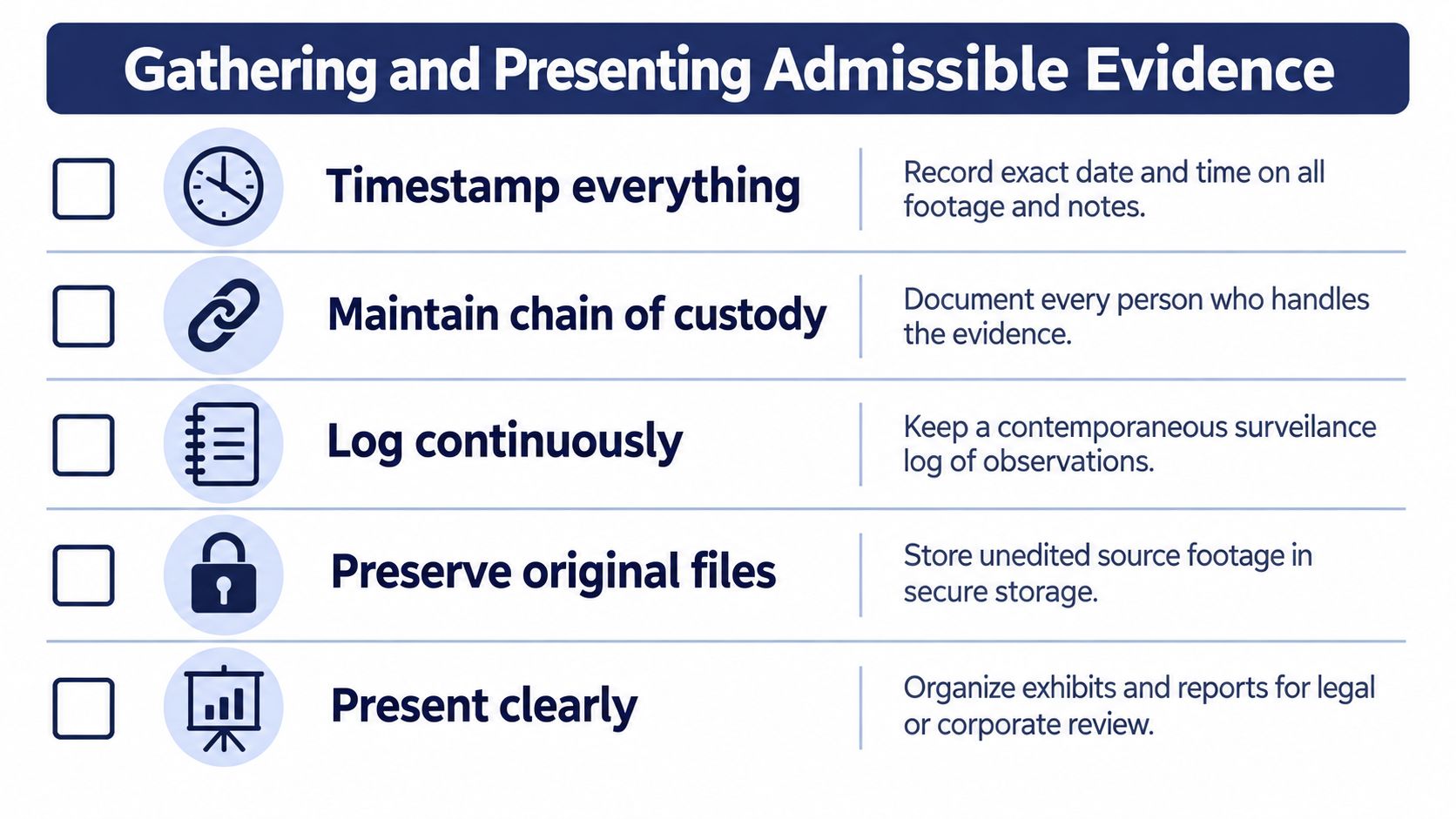
Timestamp everything: Record the date and time associated with footage, photographs, notes, and relevant file activity.
Maintain chain of custody: Document who collected, copied, stored, reviewed, or transferred the material.
Log continuously: Write observations close to the time they occur, including changes in position and periods when the subject was not visible.
Preserve original files: Keep unedited source material in secure storage and create working copies for review or presentation.
Present clearly: Organise reports, exhibits, photographs, and video references so a solicitor, tribunal, manager, or court can follow the evidence.
Evidence should answer three questions: What happened, how do you know, and can another person verify the account?
Editing may make a presentation easier to watch, but it mustn't obscure the original material or remove context without explanation. A report should distinguish direct observation from interpretation. “The subject carried a box from the vehicle into the premises” is materially different from assuming what the box contained or why it was carried.
Investigators may prepare witness statements or expert material where appropriate to the assignment. The final package should be proportionate to the client's purpose, whether that involves a solicitor, civil proceedings, an employment process, or an internal corporate review. Clients handling video material can also consult guidance on how to authenticate evidence in 2026, while recognising that technological checks don't replace a complete chain of custody and first-hand operational records.
Real-World Applications and Case Scenarios
A relationship investigation often begins with incomplete information. A client may know that their partner's routine has changed, but not whether the change reflects infidelity, work pressure, family responsibilities, or something else. A carefully scoped surveillance assignment can examine selected periods and locations without turning every aspect of the person's life into an investigative target.
The investigator would normally take a confidential account of the concern, discuss what outcome the client needs, and identify the dates most likely to produce useful information. If observation establishes a meeting or movement, the evidence should describe what was seen. If the subject follows an ordinary routine or no relevant activity takes place, that result is still important because it prevents the client from relying on an unsupported assumption.
Corporate enquiries require a different focus
Suppose a company suspects that an employee on certified sick leave is carrying out work for another organisation. The employer shouldn't begin with an assumption of fraud. A surveillance plan might examine whether the person carries out activities that appear inconsistent with the stated restriction, while avoiding irrelevant private conduct and preserving an objective record.
A similar approach may apply to suspected moonlighting, workplace theft, fraudulent injury claims, or a loss occurring around a commercial premises. The investigator needs the employer's defined concern, relevant dates, available records, and a clear understanding of how the evidence may be used. Surveillance may form one part of a wider enquiry involving HR records, access logs, stock information, interviews, or legal advice.
Corporate espionage concerns can involve a different combination of observation and technical assessment. If a director believes confidential meetings or documents are being exposed, following a person may not answer the question. A TSCM inspection, access review, or background enquiry may be more suitable than mobile surveillance.
From briefing to handover
At the end of an assignment, the client should receive a structured explanation rather than a dramatic conclusion. The investigator can identify the operational dates, summarise relevant observations, provide supporting images or video references, and explain any limitations, such as lost visual contact or restricted visibility.
This approach gives a solicitor or decision-maker material they can assess independently. It also protects the client from overreaching. Evidence is most valuable when it helps someone make a defensible decision, not when it is presented as proof of an allegation that the material doesn't establish.
Choosing the Right Investigative Partner
Selecting a private investigation firm requires more than comparing a headline hourly rate. Ask how the firm defines the objective, assesses legality, protects confidential information, records fieldwork, and reports an outcome that may not match the original suspicion.
Before instructing anyone, discuss:
Relevant experience: Can the firm explain how it handles personal, employment, corporate, or litigation-support surveillance?
Operational planning: Will the investigator assess the subject's routine, likely locations, transport, safety issues, and possible stopping points?
Reporting standards: Will you receive contemporaneous logs, clear image references, original material where appropriate, and a report separating fact from opinion?
Insurance and accountability: Can the firm explain its professional arrangements, complaints process, and data-handling procedures?
Geographic coverage: Does the team understand the locations involved and have practical resources for urban, regional, or multi-location work?
Commercial clarity: Are the proposed methods, communication arrangements, likely expenses, and billing basis explained before work begins?
A confidential initial consultation should also identify whether surveillance is the right service at all. Sometimes a background check, people tracing enquiry, process serving instruction, TSCM assessment, or legal consultation will answer the client's problem more effectively. A responsible investigator won't recommend covert work merely because the client is anxious and wants immediate action.
For individuals and businesses comparing options, private detective services should be assessed against the specific evidence required, not against promotional language. The right partner will explain the trade-offs, protect the boundaries of the assignment, and tell you when the available evidence can't support a conclusion.
Sentry Private Investigators Ltd provides discreet surveillance investigation services for private clients, legal professionals, and businesses dealing with relationship concerns, workplace absence, suspected fraud, theft, and related evidence-gathering needs. To discuss your circumstances confidentially and assess a proportionate investigative approach, visit Sentry Private Investigators Ltd.