
GPS Car Tracker UK: Legal Rules and PI Services

You've noticed unfamiliar journeys on a company vehicle, or you're worried that a family car could be stolen while parked outside the house. A quick search for a GPS car tracker UK owners can buy seems to offer an easy answer. Fit a device, open an app and watch the vehicle move.
That approach can work for straightforward asset protection, but it can also create serious problems. A tracker may show where a vehicle has been, yet it doesn't automatically prove who was driving, why a journey happened or whether the data was collected lawfully. In sensitive personal and corporate matters, the central question is not just which device to buy. It's whether tracking is justified, properly controlled and capable of producing useful evidence.
Understanding GPS Car Trackers in the UK
A vehicle owner may want tracking after a car disappears from a driveway. A fleet manager may need to check whether vans are following agreed routes. Someone dealing with suspected infidelity may notice unexplained overnight journeys and consider placing a tracker on a partner's vehicle. These situations look similar on a map, but their legal and investigative implications are very different.
Theft recovery is the clearest use case. Vehicles remain a persistent UK crime concern. In England and Wales, 129,159 vehicles were stolen in the year ending March 2024, while reported UK-wide thefts exceeded 133,000 in 2024, equivalent to roughly one theft for every 287 vehicles on the road, according to UK vehicle theft statistics. The same source reports more than 121,000 thefts in England and Wales for the year ending March 2025, alongside a separate UK dataset recording 90,509 stolen vehicles in 2025.
Those figures explain why people see a tracker as practical security equipment. Recovery services have also reported strong results for properly fitted systems. One industry report stated that 95% of vehicles fitted with Thatcham-approved trackers were recovered within 24 hours, while a 2025 update reported Tracker and UK police recovering 1,286 stolen vehicles by 30 September, with 113 arrests and 61 chop shops shut down. These figures support the view that tracking can assist recovery, but they don't mean every inexpensive device delivers the same result.
Recovery is not the same as surveillance
A tracker installed on a vehicle you own for theft recovery is materially different from secretly monitoring another person's movements. The first is usually an asset-security decision. The second may involve personal data, privacy rights and covert surveillance.
A device records location. It doesn't independently establish context, consent or lawful authority. If your objective involves a spouse, employee, business rival or another identifiable person, buying hardware online is not a substitute for an investigation plan.
Practical rule: Decide what legitimate outcome you need before choosing equipment. Recovery, fleet control and evidence gathering require different deployment decisions.
Types of Vehicle Tracking Devices Available
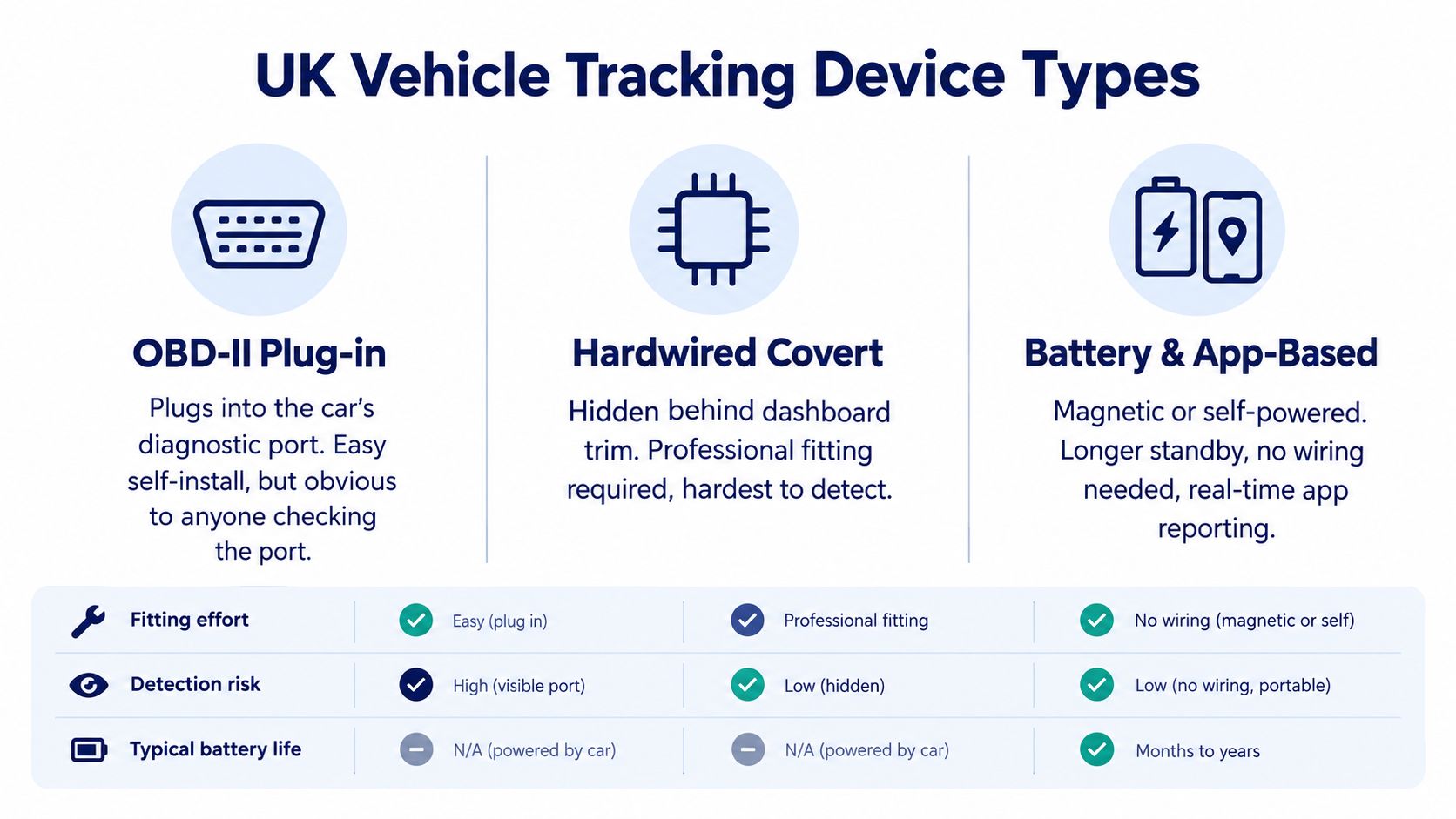
The three common options are OBD-II plug-ins, hardwired covert units and battery-powered magnetic trackers. Each has a place, but none is universally suitable. Ease of installation often increases visibility, while concealment can increase fitting complexity and maintenance requirements.
OBD-II plug-ins
An OBD-II tracker connects to the vehicle's diagnostic port, usually beneath the dashboard. It's attractive to owners who want a quick, removable installation and may suit a vehicle shared between authorised users.
The weakness is obviousness. Anyone checking the diagnostic port can see the unit, unplug it or question its presence. It also occupies a port that may be needed for diagnostics, and its position can make it unsuitable where discreet deployment matters.
Hardwired covert units
A hardwired unit connects to the vehicle's electrical system and can be concealed behind dashboard trim or within another suitable area. It's more difficult for an unauthorised person to spot, but fitting requires care. Poor installation can create electrical faults, expose wiring or leave visible signs that compromise the purpose of the device.
Professional units also tend to offer better integration with alerts, ignition status and movement events. Those features can help distinguish a genuine journey from a brief relocation, although the data still needs interpretation.
Battery-powered magnetic devices
A battery-powered tracker can be placed without connecting to the vehicle's wiring. That makes it useful where permanent installation isn't appropriate, but the device's reliability depends on battery condition, update frequency, weather exposure and physical security. A tracker that stops reporting or detaches from the vehicle provides little investigative value.
Modern UK devices commonly use multi-constellation GNSS, combining GPS, GLONASS, Galileo and BeiDou. This can improve fix availability where buildings, bridges and other obstructions interfere with satellite visibility. One UK-distributed Teltonika unit lists 135 tracking channels, sensitivity down to -165 dBm, sub-1.8 m CEP accuracy and velocity accuracy below 0.1 m/s, as described in this technical overview of a car GPS tracking unit. Those specifications matter because dependable positioning supports more useful journey and stop-start records.
Before buying, compare GPS car tracking features against the actual requirement. A consumer app may be sufficient for a family-owned vehicle's recovery plan. It may be wholly unsuitable for covert, high-stakes surveillance.
Navigating UK Legal and Privacy Rules
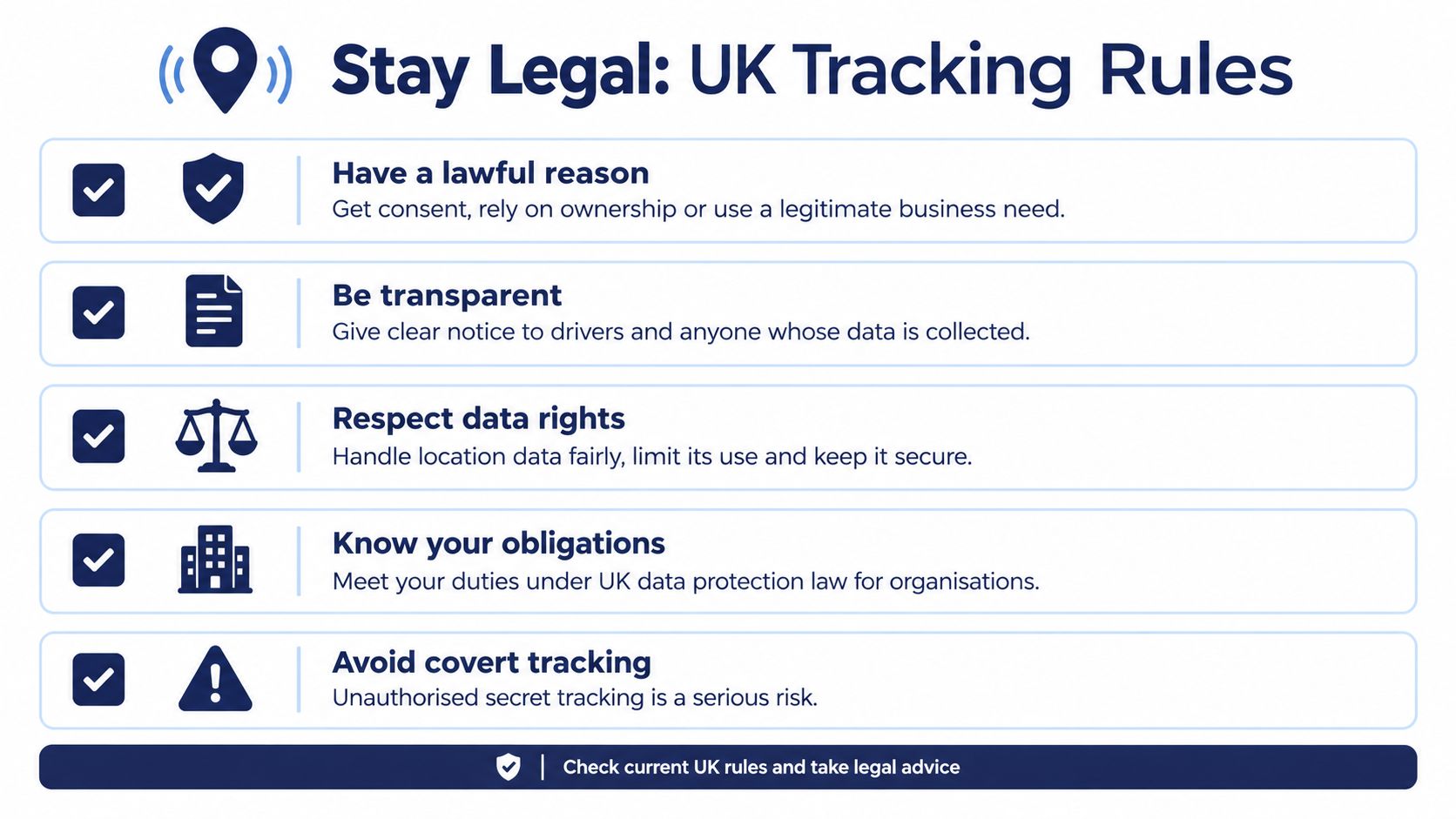
The legal risk starts when a vehicle can be connected to an identifiable individual. A Vehicle Registration Mark, or VRM, can become personal data when combined with information that identifies a keeper or driver. Location history can reveal routines, workplaces, homes and relationships, so organisations and private users need to treat it with care.
Relevant UK frameworks include the Human Rights Act 1998, Regulation of Investigatory Powers Act 2000, Investigatory Powers Act 2016, UK GDPR and Data Protection Act 2018. The practical test is whether tracking is lawful, necessary, proportionate and justified. Owning a vehicle doesn't automatically give someone unlimited permission to monitor every person who uses it.
The compliance questions that matter
A business tracking its fleet should identify its lawful basis, tell drivers what happens and limit monitoring to a defensible purpose. It should also consider whether private use is permitted and whether tracking continues outside working time.
The Information Commissioner's Office treats geolocation or behaviour tracking as a high-risk processing activity. A Data Protection Impact Assessment is required for processing involving tracking an individual's geolocation or behaviour, according to this UK vehicle tracking policy guidance. The ICO's guidance on surveillance in vehicles also emphasises assessing the rights of drivers and passengers.
A DPIA should record the purpose, lawful basis, risks, access controls, retention period and safeguards. It should explain why less intrusive methods aren't sufficient. If the organisation can't justify continuous monitoring, it should narrow the collection or choose another approach.
Covert personal tracking carries a different risk
Secretly tracking a partner, acquaintance or employee may intrude on private life and expose the installer to civil or criminal consequences. It can also damage an otherwise valid investigation by producing evidence collected through an unlawful method.
Retention needs discipline. UK fleet and telematics practice commonly discusses 30 to 90 days for live location data and 12 to 24 months for trip history, subject to purpose and justification, as outlined in this UK vehicle-tracking legal overview. Those are not universal permissions. They're operational reference points that still need to be tested against the specific processing activity.
If you're uncertain about authority, don't install first and ask questions later. Get legal advice or choose the right tracking device with professional guidance.
Practical Use Cases for Individuals and Businesses
Businesses usually begin with an operational question. Is a vehicle being used efficiently? Are routes being followed? Does the company need an alert when an asset leaves an agreed area? Individuals often begin with a personal concern, such as suspected infidelity, a disputed cohabitation arrangement or the welfare of an elderly relative.
The technology may be similar, but the legal basis and expected output differ sharply.
User Type | Primary Objective | Legal Basis | Typical Outcome |
|---|---|---|---|
Fleet operator | Asset visibility, route control and operational oversight | Documented business purpose, transparency and appropriate data protection controls | Journey records, alerts and management information |
Vehicle owner | Theft recovery and asset protection | Ownership and a justified security purpose | Location information to support recovery |
Private individual | Investigating suspected personal conduct | Situation-specific lawful authority and proportionality | Intelligence that may guide further investigation |
Corporate client | Investigating suspected fraud, absence or moonlighting | Legitimate business need, documented process and privacy safeguards | Time-stamped movement intelligence alongside other evidence |
Family or care-related user | Supporting safety and welfare | Consent or another appropriate lawful basis | Reassurance and location awareness within agreed boundaries |
Fleet operators should define the information they need before enabling every available alert. Geofencing can be useful for depots, restricted areas and agreed work zones, and this fleet management geofencing case study provides additional context on how businesses can use location boundaries operationally.
Personal investigations need more than a map
A map may show that a vehicle travelled to a particular area. It won't necessarily show who was present, what happened there or whether the journey supports the client's concern. A private investigation may require lawful physical surveillance, open-source checks, background enquiries, witness evidence or documentation obtained through proper channels.
For a business, tracker data may support an allegation of fraudulent workplace injury claims, unauthorised moonlighting or unexplained absence. It should be handled as one evidential strand, not presented as a complete conclusion on its own.
Installation Methods and Subscription Models
The purchase price is only the beginning. A functioning tracking system needs a suitable installation, cellular connectivity, a secure platform, user permissions and a process for dealing with alerts and stored history.
An OBD-II device can be connected quickly, but its visibility makes it a poor choice where tamper resistance or discretion matters. A hardwired unit needs an installer who understands vehicle trim, power management and concealment. A magnetic device avoids wiring, yet someone must check its battery, attachment and reporting status.
The recurring costs are operational
Subscriptions commonly support mobile connectivity, live reporting, map access, alerts, software and stored journey history. The important question isn't only whether a plan is cheap. Ask what happens when the subscription ends, whether data remains accessible, how accounts are secured and whether different users can have different access levels.
A fleet manager may need controlled access for supervisors, while an investigator may need a carefully preserved export of relevant events. Shared passwords, unrestricted administrator access and indefinite storage create avoidable risks.
Retention should match purpose. Live location data may need a shorter period than a properly documented trip record, and old data should be deleted when there's no continuing reason to keep it. Organisations should record who can access the platform, why access is granted and when permissions are reviewed.
Connected vehicle systems may also raise Privacy and Electronic Communications Regulations considerations in some circumstances. If the vehicle carries dashcams or CCTV, the ICO says organisations must register and pay a data protection fee, as explained in its previously asked questions on in-vehicle monitoring.
A reliable setup is therefore a governance exercise as much as an installation job. Hardware that reports accurately can still create liability if nobody controls the data.
When to Hire a Private Investigator for Tracking
DIY tracking fails most often because the purchaser focuses on the device and ignores the investigation. A consumer unit doesn't establish a lawful basis, decide whether covert deployment is proportionate or explain how evidence should be preserved. It may also be placed where it's found quickly, lose power or produce a record with no supporting context.

A professional investigator starts with the objective and the authority to act. That means establishing who owns or controls the vehicle, identifying the people affected, considering privacy risks and choosing a method that can be defended if the matter reaches solicitors, insurers, regulators or court.
Where professional deployment changes the result
A covert installation needs more than a small device. The investigator must consider concealment, signal performance, access, tamper risk and the possibility that the subject is actively looking for surveillance equipment. The deployment should be recorded internally, with relevant dates, device details and handling procedures.
Tracking can reveal movement patterns, but physical surveillance may provide the missing context. An investigator can observe who leaves the vehicle, document meetings from a lawful public vantage point and compare observations with recorded movements. That combination is more useful than handing a client an unexplained route history.
For a corporate client, the same approach can test suspected moonlighting, workplace absence or fraudulent activity without relying on a single technical source. It also helps separate a legitimate concern from an innocent explanation.
Sentry Private Investigators Ltd provides Private investigator services, including GPS vehicle tracking, covert surveillance and support for private and corporate investigations. The appropriate service depends on the facts, the client's authority and the evidence required.
Before authorising work, a professional firm should explain the proposed method, limitations, reporting process and likely cost. It should never promise that a tracker alone will prove infidelity, fraud or misconduct.
The practical sequence is usually:
Clarify the objective: Decide whether you need recovery, intelligence, observation or court-ready evidence.
Check authority: Establish ownership, consent, employment arrangements and the relevant privacy risks.
Select proportionate methods: Use tracking only where it's justified, and combine it with other lawful enquiries where necessary.
Preserve the record: Keep accurate notes about deployment, access, downloads and interpretation.
Professional surveillance isn't a shortcut around the law. It's a way to prevent an ill-considered device purchase from undermining a serious matter.
A consultation is particularly sensible when the vehicle belongs to someone else, when an employee is involved, when proceedings may follow or when the subject may discover and challenge the monitoring. In those circumstances, technical capability is only one part of the decision.
Securing Your Vehicle and Peace of Mind
A GPS tracker can be a sensible part of a theft-recovery plan or a properly managed fleet system. It becomes far more sensitive when the aim is to monitor a person's movements, especially without their knowledge. The lawful basis, purpose, transparency, access controls and retention arrangements matter as much as the tracker's location accuracy.
Use this decision test:
Asset protection: If you own the vehicle and need recovery assistance, select a reputable system and maintain the subscription.
Business monitoring: Document the purpose, complete the required assessment and notify affected drivers.
Personal or corporate investigation: Get professional advice before installing anything, particularly where covert surveillance or possible litigation is involved.
Businesses considering broader vehicle safety controls may also find this resource on how to reduce fleet liability with cameras useful when reviewing their monitoring policy. Cameras and trackers address different risks, so each should have its own justification and handling rules.
Sentry Private Investigators Ltd can discuss discreet GPS vehicle tracking, covert surveillance and related investigative requirements across the UK. Contact the firm for a confidential assessment before you deploy a device, so the method is proportionate, lawful and aligned with the evidence you need.
Sentry Private Investigators Ltd offers discreet GPS vehicle tracking and covert surveillance for private and corporate matters, with a specific approach to the legal and evidential issues involved. Visit Sentry Private Investigators Ltd to arrange a confidential consultation about your vehicle tracking requirements.