
How to Find Previous Owner of Vehicle in the UK

You've bought a second-hand car, the service book is missing, and the seller has stopped answering messages. You want to confirm the mileage, find the spare key, or resolve an argument about damage that wasn't disclosed. The obvious question is how to find the previous owner of a vehicle in the UK, but the legally correct term is usually “previous registered keeper”.
The practical route has two stages. Start with the V5C logbook and official DVLA records. If the paperwork is incomplete, the person has moved, or you need evidence for a dispute, escalate to a professional tracing agent rather than relying on random online searches.
Why People Need to Trace a Vehicle's Previous Keeper
A previous keeper may hold the missing piece of a vehicle's history. They might know whether the mileage was recorded correctly, where the spare key went, why a cherished registration was removed, or whether an accident was repaired privately. A conversation with that person can sometimes settle a question that inspection reports and online checks leave unresolved.
Common reasons for tracing include:
Incomplete service history: The handbook may be absent, while the previous keeper may know which garage maintained the car.
A private-sale dispute: A seller might stop responding after you discover undisclosed damage or a serious mechanical issue.
Outstanding finance concerns: Earlier paperwork may help establish how the vehicle was used and transferred.
A missing cherished registration: The previous keeper may have handled a plate transfer without leaving clear paperwork.
Probate enquiries: Executors may need to establish where a vehicle came from before an estate was distributed.
Fleet handovers: A former company vehicle can pass through leasing, fleet management and dealer channels before reaching a private buyer.
The difficulty is that the registered keeper isn't automatically the legal owner. The DVLA records the person responsible for registering and taxing the vehicle. It doesn't provide an unrestricted public search of private individuals, and keeper information is protected personal data under the wider framework of the UK GDPR and the Data Protection Act 2018.
Practical rule: A legitimate reason matters. Trying to obtain someone's address simply because you're curious isn't the same as tracing a keeper for an accident, court matter, asset recovery or documented dispute.
That protection is sensible. A vehicle registration number shouldn't function as a public directory entry. The clean approach is to use official records first, preserve every document, and only instruct a professional when the reason is genuine and the normal paper trail has failed.
Reading the V5C Logbook for Keeper History
The V5C is the first document to inspect because it exposes the most useful keeper-history information directly. The official GOV.UK vehicle log book guidance confirms that the document identifies the current registered keeper, records the most recent previous keeper, shows when the current keeper acquired the vehicle, gives the date of first registration and indicates the number of former keepers.
Start with the keeper details on the document. Check the name and address against the person who sold you the car, then note the acquisition date and the former-keeper information. If the seller claims to have owned the vehicle for years but the V5C shows a recent acquisition, ask for a clear explanation before relying on anything else they say.
The current V5C design has been in place since the April 2019 redesign, which made the keeper-history fields easier to interpret for motorists. Older green V5 documents can look different, so don't assume that a change in layout means the document is false. Check the registration number, VIN, make, model and keeper details together.
What the main V5C fields mean
V5C field | What it reveals |
|---|---|
Current registered keeper | The person DVLA records as responsible for the vehicle, not proof of legal ownership |
Most recent previous keeper | The latest former registered keeper shown on the document |
Date acquired | When the current keeper acquired the vehicle, useful for testing the seller's account |
Date of first registration | The vehicle's registration milestone, not the date of every later transfer |
Number of former keepers | A count of previous registered keepers, not a complete list of names and addresses |
Vehicle identity details | Registration, VIN and specification information that should match the car and its paperwork |
The former-keeper count is useful, but don't treat it as a full ownership chain. A keeper can change without a conventional private sale, such as a fleet transfer, leasing arrangement or dealer movement. Equally, a change in legal ownership may not appear in the same way as a change in registered keeper.
The V5C isn't a title document. It doesn't establish who legally owns the vehicle, and the V5C/2 new keeper slip is only the part given to the new keeper while the registration is being updated. A missing, altered or unsigned document should increase your caution. It doesn't prove wrongdoing, but it removes one of the strongest starting points for a reliable chronology.
If lost papers are part of a wider ownership problem, this guide on how to prove car ownership after lost papers offers useful context on assembling alternative evidence. Keep purchase invoices, bank records, insurance documents, messages and repair receipts together. They may not identify a previous keeper by themselves, but they can support a coherent account of the vehicle's history.
Using DVLA Form V888 to Request Keeper Data
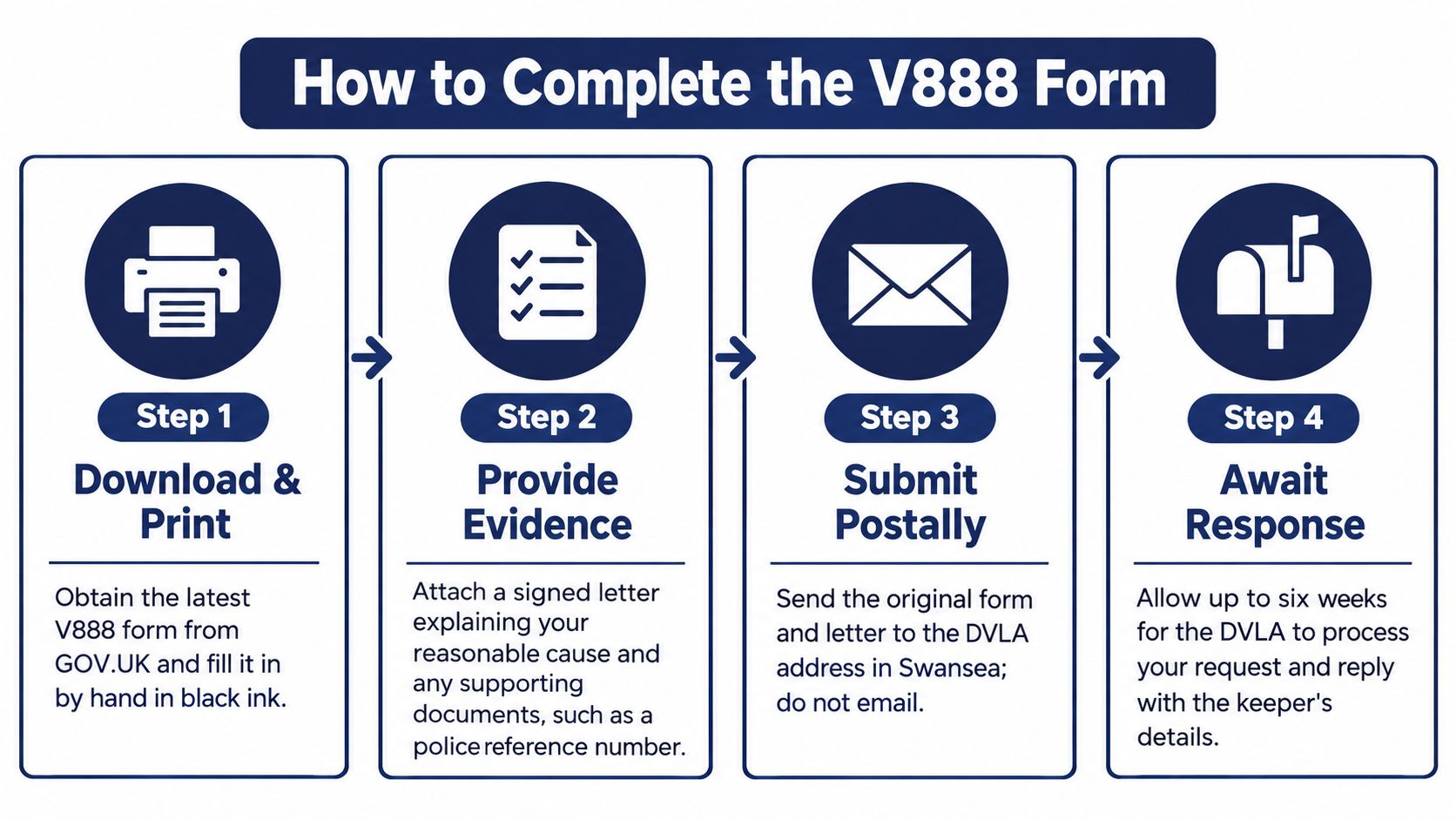
Form V888 is the official route for an individual who needs information from DVLA vehicle records. It isn't a casual owner lookup. DVLA requires the applicant to demonstrate reasonable cause, explain the purpose of the request and show how the information will be used.
The process is straightforward, but the justification has to be specific.
Establish the reason before completing the form
A vague explanation such as “I want to know who owned the car” is unlikely to be persuasive. A stronger application explains the event, the vehicle, the date or period involved, and why contacting the keeper is necessary. Examples can include tracing a vehicle connected with an accident, recovering a stolen asset or complying with a court order.
DVLA guidance confirms that consent from the keeper isn't required where the law permits disclosure for a legitimate reason. That doesn't remove the need for a proper explanation. It means DVLA assesses the application against its disclosure rules rather than requiring the keeper to approve it first.
Use the current individual V888 form and provide complete vehicle identifiers. Include the registration number, VIN where available, relevant dates and a concise statement of reasonable cause. Attach supporting material that makes the request credible, such as insurance correspondence, a witness statement, a solicitor's letter, a police reference or court paperwork.
Choose the correct form
Individuals normally use V888. Companies use different variants depending on the reason for the enquiry. DVLA's guidance distinguishes V888/2A for company requests for keeper name and address information, V888/2B for other vehicle information, and V888/3 for organisations such as parking or trespass charge operators. The correct form matters because the process is procedural, not a public database search.
For a vehicle registered to someone else on a particular date, the DVLA guidance on requesting another vehicle's registered keeper explains which route applies to the requester. Don't substitute a company form for an individual application or assume that a third-party vehicle-check provider can make the request on your behalf.
Submit a complete postal application
DVLA applications are post-based and case-specific. Send the completed form, your signed explanation and supporting documents to the address specified on the current form. Keep copies of everything, including proof of posting.
The official DVLA request information page explains the reasonable-cause requirement and the distinction between keeper information and legal ownership. DVLA may release registered keeper details where the request fits its policy, but it won't provide an unrestricted ownership history or guarantee that the information will answer every question about the vehicle.
Processing time depends on the application and the evidence supplied. If DVLA rejects the request, read the reason carefully rather than sending the same wording again. A Subject Access Request usually concerns your own personal data, so it isn't a general method for obtaining another person's details. For a genuine legal dispute, a solicitor or a professional tracing agent may be the more appropriate next step.
If you need to check the people involved in a wider matter, a structured background check screening process may be more useful than repeatedly submitting incomplete DVLA applications.
Online Vehicle Checks and Seller Due Diligence
Paid vehicle checks can expose important warning signs, but they don't normally identify a previous keeper by name and address. Services such as HPI, AA Car Data Check, RAC and Auto Trader can help you assess a vehicle's reported history, yet their keeper-history information generally stops at the number of previous registered keepers or a change-of-keeper indicator.
That makes them useful for vehicle risk screening, not personal tracing.
Provider | Previous keeper count | Name or address of keeper | Stolen or write-off flag | Mileage discrepancies |
|---|---|---|---|---|
HPI | May report keeper-history indicators | Not normally disclosed to a casual buyer | Vehicle-history warnings may be reported | May flag recorded inconsistencies |
AA Car Data Check | May show recorded keeper information in summary form | Not normally disclosed | May report relevant vehicle alerts | May identify data discrepancies |
RAC | May report the number or pattern of keeper changes | Not normally disclosed | May report stolen or damage-related markers | May compare recorded mileage |
Auto Trader | May provide vehicle-history indicators where data is available | Not normally disclosed | May display relevant history flags | May highlight mileage concerns |
Treat every result as a lead, not proof. A cloned logbook, a recent address change or stale data can create a misleading picture. Check the seller's name against the V5C, inspect the service book and MOT paperwork for names and garage details, and compare the dealer invoice with the business recorded at Companies House.
If a supplying franchise appears on the documents, contact its service department and ask whether it can verify historical work. Staff may not release personal data, but they may confirm whether the vehicle was maintained there or explain what records could be requested through a lawful channel.
For buyers checking a particular Toyota's specifications alongside its history, a resource to find used Toyota specs can help confirm that the vehicle's stated configuration matches the identification details. It won't replace a keeper trace or a physical inspection.
Don't confuse vehicle research with locating a person. A car GPS tracking unit guide is relevant to lawful vehicle security and tracking questions, but a tracker isn't a legitimate shortcut to a previous keeper's identity.
Following the Paper Trail Beyond the DVLA
A missing name on the V5C doesn't mean the trail has disappeared. The car often carries a second history in places buyers overlook.
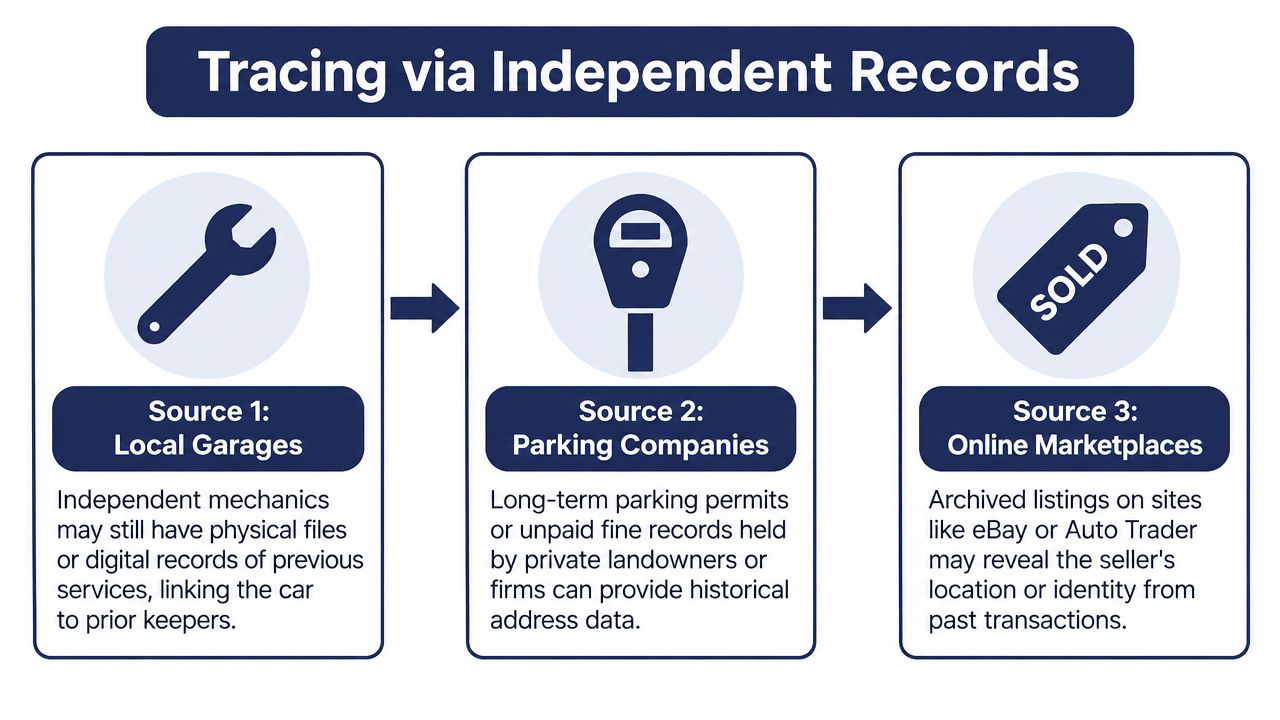
One buyer found a service sticker inside the driver's door showing a garage telephone number and a mileage entry. The service book contained only partial stamps, but an old invoice tucked behind the handbook identified the garage and the registration number. The garage couldn't disclose a former customer's personal details, yet it could confirm the work date and explain whether the vehicle had been brought in by a private keeper, a dealer or a fleet operator.
Start with records physically attached to the car
Look through the handbook, service booklet, glovebox, boot compartments and paperwork wallet. Record every useful detail before contacting anyone.
Garage stamps: Note the business name, town, telephone number, invoice number and service date.
Receipts: Look for customer names, addresses, registration numbers and mileage entries.
Dealer stickers: Check the door jamb, windscreen, bonnet area and service reminder labels.
MOT paperwork: Compare the test station, date, mileage and vehicle identity details.
Number plates: A dealer plate surround can identify the supplying or servicing business.
Use the GOV.UK MOT history service to identify test dates, recorded mileage and the testing station where the vehicle was examined. A garage may only be able to discuss the car with staff who were present at the time, and data-protection rules may prevent it from naming a customer. Even so, a polite call can confirm whether a receipt is genuine or point you towards a dealer network.
Use independent records carefully
A chassis prefix may help identify the manufacturer network or supplying main agent. That doesn't guarantee the dealer still holds the records, but it gives you a sensible starting point for an enquiry about servicing, recalls or handover history.
Finance and insurance documents can also contain useful breadcrumbs. If you were involved in the relevant contract or claim, a Subject Access Request may help you obtain your own personal data and correspondence. It isn't a general entitlement to another keeper's confidential details, so don't present it as one.
Archived marketplace listings can reveal how the vehicle was described and where it was advertised. Parking companies and private landowners may hold historical permit or enforcement records, but they won't normally disclose another person's information without a lawful basis. The purpose of these checks is to corroborate dates and identities, not to pressure staff into releasing protected data.
When to Bring in a Professional Tracing Agent
Professional tracing makes sense when the official route and the paper trail have reached their limits. It shouldn't be the first response to a simple missing service book, but it becomes proportionate when the previous keeper is material to a legal, financial or ownership dispute.
A trace is particularly justified where:
The keeper has moved repeatedly: A V5C address may be old, incomplete or linked to several unsuccessful contact attempts.
The name is misspelled: A small error can block ordinary searches, especially where the person has a common name.
The vehicle passed through trade channels: Auctions, dealers and trade plates can interrupt the consumer-facing history.
A formal dispute is active: Insurance claims, finance disagreements, undisclosed accident allegations and court proceedings need more than online speculation.
The vehicle is part of an estate: Probate enquiries may require a documented chronology rather than an informal conversation.
A proper trace doesn't mean obtaining information by deception. A reputable investigator works within a lawful purpose, checks multiple sources, records the basis for the enquiry and reports what can be supported. The useful output may include a corroborated address history, verified contact numbers, a clear contact attempt record and evidence suitable for discussion with a solicitor.
A professional trace should produce an evidence trail, not just a phone number.
Ask prospective firms how they handle data protection, what records they retain and whether they can explain their source methodology. Check whether the investigator is appropriately authorised for the work, whether the business is registered with the Information Commissioner's Office where required, and whether its terms of engagement identify the lawful purpose.
The Private Security Industry Act is relevant to certain regulated security activities, but private investigation work doesn't have a universal mandatory SIA licensing requirement in the same way as some guarding activities. Don't accept a firm's claim of “SIA licensed private investigator” as a substitute for checking its actual credentials.
Get written terms before authorising work. The agreement should state the objective, required vehicle identifiers, likely deliverables, confidentiality arrangements, cancellation terms and fee structure. A success-based arrangement can be appropriate, but define what “success” means. Sentry Private Investigators Ltd is one UK option offering UK tracing agents for people and vehicle-related enquiries.
Choosing the Right Route Forward
Choose the route according to what you already hold and why you need the previous keeper.
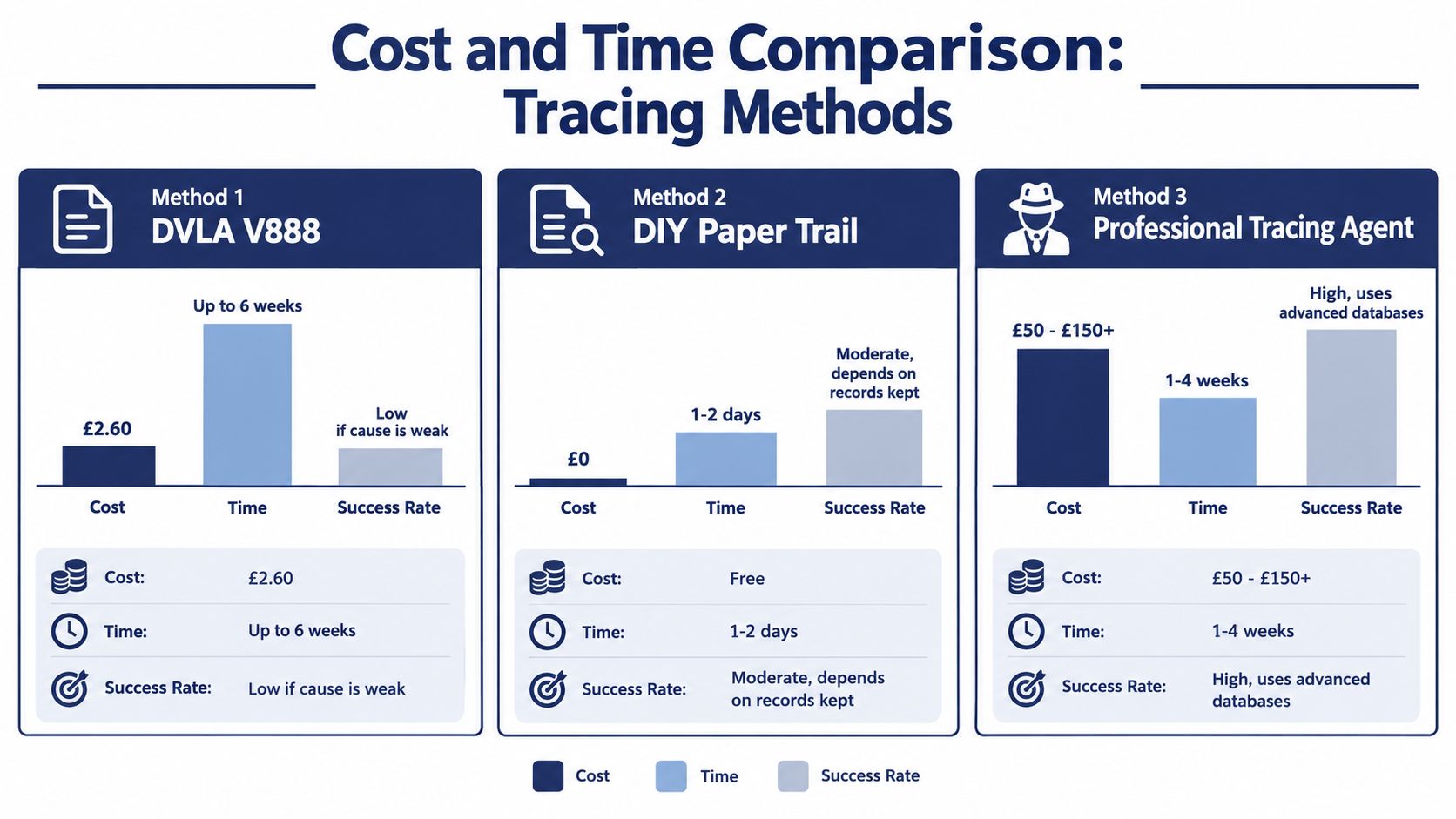
If you have the registration number, V5C or a clear vehicle identity and only need to verify the chronology, begin with the logbook and the official DVLA process. The V888 route is the appropriate first escalation for an individual with reasonable cause. DVLA's V888 application guidance explains the form and the type of vehicle-record request it supports.
If the MOT record, service stamp or dealer invoice gives you a business name but no address, contact that garage or dealer before paying for a trace. Ask for confirmation of dates, work and the route by which the vehicle entered their records. The business may not disclose personal information, but it can sometimes validate the paper trail.
If the trail is cold, the vehicle is unroadworthy, or the issue involves inheritance, debt recovery, fraud, finance or litigation, use a solicitor or a properly vetted tracing agent. Don't pay an unverified “find anyone” website just because it promises instant results.
The sensible decision is based on proportionality. Online checks are useful screening tools, DIY paperwork costs little, and professional work carries a fee that should be justified by the importance of the outcome. Be wary of any provider that promises guaranteed access to confidential data or refuses to explain its terms before taking payment.
If your purpose is legitimate and the evidence matters, don't keep repeating searches that cannot legally reveal a name or address. Assemble the V5C, receipts, MOT details, messages and dispute documents, then take the complete file to a qualified professional who can tell you whether a trace is realistic.
Sentry Private Investigators Ltd can assess the vehicle records, paperwork and legal purpose behind your enquiry before recommending a proportionate tracing route. Visit Sentry Private Investigators Ltd to discuss a confidential vehicle keeper trace and receive clear terms before any work begins.