
Fundamental Dishonesty in UK Injury Claims: What It Means

Updated: 1 hour ago
Your employee has been off work for five months with a back injury. Then a colleague mentions seeing them unloading boxes at a weekend market, and you're left holding a claim you no longer trust and no clear idea what to do with that doubt.
Or you're on the other side. A defence has arrived accusing you of fundamental dishonesty, and the phrase feels far heavier than the muddled form you filled in during a bad week.
Both situations turn on the same question, and it isn't "did someone lie?" It's "how much of the claim rests on the lie?" That distinction decides whether a court trims an award or throws out an entire case, and it's worth understanding before you act on a suspicion or answer an allegation.
What Fundamental Dishonesty Means and Where the Line Falls

A claimant says an accident caused lasting injuries, but later evidence conflicts with part of that account. The conflict may expose a mistake, an exaggeration or a fabrication. Those are different things, and a single inconsistency rarely proves fundamental dishonesty.
The term describes dishonesty about a matter central to a personal injury claim: for example, whether the accident happened or the extent and duration of the injury. A wrong date on a form may have little effect. An invented accident goes to the foundation of the claim.
Section 57 of the Criminal Justice and Courts Act 2015 sets out the meaning and effect of fundamental dishonesty in personal injury litigation (section 57 of the Act). It applies after the court has found the claimant entitled to damages, and the defendant must apply for the claim to be dismissed.
The two-stage test courts actually apply
The court decides whether the claimant was dishonest on the balance of probabilities: whether dishonesty is more likely than not. That is the civil standard, distinct from the criminal standard.
Under Ivey v Genting Casinos, the court first establishes what the claimant knew or believed about the facts. It then considers whether the conduct was dishonest by the standards of ordinary decent people (Law Gazette's explanation of the Ivey approach).
The distinction between exaggeration and fabrication matters. A claimant might have a genuine injury but overstate symptoms or how long they lasted. The court must assess whether the exaggeration was dishonest and significant in relation to the claim. A fabricated accident or invented injury presents a different problem because it challenges the basis of the claim itself.
An inconsistency alone does not settle that question. A claimant may misremember a date, describe symptoms differently on a better day, or give an inaccurate account through embarrassment. The court must consider what the claimant believed and whether the discrepancy bears on the claim's liability or value.
Where the line falls in practice
Conduct | Likely effect on the claim | What the court focuses on |
|---|---|---|
Honest mistake or minor inconsistency | Damages assessed on the evidence as normal | Whether the mistake affected liability or value |
Genuine injury with exaggerated symptoms or duration | Exaggerated element may be reduced or assessed separately | Whether the exaggeration was substantial and material |
Fabricated accident or invented injury | Whole primary claim may be dismissed unless substantial injustice would follow | Whether the dishonesty goes to the heart of the claim |
The difference is like a dimmer switch, not a simple on-off button. Exaggeration may distort part of a genuine claim; fabrication may undermine its foundation.
The practical question is whether the discrepancy is material and what the claimant believed when making the disputed statement. If a minor error could not affect liability or the value of the claim, it is unlikely, by itself, to establish fundamental dishonesty.
If the court finds fundamental dishonesty, dismissal of the whole primary claim is mandatory unless that would cause substantial injustice. The court must also record the damages it would otherwise have awarded. Even honest parts of the claim can therefore be lost, which is why the allegation should be based on evidence rather than suspicion. For comparison, Florida auto insurance fraud penalties concern a different legal system and do not determine the UK test.
How Section 57 Can Dismiss a Whole Claim
Once entitlement is established and a defendant applies, the court follows a fixed sequence. Each step exists for a reason, and knowing them tells you what the evidence has to achieve at every stage.
The four stages below decide the outcome.
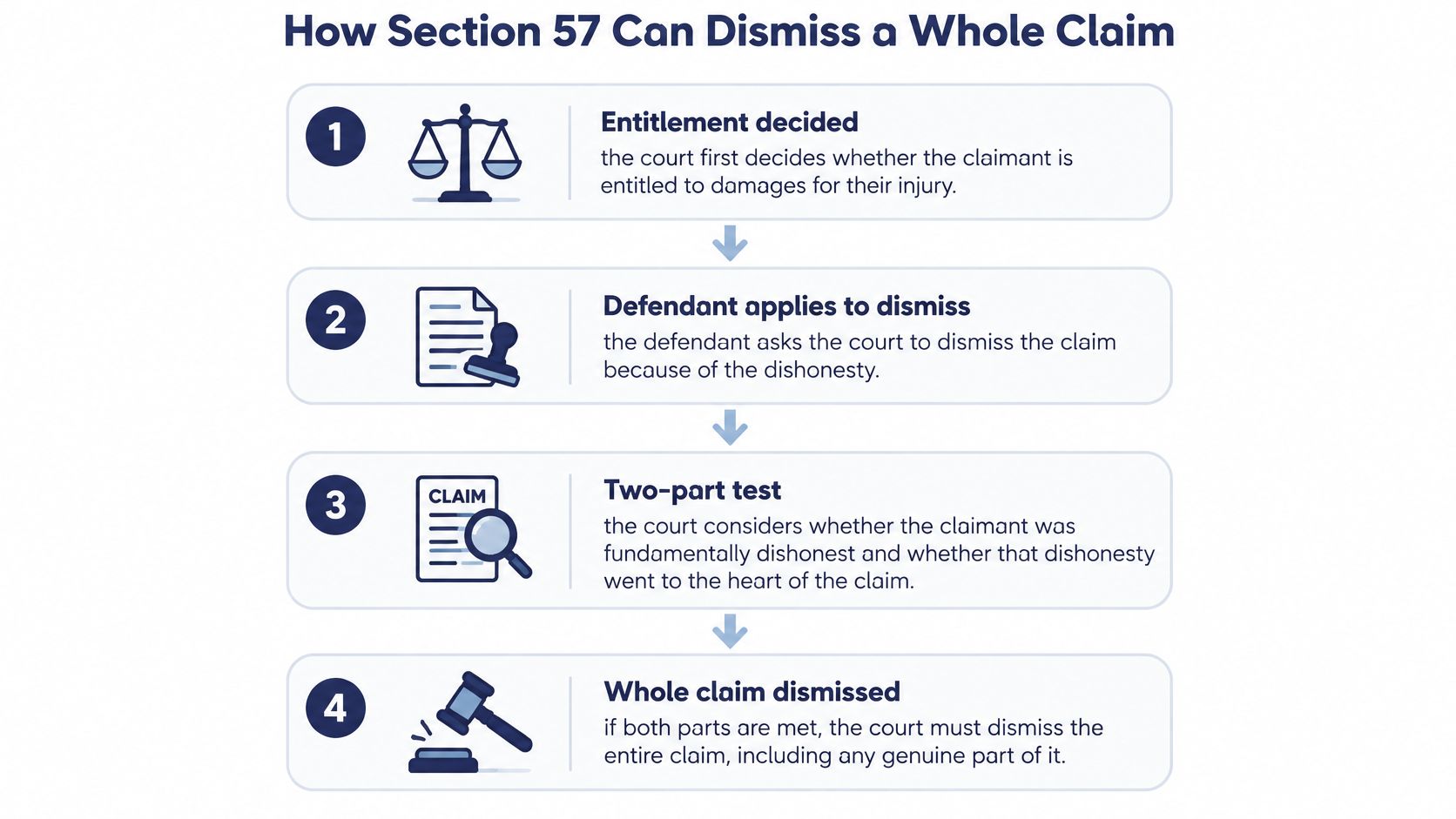
Entitlement is decided first. Before dishonesty is even considered, the court works out whether the claimant is entitled to damages for the injury. This is why a claimant with a real injury still has something to lose at the later stages, and why the dishonesty question is never the opening move.
The defendant makes the application. Dismissal doesn't follow automatically from an allegation of exaggeration, however strongly it's worded. The defendant has to ask, and it has to ask with evidence rather than suspicion. The provision has applied to personal injury claims since 13 April 2015, when it was commenced by the Criminal Justice and Courts Act 2015 (Commencement No. 1) Order 2015.
The court applies the balance of probabilities to the dishonesty. It asks whether the claimant was dishonest in relation to the primary claim or a related claim. Related matters, so a separate but connected claim can be drawn in and examined on the same footing.
Dismissal follows unless it would cause substantial injustice. The safeguard exists so that a claimant with a genuine injury and a mistaken account isn't wiped out by a technical falsehood. It is narrow, and it isn't a soft landing for anyone who set out to deceive.
The court records what it would have awarded. That figure isn't decorative. It feeds the judgment and the costs assessment, and it shows the claimant precisely what the dishonesty cost them.
Read together, the steps point to one practical conclusion. The dispute will turn on the reliability of the claim as a whole, so the evidence has to speak to the whole claim. A camera that catches one afternoon proves one afternoon, and nothing more.
Judges hear exaggerated claims often enough to be alert to the difference between someone who misdescribed a bad day and someone who built a case around a fiction. The second category is what the statute was written for.
Evidence That Proves Dishonesty and Evidence That Misleads
Evidence in an injury dispute is an argument, not a pile. Each item has to be tied to a specific pleaded allegation, carry a date, and be strong enough that a solicitor can explain in one sentence what it proves.
Think of a jigsaw. One piece tells you very little. Pieces that share a date, a place and a person start to show a picture, and the picture is what a court is asked to look at.
The five sources below appear in almost every suspected exaggeration case. Each has a limit worth knowing before you spend money on it.
Evidence type | What it can show | Main limit |
|---|---|---|
Surveillance footage | Activity at a stated date and time | A single clip can mislead without full context |
Medical records and chronology | Symptoms and treatment over time | Symptoms fluctuate and reports vary between clinicians |
Social media posts | Activity and timing of posts | Posts may be old, edited or unconnected to the injury |
Employment and attendance records | Work pattern and absence | Shows attendance, not injury severity on its own |
Witness statements | First-hand observation | Depend on the witness's reliability and independence |
What makes a piece of evidence worth something
Four qualities separate material that survives a hearing from material that gets explained away. It's dated and timestamped, so there's no argument about when it was captured. It's complete across the relevant period, not one clip from one afternoon. It's authenticated, meaning a witness or investigator can explain how it was collected and can be questioned about it. And it's corroborated, so the footage agrees with the attendance records and the medical chronology instead of sitting alone.
Length matters far less than fit. A thirty second clip of a claimant lifting a bag proves that they lifted a bag on that date. Set it against a medical chronology recording six months of reported inability to lift anything, and it starts to say something about the claim rather than about the bag.
How the material was obtained matters just as much. Covert surveillance is lawful where the client has a legitimate interest in the matter, and it stops being a neutral exercise the moment it drifts into privacy or data protection breaches. We won't accept an instruction where there's no lawful basis for the activity, because badly collected evidence hands the other side an argument that has nothing to do with the injury.
Where a claim runs to hundreds of pages of treatment notes, a structured method pays for itself. This walkthrough on reviewing medical records for injury cases covers how to build a timeline that holds up when someone tests it in a hearing.
Before you rely on any single item, apply three checks:
When was it recorded? An undated clip or an undated note is close to worthless, because the other side will say it proves nothing about the period in dispute.
What does it prove about the claim? Not what it shows in general, but which pleaded allegation it contradicts and how directly.
What else supports it? One source is a lead. Two sources that agree on date, place and person are evidence.
Investigating Suspicion Without Overstating the Case
The biggest risk in a suspected dishonesty case usually isn't missing evidence. It's using the phrase before the evidence has been tested.
Insurance fraud is a measured problem rather than a hunch. About 13,700 insurance-related fraud offences were recorded or referred to the National Fraud Intelligence Bureau in England and Wales in 2023 (House of Commons Library), and UK insurers detected more than 98,400 fraud-related claims worth over £1 billion in 2024, up 12% in volume from 2023 (Association of British Insurers). Employers and insurers have good reason to look. Looking carefully and alleging dishonesty are two different acts.
Investigation is not accusation
Preserve the originals. Don't crop, edit or annotate a file, and don't let anyone else do it. The unaltered version is the one that matters if the material is challenged.
Write down the discrepancy and its date. A note saying "story doesn't add up" is useless six months later. A note saying "claimed inability to drive from 3 March, observed driving on 14 April" is a starting point.
Test the innocent explanation before you draw a conclusion. Claimants recover. Claimants have good and bad days. Claimants sometimes describe symptoms badly because they're embarrassed or in pain.
Record the claimant's explanation. If there's a reasonable answer, you want it on file before a decision is made, not after.
Use measured language until the evidence is assessed. "Inconsistent with the medical evidence" is defensible. "Fraudulent claim" is a conclusion you may have to justify.
Confirm the lawful basis before the work starts. Purpose, method and data handling all need to be settled in advance, not improvised once footage exists.
A civil finding and a criminal conviction need different evidence and carry different consequences. A court finding fundamental dishonesty dismisses a claim; a prosecution has to prove an offence to the criminal standard. Keep the two apart in your own thinking and in anything you commit to writing, because an internal file note can end up being read by someone with a very different interest in it.
There's a further layer of risk in how allegations are put before trial. Current Civil Procedure Rules material indicates proposed or developing provisions on false statements made before proceedings, including statements in pre-action protocol documents, with possible contempt consequences (Ministry of Justice). An accusation in a letter, a pleading or an expert report can create its own procedural exposure if the evidence behind it is thin.
When a challenged claim does move toward resolution, the argument usually turns on figures as much as facts. Insurers weigh the cost of fighting against the cost of settling, and this guide to negotiating with an insurance adjuster covers how those conversations are normally approached.
For employers deciding whether to observe someone at all, our guide to lawful covert surveillance for employers sets out where the line sits.
The test before anything is sent is straightforward. Could you explain every item of evidence to a court without overstating what it shows? If not, the file isn't ready and neither is the letter.
How Evidence Plays Out in Practice
Suppose a claimant says a head injury has left them unable to drive. Dated observations show them driving the same vehicle along a route on more than one occasion.
The mismatch matters because driving may involve concentration, reaction and physical control. But the observation alone does not establish what the claimant could do at other times, or whether the activity conflicts with the medical evidence. Dates, clear identification and comparison with the medical account help show what the evidence supports.
That is the difference between an inconsistency and proof of fundamental dishonesty. A single discrepancy may have an innocent explanation, or say little about the claim's overall value. The court must assess the evidence in context.
Now consider a knee injury. The claimant reports being unable to climb stairs, while dated observations show them climbing a ladder weeks later. The difference could reflect recovery. Medical records and the timing of the damages claimed matter: evidence of later ability does not, by itself, show that an earlier account was fabricated.
Exaggeration and fabrication are also different. A person might overstate a limitation while having a genuine injury. A false claim about an injury or its effects goes further. The court needs evidence that supports the relevant conclusion, not merely a detail that seems inconsistent.
Sentry Private Investigators Ltd has reported a case involving a subject who claimed to be completely blind but was observed driving. That observation may be significant, but its meaning still depends on the evidence and the issues in the claim.
For workplace injury matters, employee fraud personal injury claims may involve comparing observations with attendance records and medical evidence. Corporate and workplace investigations aim to protect business interests through factual, evidence-based reporting.
An investigator's role is to provide accurate, dated evidence and a clear account of what it does, and does not, show. Some investigations find no dishonesty. That can prevent an unsupported allegation and help a client avoid pursuing a case the evidence cannot sustain.
Confirm the Evidence Before You Act
By now the decision is probably clear in outline. You either want to challenge a claim, answer one made against you, or satisfy yourself that an absence is genuine before you act.
Start with a discreet assessment of what evidence already exists, before anyone is accused of anything. Gather the original claim documents, the medical reports, the dates of the incident and any treatment, any footage or messages already in your possession, and a written note of each inconsistency with its date. That bundle tells a solicitor whether there's a case worth pursuing.
A solicitor should advise on whether section 57 applies to the facts you have, because the statute operates in a particular procedural setting and the court makes the final decision. Bring them the file, not the conclusion.
Sentry Private Investigators Ltd (SPI) can assess what evidence exists in a suspected injury claim fraud matter, whether it was collected lawfully, and whether the person who gathered it can stand behind it. We conduct investigations with complete confidentiality and don't disclose information without the client's consent. We don't promise predetermined outcomes, and we may carry out due diligence before work starts, which can require proof of identity or compliance with money laundering regulations.
If you're still deciding whether to involve anyone at all, our guidance for suspicious spouses and employers walks through how that decision usually unfolds. Our personal injury fraud and workplace injury claims pages explain what each service covers, and the contact page is the fastest route to a conversation.
Sentry Private Investigators Ltd investigates suspected fraudulent personal injury claims across Birmingham, London and the wider UK, pairing covert surveillance with record analysis so that what reaches your solicitor is dated, lawful and explainable. If a claim on your desk doesn't add up, or you're answering an allegation you believe is wrong, we can tell you what the evidence supports before anyone commits a word to paper. Visit Sentry Private Investigators Ltd to discuss the matter in confidence.
