
Crypto Scam Recovery: What UK Victims Should Do

£146,222,332. That is what UK victims reported losing to cryptocurrency fraud between the start of 2021 and 18 October of that year, across 7,118 reports, with an average reported loss just over £20,500 per victim, according to Action Fraud.
That is what people bothered to report, in one part of one year.
Crypto scam recovery is separate processes, on different clocks, owned by different organisations. A bank reviews reimbursement for a transfer it sent. An exchange freezes assets it still holds. Criminal-asset powers sit with the police and the courts. Only the route your money took will apply to your case.
Spend the next 48 hours finding which of those can still act. Judge progress by intermediate outcomes: a fraud reference logged, a freeze requested, the payment trail preserved. A success rate will not tell you where your money is. No reputable firm will ask you to pay a recovery fee in crypto, or to move what is left into a wallet they control.
What Recovery Looks Like by Payment Route
Recovery follows the payment, not a success rate. No official UK source publishes one. Anyone who quotes your odds is guessing or selling. The useful question is narrower: which counterparty still exists, still holds something, and can be reached by a bank, an exchange, or a court?
That depends on how the money left your account. Bank reimbursement, an exchange freeze, and criminal asset powers are three separate mechanisms. They do not stack into one refund. Judge progress by whether a specific step has started, not by a percentage on a tracing firm's site.
During 2024, UK victims submitted more than 17,000 reports of crypto-investment fraud to Action Fraud, according to figures cited by the National Crime Agency. That is a report every half hour, all year. Volume does not create a payout scheme.
Payment route | Contact first | What may still be possible | Ombudsman or FSCS |
|---|---|---|---|
UK bank transfer | Sending bank fraud team | Fraud escalation and a reimbursement review for that payment. Progress is a recall logged, not money returned | Not FSCS crypto cover |
Debit or credit card | Card issuer | Chargeback under card scheme rules, and section 75 for a credit card where the legal test is met | Card scheme rules, not FSCS crypto cover |
Still inside a UK-authorised exchange | That exchange, via its own website | An account freeze if the assets remain. Progress is the freeze, or a written refusal | Only if the firm is authorised |
Self-custody wallet, sent on-chain | Report Fraud, then any identified receiving exchange | A freeze only if an exchange or a court can reach the assets | Generally none |
Split across several wallets | Report Fraud and a solicitor if an off-ramp appears | A trace to an exchange, then disclosure or a freeze | No automatic compensation |
Cash or vouchers converted to crypto | Report Fraud | Very limited once converted and sent | Usually none |
Start at the top. Stop at the row that matches the payment.
Bank transfer. Call the fraud line, not the branch number. Ask for the payment to be recalled under the receiving bank's fraud process. Give the date, amount, sort code, account number, and the story in five sentences. A reimbursement review is the result you can check for. A refund is uncertain, and the bank decides it.
Card. Ask the issuer to raise a chargeback. For a credit card, ask them to consider a section 75 claim. The card scheme's rules decide the chargeback.
Exchange. Use the compliance contact published on that exchange's own site. Ignore a link in an email that arrived this morning. If the coins are still on the platform, the result that matters is a freeze. If they have already left, the exchange cannot invent one.
Self-custody coins sent on-chain. You can report, and you can trace. That is the limit unless the coins land somewhere a court can reach. No reputable firm will ask you to pay a release fee, a tax, or a second transfer to get those coins back.
The limit that sits beside every row
The FCA's crypto investment scam guidance is blunt. The regulator says it cannot recover victims' money, it directs you to Report Fraud, and it warns that most crypto activity sits outside UK regulation. Financial Ombudsman Service and Financial Services Compensation Scheme protection will generally not apply, whatever the platform's website implied.
Criminal asset powers are a third track, and they are not yours to run. Official statistics recorded £284.5 million in total asset recovery in the financial year ending March 2025, according to the government's asset recovery statistics user guide. That figure is state asset recovery. It is not a payout rate for people who reported a scam. Firms selling tracing like to place the two side by side. Keep them apart.
Pick your row. Make that call today.
Secure Evidence and Build a Solicitor-Ready File
In 2018–19, Action Fraud and the Financial Conduct Authority recorded more than 1,800 reports of cryptoasset and foreign-exchange investment scams, over three times the previous financial year. Victims reported more than £27 million lost, with an average loss above £14,600, per Action Fraud. Bank fraud teams have seen this shape of case for years. A dated, indexed file gets read. A phone call full of story gets parked.
The National Crime Agency warns victims to stay alert to follow-on recovery scams. That second approach is common. Build the file before you talk to anyone who contacted you first.
Judge the case by intermediate results, split by how you paid. A bank reimbursement is a recall or a written refusal with a reference. An exchange freeze is a compliance ticket against a named transaction ID. Criminal-asset powers are court orders, and only a solicitor can seek them. None of those is a refund rate.
Seven steps to take today, and why each one matters
Stop every further payment. No "tax" to release profits, no "verification fee", no top-up to withdraw. Each extra pound you send makes the loss larger and funds the next approach.
Refuse all remote access. Uninstall AnyDesk or TeamViewer if a supposed support agent asked you to install it, and change passwords from a different device. Anyone on that machine can see your banking, your email and your exchange logins.
Export the raw material. Exchange statements, transaction IDs, wallet addresses, screenshots of the fake dashboard, emails, telephone numbers, domain names and the bank payment records. Save originals in read-only form and calculate a cryptographic hash for each export. The hash shows the file has not been edited since you captured it, which kills the claim that you altered a screenshot.
Build one timeline in UTC. Two columns: what happened, and how certain you are. Mark each line as a confirmed blockchain entry or as a hypothesis about who controls a wallet. Mixing the two is the usual reason a solid file falls apart.
Call the sending bank and ask whether a reversal is still possible. Then ask what they need in writing. Get a reference. That reference is the bank-route outcome, even if the answer is no.
Report it to Report Fraud and store the reference in the same folder. You will need that number with insurers, solicitors and exchanges.
Notify the exchange that sent or received the assets, using only a contact on that exchange's own website. Say you are a victim of fraud, give the transaction IDs, and ask what compliance requires. A freeze, if they grant one, only covers an account that exchange controls.
Then stop. Do not ring the scammer to negotiate, and do not message them to demand a refund. You hand them your intent and your timeline.
Practical rule: if you can't name the file, its hash and the UTC time it was captured, it isn't evidence yet.
Why a screen balance is not a loss figure
A dashboard showing £80,000 is a number a website generated. Your own records are the primary evidence.
If the tokens you paid in were volatile or thinly traded, record the price source, the trading pair and the exact timestamp you used for every valuation. Use a recognised reference, keep the export, and apply it the same way throughout. A solicitor needs a defensible calculation, not the biggest number in the folder. A court will reject an inflated claim, and so will a bank.
Where tracing stops and lawyers start
Technical tracing maps the transaction graph from your wallet through intermediary wallets to identifiable exchanges or fiat off-ramps. Blockchain analytics can cluster addresses and spot on-ramps and off-ramps. It cannot name the person behind a wallet that dumped funds into cold storage, or behind a platform whose identifying records sit off-chain.
Disclosure orders, asset-preservation orders, freezing orders, search orders and relief against unknown defendants close that gap. UK courts have adapted all of these to cryptoasset facts. Speed matters because evidence and assets cross borders fast. That work belongs to a lawyer. Any firm that says an investigator can obtain those orders is overselling.
If you are unsure whether this has moved from "worth reporting" to "worth investigating", the signs you need a private detective set out the decision points.
Take a worked example. A transfer leaves a UK exchange at 09:14 and hits three wallets in 41 minutes. The deliverable is a receiving-platform identification, a clean chronology and an exhibit bundle a solicitor can put before a judge. On the bank route, progress is the recall reference. On the exchange route, progress is the compliance request against those transaction IDs. On the court route, progress is an order a judge can make. "We'll get your Bitcoin back" is none of those.
What Happens After You Report the Scam
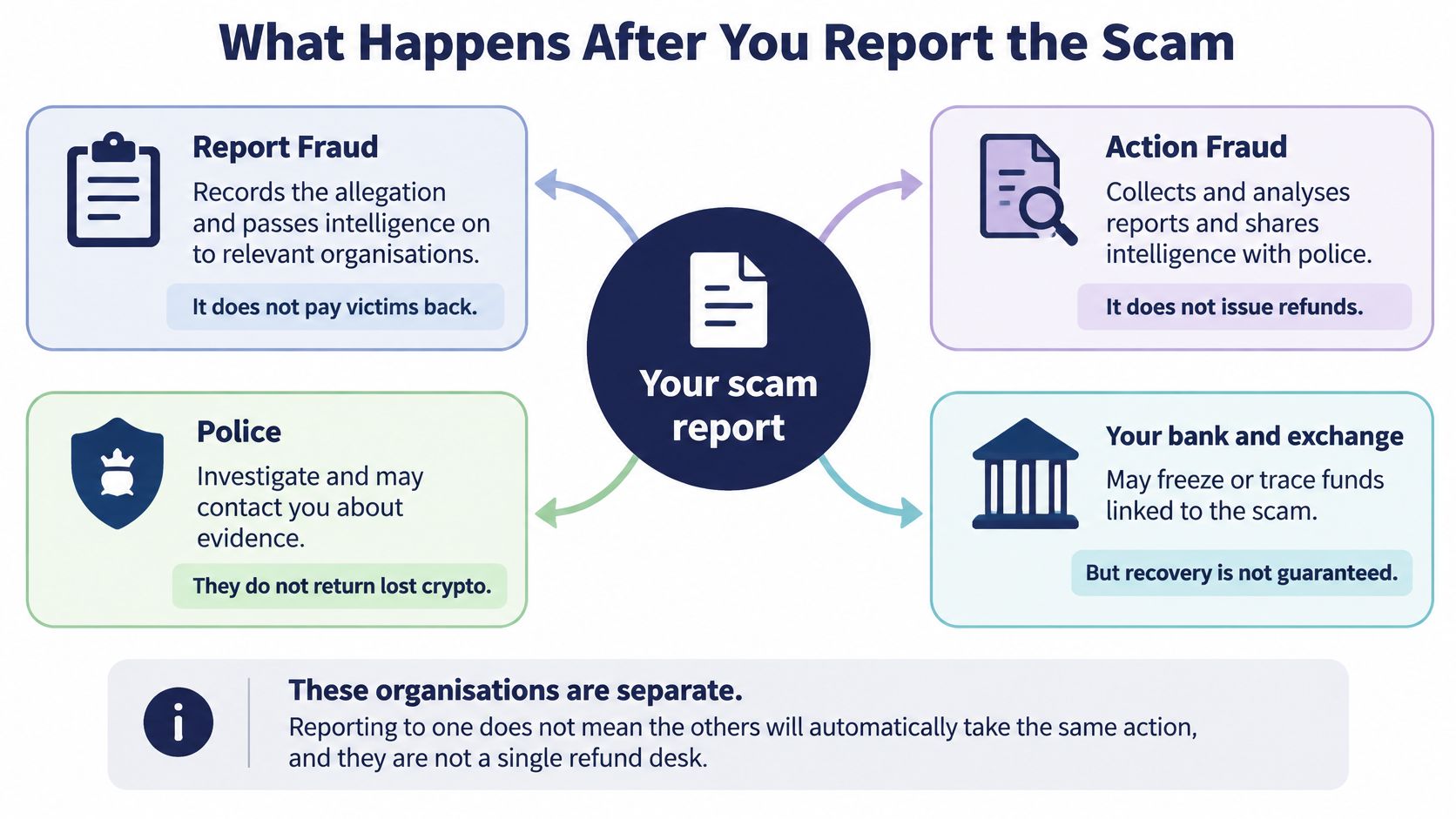
4.16 million fraud offences were recorded in the year ending March 2025, a 31% increase, according to the Economic Crime Plan progress report. That queue is why a report is a filing, not a payout date. Judge the weeks that follow by what each body controls, and by the payment route the money took.
Four organisations touch the file. Refunds are not their product.
Report Fraud records the allegation and passes intelligence onward. It does not pay victims back.
Action Fraud collects and analyses reports and shares intelligence with police. It does not issue refunds.
The police investigate and may contact you about evidence. They do not return lost crypto.
Your bank and the exchange may freeze or trace funds they still hold. A freeze only ever reaches an account that firm controls. Money already converted and sent on is outside that reach.
Split the case by who holds the money
Match the next step to the payment route. Do not treat one "recovery rate" as the score.
A card or bank transfer still inside a UK bank is a reimbursement question for that bank. The useful early result is a fraud review opened, a recall attempted, and a written outcome. Days to weeks is the realistic clock.
Crypto that hit an exchange the firm still operates is a freeze question. Ask whether the receiving account is restricted and whether the platform will preserve logs. A freeze often lands in days, then stalls. Stalled is not the same as refused, and it is not money back.
Coins that have left any account a bank or exchange controls fall under criminal-asset powers. Parliament widened that toolkit in the Economic Crime and Corporate Transparency Act 2023, in force from 26 April 2024. The government's asset recovery guidance sets out powers to investigate, freeze, seize, recover and realise cryptoassets linked to criminal activity. The same official dataset lists cryptoasset seizures, crypto-wallet freezing orders, restraint orders and confiscation orders. Competent authorities apply for those orders. A court grants them. A tracing fee does not buy one.
From 2019 to 2024, more than £450 million was recovered from UK confiscation orders, with £88 million returned to victims as compensation, per the Crown Prosecution Service's 2025 progress report. That is the criminal-justice system recovering from convicted offenders across all crime types. It is not your case, and it is not a percentage you can bank.
Intermediate outcomes worth chasing: a bank decision in writing, an exchange account freeze, a preserved log, a wallet link, and a named receiving platform a solicitor can use. None of those is a refund. All of them are progress.
Where the loss sat inside a regulated investment product or a broker account, arbitration can run beside the criminal file. The FINRA arbitration recovery guide for investors from Kons Law explains how those claims are built. Treat that route as adjacent to the crypto file, not a substitute for the report.
No reputable firm will ask you to pay a release fee, a tax, or a "gas" charge to get the coins back. Those demands are not how banks, exchanges, police or the courts return money.
If you'd rather absorb the sequence before you start dialling, this short walkthrough covers the reporting order and what each organisation does with your information.
Three clocks, not one resolution date
A bank fraud review runs in days to weeks. An exchange freeze runs in days, then often sits. A court application runs in weeks to months. Chase each party on its own clock, and expect staged updates rather than a single date when "the money comes back."
A late report is still worth filing. An early one gives a freeze a fighting chance, because the coins may still be sitting where somebody can be compelled to look.
How to Refuse a Recovery Room Approach
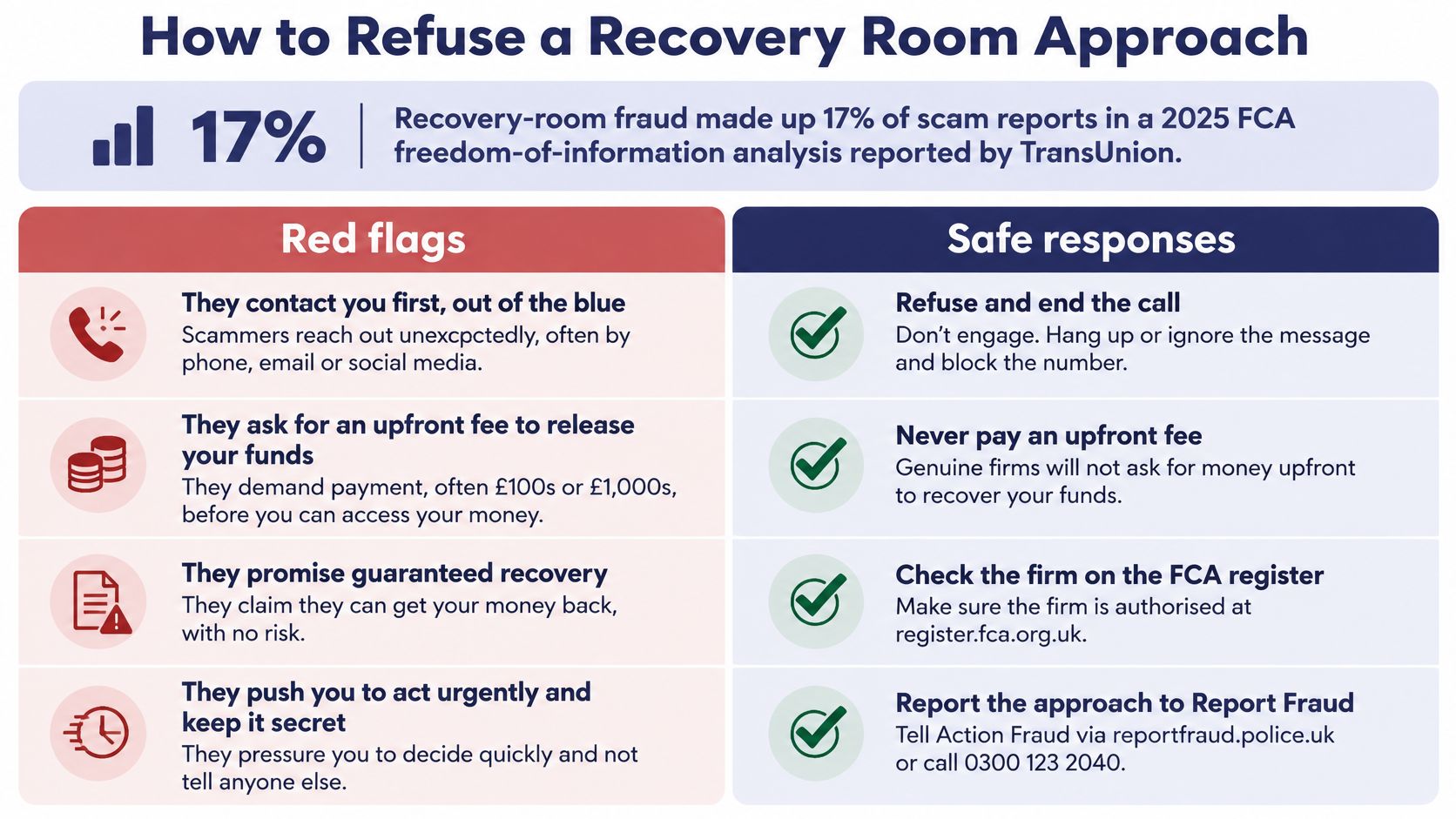
A 2025 FCA Freedom of Information analysis reported by TransUnion found that recovery-room fraud represented 17% of scam reports to the FCA, and that approximately 70% of those recovery-room cases involved cryptocurrency victims who had already been defrauded.
That 17% is a share of reports, not a headcount of people on a second call right now. Still treat every inbound offer as a second attempt until you have proved otherwise.
A week after you lost money to a fake trading site, someone calls. They already know the amount. They may know the platform name, the date, and the wallet you paid into. They offer to release your coins for a tax, insurance or gas fee, and they sound patient and well spoken.
Refuse the fee. A bank reimbursement, an exchange freeze and a criminal asset order are separate routes with separate paperwork. No reputable firm sells all three as one paid release.
Check | Genuine route | Recovery-room approach |
|---|---|---|
Who makes contact | You use a number from the official website | They email, call or message you first |
What they ask to be paid | No fee to a stranger to release coins | Upfront tax, insurance, gas or release fee |
What access they want | You keep the wallet keys | Seed phrase, private key or remote access |
What they can show | Your own Report Fraud reference | A balance screenshot and a guarantee |
How they describe the result | A freeze, disclosure, or no recovery | A fixed success percentage |
Run every approach through that table before you share a single detail. Find the firm's own website and call the number published there. Ignore the number in the email, the number in the WhatsApp message, and any number a search engine puts in a sponsored slot.
On that call, ask one question and stop. Which named platform holds the coins, and what written freeze or disclosure can they show you? If they pivot to a fee, a seed phrase or a remote session, end it. A genuine route starts from a number you looked up, uses your own Report Fraud reference, and accepts that the result may be a freeze, a disclosure, or no recovery at all.
Three things no legitimate firm will ever ask for: your seed phrase, a private key, or a remote-access session. And no genuine investigator takes payment in crypto to release crypto.
Check a firm's registration before you instruct anyone. The Sentry Private Investigators due diligence guide is the place to start that check, and doing it yourself is what stops a second loss.
Judge the proposal, not the promise
Score any proposal on intermediate outcomes only. A quoted success percentage is a sales line. It shows the salesperson's confidence, not coins coming back.
A named exchange where your funds landed, with the transaction path to prove it.
An account freeze confirmed in writing by the platform's compliance team.
Disclosure obtained from a platform, host or payment processor.
A restraint or preservation step taken through a solicitor.
Net funds returned, less fees, paid to you.
Bank money, an exchange hold and a court preservation step each produce a different piece of paper. Ask which one they can obtain, and by which route. If the answer collapses back to a single percentage, hang up.
Volatile or illiquid tokens make this harder again, because you need contemporaneous valuation evidence and a clear explanation of the loss calculation. Ask any firm how they'll value yours. A vague answer tells you plenty.
Instruct only a firm you found yourself.
Ask SPI to Review the Case File
Here's my honest view on when to bring in investigators. Do it when three things are true: your report to Report Fraud is already filed, nobody has asked you for a release fee, and at least one of the following applies.
Your bank or exchange has stalled. You have a reference number and no movement, and you need someone to press the point with a proper chronology rather than another emotional phone call.
A UK person or company in the evidence needs identifying. A receiving account, a company that rented the server, a name behind a payment link. That's lawful enquiry work, not magic.
A solicitor wants the file checked. Before an application goes in, a second pair of eyes on the timeline, the hashes and the wallet attribution saves money and embarrassment.
The process at Sentry Private Investigators Ltd is deliberately unglamorous. The first call or email is a free, confidential consultation, on 0121 769 1626 or info@sentryprivateinvestigators.co.uk. We take the detail, and we may carry out due diligence before any crypto-related work begins, which can require proof of your identity and compliance with money laundering regulations. You get a quote. Work starts only after you approve that quote, which is also the moment to read up on what to check in detective agreements before you sign anything, from us or anyone else.
From our Birmingham head office we take instructions across the UK, including London, and where a UK identity is already supported by evidence in your file, our people tracing service is often the fastest useful step. You'll find the contact details and our private investigator pages for Birmingham and Leicester on the main site.
What we can add is narrow and real: lawful enquiries, identity work where the evidence supports it, and a clear brief your bank, exchange or solicitor can act on. What no investigator can add is a wallet freeze, a criminal confiscation order or a guaranteed refund. We won't ask for a seed phrase, remote access, or a payment in crypto to release crypto, and we won't quote you a recovery percentage.
Send the Report Fraud reference and the row from the first table that matches your payment route. That's the next act, not paying anyone who found you first.
If your report is filed and the trail has gone quiet, Sentry Private Investigators Ltd can review the file, trace what is traceable and put a defensible chronology in front of your bank, the receiving exchange or your solicitor. Call 0121 769 1626 or email info@sentryprivateinvestigators.co.uk for a free, confidential consultation, and we'll tell you which route is still live. Start at Sentry Private Investigators Ltd and bring your references, not your hope.