
How Long Does a DBS Check Take in 2026? Timings by Level

Basic DBS checks are processed in up to 3 days, while Standard and Enhanced checks usually take around 8 weeks; Enhanced checks can take longer when police review is needed. But are you counting from the day you complete the form, or the day your employer receives the evidence needed to approve your start?
That difference matters. Processing time isn't the same as the full recruitment timeline, and nobody can promise an exact completion date for an individual application. Separating the steps helps you plan sensibly, recognise an avoidable delay and decide whether a separate background enquiry would address a different concern.
How Long Each DBS Check Level Takes
A Basic DBS check is generally the quickest option. The GOV.UK criminal-record application page gives a processing time of up to 3 days and explains that the paper certificate arrives by post, so completion and receipt aren't necessarily the same day.
For Standard and Enhanced checks, GOV.UK's employee and volunteer guidance gives an estimate of around 8 weeks, alongside a wider up to 14 days estimate for Basic checks. These are planning estimates, not guaranteed deadlines.
Official DBS processing times by check level
Check level | Typical processing time | What it covers | Usual use |
|---|---|---|---|
Basic | Up to 3 days, GOV.UK processing estimate | Unspent convictions and cautions | Any position or purpose |
Standard | Around 8 weeks, GOV.UK estimate | Spent and unspent convictions, cautions, reprimands and warnings, subject to filtering rules | Certain jobs, licences and professions |
Enhanced | Around 8 weeks, longer if police review is needed | Standard information plus relevant non-conviction information | Eligible roles, including regulated activity with children or vulnerable adults |
Enhanced with barred list check | Around 8 weeks, longer if police review is needed | Enhanced information plus the applicable barred list checks | Regulated activity where barred lists apply |
The coverage descriptions are a practical overview, not permission to request every level. The duties of the role determine eligibility, and an Enhanced check doesn't automatically include a barred list search. An employer should establish what it can lawfully request before submitting an application.
Which clock should you use?
The shorter Basic estimate describes straightforward processing. The wider allowance accommodates the full journey, including validation, corrections and postal delivery. For Enhanced applications, police-stage work forms part of the checking process and can extend the wait; don't treat it as a fixed extra period you can calculate in advance.
Practical rule: Plan a Basic application in days, but give Standard or Enhanced applications a multi-week window and leave room before the intended start.
A faster level isn't an acceptable substitute for the level a role requires. If you're unsure about the differences, compare DBS check levels, then confirm the required level with the employer before organising your timeline.
The Stages Your Application Passes Through
Say you've accepted a role and returned your application documents. It may feel as though the DBS wait has started, but the employer could still be checking your identity evidence or preparing the submission. Ask whether the application has reached DBS, rather than assuming that returning a form starts the processing clock.
The application follows a recognisable route, although Enhanced checks can involve additional work within the checking stage.
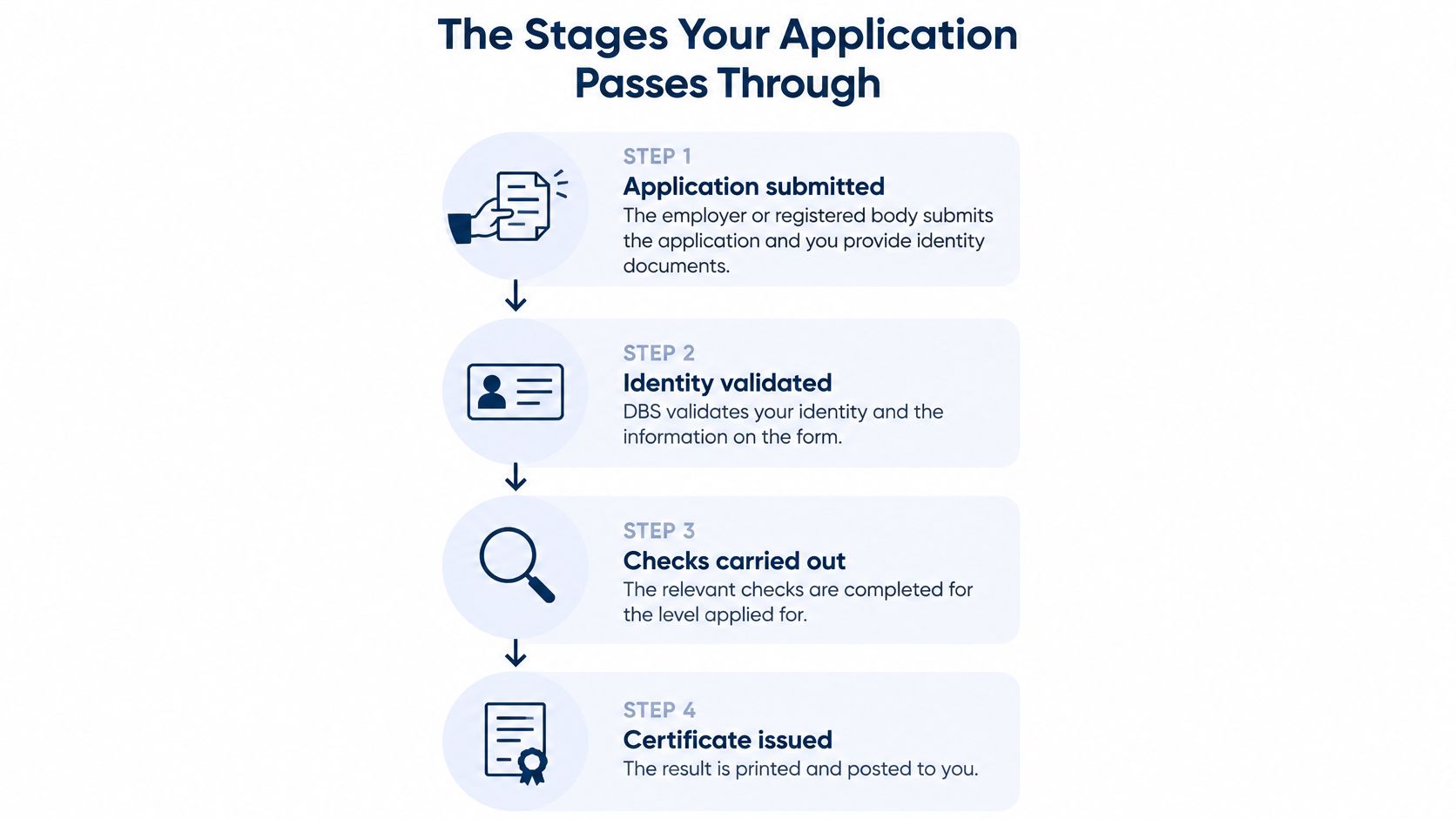
From submission to record searches
Application submitted. For Standard and Enhanced applications, the employer or registered body manages submission. Your part is to provide complete details and acceptable identity documents promptly. Use your full name consistently and explain any previous names when requested.
Details validated. The submitting organisation checks identity evidence, and DBS validates the application information. If something doesn't match, the applicant and submitting organisation must resolve it. A missing detail won't resolve itself while the application waits.
Relevant checks carried out. DBS searches the records appropriate to the level requested, including barred list information where applicable. Applicants can't control the search itself, but they can remain available to answer clarification requests.
Certificate issued. Once the checks finish, the certificate is produced and sent. Check that the delivery address is correct, and establish how your employer wants you to present the result.
For an Enhanced application, the checking stage can include referral to relevant police forces. Officers may need to assess locally held information before the certificate can be issued. That isn't a stage an employer can complete on the applicant's behalf.
Completion isn't the same as delivery
According to the DBS guide to Basic checks for employers, 88% of Basic DBS checks were completed within 48 hours in 2024. That measures completed checks, not a promise that the applicant held the posted certificate within that period.
For a broader explanation of how enquiries are organised, Paradigm International on background investigations provides additional context. Keep that broader process distinct from the official DBS application route.
For a straightforward Basic application, preparation and delivery may account for a noticeable part of the overall wait. For an Enhanced application, watch the police-review stage most closely, without assuming that a longer review means an adverse result.
Why Enhanced Checks Take Longer
An Enhanced check can require more than a search for convictions and cautions. Police officers may assess whether locally held, non-conviction information is relevant to the role and appropriate for disclosure. That involves judgement, not just retrieving a record.
The police-review stage is easier to understand as a separate operational task.
What the published targets mean
The DBS statistics and performance standards set out the completion targets below. The same reporting records historical average issue times of 2.3 calendar days for Standard checks and 10.2 calendar days for Enhanced checks in the 2019–20 financial year.
DBS and police-stage completion targets
Milestone | DBS issue target | Police-stage target |
|---|---|---|
Within 14 days | 75% | 85% |
Within 18 days | No separate milestone published | 90% |
Within 25 days | No separate milestone published | 95% |
Within 28 days | 90% | No separate milestone published |
Within 60 days | 99% | 100% |
DBS issue targets concern disclosures issued after receipt. Police-stage targets concern that stage's completion, so don't add the columns together to produce an individual deadline. A target also isn't evidence that every application currently meets it.
The historical averages show that routine cases can move quickly. They don't establish how long a new application will take, and they shouldn't be used to promise a candidate an early start.
Why individual applications differ
The main sources of uncertainty are:
Several police jurisdictions. Different forces may need to review their own records before the application can progress.
Inconsistent personal details. Missing or conflicting information can require clarification before reviewers can confidently match records.
Non-conviction information. Officers may need to assess relevance rather than confirm that information exists.
This video provides another way to engage with the subject.
A longer wait doesn't, by itself, tell an employer what the certificate will contain. Recruitment decisions should rely on the completed evidence and the organisation's appropriate assessment, not speculation about processing speed.
Plan around the longest realistic window your recruitment can accommodate, not the quickest result another applicant received.
Avoid Delays and Track Your Application
Submitting again isn't a reliable way to move an application forward. A duplicate can create another application to manage, potentially starting a separate processing journey rather than accelerating the existing one. Find out what's happening to the original application first.
The GOV.UK Basic DBS applicant guidance explains the importance of accurate application information. Forms with errors or omissions may be returned for correction within 24 hours, but the time needed to obtain and submit the correction adds to the overall wait.
Fix what you can control
GOV.UK's childcare-provider guidance notes that living at different addresses during the previous five years can extend checks. It also highlights an important boundary: a DBS check isn't a complete overseas criminal-record check, so separate overseas evidence may be needed.
Delay triggers and the right response
Delay trigger | Why it adds time | Action to take |
|---|---|---|
Address history across several addresses in the last five years | Each address adds verification work | Give complete address dates before submitting |
Incomplete or inaccurate personal details | Forms can be returned for correction | Match name and date of birth to ID before submitting |
Several police forces involved | Each force reviews its own records | Expect the longer Enhanced timeline and don't resubmit |
Overseas history | A UK DBS check isn't a full overseas record check | Arrange separate overseas evidence early |
A police-stage wait can be part of normal processing. An application that hasn't been submitted, or a clarification request nobody has answered, is a different problem and needs action.
Follow a clear tracking routine
Confirm submission. Ask the employer or registered body to confirm that the application was sent and obtain the reference number.
Check progress online. Use the official tracking route appropriate to the application level while the check is in progress. Note the stage shown rather than relying on a general assurance that it's being processed.
Discuss the start date. Ask the employer how an outstanding result affects onboarding and agree who will provide updates. Don't assume you can start duties without approval.
Resolve an identified problem. Contact the submitting organisation or DBS as appropriate if the status shows an issue or clarification is required.
For a prolonged application, DBS employer guidance supports requesting a status update at 60 calendar days, rather than repeatedly applying again.
Volunteer coordinators may also find volunteer background screening tools from Alignmint useful when considering how to organise screening administration. Such tools don't replace UK DBS eligibility decisions or official tracking.
Reduce future waiting where eligible
The DBS Update Service costs £15 per year and is free for volunteers. Join using the application reference while the check is in progress, ensuring DBS receives the application within 28 days of joining, or register using the certificate number within 30 calendar days of its issue date.
With permission, an organisation can receive an immediate online status result where the role, workforce and check level are equivalent. The service isn't available for Basic checks and doesn't replace the first Standard or Enhanced application.
Planning Your Timeline Back From a Start Date
Work backwards from the date the employer needs to approve your clearance, not just the date you hope to walk through the door. Leave preparation time before submission and space afterwards for receiving and presenting the certificate.
Consider a hypothetical Standard-check applicant starting on 1 March. They could target early January for submission, roughly eight weeks beforehand, then move their preparation earlier still to create an additional two-week contingency. That contingency is a planning choice, not an official delivery estimate or a guarantee against delay.
A timeline you can adapt
Week 0, confirm the requirement. Ask the employer to establish the correct level and what evidence must be available before you start. For a Basic application, reserve time for processing and delivery rather than using the same schedule as an Enhanced check.
Weeks 0 to 1, prepare and submit. Supply identity evidence, resolve name discrepancies and confirm the submitting organisation has everything it needs.
Weeks 1 to 8, monitor progress. Treat this as the hypothetical Standard or Enhanced processing window, not a fixed completion promise. An Enhanced referral may require a longer allowance.
After processing, complete onboarding. Allow for the certificate to arrive and for the employer to review the required evidence.
Build a contingency: If a correction is requested, revise the plan when you respond. Don't leave the original start date untouched and assume the lost time will be recovered.
A separate concern about someone's identity or circumstances needs its own scope and timetable. Understanding when to hire a private investigator can help distinguish that enquiry from waiting for an official recruitment certificate.
Confirm the Right Check Before You Set a Start Date
Start with the role, not the fastest advertised turnaround. If a Basic check is appropriate, use that route and allow for the document to arrive. If the duties require Standard or Enhanced disclosure, agree a realistic recruitment schedule with the employer before making firm commitments.
For volunteering, the setting alone doesn't settle eligibility. Someone considering a childcare role may find HeyLocals advice for childcare volunteers useful for understanding the practical commitment, but the recruiting organisation must confirm the screening required for the actual duties.
Separate official disclosure from independent enquiries
A DBS certificate is issued through the government DBS process. A private investigator can't issue one, bypass police review or provide an independent report as a substitute where an official certificate is required.
An independent enquiry answers a different question. You might need to establish whether a person's identity is consistent with public records, or assess a concern before making a significant personal commitment. That's broader due diligence, not an alternative route into restricted criminal-record information.
Sentry Private Investigators Ltd provides detailed background due diligence for individuals and businesses, including identity verification, public-record checks and risk assessment before significant personal commitments. For recruitment-related context, Sentry Private Investigators on employee screening explains how broader enquiries fit alongside formal screening.
Choose an enquiry with a clear purpose
Our initial assessment helps clarify whether background checks, surveillance or technical services would best address your concern. We listen to the circumstances and explain realistic options, likely outcomes, timescales and costs before you commit.
That distinction protects you from paying for an enquiry that can't answer your question. If you need a statutory certificate, follow the official route. If your concern involves identity, public information or a specific risk outside that certificate's scope, define that concern before commissioning further work.
SPI is a vetted and approved agency of the Association of British Investigators. Our approach is to establish what can appropriately be investigated, rather than promise an exact result or suggest that every concern needs the same method.
Confirm the required DBS level with the employer first. If an independent enquiry is also needed, seek an initial assessment with a clear explanation of what you need to establish.
Sentry Private Investigators Ltd offers discreet background enquiries for individuals and businesses where an official DBS check doesn't answer the whole concern. Visit Sentry Private Investigators Ltd to discuss your circumstances and receive an initial assessment of the appropriate approach, likely timescales and costs before committing.