
Remote Employee Monitoring: A UK Employer Guide

One in three UK organisations now monitors its employees' digital activity, according to the UK Government's 2025 consultation on workplace monitoring technologies. This isn't a fringe habit or a Silicon Valley experiment. It's an ordinary management decision, taken by ordinary employers, often with a tool nobody properly explained to the people on the other end of it.
Our view is blunt. Monitoring isn't the scandal, and surveillance isn't the fix. The trouble starts when an employer buys a dashboard to answer a question that a work record, a signed policy or a short, scoped enquiry would answer better. More activity data doesn't produce stronger evidence. One written purpose does.
Remote Employee Monitoring in the UK Today
Monitoring can range from a record of system access to continuous observation through a webcam. The technology determines how much an employer can see, but it does not determine how much they should collect.
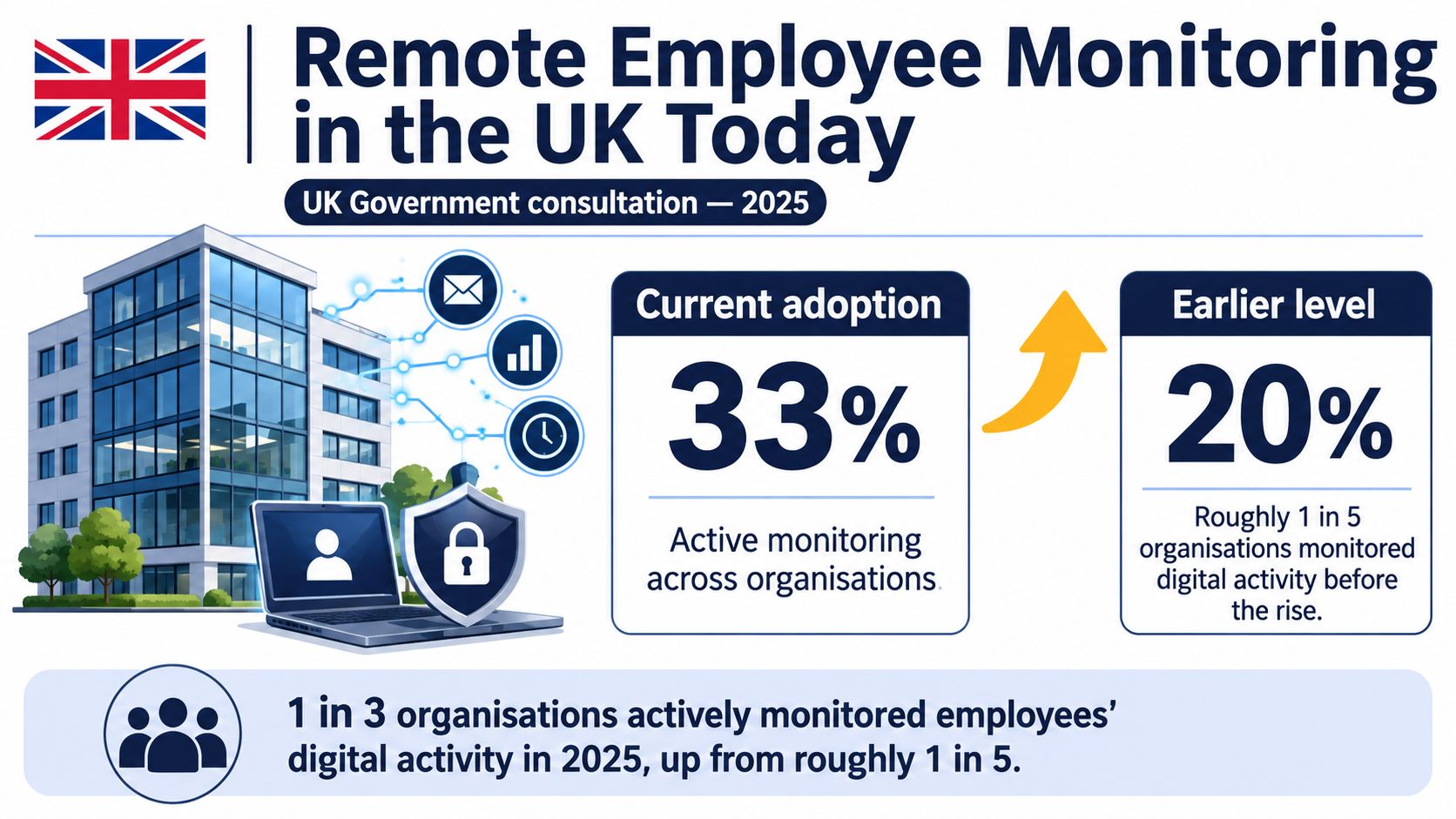
What the adoption figures do and don't tell you
Estimates of workplace monitoring vary because the term covers different practices. An employer checking access records is doing something very different from one capturing screens or reviewing communications. Workers may also be unclear about what is collected and why. That uncertainty makes a clear explanation of the purpose and scope more useful than another activity dashboard.
Start with records the business already holds. Output, milestones and access logs can show whether work is being completed or a system is being used unusually. More activity data does not create stronger evidence: mouse movement, for example, cannot establish the quality of someone's work.
Security concerns need a defined response. RDE Technologies on insider threat risks explains why organisations should take risks from trusted accounts seriously. For an employer, reviewing relevant file-access records is more focused than monitoring every moment of an employee's day.
Use six questions to set the boundaries:
What specific concern needs answering?
Which existing records could address it?
What monitoring method would collect only the necessary information?
What lawful basis and notice apply?
What policy governs access, retention and challenge?
When should routine oversight stop and a scoped enquiry begin?
Routine oversight should track work outcomes and relevant system access. If a defined suspicion remains after those records are reviewed, consider a proportionate investigation rather than widening monitoring across the workforce. Every tool should have a written purpose before it is switched on. If the employer cannot explain why it is recording, it should not be recording.
Monitoring Methods Compared by Risk and Use
Choose the monitoring method that answers the business question with the least intrusion. The ICO's scoping research on monitoring at work found that 12% of UK firms with remote-working employees, rising to 16% of larger firms, had implemented online software to track employees and monitor productivity. A further 10% of firms without such software planned to introduce it. These figures measure deployment, not whether the software provides useful evidence.
Method | Data captured | Usual purpose | Privacy risk | Proportionate alternative |
|---|---|---|---|---|
Activity software | Logins, apps and idle time | Attendance and output proxies | Medium to high | Milestone and deliverable records |
Keystroke logging | Keys pressed on a device | Alleged time theft | Very high | Access logs for the relevant system |
Screenshots | Timed images of the screen | Misuse of work systems | High | Short review of the suspect account |
Webcam monitoring | Video of the person at home | Presence checks | Very high | Agreed check-ins or output review |
Email and message logs | Content of work communications | Misconduct or data loss | High | Headers or metadata first |
GPS or device location | Movements and timings | Vehicles or field work | High when used at home | Vehicle GPS for a defined purpose |
Why activity data is a proxy, not proof
Keystrokes, mouse movement, idle time and login duration show device use, not completed work. Activity scores cannot establish productivity on their own. Two account managers might show similar dashboards while delivering different amounts of client work.
Start with the operational question. For output, review milestones and deliverables. For suspected access to restricted information, examine relevant access logs. These records are closer to the concern than continuous keystroke capture.
Set a clear purpose, retention period and access process for any data collected. Require a human review before treating an alert as evidence of misconduct. More activity data does not create stronger evidence; it can instead create noise and mistaken allegations.
The rows to think hardest about
Screenshots. A timed image can capture private material on screen, including banking pages, a child's homework or a hospital letter. If the concern relates to a work system, review that system's logs instead.
Webcam checks. Filming someone at home is a highly intrusive way to check presence. Use agreed check-ins or review deliverables where those measures answer the question.
Email and message content. Messages may include sensitive personal information and details about people outside the business. Check headers or metadata first. Review content only when the concern specifically concerns what was said or sent.
GPS. Vehicle tracking can help check routes and timings for a defined work purpose. Tracking a device at home risks capturing movements unrelated to work.
Cross out any method that collects family life or private communications when a work-system record would answer the same question. Keep the comparison with the decision record: it shows why the less intrusive method was chosen.
Lawful Bases Notice and Covert Limits
UK GDPR requires a lawful basis for monitoring, and the monitoring must be necessary and proportionate to a defined purpose. Tell workers what information you collect, why you collect it, how you will use it and who can access it. Give that notice before monitoring starts, normally through a handbook, contract or standalone policy.
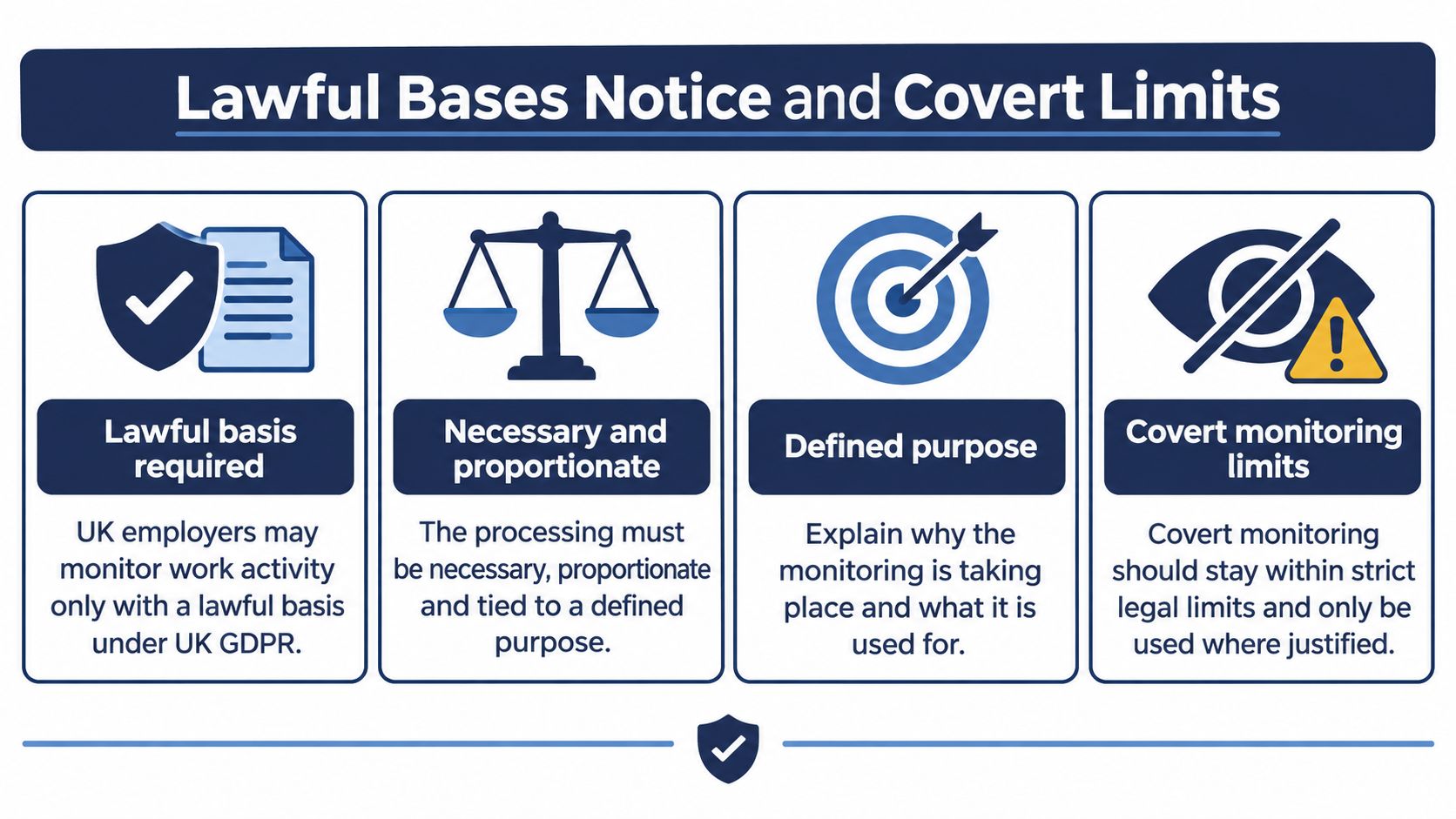
Legitimate interests is a common basis, but it requires a genuine balance between the employer's need and the worker's privacy. Unexpected or excessively intrusive monitoring can fail that test. Remote work makes the boundary sharper: a work device or account may reveal family life, personal messages or activity outside working hours.
Where the covert line actually sits
Covert monitoring is for a specific investigation, not routine productivity tracking. Government guidance on monitoring staff at work says it may be used without a worker's knowledge where there is suspicion of a criminal offence and informing them would make detection harder. Keep it limited to the investigation and stop when the investigation ends. Employment-practices guidance also says covert monitoring should rarely be justified, authorised at the highest level and based on grounds for suspecting criminal activity or equivalent malpractice.
A vague hope of finding misconduct is not enough. Set out the allegation, the accounts or devices in scope, the relevant period and a stop date. More activity data does not create stronger evidence. Start with output records and access logs; consider covert help only where a defined suspicion remains and open monitoring could prejudice the enquiry.
If you want the reasoning in plain terms before you draft a policy, this is a useful watch:
The record you keep before the first covert step
Write down the decision before any covert monitoring begins:
The allegation, in one factual sentence.
The decision-maker authorising it, at senior level.
The scope, naming devices, accounts and hours.
The start and stop dates, with the stop date fixed in advance.
The evidence sought, and why it will answer the question.
Why open monitoring would prejudice the enquiry.
Monitoring workers everywhere is unacceptable. Do not monitor toilets or other private spaces, and do not continuously film someone's home under the guise of checking attendance.
If outside help is needed, match the investigator's brief to the recorded scope. Name the suspected conduct and relevant period. The brief must not authorise observation of a person's private home life.
DPIA, Policy and Worker Trust
A Data Protection Impact Assessment is required before monitoring likely to create a high risk to workers' or anyone else's rights and interests. The ICO singles out monitoring emails and messages as an example that needs one, because communications can hold sensitive personal information about people who don't work for you at all. The ICO's guidance on specific monitoring methods sets out what it must cover.
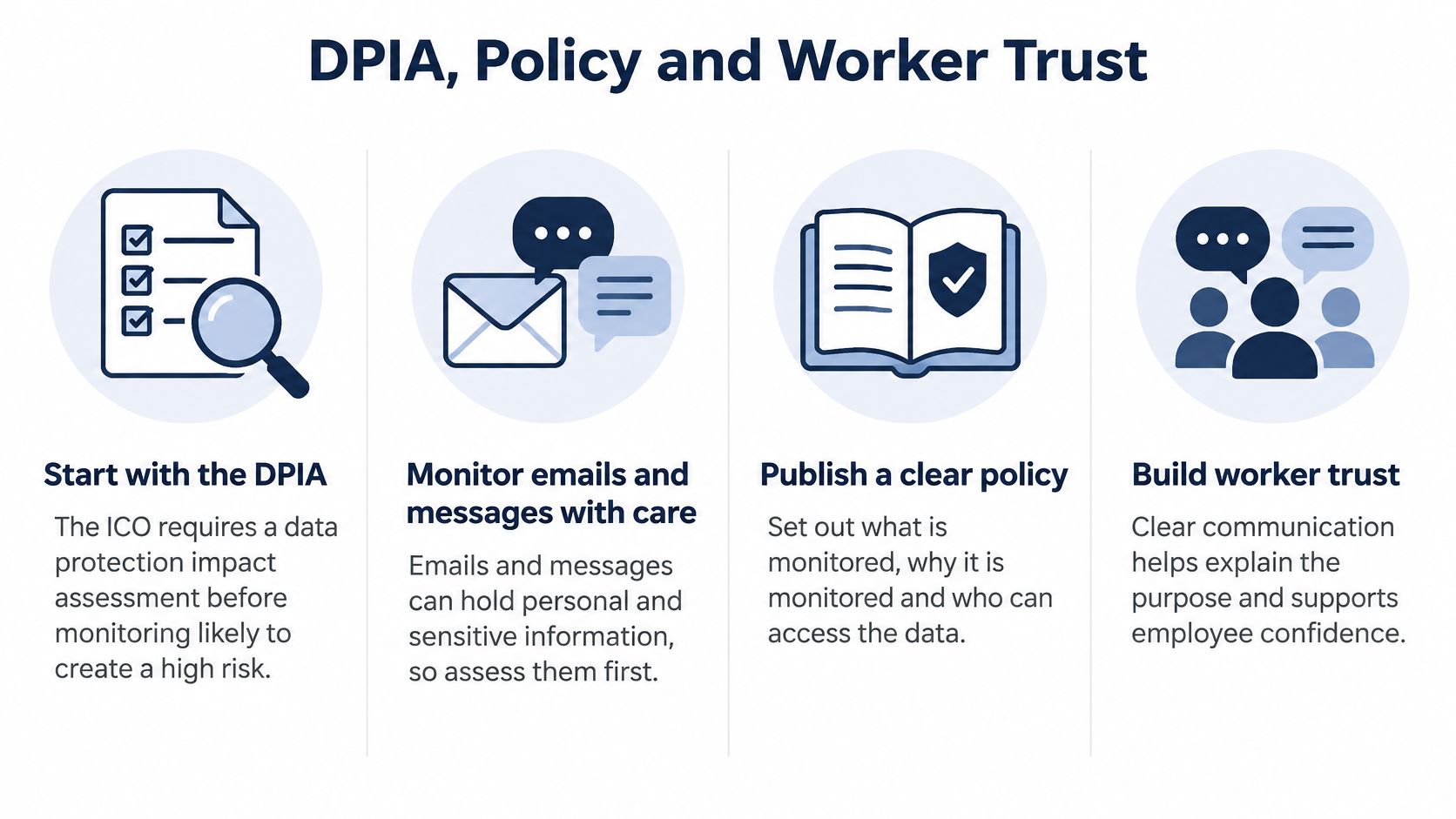
The DPIA as a checklist, not a formality
Work through each heading and write a real answer:
The monitoring itself. What will run, where, and on which devices.
The purpose. The specific risk or question it addresses.
The categories of information. Including anything incidental it might sweep up.
The people affected. Staff, clients, and family members in the room.
The risks, rated, then the safeguards that reduce them.
The alternatives. Why a less intrusive option wouldn't achieve the same result.
Remote work adds rows to that assessment: personal or shared home devices, screenshots, keystroke logging, location data, webcam access, and the accidental capture of family members or private conversations. The ICO also recommends consulting workers and involving them when monitoring technology is introduced. Consultation isn't decoration. It's how you discover that your "productivity insight" reads to staff as a camera in the spare room.
What the written policy has to say
A usable policy answers six questions in plain English: what's collected, why, who can see the raw data, how long it's kept, when the business aggregates rather than names an individual, and how an employee challenges a wrong reading before it feeds a performance or disciplinary decision.
When a concern does end in a formal finding, the report itself has to stand up. Our Sentry Private Investigators report template shows the structure we use: what was asked, what was found, what was deliberately excluded, and why. If you're drafting the policy from scratch, a restaurant employee policy guide is a decent model for tone, short sections in plain language with no lawyerly fog.
Then there's the cost of getting the tone wrong. An ICO-commissioned study reported by UKAuthority found that 70% of respondents considered workplace monitoring intrusive, and only 19% would feel comfortable accepting a job knowing their activity would be monitored. The same article covers a Prospect survey of 2,424 UK workers, in which 32% reported being monitored, up from 24% earlier in 2021, and 80% said webcam monitoring of remote workers should be banned or heavily regulated.
The line to hold: a high activity score is not the same as good work. It's a record of a machine being touched.
Perceived surveillance erodes the cooperation that monitoring is supposed to protect, especially when staff can't tell security monitoring from productivity scoring. Notice before anything starts, role-based access to raw data, short retention, aggregation where identification isn't needed, and no continuous webcam or keystroke surveillance unless a documented necessity and proportionality assessment says otherwise. If your policy can't name the purpose and the stop date, the monitoring isn't ready to start.
How to Investigate a Specific Remote Work Concern
More data doesn't make a stronger case. It usually makes a weaker one, because indiscriminate collection drags in third parties, embarrasses the employer months later and leaves the actual question unanswered.
The regulator's own employment guidance on monitoring workers is clear that remote monitoring creates heightened privacy risk, precisely because an employer can inadvertently capture information about a worker's family and private life at home. That risk doesn't come from investigating a real concern. It comes from running the investigation wide instead of narrow.
Suspected issue | First evidence | Leave uncollected | Covert step only if |
|---|---|---|---|
Moonlighting | Contracted hours, deliverables and open business records | Home webcam and household devices | Open checks would prejudice a serious breach |
False sickness absence | Absence pattern and occupational health process | Continuous home video | There's a recorded suspicion of fraud |
Time fraud | Logins set against agreed deliverables | All-day keystroke logs | Existing records can't test the specific allegation |
Misuse of company systems | Access logs and data-loss alerts | Personal email on a home device | The review is limited to the relevant accounts |
Theft of confidential files | File-access history in a short window | Personal devices and family activity | A defined malpractice allegation is recorded |
Five steps that keep an enquiry narrow
Start with an anomaly you can point at. An output gap, an access log, a policy record. Something dated and objective.
Write the legitimate purpose. One paragraph, naming the concern and the decision it will inform.
Set a short review period. Days, not months, and a fixed end date.
Limit collection. Named devices, named accounts, named hours. Nothing else.
Take advice before anything covert. Covert work needs a documented suspicion, not a hunch that's grown comfortable.
Where presence data is weak, test the things that describe the job: deliverables, service levels, quality, client response and agreed hours. Mouse movement and meeting attendance are the easiest numbers to pull and the least useful to defend, because knowledge work rarely shows effort through activity.
An enquiry that can't state its stop date isn't an enquiry. It's a habit.
If the concern is a rival employer, our competitor private investigations work starts from contracted hours and deliverables, not a screen recorder. Stop the review the moment the question is answered, and separate work evidence from private information before anyone writes a report.
Decide When a Private Investigator Should Take Over
A private investigator is appropriate when a specific concern, such as employee theft, suspected moonlighting, unexplained absence or a fraudulent workplace injury claim, cannot be resolved through routine oversight. More activity data will not make the evidence stronger. Escalate from relevant work records to a defined investigation only when those records leave a clear question unanswered.
Sentry Private Investigators Ltd begins with an initial assessment to clarify whether surveillance, background checks or technical services best fit the concern. Its corporate investigations cover matters including corporate espionage, employee theft, fraudulent workplace injury claims and employee absences. Covert surveillance with one investigator starts from £349 for up to five hours.
For a suspected workplace fraud, workplace fraud surveillance support explains the relevant service. Sentry provides regular updates during investigations and can agree a suitable method and time to contact clients where discretion matters.
The enquiry checklist
Have these details ready before you call:
The concern: a specific, factual suspicion.
The evidence already held: relevant dates, records and who has reviewed them.
The key dates: for example, an absence pattern, missed deadline or file access.
The boundary: what information or activity is unrelated to the work concern.
A clear boundary helps keep an enquiry focused on the business question. Routine oversight should address routine performance concerns; a scoped investigation is for a specific suspicion that ordinary records cannot resolve.
Sentry provides customized investigative services to businesses across the UK. For remote-work concerns, the first question is whether surveillance, background checks or technical services are the right fit. Visit Sentry Private Investigators Ltd to discuss the concern and the available approach.