
Gross Misconduct: UK Examples and Dismissal Rights

It's a Tuesday morning and your operations manager is holding a stock report that doesn't reconcile. Two pallets are missing, the warehouse camera has a blind spot by the loading bay, and one team leader has been unusually helpful in explaining it away. Somebody in the corridor has already used the words gross misconduct, and you have until Friday to decide what happens next.
That phrase carries more weight than most employers realise, and it usually arrives before anyone has checked the facts. The label decides nothing on its own. What decides the outcome is whether the conduct matches your written rules, whether the investigation tested the evidence properly, and whether dismissal is a proportionate response to what you can prove.
Get those three things right and a gross misconduct dismissal usually holds up. Get them wrong and a case that looked open and shut can still be lost, with the employer paying for a decision it thought was obvious.
What Gross Misconduct Means and Common Examples
Gross misconduct is wrongdoing serious enough to destroy the trust an employer needs in order to keep someone in the job. It's the category that can justify dismissal without notice or pay in lieu, which is exactly why it shouldn't be used loosely. There's no fixed legal list. A one-off lapse in an otherwise sound record is usually a warning matter. A deliberate act that breaks the working relationship can be gross misconduct even on the first occasion.
The GOV.UK guidance on writing disciplinary rules describes gross misconduct as conduct considered so serious that it is likely to justify dismissal without notice, and it names fraud, theft and physical violence as the examples employers typically include. The same guidance makes a point many employers skip: your own written rules should set out which behaviours fall into the category, so staff know the standard and an investigator has something concrete to test the facts against.
Most cases that reach a dismissal without notice involve a working relationship that has already broken down, as in the situation below.

Common examples of gross misconduct by category
Category | Example | Typical setting |
|---|---|---|
Theft | Taking stock, cash or company property | Retail, warehouses, offices |
Fraud and dishonesty | Falsified expenses, timesheets or sickness claims | Finance, payroll, any office |
Violence or threats | Physical assault or threatening a colleague | Any workplace |
Serious negligence | Ignoring safety rules and causing serious harm | Construction, care, logistics |
Serious insubordination | Refusing a lawful instruction on a safety-critical task | Manufacturing, site work |
Conflict of interest | Running a rival business while employed (moonlighting) | Professional services, sales |
Serious harassment or discrimination | Repeated abusive conduct towards staff | Any workplace |
Breach of confidentiality | Leaking client data or trade secrets | Technology, legal, healthcare |
Now put yourself in the manager's chair. The stock count shows a gap, the shift pattern points at two people, and the team leader offers to sort it out. The table gives you the category, which is theft. It doesn't give you proof. Before anyone writes gross misconduct into a letter, you need to establish what went missing, who took it, and whether the employee's explanation survives scrutiny.
Start with your own policy wording
Read the disciplinary section of your handbook before you read anything else. If it names the behaviour, or describes a category that plainly covers it, you have a benchmark. If it's silent, the phrase in your dismissal letter has nothing behind it. Where stock or cash is involved, the evidential work is often what separates a warning from a dismissal that survives, and our page on investigating workplace theft with a private detective sets out what a factual enquiry looks like.
Practical rule: if you can't point to the sentence in your policy that the conduct breaches, you're not ready to send the invitation letter, let alone the outcome.
There's useful background on conduct conversations in HR Management 365's guidance on behaviour at work, particularly on how much of a case turns on the way the conversation is handled rather than the rule itself.
Testing Whether Conduct Crosses the Line
Two employers can look at identical facts and reach different conclusions, and both can be reasonable. What separates a defensible decision from a vulnerable one is the reasoning behind it. Four tests do most of the work.
The written rule and the seriousness of the act
Start with the policy wording. Does your disciplinary procedure define the conduct as gross misconduct, or list it as an example? Wording matters more than the label people use in meetings. A manager calling something gross misconduct doesn't make it so, and a policy that calls it serious misconduct still needs to be applied as written.
Then ask how serious the act was. Was it deliberate, dishonest or dangerous, and did it cause real harm or create a real risk of it? An accident that injures someone is a different matter from ignoring a safety rule that everyone knows. Intent and consequence both count, and neither on its own settles the question.
Has trust broken down, and is there a pattern
The third test is trust. Can you rely on this person to do the job without close supervision, and to change their behaviour? That's the heart of the matter, because gross misconduct is about the relationship rather than the incident.
The fourth is pattern, and employers often underestimate what they're allowed to consider. UK employment law doesn't require one isolated act. In the 2018 Employment Appeal Tribunal case of Mbubaegbu v Homerton University Hospital NHS Foundation Trust, an employee with an untarnished 15-year disciplinary record faced an initial set of allegations, and the employer uncovered a further 22 allegations during its investigation before dismissing him. The tribunal found the dismissal fair, and the EAT confirmed there's no rule requiring a single act to amount to gross misconduct, as Dentons' summary of the Mbubaegbu decision explains. A series of acts, none serious enough alone, can together show the employee can't be relied upon to change.
Off-duty conduct counts too when it collides with the employer's interests. We've dealt with a moonlighting case where the subject was found running his own law firm specialising in PPI claims, in direct competition with his employer.
A clean record is relevant, but it isn't a shield. Where the overall pattern is serious and the process is fair, long service doesn't automatically prevent dismissal.
Mitigation still has to be weighed: length of service, the employee's explanation, how you've treated others for similar conduct, and whether dismissal is proportionate. Run three questions before you decide. What did the rule say? What did you conclude, and why? And is dismissal a proportionate response to those findings?
Gathering and Preserving Evidence Lawfully
An investigation is only as strong as the file it leaves behind. The single most useful discipline is separating established facts from inference. A till is short and one employee was on shift: the shortage is a fact, the involvement of that employee is an inference until something supports it. Files that blur the two give a tribunal an easy route to finding the dismissal unfair.
Recent Employment Appeal Tribunal decisions make the test explicit. A tribunal examines what the decision-maker concluded, whether that conclusion rested on reasonable grounds, and whether the investigation adequately tested the evidence, as this Employment Appeal Tribunal judgment on dismissal reasons sets out. A policy label proves nothing on its own. The conduct has to be reasonably characterised as sufficiently serious, and dismissal has to be proportionate.
Evidence to secure and the risk to avoid
Evidence type | What to keep | Handling risk |
|---|---|---|
Written policies and contracts | Signed handbook and rule acknowledgement | Missing acknowledgement weakens the case |
CCTV and access logs | Original files with timestamps | Footage overwritten after the retention period |
Emails and messages | Full threads with metadata | Screenshots with no context |
Witness accounts | Dated, signed notes from each witness | Leading questions or shared accounts |
Records and documents | Original copies, not edited versions | Altered or incomplete records |
Covert or third-party material | Source, date and chain of custody | Unlawful capture or unreliable origin |
Timing matters more than employers expect. CCTV systems overwrite on a cycle you probably don't control, and access logs get purged. Secure footage and door records the day the allegation lands, not the day before the hearing. Preserve full email threads rather than a screenshot of one message, because context is what shows whether a request was authorised.
Covert or third-party material needs checking before anyone relies on it, on four points: reliability, relevance, authenticity and lawful handling.
Evidence that's real but obtained unlawfully can end up doing more damage than evidence you never gathered.
The lawful basis test
We consider privacy, data protection, trespass and other legal requirements when assessing and conducting any investigation, and we won't take on an instruction where there's no lawful basis for the proposed activity. That's a commercial position as much as an ethical one: a report built on unlawful capture is a liability in the hearing room.
A private investigator can help with discreet witness location, review of digital or physical evidence, and time-logged observation where it's lawful, while you keep the disciplinary decision. The wider principles behind online research are well set out in practical rules for compliant OSINT from Digital Footprint Check, which is a useful benchmark for open-source work in a workplace case.
For the file itself, our guidance on UK compliance guidance for internal investigations shows the shape a report should take. Whatever template you use, four habits carry the case: separate facts from inference, date every item, keep the original, and note who holds each file. Where the facts are contested and time is short, outside help earns its place quickly.
Suspension and Disciplinary Hearings Step by Step
A warehouse manager finds stock missing on a Friday afternoon and already has a name in mind. Calling it gross misconduct at that moment does not settle anything. The label describes the allegation. The investigation and a fair process decide what happens next. A private investigator can supply lawful evidence for the file. The employer still makes the decision.
An employer can dismiss immediately for gross misconduct, and the GOV.UK guidance on conduct dismissals is clear that "immediately" does not mean skipping a fair process. You investigate the incident, give the employee a chance to respond, and only then decide whether dismissal is appropriate. A tribunal looks for that sequence whether the decision lands on day one or three weeks later.
The Acas disciplinary guide makes the same point from the procedural side: even where gross misconduct looks obvious, the employer must investigate and follow a fair procedure before dismissal without notice or pay in lieu becomes an option.
Suspension often causes the first confusion. It works like stopping play so the officials can check an incident. The player is not sent off yet.
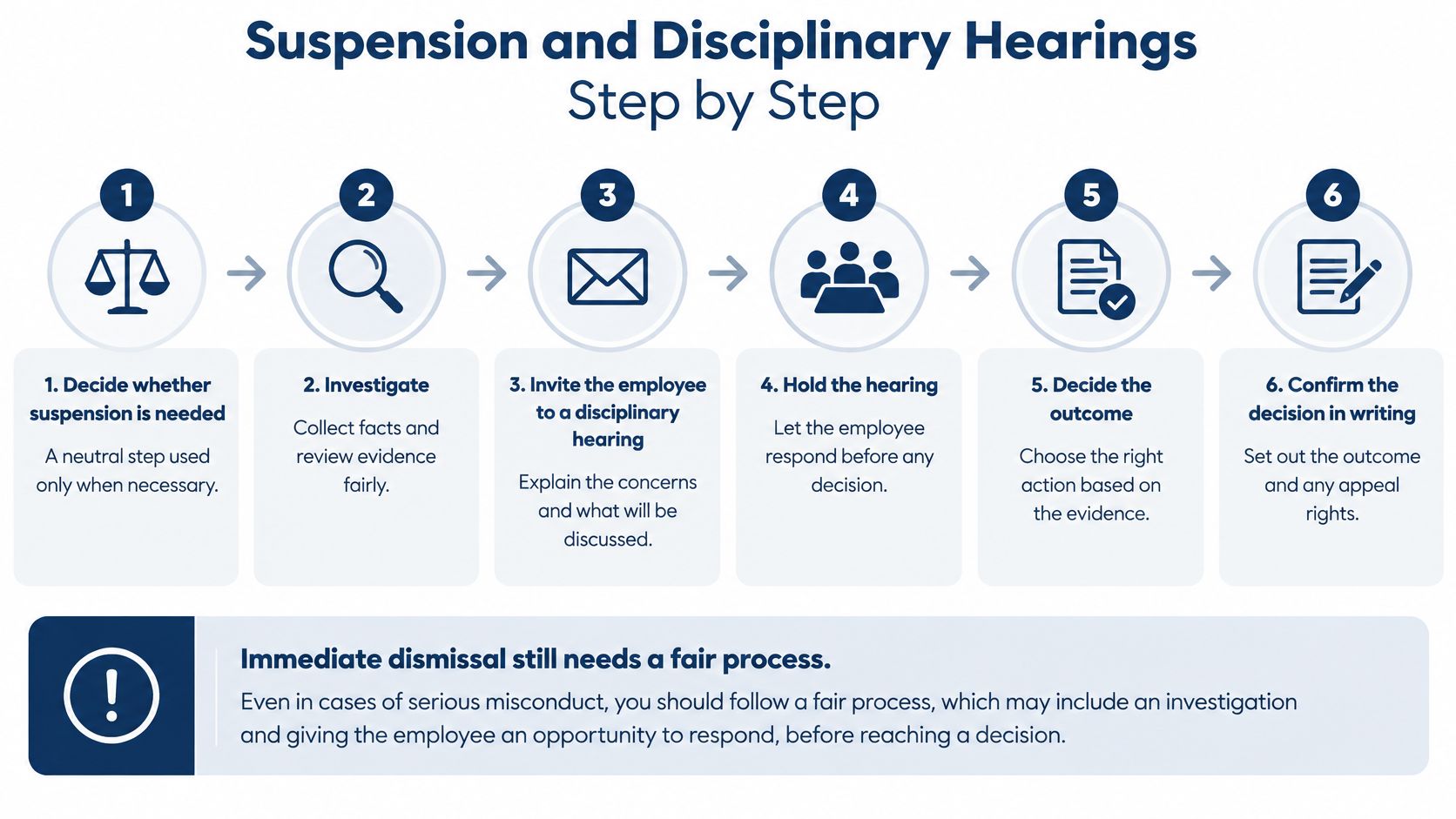
Decide whether suspension is needed. Suspension is a neutral step, not a punishment, and where the contract allows it should be on full pay. Review it at fixed intervals. A suspension left running for months starts to look like a conclusion someone reached early.
Put the allegation in writing. Name the conduct, the rule it breaches and the fact that an investigation is starting. A vague letter leaves the employee guessing what they are answering. That is unfair, and it makes the later hearing harder to run.
Appoint an investigator who will not decide the outcome. Separation matters, because a decision-maker who ran the fact-finding can look as though they had made their mind up before hearing the response. In a small business the roles may overlap, but document why and keep the reasoning visible.
Test the evidence and write a findings report. Set out what is established, what is inferred and what is disputed. A report that only lists the evidence against the employee is half an investigation and reads that way. Outside evidence, including lawful surveillance or witness material, feeds this report. It does not choose the sanction.
Invite the employee to a hearing in writing. Give reasonable notice, copies of the evidence and the right to be accompanied. Presenting new material at the hearing itself is the slip that most often derails an otherwise sound case.
Hold the hearing properly. Present the evidence, let the employee respond in full, and check alternative explanations rather than waiting for them to be volunteered. Record what was said.
Decide and confirm the outcome in writing with reasons. The letter should connect the findings to the sanction and explain why the sanction fits. A one-line letter is a gift to an employee's adviser.
Explain the right of appeal and its time limit. Someone who did not take part in the original decision should hear the appeal. An appeal is not an admission of doubt. It is the step that shows the process was open.
What a fair record looks like at the end
A defensible file is plain to read and easy to follow. Dated notes of what was gathered and when. Written reasons for each finding. The employee's answer recorded in full, not shortened to a sentence. The reason a conflicting explanation was rejected.
If someone picked the file up a year later, they should see how the decision was reached without asking you. Clear, evidenced writing is a habit in other fields as well. South African energy insights from Lighthouse Consultants deal with a different subject and do not set the standard for a staff case. A disciplinary file still has to carry its own dates, findings and the employee's full answer.
Dismissal, Pay and Employee Rights
A warehouse supervisor is caught on dated notes selling stock out of the back door. HR writes "gross misconduct" on the file and assumes the contract ends that day, with nothing further owed. The label does not decide that. What decides it is whether the investigation was fair, whether the evidence would stand up, and which legal test the dismissal has to meet. A private investigator can supply lawful, factual evidence of what happened. The employer still chooses the sanction, and still has to get pay and notice right.
There are five realistic landing points, and which one you reach changes what the employee is owed.
Outcome | When it is used | Notice and pay |
|---|---|---|
Summary dismissal | Gross misconduct proven after a fair process | No notice or pay in lieu |
Dismissal with notice | Serious misconduct that is not gross misconduct | Contractual or statutory notice applies |
Final written warning | Serious misconduct with mitigating factors | Remains on file; no dismissal |
Suspension pending investigation | Allegation under investigation | Usually paid; must be reviewed regularly |
Tribunal claim | Procedure or reason found not fair | Compensation depends on the claim |
The two tests that decide a claim
UK employment law assesses gross misconduct differently depending on the claim, and the Employment Appeal Tribunal's analysis of unfair and wrongful dismissal sets out the split clearly.
For unfair dismissal, the employer needs a genuine belief in the misconduct, reasonable grounds for that belief, and an investigation that was reasonable in the circumstances. The tribunal then asks whether dismissal fell within the range of reasonable responses. Conclusive proof is not required. Unsupported suspicion is nowhere near enough. A careful report helps the belief. It does not replace the decision, and it does not make every dismissal fair.
For wrongful dismissal, the question is different. The tribunal decides whether the conduct amounted to a repudiatory breach of contract, typically a deliberate disregard of essential contractual obligations. It is not asking whether a reasonable employer could have dismissed.
The two can point in opposite directions. A contract works like a load-bearing wall. Hairline cracks can stack up until you no longer trust the structure, even if no single crack brings the wall down. Say an employee repeatedly ignored a documented process, and each lapse caused only minor disruption. A fair process might conclude that the accumulation means you cannot rely on them, so dismissal is fair. If no single breach went to the heart of the contract, the same dismissal can still be wrongful, and notice or damages would be owed. A file built only for the unfair dismissal test can leave an employer exposed on the contractual one.
What happens next, and what the employee can do
For future roles, a factual reference is usual, and a prospective employer may ask directly about a past dismissal. A reference has to be fair and accurate. That is a practical reason to write the outcome letter with care in the first place, tying the findings to the sanction you chose.
On the employee's side, the routes are an internal appeal, Acas early conciliation before any tribunal claim, and a tribunal claim itself. Tribunal deadlines run from the effective date of termination and expire in months, not years. Anyone considering a claim should take employment advice promptly rather than waiting to see how they feel about it.
Dismissal without notice is a serious step for everyone involved. It removes pay that would otherwise continue through a notice period, and it is the outcome most likely to be challenged. It deserves a file that can carry both tests: a fair process, and conduct serious enough to end the contract at once.
How a Private Investigator Supports the Process and When to Hire One
An external investigator is a fact-finder, not a decision-maker. The most useful work sits before the hearing: locating a witness who has left the business and taking a dated account where it's lawful to do so, reviewing digital or physical evidence, and observing working hours or an absence claim in a way that produces time-logged, defensible material.

The limit is worth stating plainly, because it's the thing employers most often get wrong. No investigator can make the disciplinary decision for you, and no report shields an employer from tribunal scrutiny. External findings meet the same standards as internal ones: reliability, authenticity and lawful handling. A report that fails those tests is no better than a rumour with a cover page.
Three triggers to instruct one
The evidence is thin or conflicted. Two accounts contradict each other and neither is documented. Independent fact-finding is the quickest route to something a hearing can rely on.
You lack HR independence. In a small business, the owner is often the investigator, the decision-maker and the appeal. Bringing in someone external gives the process a visible separation it can't produce internally.
The allegation involves theft, fraud or dishonesty. These cases turn on detail: dates, access, movements, patterns. Our work on gathering evidence through lawful corporate surveillance covers how that evidence is built and recorded.
In business matters, we investigate corporate espionage, employee theft, fraudulent workplace injury claims and employee absences, and in employment disputes we serve witness statements, disciplinary notices and settlement offers. Every enquiry is confidential, and nothing is disclosed without the client's consent. For a case like the one in the video below, the value is in the timeline rather than the drama.
Questions to ask any provider
Four questions sort a professional from a chancer. How is confidentiality protected, including who inside the firm sees the file? What lawful basis supports each task, and would they decline one that doesn't have one? How will evidence be recorded and handed over, in what format and with what dates? And who is the report for, you, your solicitor, or a hearing panel?
A provider who can't answer the second question in specific terms won't survive cross-examination of their own report.
We're based in Birmingham and work across the UK, including London, Leicester and Nottingham, and we won't take on an instruction without a lawful basis for the activity. If the facts sit inside your own building, a discreet external review is often enough to convert a suspicion into something you can either act on or drop.
If you're holding a stock discrepancy, a sickness pattern or an expense claim that doesn't add up, Sentry Private Investigators Ltd can gather lawful, time-logged evidence and give you a factual report you can take into a hearing, while the disciplinary decision stays firmly with you. Our investigators work discreetly across Birmingham, London, Leicester, Nottingham and the rest of the UK, and every enquiry is treated as confidential. Visit Sentry Private Investigators Ltd with a short summary and a dated timeline, and we'll tell you plainly what can be evidenced and what can't.