
What Do Companies Use for Background Checks in the UK

You've got a CV on your desk that looks polished, the references are thin, and the candidate says the gaps in their history are “nothing to worry about”. That's the point where most business owners ask what companies use for background checks, and the honest answer is that the right process is never just one search. A proper UK screening workflow layers identity, right-to-work, employment history, qualifications, criminal-record checks and role-specific due diligence so you can verify claims, not just collect paperwork.
A single database check rarely settles the actual question. It might confirm a name, or reveal a record, but it won't tell you whether the person is who they say they are, whether they can legally work, whether the qualifications are genuine, or whether the story in the CV matches the facts. That's why effective screening is a workflow, not a product.
For employers, the practical choice is between a basic tick-box exercise and a risk-based process that matches the role. For investigators and screening specialists, the job is to fill the gaps the digital checks can't cover, especially where the history is patchy, the role is sensitive, or the commercial exposure is high.
Why UK Background Checks Are More Than One Database
A hiring manager once gets a CV that seems to answer every requirement too neatly. The dates line up, the job titles sound impressive, and the references are polite but vague. In practice, that's exactly when a business needs a layered check, because each part of the screening process answers a different question.
Identity asks whether the person is who they claim to be. Right to work asks whether they're legally allowed to do the job. Employment history checks whether the previous roles, dates and responsibilities are real. Qualifications confirm competence, while criminal-record screening addresses role-specific safeguarding or trust concerns.
Practical rule: if one check would be enough, the role probably isn't high risk. If the role affects children, vulnerable adults, money, regulated activity or security, the employer needs more than a single search.
That's why a professional screening approach works better than a consumer-style background product. Digital checks are useful, but they don't replace judgment, source verification, or a proper understanding of what the role involves. A private investigator fits alongside those checks when the issue is deeper than a database can answer, for example where a candidate's history doesn't stack up or a business needs discreet verification before making a decision.
The sensible model is simple. Match the depth of the screening to the job, use different checks for different risks, and document why each layer is necessary. That keeps the process defensible and stops you paying for irrelevant searches that add noise rather than certainty.
The Core Building Blocks Every Employer Uses
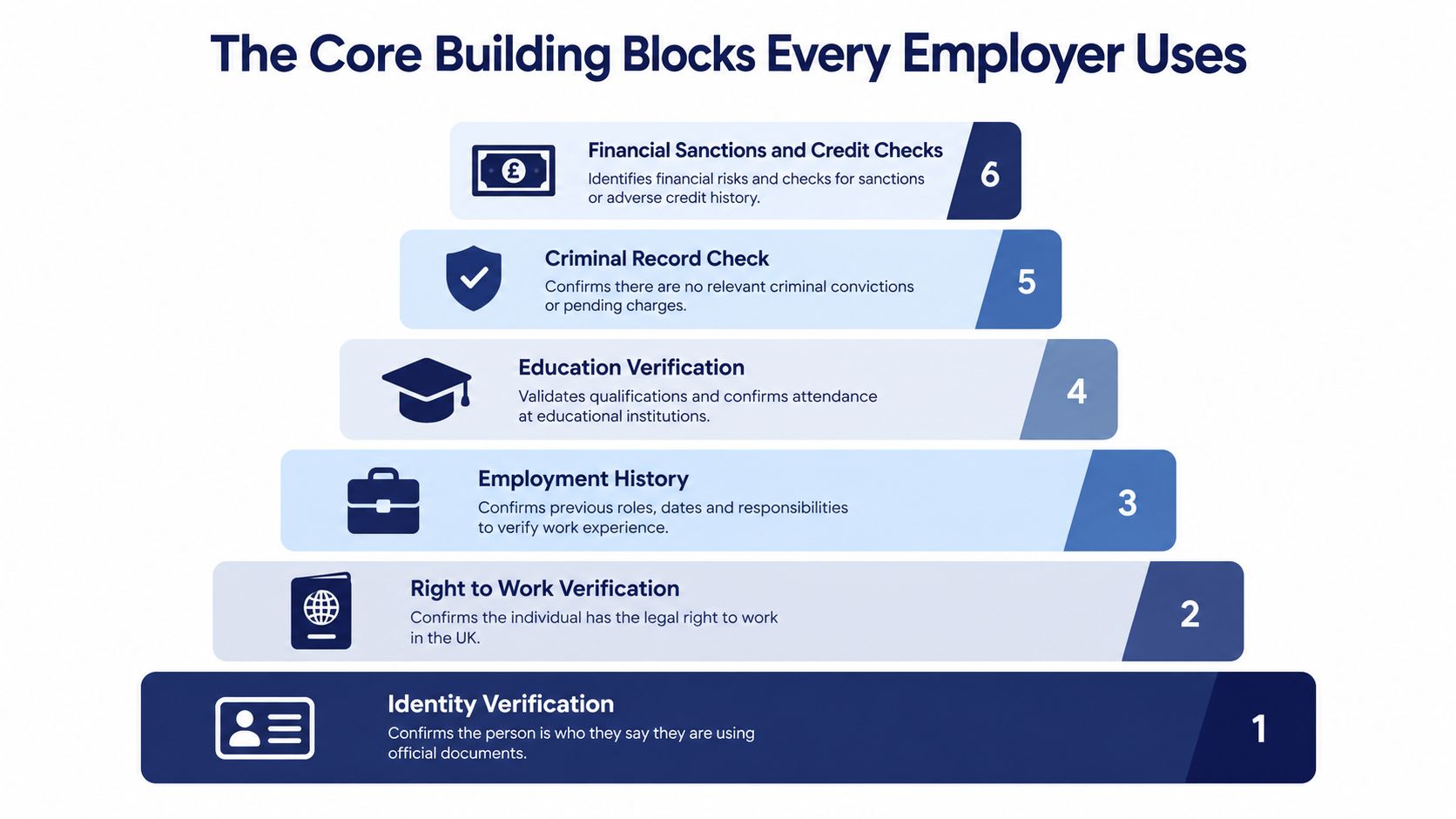
The simplest way to think about UK background screening is as a pyramid. The lower layers apply to almost everyone. The higher layers appear only when the role, legal framework or risk profile justifies them.
The base layer
At the bottom sits identity verification. If you do not know who someone is, every other check becomes less reliable. Next comes right-to-work verification, which is separate because the question is not just identity, it's legal permission to do the work.
The mid-layer
Above that comes employment history, education verification and references. These are the practical checks that test whether the candidate's experience and claims hold up. A gap here doesn't always mean fraud, but it does mean you need corroboration before you rely on the CV.
The higher-risk layer
Then you move into criminal-record screening, usually through the DBS where the role qualifies. For more sensitive posts, employers may add address-history review or other specialist due diligence. The most sensitive jobs can also justify financial checks or sanctions-related screening, particularly where the person will handle money, contracts or regulated assets.
If you want to compare how another market structures similar controls, Australian event security clearance requirements is a useful reference point. The core principle is the same, the depth of the check follows the level of access.
For a business owner, the point is not to copy every layer blindly. It's to build a screening matrix that matches the role. If the role touches children, vulnerable adults, sensitive records or cash handling, deeper checks become sensible. If it doesn't, over-screening can create cost, delay and privacy problems without improving the hire.
DBS Checks and When Each Level Applies
A hiring manager approves a candidate for a role with access to vulnerable people, then finds out the vacancy does not qualify for the level of DBS check they assumed they could order. That is a common mistake. DBS screening is not one product. It is a set of checks with different legal gateways, and the level has to match the duties of the job.
The system is used at scale, which is one reason employers tend to treat it as standard process rather than a judgement call. In 2025 to 2026, DBS issued more than 7.4 million certificates, and Basic checks accounted for roughly 39% of the total, according to the DBS Annual Quality Account 2025 to 2026. That volume matters, but it does not change the core rule. You only use the level the role is legally entitled to use.
What each level tells you
A Basic DBS check shows unspent convictions and conditional cautions. It suits roles where an employer wants a lower-level criminal record screen but has no lawful basis for a higher check.
A Standard check can disclose spent and unspent convictions and cautions. An Enhanced check can include the same material plus relevant police-held information where the law allows it. An Enhanced with Barred List check adds barred list status for work that falls into regulated safeguarding activity.
DBS Check Level | What It Discloses | Typical Role Type |
|---|---|---|
Basic | Unspent convictions and conditional cautions | General roles where lower-risk screening is appropriate |
Standard | Spent and unspent convictions and cautions | Roles with a lawful basis for more detailed screening |
Enhanced | Standard information plus relevant police-held information | Jobs involving children, vulnerable adults or higher trust |
Enhanced with Barred Lists | Enhanced content plus barred-list status | Regulated safeguarding roles |
In practice, I advise employers to treat DBS as one layer in a risk-based workflow, not the whole screening decision. A clean certificate does not verify identity, work history or right to work. It answers one question about criminal record information within a defined legal scope.
You also need a written policy on employing ex-offenders and a clear understanding of the Rehabilitation of Offenders Act rules. Context matters. The relevance of any record depends on the role, the age of the matter, and the risk created by the duties involved.
That is where experienced screening support helps. Digital checks are efficient for standard process, but edge cases still need human judgement, especially where duties are sensitive or the role profile sits close to the legal boundary for a higher-level check. If you need help matching the vacancy to the correct check level, Sentry background checks services is the practical starting point.
Right to Work Verification as a Compliance Control
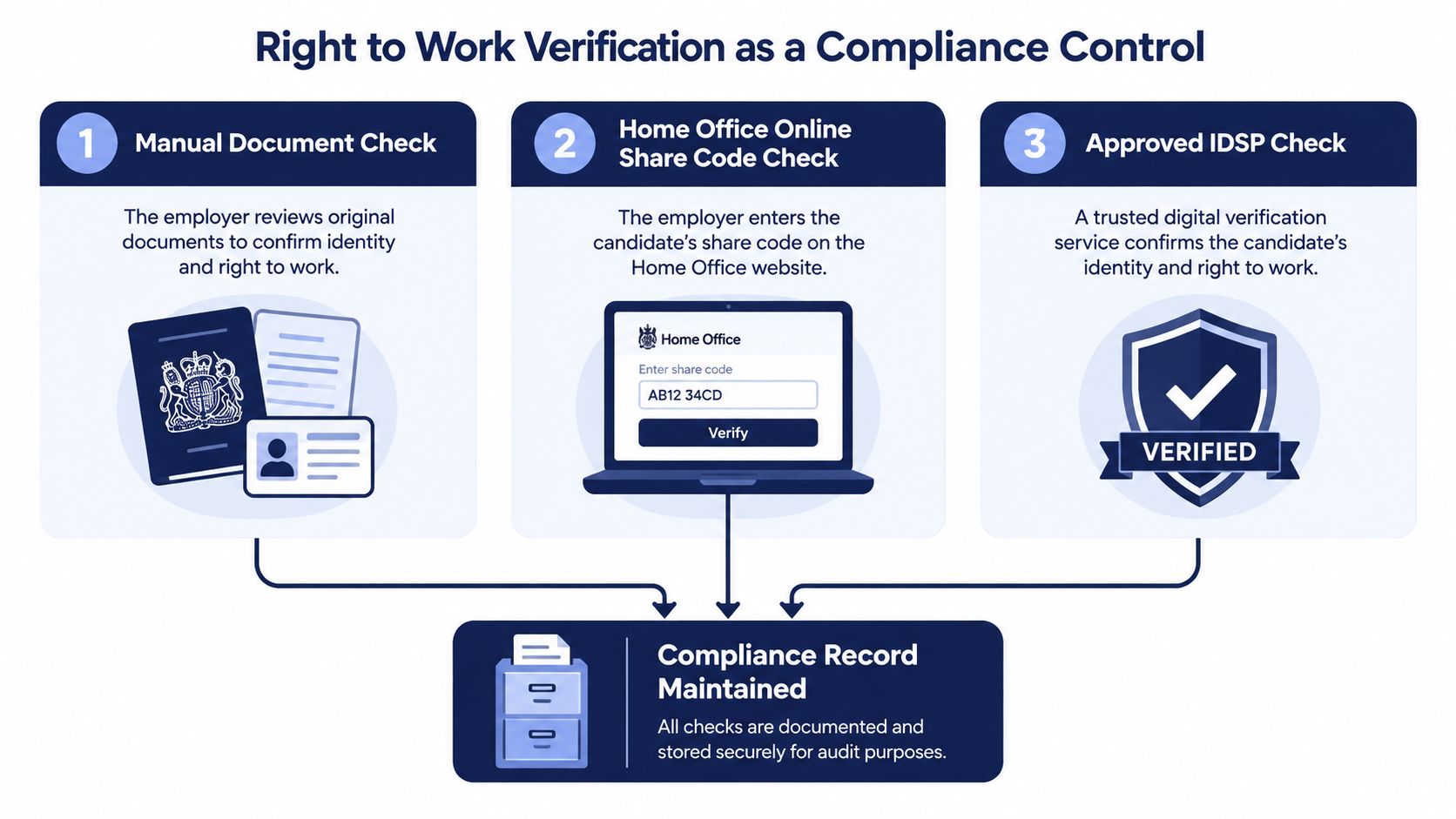
Right-to-work checks are not just an ID scan. They're a documented compliance control that protects the employer if the hiring decision is later challenged. If you do them properly, you can establish a statutory excuse against a civil penalty for illegal working.
There are three approved routes. A manual document check is used where eligible original documents must be inspected. A Home Office online share code check is used where the applicant has a share code and date of birth. An approved digital verification service provider can be used for certain identity routes, including British and Irish passport holders with a valid passport, through Identity Document Validation Technology.
The employer's job is to choose the correct route first, not last. That starts with the applicant's nationality and immigration-document status, then the evidence route follows from that. Biometric residence cards and permits are no longer accepted as standalone evidence, so where a share code is required, the employer has to use it.
Keep the record, not just the result. The file should show the identity evidence, the date of the check, the method used, the permitted work conditions and the reviewer's decision.
That's why how to check someone's identity matters as a separate control from the right-to-work test. The first question is who the person is, the second is whether they're allowed to work in that role. Mixing those up causes avoidable mistakes.
If permission to work is time-limited, the employer also needs a follow-up check before the permission expires. Sloppy recording removes the protection, and inconsistency can also create discrimination risk. The safest approach is a standard workflow, applied the same way every time, with an auditable trail attached.
Employment, Education and Reference Verification
A CV can be tidy and still be wrong. A title may be inflated, a qualification may be described loosely, and a referee may stay vague because they know the limits of what they are being asked.
Employers check previous employment dates, job titles, responsibilities and reasons for leaving. They also confirm rehire eligibility where that matters, especially for sensitive or managerial roles. If the role depends on professional competence, qualifications should be verified directly with the awarding body rather than accepted at face value.
Screening benchmarks show why that matters. According to a 2025 screening benchmark report, inconsistencies in previous employment history appeared in 64% of cases, and qualification discrepancies appeared in 47%. Those figures show that recruitment checks are dealing with routine risk, not rare exceptions.
What to verify and why
Employment dates: confirm the timeline and look for unexplained gaps.
Role held: test whether the candidate held the job claimed.
Leaving reason: watch for patterns that affect trust or conduct.
Qualifications: verify them directly where technical competence matters.
References: use structured questions, not open-ended praise, so the answers can be compared.
Address history also helps where identity consistency matters, particularly in higher-risk roles. Social media screening can be useful when it is targeted and lawful, but it should not turn into a fishing expedition. Specialist providers become more relevant where the role carries more exposure, such as handling money, sensitive information or regulated assets.
Good screening does not hunt for gossip. It confirms facts, tests gaps and records what changed between one job and the next.
A private investigator adds value when the paper trail is incomplete and the business needs discreet verification before making an offer. That sits alongside digital checks rather than replacing them. The right level of scrutiny depends on the role. A lower-risk role needs a lighter process. A high-trust role needs corroboration from more than one source.
UK GDPR and the Proportionality Rule
Background checks process personal data, so the UK GDPR and Data Protection Act 2018 sit underneath everything discussed so far. The Information Commissioner's Office expects employment information to be processed lawfully, fairly, transparently, accurately, securely and for a justified purpose. That sounds legalistic, but in practice it means the employer has to be able to explain why each check exists.
A useful way to test any screening step is simple. If you can't justify it for the role, don't run it. If you can justify it, keep the scope narrow and tell the applicant what you're checking.
The same logic appears in modern security and privacy workflows, including SOC-ready workflows for privacy rules, where process discipline matters as much as the technology used. Background screening is no different. Good process beats broad collection every time.
The practical standard
Lawful basis: identify the legal reason for processing before the check starts.
Proportionality: tie the depth of the check to the role's actual risk.
Data minimisation: collect only what you need to decide.
Transparency: tell the candidate what is being checked.
Retention limits: keep records only as long as they remain necessary.
Broad or indiscriminate checks create privacy, accuracy, discrimination and unlawful-processing risks. They also make hiring slower and harder to defend if the decision is challenged later. A written screening matrix helps because it forces consistency. So does a clear ex-offender policy, which prevents ad hoc decisions based on instinct rather than lawful criteria.
The point is this. Compliance isn't a box to tick after the screening is done. It's what makes the screening defensible in the first place.
The Hidden Risk After Someone Is Hired

Most businesses treat screening as a pre-employment event. That's understandable, but it misses where a lot of risk lives, after the person is already on payroll. Cifas, the UK fraud prevention service, has surveyed employees on workplace fraud and found the problem persists well beyond day one, including among staff who work remotely for all or part of the week. Insider risk doesn't expire when the contract is signed.
A stronger model treats screening as a lifecycle. Start with pre-hire checks, then add risk-based review when duties change, a promotion gives the employee more access, or new information appears. That can include conflict-of-interest declarations, refreshed identity or eligibility checks where justified, and secure leaver procedures so access is removed properly.
The digital-identity market is moving in the same direction. As noted earlier, government sector analysis has found that a growing share of digital-identity providers can support right-to-work checks and employee background screening directly or indirectly. The exact figures matter less than the trend: the infrastructure for repeatable, lower-friction verification is expanding, which makes lifecycle screening easier to operate without turning it into blanket surveillance.
What ongoing control should look like
Promotion review: re-check where the new role changes exposure or authority.
Conflict declarations: ask staff to declare outside interests that could affect judgment.
Leaver control: remove access, recover assets and document the exit cleanly.
Targeted escalation: review new concerns only when there's a reason, not constantly.
Any ongoing monitoring must still be necessary, transparent and proportionate under UK data-protection rules, as covered in the previous section. Blanket surveillance is the wrong answer. Targeted review, documented triggers and a clear policy are what hold up when a regulator, tribunal or client asks why a person was re-checked.
Where a Professional Investigator Adds Value
Digital checks answer the straightforward questions quickly. A professional investigator adds value when the problem is messier, such as a gap in employment history, references that can't be verified, a director who needs deeper due diligence, or an existing employee whose conduct has raised concern. That's where discreet fact-finding can sit alongside DBS, right-to-work and verification checks rather than competing with them.
For businesses that want that extra layer, Private investigator services can support pre-hire due diligence and post-hire investigations across Birmingham, London and the wider UK. Sentry Private Investigators Ltd also work on background checks where a company needs a more detailed, confidential view of the facts before it commits to a decision.
If the screening result is clean, great. If it isn't clear, the next step is often proper investigation, not guessing.
The commercial question isn't whether to use checks or investigators. It's which combination gives you a defensible decision without slowing the business down. If you need that balance, make the enquiry and get the process matched to the role rather than forcing every vacancy through the same template.
If you need a discreet, structured approach to recruitment screening, Sentry Private Investigators Ltd can support identity verification, background checks and post-hire investigations with a process built around the role and the risk. Visit Sentry Private Investigators Ltd to discuss your requirements and arrange confidential support for your next hire.