
Employee Absence Management: UK Guide for 2026

The UK sickness-absence rate was 2.0% in 2024, equating to 148.9 million lost working days across the labour market. That scale makes employee absence management a business continuity issue, not merely an HR administration task.
A manager may be looking at a long-term absence that has become difficult to explain. The employee has supplied the required medical paperwork, but colleagues have reported seeing them carrying out physically demanding work elsewhere. Another employee repeatedly calls in sick before particular shifts, then appears active in public posts during the claimed recovery period. These situations create pressure, but suspicion alone isn't evidence, and a careless investigation can expose an employer to privacy, discrimination and unfair-dismissal risks.
Effective absence management gives you a structured way to support genuine illness, maintain staffing levels and investigate credible inconsistencies. It combines accurate records, fair procedures, return-to-work discussions and, where justified, discreet professional investigation.
Understanding Employee Absence Management
Employee absence management is the organised process used to record, understand and respond to time away from work. It covers routine sickness reporting, short-term recurring absence, long-term health conditions, return-to-work arrangements and concerns about possible misuse. A good system protects the employee while giving the business reliable information for staffing and decision-making.
Consider a small logistics company with one experienced driver absent for several weeks. The owner is concerned because deliveries are being missed, but doesn't know whether the issue is a genuine health condition, a capability matter or deliberate misuse of sick leave. Treating the absence as misconduct immediately would be unsafe. Ignoring the operational impact would also be poor management. The correct response starts with records, communication and a clear distinction between health-related support and conduct investigation.
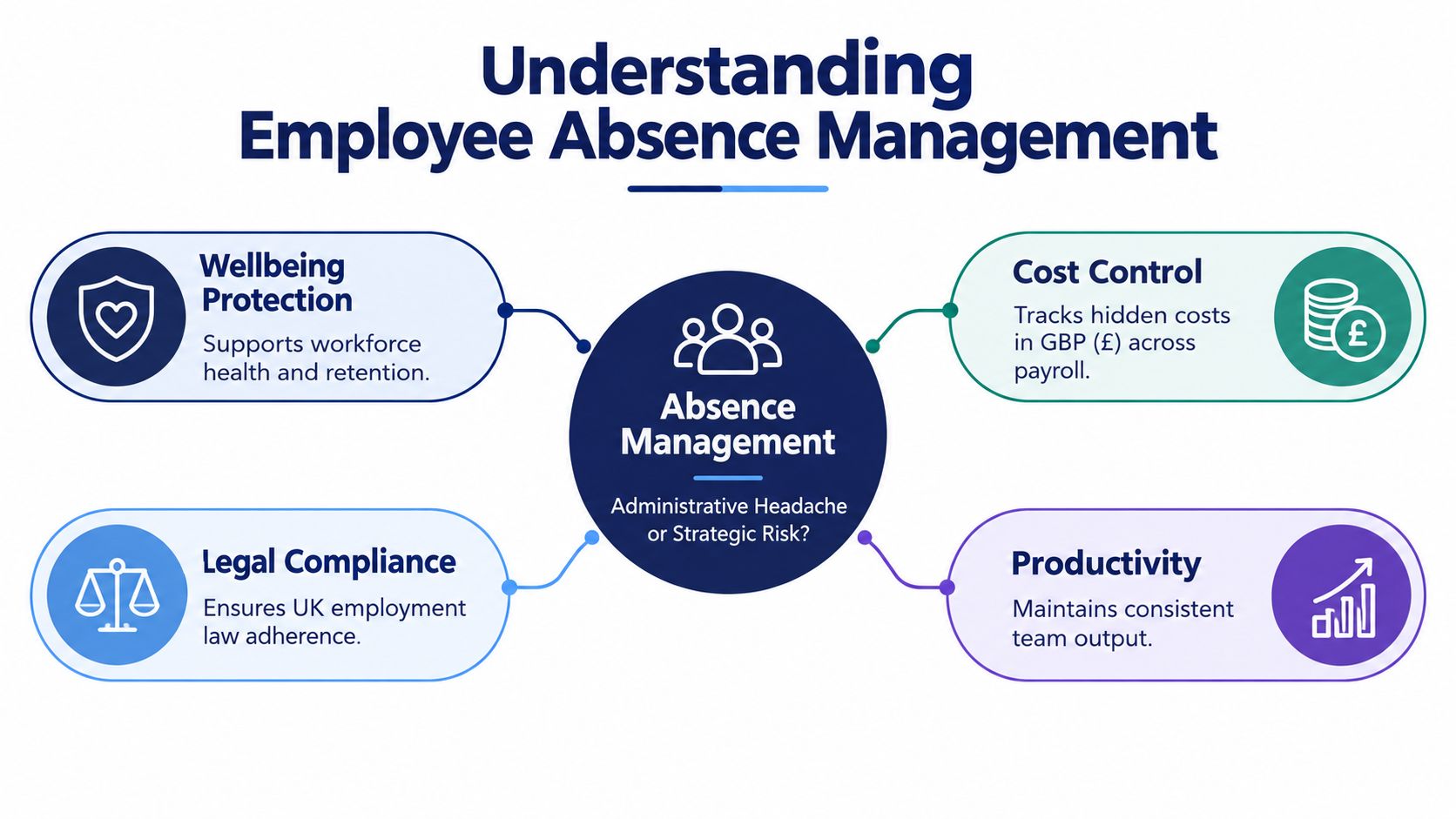
The Office for National Statistics explains that 2.0% of total working hours were lost through sickness or injury in 2024. Its estimate of 148.9 million working days lost, equivalent to 4.4 days per worker, shows why even a modest headline rate can create serious disruption when spread across a large workforce.
Two different management problems
Short-term recurring absence concerns frequency. Several isolated absences may affect shift planning, team morale and workload distribution. The employer should look for patterns, hold appropriate return-to-work conversations and consider whether support, workplace changes or further review is needed.
Long-term continuous absence concerns duration and recovery. It may require occupational-health input, a phased return, reasonable adjustments and regular contact agreed with the employee. A long-term health condition isn't automatically a conduct issue, even when the operational consequences are significant.
Practical rule: Manage the absence first. Investigate conduct only when objective information creates a separate, reasonable concern.
Small businesses don't need an elaborate system to begin. They need consistent reporting channels, secure records, trained managers and a written process that tells people what happens next. That foundation makes later decisions more defensible and reduces the risk that one employee is treated differently from another.
Building an Effective Absence Management Policy
A workable policy answers four questions before a difficult case arrives: how must absence be reported, what information is recorded, when is a review triggered, and who decides the next step? It should also explain that a health-related absence may lead to support or capability management, while suspected dishonesty may require a separate conduct investigation.
The policy should require prompt notification through a defined channel, record the date and expected duration, and set out how contact will be maintained during longer absence. It should explain return-to-work meetings without presenting them as interrogations. Employees also need a clear distinction between sickness absence and annual leave. A practical explanation of that difference is available in this guide to distinguish sick days from vacation.
Measure patterns, not just totals
The CIPD's 2025 survey of 1,101 UK organisations found average absence of 9.4 days per employee annually, compared with 7.8 days in 2023. The survey identified minor illness as the leading cause of short-term absence, cited by 78% of employers, while mental ill health was the leading cause of long-term absence, cited by 41%. These figures support a policy that separates short-term frequency from long-term duration rather than applying one automatic threshold to every case. (CIPD survey)
Track absence by:
Duration band: Separate isolated days, repeated short absences and continuous cases.
Cause category: Record the information the employee provides without asking managers to diagnose medical conditions.
Recurrence: Identify patterns linked to particular shifts, locations or working arrangements.
Department and manager: Check whether one team has unusual concentration or inconsistent recording.
Work pattern: Compare absence with rotas and scheduled duties, while avoiding assumptions.
A useful trigger should prompt a review, not predetermine an outcome. Wording such as “the organisation may review repeated or extended absence to understand support needs and operational impact” is safer than language implying that reaching a numerical threshold proves misconduct.
Managers should also know how to run background screening when recruitment, conflicts of interest or suspected secondary employment form part of a wider risk review. Screening doesn't replace an absence investigation, but it can help establish relevant context when conducted lawfully and proportionately.
Legal Requirements and Fit Note Rules
Medical certification and investigative evidence answer different questions. A fit note provides a registered healthcare professional's opinion about whether a worker is fit for work, may be fit with support, or isn't fit for work. It doesn't establish everything the employee did during every day of the absence.
Acas states that a worker must obtain a fit note when they've been ill for more than seven calendar days, or when the employer requests one. Acas also explains that an employer may ask for a fit note before paying Statutory Sick Pay, and eligible workers are entitled to Statutory Sick Pay from the first day of sickness absence. (Acas guidance on Statutory Sick Pay)
Keep medical and conduct questions separate
A fit note may support the fact that a health professional considers the employee unfit for work. It doesn't prove that the employee was incapable of every activity, nor does it automatically validate or disprove concerns about secondary work, public activity or inconsistent statements.
Employers should avoid making their own medical judgments. If the question is whether the employee can perform particular duties, an occupational-health referral may provide a more reliable assessment. If the concern is that the employee has deliberately misrepresented their activities, the employer needs relevant factual evidence and a fair process.
A certificate can explain a health opinion. It can't answer every conduct question arising during the absence.
Equality obligations matter throughout. A disability or mental-health condition may require reasonable adjustments to attendance procedures, communication methods, duties or return-to-work arrangements. The fact that an absence is inconvenient, frequent or difficult to understand doesn't remove the need to consider whether a protected condition is involved.
Employers operating across jurisdictions may encounter different administrative approaches, which is why resources such as con Spark gestisci l'ispezione can offer contextual reading. UK employers must still apply UK employment, privacy and equality requirements to their own cases. Keep medical information confidential, restrict access and document why each piece of information is relevant.
Spotting the Difference Between Illness and Fraud
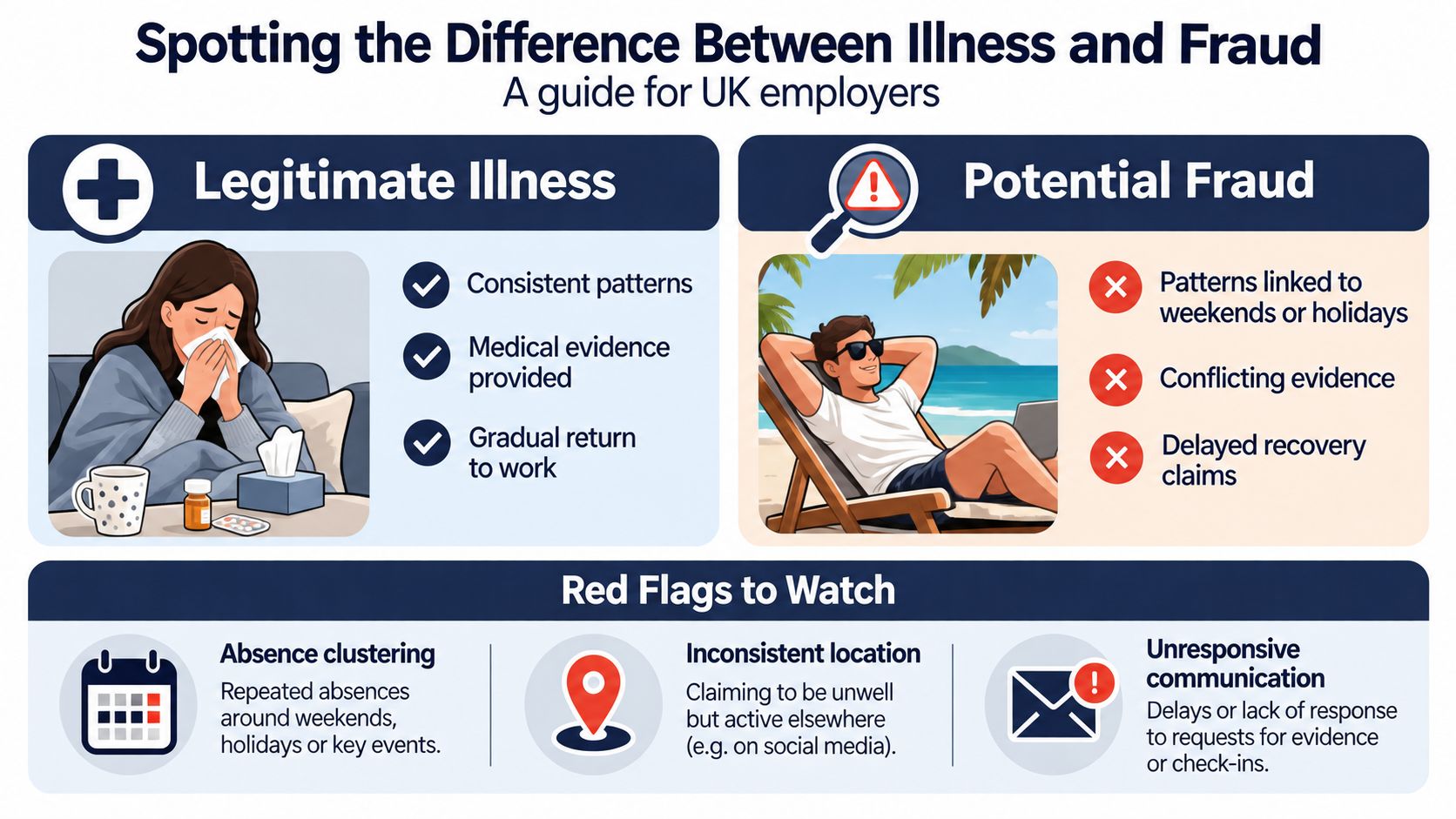
Suspicious absence usually begins with an inconsistency, not a confession. An employee may report an injury that prevents a particular job but remain able to perform lighter activities. A person may be absent from a scheduled shift yet appear to be working elsewhere. Neither example proves fraud. Both may justify a careful review if the information is reliable and relevant.
The UK government survey covering 2024 to 2025 found that 49% of workers had taken at least one sickness absence in the previous twelve months, while 58% had worked despite not feeling well enough to do so. Among workers who had taken sickness absence, 34% had taken time off on only one occasion. The figures show why a single absence should not be treated as suspicious merely because it is inconvenient or unusual. (UK government survey)
Compare the evidence, not the stereotype
Legitimate illness may involve:
Consistent communication: The employee follows the reporting process and provides relevant updates.
Medical support: Certification or occupational-health information broadly supports the restrictions described.
A credible recovery pattern: The employee engages with agreed contact and return-to-work arrangements.
Activity within limitations: Being able to leave home or carry out light tasks doesn't necessarily mean being fit for the employee's normal role.
Potentially fraudulent conduct may involve:
Contradictory activity: Observed conduct appears incompatible with the specific incapacity claimed.
Repeated timing patterns: Absences repeatedly coincide with particular shifts, weekends or other operational events.
Secondary employment: Evidence suggests paid or organised work during the claimed period of incapacity.
Conflicting accounts: Dates, locations or explanations change without a reasonable explanation.
Unresponsive communication: The employee repeatedly avoids agreed contact without a clear reason.
The investigator should record what happened, when it happened, how it was sourced and why it matters. Don't write that an employee “looked perfectly healthy” or “was pretending”. Those are conclusions and may involve medical assumptions. Record observable facts, such as a person lifting an item, entering a workplace or carrying out a named task.
A structured medical chronology and red flag guide can help legal and HR teams organise timelines without turning a pattern into proof. Before escalating, ask whether the evidence could have an innocent explanation and whether the same concern would be handled consistently for another employee.
How Surveillance and Investigations Provide Evidence
Professional investigation becomes relevant when internal records identify a credible question that ordinary HR processes cannot answer. The common advice to hold a return-to-work meeting, request a fit note and follow a capability process is necessary in many cases, but it doesn't resolve every concern involving secondary employment, contradictory public activity, absences around shifts or alleged fraudulent workplace-injury claims. (CIPD commentary)
A business owner might have rota data showing repeated absences before specific duties, public material suggesting a different account and no reliable internal way to test what happened. The right response isn't to arrange informal monitoring by a manager. It is to define the question, assess proportionality and consider whether an independent investigator can gather relevant evidence lawfully.

What a professional investigation should establish
Surveillance may document observable activity from lawful positions in public places. It should focus on the defined concern, not become unrestricted monitoring of an employee's private life.
Vehicle tracking can sometimes assist with questions about movement or attendance, but it raises significant privacy and data-protection issues. An employer should not assume that placing a tracker on a vehicle is lawful just because the vehicle relates to work. The purpose, authority, necessity and handling of the data must be considered before any technical method is used.
Background checks may help examine declared interests, business connections or potential secondary employment. They must remain relevant to the investigation and comply with applicable privacy obligations.
Evidential reporting should preserve dates, times, locations, observations and source information. Original files, notes and metadata should be handled so that the material can be explained later. If evidence may be used in a disciplinary process, civil claim or tribunal, chain of custody matters.
Investigator's observation: The strongest report often contains less speculation. It sets out the question, records the observations and lets the decision-maker assess the significance.
Sentry Private Investigators Ltd provides discreet workplace absence investigations, including covert surveillance, vehicle tracking and structured evidential reporting for suspected absenteeism or fraudulent absence. An employer considering this route should first obtain HR or legal advice where the case involves disability, sensitive medical information, alleged injury or a likely dispute. The company's practical guide to surveillance work explains the operational issues employers should consider before commissioning surveillance.
Professional surveillance isn't a first resort, and it isn't a substitute for fair treatment. Used narrowly, it can test a specific factual question. Used casually, it can damage trust, collect excessive personal information and weaken the employer's position.
Step-by-Step Process for Managing Suspected Fraud
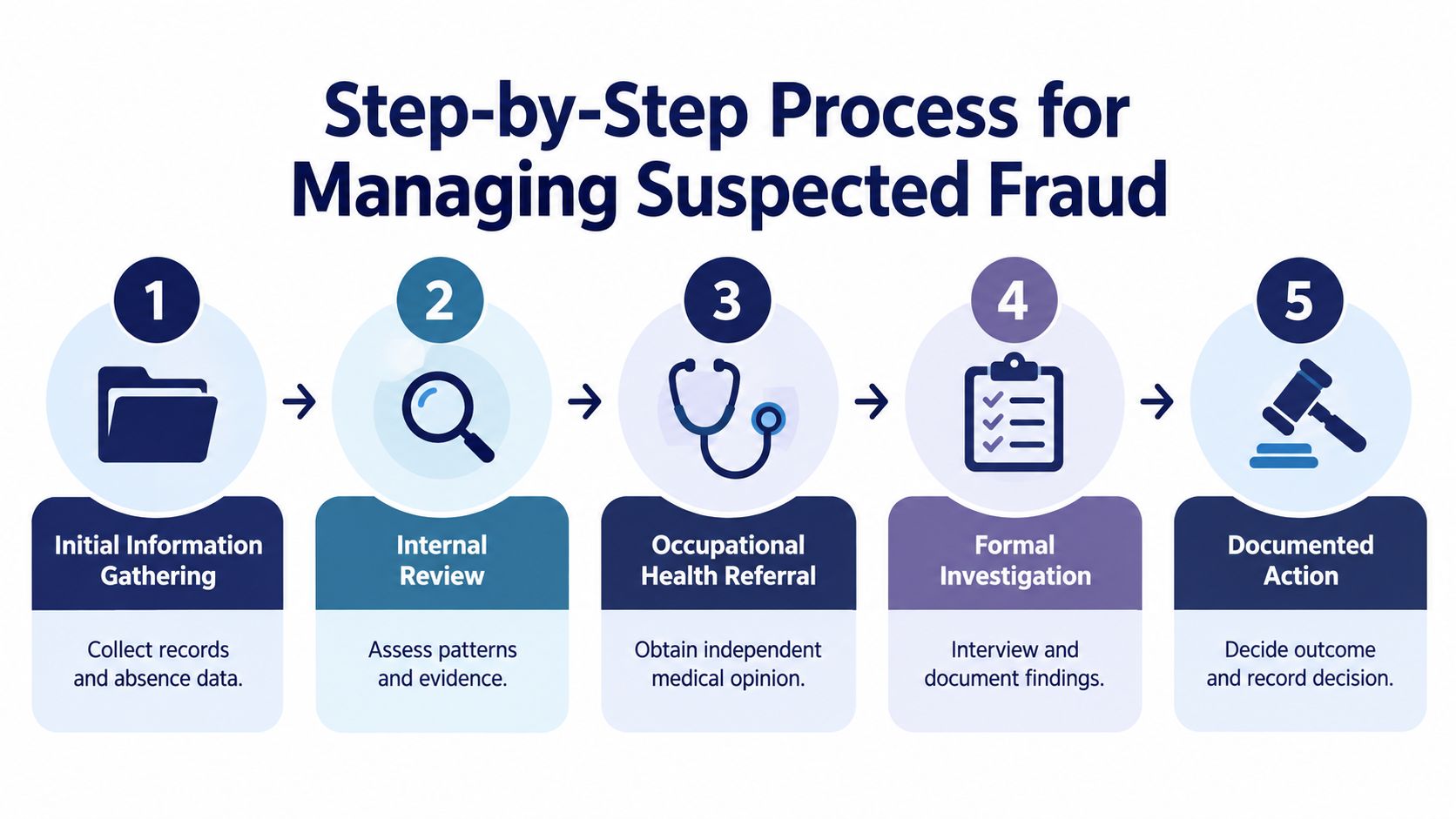
A defensible investigation moves from concern to evidence in controlled stages. Each stage should answer a defined question and prevent the employer from jumping from an unusual pattern to a disciplinary conclusion.
1. Gather the initial information
Collect absence notifications, fit notes, rota records, return-to-work notes, relevant correspondence and any specific source of concern. Preserve material in its original form where possible. Don't circulate rumours or invite colleagues to conduct their own observation.
2. Carry out an internal review
Test the timeline. Does the concern relate to capability, conduct, a possible policy breach or a misunderstanding of the employee's restrictions? Check whether similar cases have been treated consistently. Separate facts from assumptions and identify gaps that need clarification.
3. Consider occupational health
An occupational-health referral can address fitness for duties, likely restrictions, adjustments and a suitable return-to-work approach. It should not be used to ask a clinician to decide whether an employee is honest. Medical opinion and conduct evidence have separate roles.
4. Decide whether formal investigation is proportionate
If the concern remains specific and credible, consider an independent investigator. Set written objectives, define the relevant period and identify prohibited or unnecessary lines of enquiry. Confidentiality should be maintained on a need-to-know basis.
The Civil Service report for the year ending 31 March 2024 recorded 7.8 average working days lost per staff year, compared with 8.3 days in the previous year. Long-term sickness accounted for 4.6 days per staff year, while short-term sickness accounted for 3.2 days. Mental ill-health represented 46.8% of long-term absence, and musculoskeletal disorders represented 13.5%. (Civil Service sickness-absence report) These figures reinforce the need to investigate the individual facts rather than rely on assumptions about health, age, sex or occupation.
5. Document the outcome
Give the employee a fair opportunity to respond to relevant evidence. Decide whether the outcome is support, adjustment, capability action, no further action or disciplinary action. Record the reasoning, the evidence relied upon and any appeal route.
For complex cases, employers may consider business private investigations where external evidence gathering, witness work or discreet surveillance is required. The investigator's role is to establish facts. The employer remains responsible for the employment decision.
Best Practices for Ongoing Absence Management
Strong employee absence management is a continuing control system, not a campaign launched only after suspicion arises. Managers should review absence records regularly, check that reporting is consistent and ensure that return-to-work conversations identify support needs as well as operational concerns. Employees should understand how to report illness, who will contact them and how their information will be protected.
Benchmarking also needs care. The ONS latest sickness-absence data reports a 2.0% sickness-absence rate in 2025, defined as working hours lost because of sickness or injury, equating to 148.8 million working days and 4.4 days lost per worker. The Health and Safety Executive estimated 35.7 million working days lost to work-related ill health in Great Britain during 2024/25, including 22.1 million days attributed to stress, depression or anxiety. These are different measures and should not be treated as interchangeable.
Use two lenses
Hours lost helps show the effect on total working capacity. Days per worker helps reveal the experience of employees and the operational effect of individual cases. A stable frequency rate can conceal a small number of prolonged absences, while a high frequency rate may reflect brief illnesses that require supportive management rather than suspicion.
A practical dashboard should show:
Frequency: How often people are absent.
Duration: How long each episode lasts.
Cause: What broad category has been recorded.
Concentration: Whether cases cluster by team, site, manager or shift.
Response quality: Whether return-to-work meetings, adjustments and referrals happen consistently.
Train the people who make the decisions
Line managers need training in factual note-taking, respectful conversations, confidentiality and escalation. They should know when not to ask medical questions and when to involve HR, occupational health or legal advisers. They should also understand that social-media activity, a fit note or a colleague's comment may be a lead, not a conclusion.
Technology can improve records and reporting, but it doesn't remove judgement. A spreadsheet, HR platform or payroll-integrated system should support an audit trail, access controls and consistent workflows. It shouldn't automatically label employees as fraudulent because an absence matches a calendar pattern.
The right sequence is simple: support genuine illness, review unusual patterns, investigate specific concerns and decide only after the employee has had a fair opportunity to respond.
Specialist investigative support adds value when the issue is narrow, evidence-based and difficult to test internally. It can be appropriate for suspected secondary employment, contradictory activity, repeated absence around shifts or a disputed workplace-injury claim. It is not appropriate as routine monitoring of every absent employee, and it won't cure a weak policy or poor record-keeping.
If absence concerns are affecting staffing, payroll or the credibility of your internal process, speak with Sentry Private Investigators Ltd about discreet surveillance, workplace absence investigations, vehicle tracking and structured evidence gathering. Visit Sentry Private Investigators Ltd to discuss the facts confidentially and identify a proportionate next step.