
RF Signal Detector: A Practical UK Guide to Finding Bugs

A private conversation is repeated by someone who should never have heard it. A competitor appears to know what was discussed in a confidential meeting. A partner refers to details shared only inside the home. You retrace the week, check who had access, and eventually look at the smoke alarm, socket, clock or vehicle tracker with a new suspicion.
That concern may be justified, but a consumer RF signal detector won't answer the question on its own. It can tell you that radio-frequency energy is present. It can't normally tell you whether that energy comes from a covert microphone, your router, a nearby phone or a lawful transmitter next door.
This distinction matters in the UK. A proper technical surveillance investigation is about identifying, testing and documenting a source, not reacting to the loudest beep.
When a Hidden Device Feels Plausibly Real
A senior manager notices that private details from an upcoming negotiation keep surfacing in unrelated conversations. The information isn't public, and only a small group attended the meeting. After checking email access and speaking to colleagues, the manager starts looking around the office. The smoke alarm seems newly positioned. A meeting-room clock has an unfamiliar power lead. A small device behind a cabinet suddenly feels plausible.
That reaction is common when several details point in the same direction. New contractors may have had unsupervised access. A former employee may know the room layout. A partner may demonstrate knowledge of private conversations without an obvious explanation. These signs don't prove surveillance, but they give a client a sensible reason to investigate rather than dismiss the concern.
The internet often turns that concern into certainty. It presents every unusual noise, battery drain or glowing light as evidence of a listening device. That approach creates panic and encourages people to buy equipment they don't understand. A more useful approach begins with a question: what exactly could the suspected device transmit, and what evidence would distinguish it from ordinary radio activity?
The first question is not “where is the bug?”
It is “what is the unexplained behaviour?” Record when the information appeared, who could have accessed the property, which rooms were involved and whether the issue relates to a home, office, vehicle or electronic account. This record helps an investigator test a theory instead of searching randomly.
A covert device may transmit continuously, in short bursts, only after detecting sound or movement, or not transmit at all while it stores information. A handset may therefore produce a strong reading during one check and nothing during another. The reverse can also happen, where a powerful lawful transmitter creates a very convincing alert.
Practical rule: Suspicion justifies a methodical examination. It doesn't turn an RF reading into proof.
An RF signal detector is a handheld instrument that senses radio-frequency energy in the air and converts that energy into an audible tone, numeric reading or visual spike. It detects a property of a signal. It doesn't automatically identify the object producing it or establish that surveillance has taken place.
What an RF Signal Detector Actually Does
Think of a radio wave as an invisible carrier moving through a room. A radio receiver uses an antenna to collect a small amount of electromagnetic energy, then processes it so the receiver can identify useful characteristics. An RF detector follows a similar principle, although its purpose is usually to reveal the presence and behaviour of energy rather than play a broadcast.
Frequency describes how rapidly a wave cycles, measured in hertz. Wavelength describes the physical distance between repeating points on that wave, measured in metres. The two are connected, so a device operating in a particular band produces a recognisable relationship between its frequency and wavelength. This is why an instrument designed for one part of the spectrum may perform poorly in another.
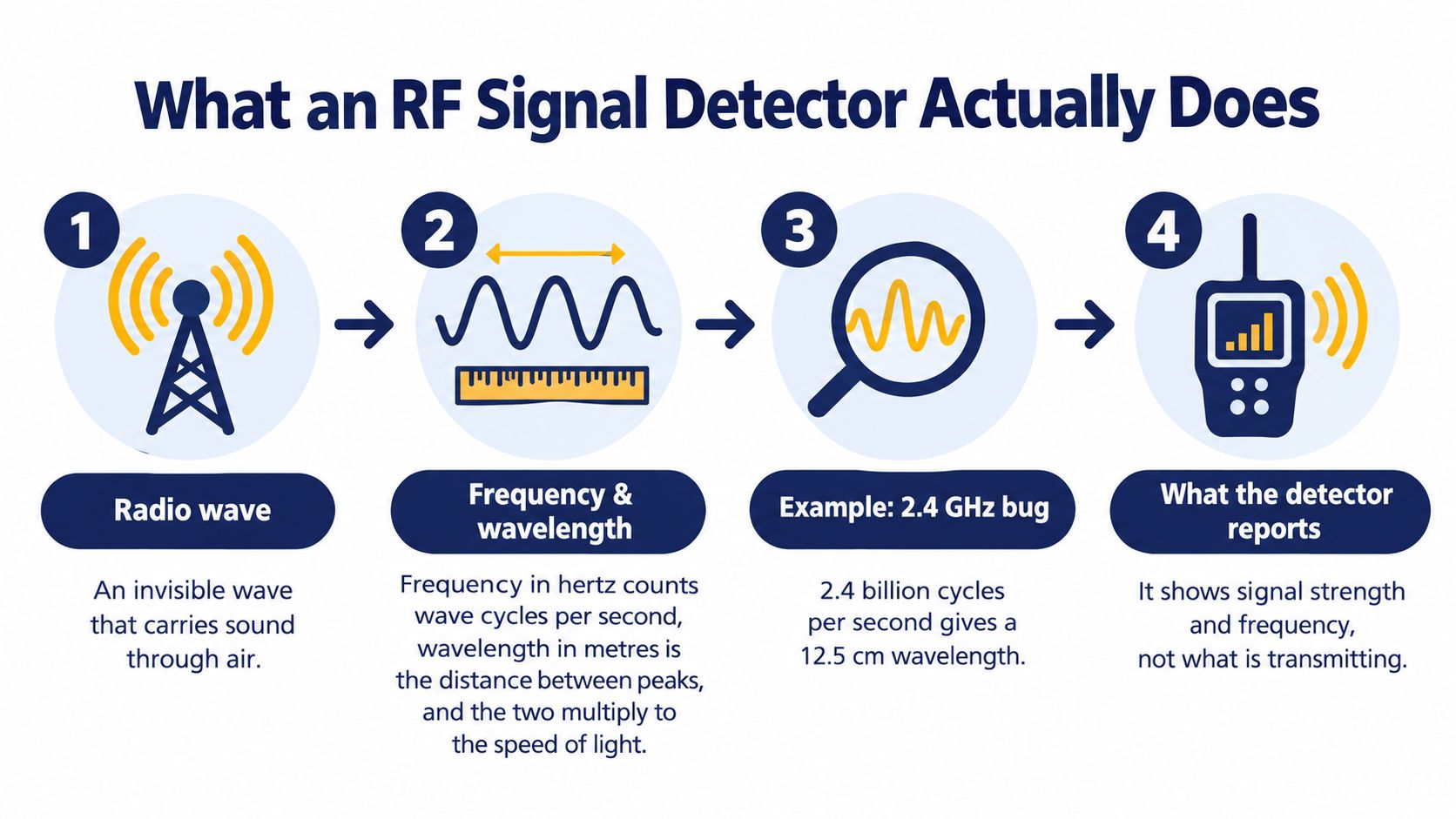
From invisible energy to an alert
The signal path is easier to understand in four stages:
The antenna receives energy. The detector's antenna picks up electromagnetic energy, including wanted transmissions and background emissions.
The receiver selects or scans. Internal circuitry may examine a wide range or focus on a particular band. A tuned receiver can listen for bands associated with GSM, LTE, Bluetooth or Wi-Fi.
The amplifier raises a measurable response. Weak energy must be separated from the instrument's own noise and from competing signals in the environment.
The detector reports a result. The output may be a tone, a rising bar, a signal-strength value, a frequency display or a spectrum trace.
A broadband detector scans across a large frequency range and gives a general indication that energy is present. It's quick, but it may combine several unrelated sources. A tuned detector examines selected bands in more detail, which can help an operator compare a suspected signal with known Wi-Fi, Bluetooth or mobile activity.
More capable equipment can use threshold logic and signal-pattern analysis. It may identify a burst, a recurring transmission or a change in the spectrum that deserves closer examination. That still doesn't reveal the message being sent. It reports signal characteristics, not the content or purpose of the transmission.
The UK framework covers electromagnetic energy across a very broad range. The Wireless Telegraphy Act explanatory notes describe wireless telegraphy in terms that extend up to 3,000 GHz, and define harmful interference by its effect on lawful radio transmissions. For a TSCM inspection, that means frequency coverage, dynamic range and measurement quality matter far more than a simple “bug finder” label.
Consumer Detectors Versus Professional TSCM Equipment
A pocket detector and professional TSCM equipment serve different purposes. Treating them as competing versions of the same product is a mistake.
A consumer device can be useful for a quick confidence check in a home office. It may highlight a strong nearby transmission from a phone, router or wireless accessory. It may also help you identify changes after known devices are switched off. That's useful intelligence, provided you treat the result as a starting point.
Professional equipment supports a different standard. A technical investigator may combine spectrum analysis with near-field probes, non-linear junction detection, thermal inspection and physical examination. Those tools address different problems, including electronic components that aren't transmitting and wired microphones that an RF-only device can't see.
Comparison at a glance
Feature | Consumer Detector | Professional TSCM |
|---|---|---|
Main purpose | Quick indication of nearby RF energy | Structured detection, analysis and source assessment |
Typical operation | Broad scan with tone, bars or a simple display | Spectrum analysis, directional searching and controlled testing |
Signal detail | Limited frequency and pattern information | Frequency, bandwidth, field strength or received power, timing and transmission behaviour |
Non-transmitting devices | Usually missed | May be investigated with NLJD, thermal and physical techniques |
Wired microphones | Not detected by RF alone | May be found through physical inspection and complementary equipment |
Evidence quality | Personal intelligence | Calibrated, documented findings suitable for further investigation |
Best setting | Low-consequence home or small office concern | Confidential business, legal, family or vehicle investigation |
A professional receiver should be assessed across relevant bands, not marketed through one impressive sensitivity figure. The UK ultra-wideband rules show how very low-power emissions can coexist with other radio services. They also explain why noise performance, resolution bandwidth, filtering and overload recovery affect the result.
The right question isn't “How much does the detector cost?” It's “What happens if it misses the device?”
A consumer detector is reasonable when the consequence of a false alarm is limited and you only need preliminary information. Professional TSCM equipment becomes the correct choice when a missed device could affect a company, legal strategy, relationship dispute, safety decision or criminal investigation.
Why a Reading Does Not Prove a Bug Is There
The contrarian position is the accurate one: an RF signal detector is a spectrum monitor, not a bug detector.
Modern buildings contain phones, Wi-Fi routers, smart speakers, Bluetooth accessories, laptops, tablets, wireless cameras, cordless equipment and neighbouring transmitters. A detector may respond to any of them. It may also respond to a signal that enters through a wall or window, even though the source isn't inside your property.
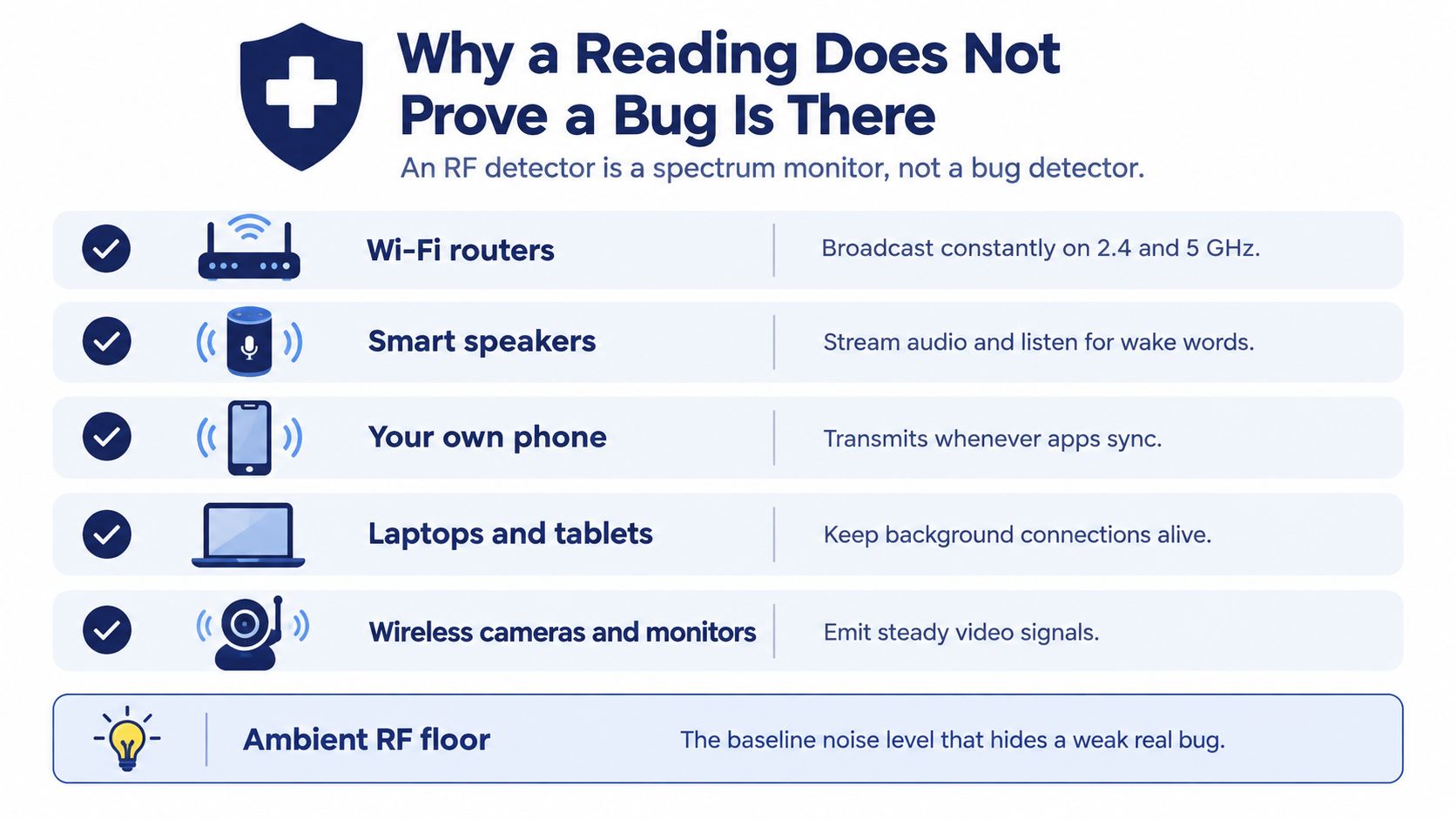
Build a controlled baseline
Start by recording the room in its ordinary state. Note the detector mode, location, antenna, displayed frequency or range, signal indication and time. Then switch off known transmitters one at a time, recording what changes after each action.
A useful sequence is:
Record the normal environment. Capture readings from the doorway, desk, meeting table and areas close to fixtures.
Remove known sources. Switch off your own phone, router, smart speakers, Bluetooth accessories and other equipment where practical.
Repeat the same positions. Keep the detector orientation and settings consistent so the comparison means something.
Restore devices individually. Reintroduce equipment one at a time and look for matching changes.
Investigate what remains. An unexplained, repeatable signal deserves closer examination, not an immediate accusation.
Ofcom's guidance on interference to radiocommunications apparatus recommends switching equipment off one at a time and keeping an incident log for at least a week before reporting interference. That evidence-led habit is valuable during a privacy investigation too.
A detector can't tell you whether a transmission contains audio, video or location data. It can't reliably distinguish a covert transmitter from a neighbouring baby monitor, and a weak reading doesn't exclude a device that stores data, uses intermittent bursts or transmits only when triggered.
Ofcom's published enforcement material records 2,696 complaints about interference and 1,539 radio-system licence compliance checks in its reported 2013 to 2014 figures, alongside investigations into illegal broadcasters and enforcement action. Those figures demonstrate a crowded and active RF environment, not a hidden bug in every room. Read the Ofcom enforcement report for the regulatory context.
A consumer reading is intelligence, not evidence. It becomes meaningful only when you can reproduce it, isolate known sources and connect the remaining signal to a physical or technical finding.
How to Use an RF Signal Detector Effectively
A casual walk around the room produces casual results. If you're going to use an RF signal detector, carry out a repeatable sweep and write down what happens.
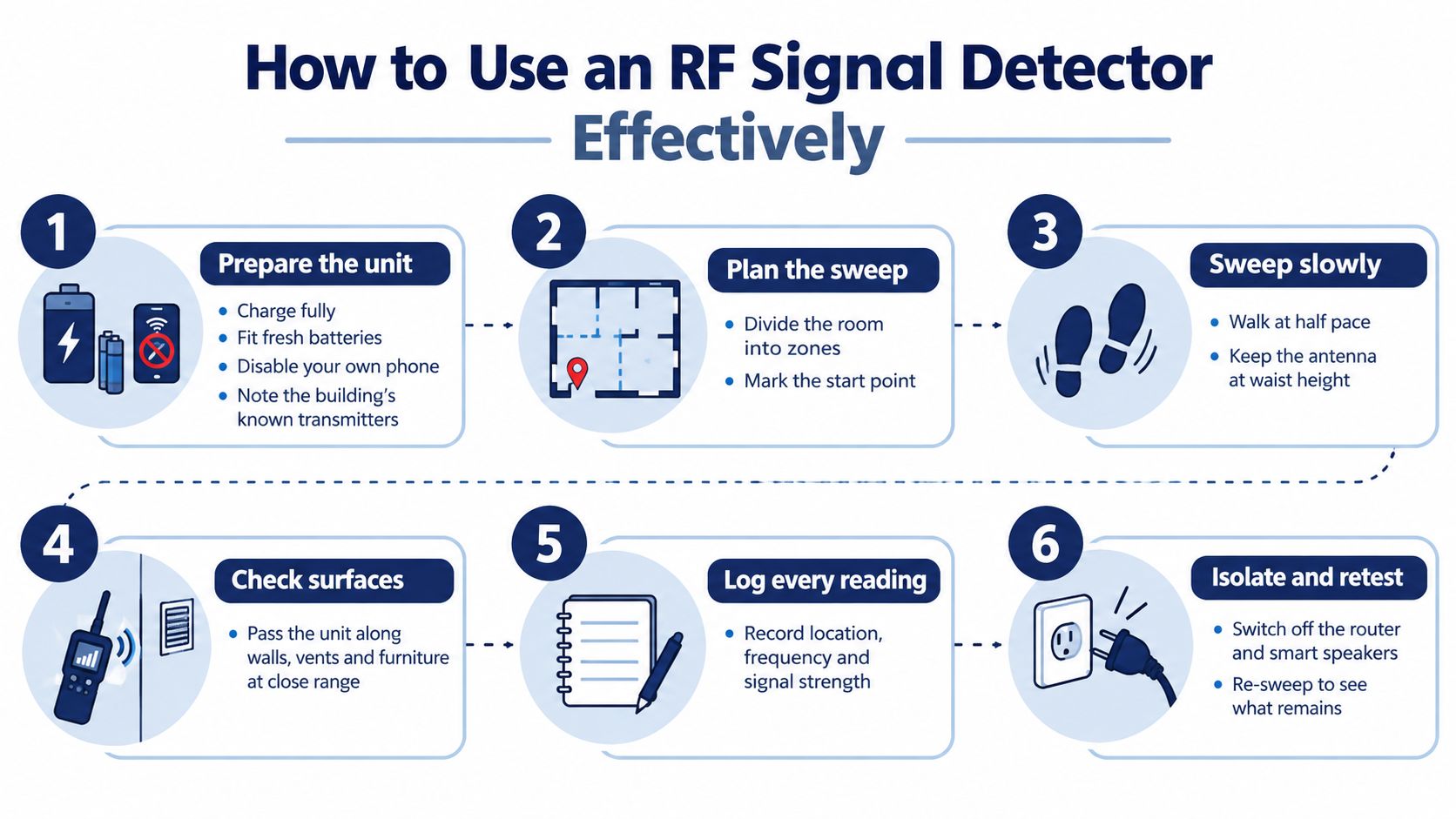
Prepare before entering the room
Charge the instrument fully and fit fresh batteries where the design allows it. Disable your own phone or place it outside the search area, and note the building's known transmitters, including routers, cordless equipment and security systems. Mark the perimeter and decide how you'll record each position.
Begin at the doorway. Divide the room into zones, then move slowly through overlapping arcs with the antenna extended. Keep your movement steady and avoid placing your body directly between the antenna and the area being tested.
Work from fixed services towards movable objects
Check mains sockets and cable routes first, then lighting fittings, smoke detectors, clocks, vents, furniture and soft furnishings. Move close to surfaces without striking or disturbing them. A device hidden behind a fixture may produce a stronger response when the antenna is close, but a strong response at one position can also come from wiring or equipment on the other side of a wall.
When the detector shows an anomaly, stop and hold the position for at least thirty seconds to see whether the response is sustained. Switch between wideband and tuned modes if the instrument provides them. Record the frequency, signal indication, location, time and any change when a known device is powered down.
Speed creates impressions. Consistency creates a useful record.
Repeat the sweep at a different hour. Intermittent devices, phones, network activity and scheduled equipment can change the RF environment. Don't alter a suspicious object just to see what it does. Photograph its position, note its condition and preserve the scene for an investigator.
The measurement itself needs context. A technically useful record should include the antenna type, detector settings, measurement location, noise floor and, where available, screenshots or waterfall captures. Changing the resolution bandwidth changes the displayed noise power and can alter an alarm threshold, so comparisons are only useful when settings remain consistent.
A handheld scan can't replace source identification. If a reading follows you from room to room, appears near building services or changes unpredictably, stop treating the process as a consumer test and ask for a professional assessment.
UK Law, Ofcom Rules and Why Jamming Backfires
Owning a detector is not the same as intercepting communications or deliberately disrupting them. The legal boundary matters because an anxious client can make the situation worse by buying a jammer online and switching it on.
Under section 8 of the Wireless Telegraphy Act 2006, using wireless-telegraphy apparatus generally requires an Ofcom licence unless a specific exemption applies. Ofcom explains that short-range devices may operate on a non-interference and non-protected basis, meaning licence exemption doesn't give a device unlimited permission to disrupt other users. The Ofcom short-range device guidance includes specified bands such as 2,400 to 2,483.5 MHz and 17.1 to 17.3 GHz, with a 25 mW maximum effective isotropic radiated power for equipment using the former band.
The law also distinguishes detection from interference. A strong reading may come from a nearby lawful transmitter, and signal strength alone doesn't establish deliberate jamming. Harmful interference depends on the effect on communications, including degradation, obstruction or repeated interruption. The Wireless Telegraphy Act body text makes deliberate interference an offence.
The practical consequences
Legislation or regulator | Relevant issue | Likely consequence |
|---|---|---|
Wireless Telegraphy Act 2006 | Unauthorised apparatus or intentional interference | Investigation, enforcement and potential criminal proceedings |
Ofcom licensing framework | Transmitting equipment used without a licence or exemption | Regulatory action and removal or restriction of equipment |
Ofcom interference process | Harmful or unexplained emissions affecting lawful services | Logged complaint, technical investigation and possible enforcement |
Evidence handling | Altering, blocking or destroying a suspected transmission | Loss of useful evidence and possible disruption to lawful communications |
Jamming is a poor response even before the legal risk. It may disrupt your own Wi-Fi, mobile communications, GPS, alarms or safety-related systems. It can alert whoever operates the suspected device, contaminate the RF environment and make later testing harder.
The lawful route is straightforward. Record the signal, preserve the physical scene, avoid transmitting interference and instruct a qualified investigator. If the findings indicate a genuine offence, a professional can help coordinate technical information with Ofcom, the police or legal advisers. Clients who need to detect electronic eavesdropping should focus on preserving facts, not conducting an improvised counterattack.
When a Consumer Detector Stops Being Enough
A handheld unit loses authority when the consequences of a missed detection become serious.
A consumer detector may be adequate for a preliminary check in a private flat or home office. It can help you identify whether a known router or phone explains an unexpected alert. It can't provide confidence that a room is clear when the suspected device is dormant, burst-mode, encrypted, wired or hidden in a vehicle or mains system.
Use consequence as the decision rule
Professional testing deserves serious consideration where:
Corporate confidentiality is involved. Board meetings, acquisition discussions and regulated information require more than a tone from a pocket instrument.
Legal or HR conversations are at stake. A missed device may affect litigation, negotiations or a workplace dispute.
A relationship dispute involves assets or coercive behaviour. Repeated anomalies deserve independent testing rather than confrontation.
The same unexplained signal returns. Repetition after known devices are isolated changes the situation from curiosity to an investigative lead.
The suspected source is physical but not obviously radio-based. Fixtures, vehicles, drones, mains wiring and concealed electronics require complementary methods.
The result must stand up to scrutiny. A calibrated instrument, documented settings and a written report carry more weight than a consumer display.
The UK's electronic monitoring statistics provide a useful reminder that RF technology remains operationally significant even as GPS systems expand. In England and Wales, 7,306 people were fitted with an RF electronic-monitoring device by 30 June 2024, representing 35% of all people fitted with an electronic-monitoring device. The government electronic monitoring statistics also distinguish an RF detector, which identifies RF energy, from an RF monitoring system, which uses a radio link to confirm presence or absence in a defined area. The distinction is important. Radio technology can perform a specific job, but the instrument must be matched to the question.
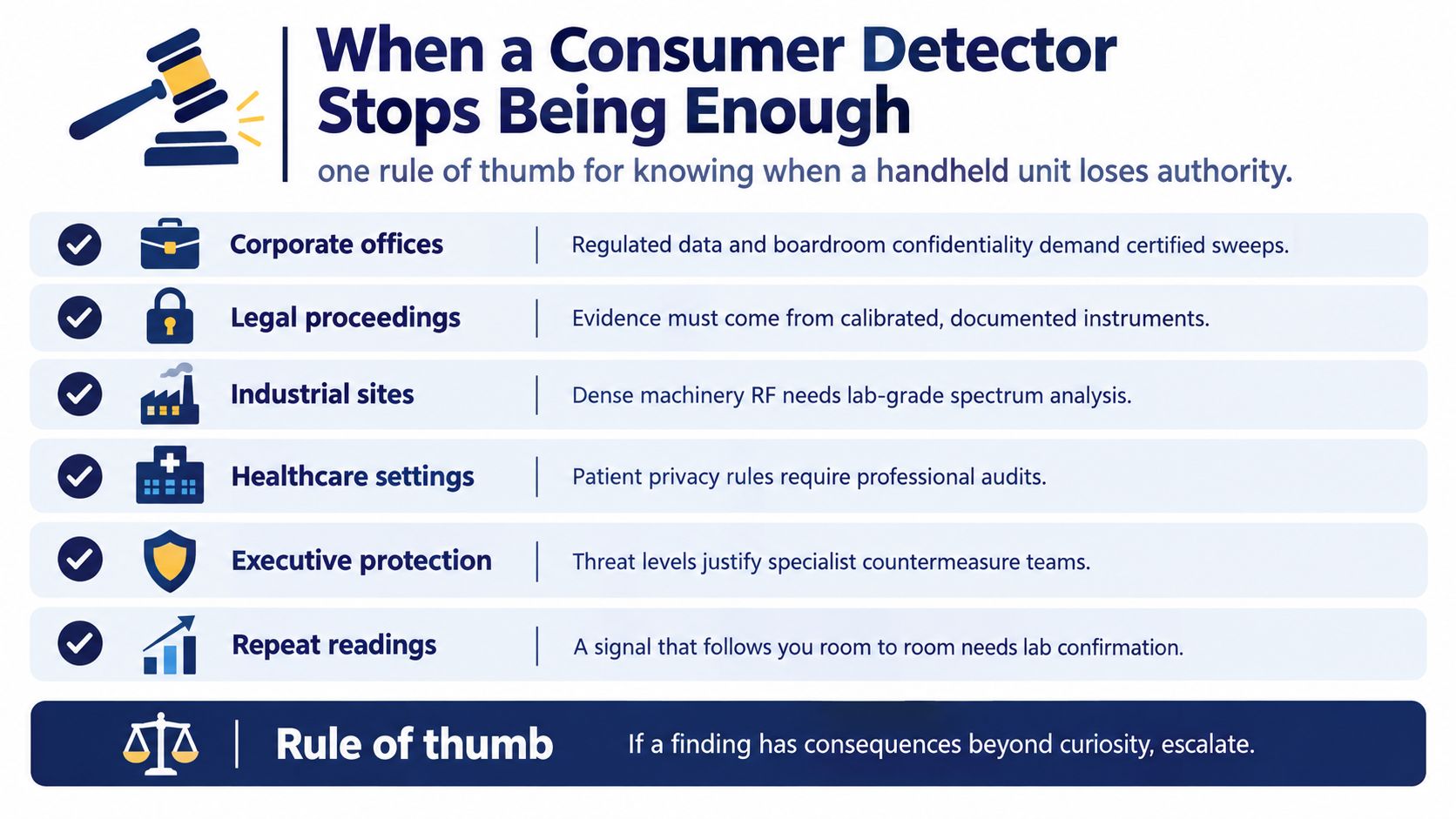
A move from a consumer detector to a qualified sweep isn't defeat. It's the same decision as calling a specialist when a domestic fault affects a whole electrical installation. If a finding could affect your reputation, finances, safety, family or legal position, use Sentry Private Investigators Ltd TSCM services rather than relying on another unverified reading.
Booking a Professional Bug Sweep With Sentry
A confidential enquiry should begin with triage, not pressure to purchase equipment. Explain what happened, where it happened, who has access and whether the concern involves a property, vehicle or device. The investigator can then decide whether an RF-focused assessment is appropriate or whether the situation calls for a wider technical surveillance countermeasures examination.
The visit should have a defined scope and an agreed window. A professional sweep may combine RF spectrum analysis, near-field examination, a non-linear junction detector, thermal inspection and a physical search of likely hiding places. Each method answers a different question. Spectrum analysis looks for transmissions, NLJD testing can help identify electronic components that aren't transmitting, and physical inspection may reveal a wired or concealed device that RF equipment cannot see.
For a three-bedroom property or a single office, the work will typically take half a day. That duration depends on access, room layout, vehicles, outbuildings and the number of systems that need to be isolated and retested. A rushed sweep is not a sign of efficiency if the investigator hasn't established a baseline or examined the anomalies properly.
What the report should contain
A useful written report should record:
The scope of the inspection. Identify rooms, vehicles, equipment and areas that were included or excluded.
The instrument work. Record relevant settings, antenna use, frequencies, signal captures and unusual readings.
The physical findings. Include suspicious objects, device serial details, wiring changes and photographs where appropriate.
The interpretation. Separate detected RF energy from suspected source identification and any evidence of harmful interference.
The next step. Explain whether further technical testing, legal advice, police contact or Ofcom reporting is appropriate.
TSCM findings are intelligence and technical evidence for decision-making. They aren't automatically court evidence just because a professional has written them down. If a criminal offence appears possible, preserve the scene and obtain appropriate legal advice. An investigator can help organise technical material for communication with the police, Ofcom, insurers or a family solicitor, but clients shouldn't take enforcement into their own hands.
Warning signs that justify picking up the phone instead of ordering another detector include new contractors with unsupervised access, unexplained battery drain across multiple devices, hushed voices in meeting rooms and a partner showing knowledge of private conversations. None proves a bug. Together, they justify a discreet assessment.
For clients who need UK bug sweeping services, the priority should be confidentiality, controlled testing and a clear written record. Don't confront a suspected operator, don't use a jammer and don't remove an unfamiliar device before it has been documented.
Sentry Private Investigators Ltd provides discreet TSCM bug sweeps using RF detection, spectrum analysis and complementary inspection methods for homes, offices and vehicles. If an unexplained signal or privacy concern has consequences beyond curiosity, visit Sentry Private Investigators Ltd to make a confidential enquiry.