
How to Run a Background Check on Someone UK

You're probably looking at one person right now and trying to answer a simple question, is this person who they say they are, and can I trust what they've told me? That could be a new hire, a tenant, a partner, a supplier, or someone you're considering bringing into a sensitive role. The mistake many people make is treating a background check as one search, one report, and one answer. In the UK, it's a layered process, and if you don't separate the layers, you end up with a result that looks official but tells you very little.
What a Background Check in the UK Really Means
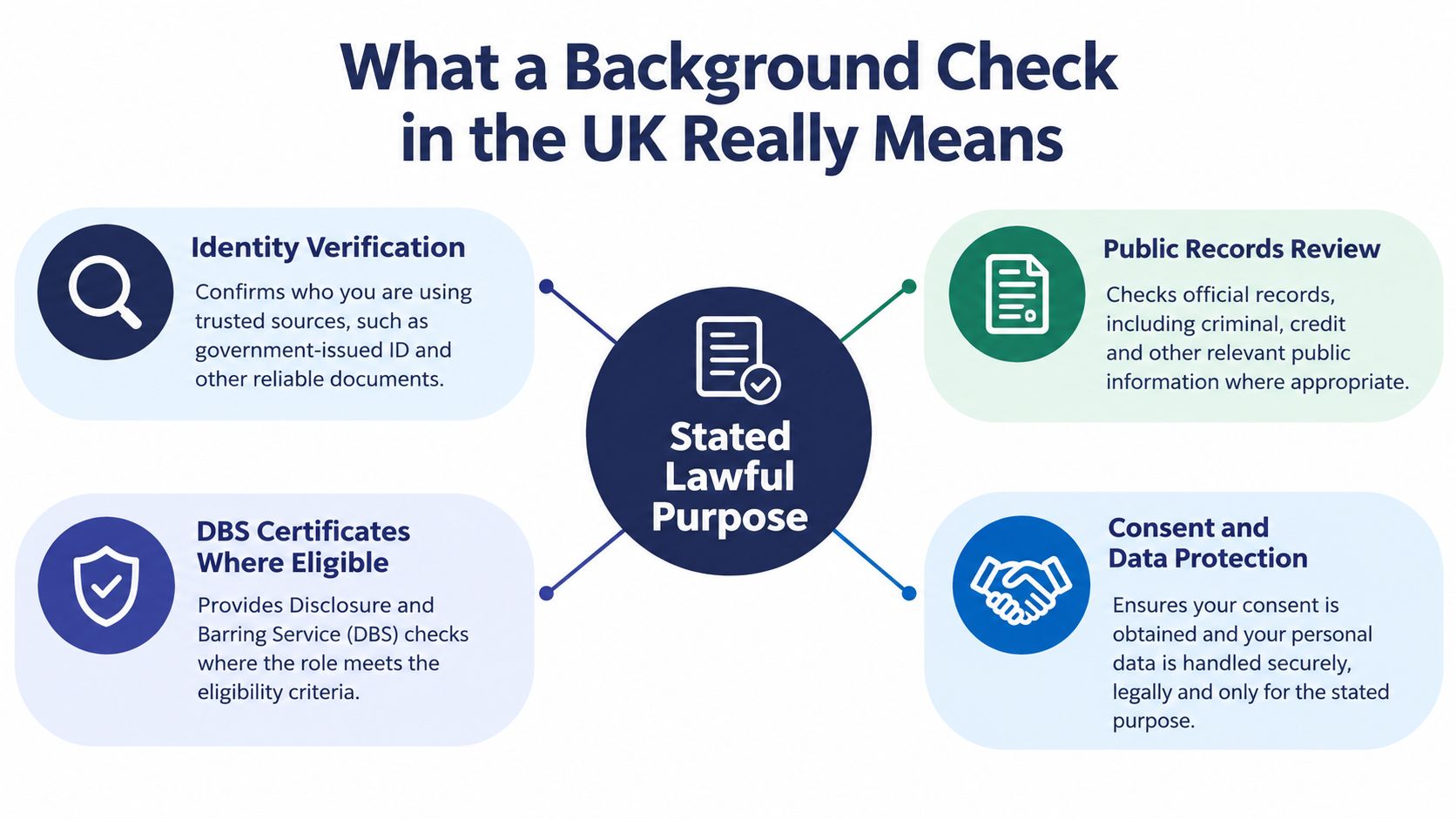
A proper UK background check starts with purpose, not curiosity. You need to know exactly why you're checking, what you're allowed to check, and what you'll do with the result. That matters because a DBS certificate, an identity check, a right-to-work check, and public-record corroboration all answer different questions.
The job, the person, and the legal route
If you're hiring, you're usually checking whether someone is suitable for a specific role. If you're a landlord, you're trying to reduce risk without drifting into unnecessary intrusion. If you're checking a partner or acquaintance, you're not entitled to rummage through someone's private life just because you're uneasy.
The cleanest way to think about how to run a background check on someone UK is this, define the lawful purpose, choose the narrowest checks that serve it, and only keep the result for as long as that purpose needs it. The ICO's employment guidance expects privacy information, source tracking, retention control, and clear handling of recruitment records, not casual data hoarding.
Practical rule: if you can't explain the purpose in one sentence, you're not ready to search.
The same discipline applies to every source you touch. A person's identity, criminal record, right to work, qualifications, business links, and public litigation history are separate evidential streams. Treating them as one big “background report” is how people overreach, miss red flags, or both.
For a useful overview of service scope, start with background checks services explained. If you're screening people for roles like childcare, it also helps to compare the sort of warning signs shown in nanny screening red flags, because the same principle applies, match the level of scrutiny to the risk.
Setting a Lawful Purpose and Getting the Right Consent
Before you search anything, write down four decisions. First, state the objective in one sentence. Second, choose the lawful basis and keep it proportionate. Third, decide how long the material will be retained. Fourth, decide in advance how you'll assess anything adverse.
Put the scope on paper first
A lot of people skip this and jump straight into databases. That's backwards. If you're checking a potential employee, the scope might be identity, work history, qualifications, DBS eligibility, and right-to-work status. If you're checking a contractor, it might also include company ownership, litigation history, and address consistency.
For private enquiries, keep the wording plain. Something like, “I'm asking for your consent to verify your identity, current address, and employment history for due-diligence purposes,” is clear enough. What you should avoid is vague language like “I want to do a full check,” because that invites scope creep and makes later decisions hard to justify.
Keep an audit trail from the start. Write down what you searched, why you searched it, and who reviewed it.
Consent should be specific, not decorative
Consent only helps if the person knows what they're consenting to. If you're a business, that means a fair notice, a defined purpose, and a record of what data you collected from where. If you're a private requester, it means staying within lawful, proportionate enquiries and not pretending consent gives you access to anything you want.
The ICO's guidance is blunt on this point, recruitment information needs privacy information that explains the purpose, retention period, and recipients, and information gathered from other sources usually has to be shared within a reasonable period and no later than one month. That's not a box-ticking exercise. It's the boundary between a disciplined check and an illegal trawl.
DBS Levels and What Each Certificate Actually Discloses
DBS is where many DIY searches go wrong, because people assume every certificate gives the same answer. It doesn't. The level you can request depends on the role and the legal route available, and that distinction matters more than the badge on the certificate.
Basic, Standard, and Enhanced are not interchangeable
A Basic DBS check is the public-facing option. In England and Wales, it can be requested by anyone aged 16 or over, for any position or purpose, and it shows unspent convictions and conditional cautions only. GOV.UK says an average of 2.6 million Basic DBS checks are requested each year, based on DBS data from 2019 to 2024, and in 2024 88% were completed within 48 hours while about 36,000 disclosed a conviction each year. Those figures show scale and speed, not completeness. GOV.UK basic DBS guidance
Standard and Enhanced checks are different. They're tied to eligible roles, and a private requester can't just decide to order one because they want a deeper look. A recruiting organisation has to make the application through the correct route, and the role has to qualify under the DBS rules.
Here's the simple comparison.
DBS levels at a glance | Who can request | What it discloses | Typical use |
|---|---|---|---|
Basic | Anyone aged 16 or over, subject to the proper process | Unspent convictions and conditional cautions | General screening, landlord checks, broad due diligence |
Standard | Only where the role is legally eligible, via the proper organisation | More than Basic, but still limited to the role and rules | Regulated roles, sensitive employment |
Enhanced | Only where the role is legally eligible, via the proper organisation | Standard-level disclosure plus additional information where permitted | Safeguarding and other eligible roles |
If you want a plain-English breakdown of the higher level, what does an enhanced DBS check show is a decent companion read.
A clean result doesn't mean there's nothing to see. It means the disclosed record is empty at that level on that date. Spent convictions, cautions, filtering rules, and role restrictions can all make a certificate look more reassuring than the underlying reality. Treat the document as one input, not the final word.
Public Records Worth Searching and How to Use Them
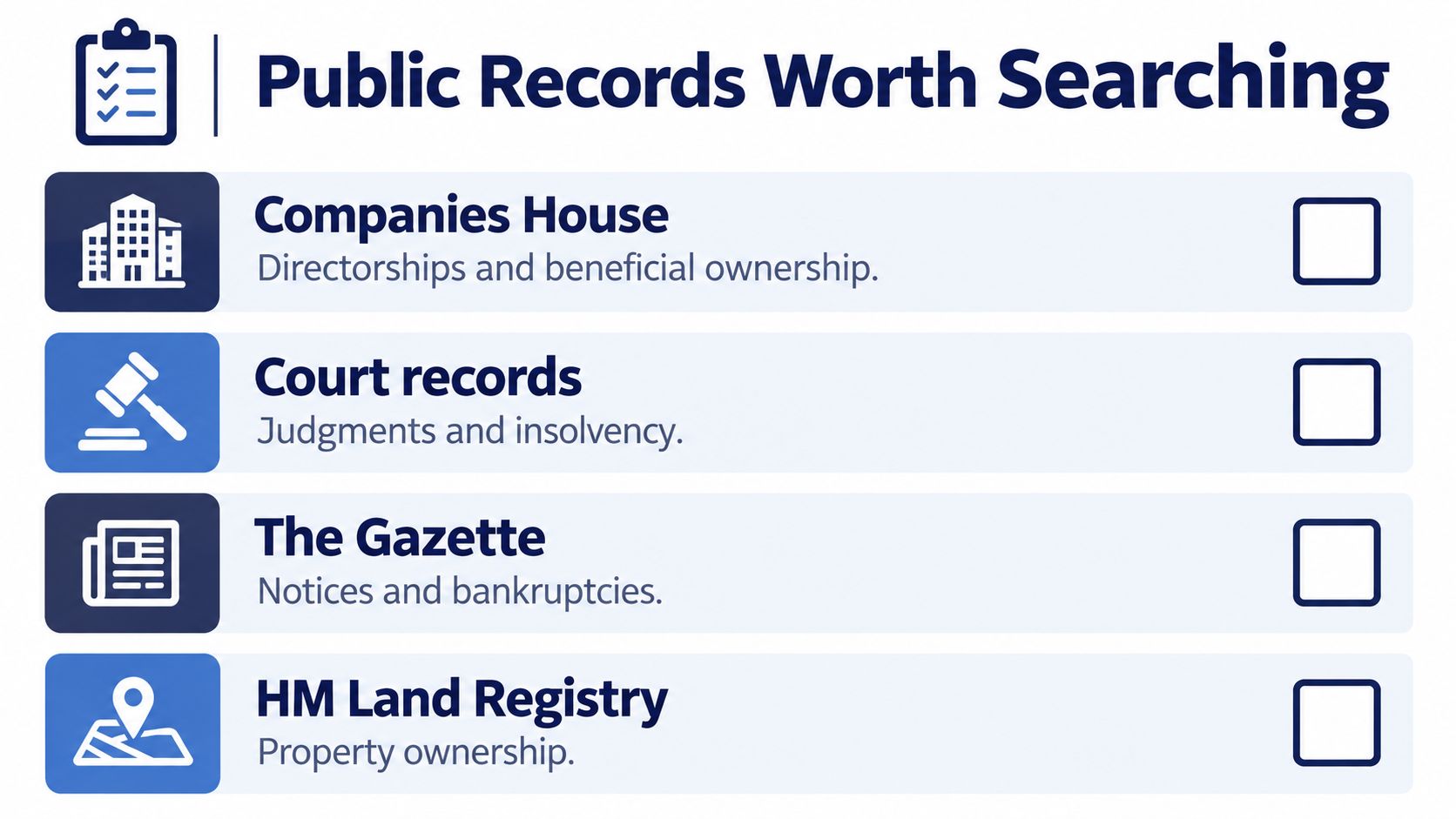
A sensible check leans on public records because they let you verify claims without overstepping into private data. The trick is to use them for corroboration, not as a substitute for judgment. One result on its own rarely proves anything. Two or three matching records usually tell a much clearer story.
Start with the records that match the claim
If someone says they run a company, check Companies House. If they claim to be a regulated professional, check the relevant register. If they say they've moved repeatedly, look for consistency in address history and any linked public records. If they're in a role connected to immigration compliance, use the prescribed right-to-work route rather than trying to infer status from informal paperwork.
The Home Office route matters because it's the lawful one. GOV.UK allows three permitted right-to-work routes, manual document checking, an online check, or an approved digital verification service. A manual check means original documents, checking they're genuine and untampered with, confirming they belong to the applicant, and verifying that the person can do the work offered. For online checks, the employer uses the applicant's share code and date of birth, compares the photo, checks the work permission and restrictions, and keeps evidence of the check. Employers' right to work checklist
The important point is that right-to-work is separate from DBS. A DBS certificate does not prove immigration permission, identity, or entitlement to do a particular job. If you're sponsoring workers, official guidance also treats right-to-work as a distinct record-keeping duty. Workers and temporary workers guidance for sponsors
Use the source that fits the claim
For corporate claims, fetch public profile data can be useful as a starting point when you're trying to identify the best public sources to cross-check, but don't confuse convenience with proof. Companies House can show directorships, but it won't tell you whether someone is reliable. Court and insolvency records can matter, but name collisions are common, and dissolved companies can muddy the picture. Professional registers help, but only for professions that are regulated.
A public record is evidence, not verdict. Verify the name, the date, and the link to the person you're checking before you treat it as meaningful.
For tracing and harder identity work, UK tracing agents are often the next step when the record trail is thin or inconsistent.
Why a Clean DBS Result Can Still Be Misleading
A clear certificate can make people relax too soon. That's a mistake. A clean DBS result only tells you what was disclosed at that level on that date. It does not prove the person's identity, their employment history, their address history, or their online persona.
Identity risk has moved beyond the old tricks
Cifas recorded more than 118,000 identity-fraud cases in the UK during January to June 2025, and the reporting linked to that period says identity fraud accounted for more than half of reported fraud cases. The lesson isn't the headline number, it's the method. Synthetic identities, fabricated profiles, and manipulated digital footprints can all slip past a shallow check. Cifas Fraudscape 2025 half-year update
That means the old “no convictions, so all clear” mindset is too simple. Someone can have a completely unremarkable DBS outcome and still be using a stolen identity, padding a CV, hiding previous conduct, or presenting social media that doesn't match their real life. The certificate hasn't failed. You've just asked it the wrong question.
Corroborate the story, don't admire it
If a person claims to have a certain job, check the employer directly using contact details you sourced yourself. If they say they run a business, compare the claim with Companies House records. If they say they belong to a professional body, confirm it on the relevant register. If their address history is scattered or inconsistent, treat that as a prompt to dig deeper, not as a reason to panic.
The same goes for behaviour. Urgency, secrecy, refusal to provide proportionate consent, and dates that keep shifting are all escalation triggers. Those signs don't prove wrongdoing, but they do justify stopping the DIY search and getting proper help.
Bottom line: a clean DBS result is a starting point, not a conclusion.
When to Bring in a Licensed UK Investigator
There's a point where a sensible check stops being a desk exercise and becomes an investigation. That point arrives fast when the facts are cross-border, ownership is layered, or the person you're checking is giving you just enough information to keep you guessing. It also arrives when you need evidence, not suspicion.
Escalate when the trail gets complicated
Bring in a licensed investigator when records sit in multiple countries, when companies are hidden behind nominees or linked entities, or when the history you've been given doesn't line up with public records. Time pressure is another trigger. If a hiring decision, tenancy, or internal fraud concern can't wait while you learn the law from scratch, don't improvise.
A reputable firm does more than Google searches. It can carry out people tracing, identity and address verification, covert surveillance where that's lawful and justified, technical surveillance countermeasures if you suspect bugging, and corporate due diligence. Those services sit alongside DBS and right-to-work checks, they don't replace them.
You should also check the investigator before you instruct them. Ask for ICO registration where relevant, insurance, and a written scope. If the work involves regulated activity or professional membership, verify that too. A proper investigator won't flinch at giving you a defined plan in writing.
For a general overview of what the market should be offering, private detective services should be described clearly, with the scope and limits spelled out before anyone starts.
Your Next Step and How Sentry Can Help
The right order is simple. Define the purpose, get proportionate consent or notice, run the correct DBS level through the proper route, check identity and right to work separately, corroborate claims with public records, and treat any clean result as the beginning of your judgement, not the end of it. If the case turns messy, stop forcing it into a DIY shape.
Sentry Private Investigators Ltd works on background checks, employment verification, tracing, surveillance, and corporate investigations from Birmingham and across the West Midlands, London, Leicester, Nottingham, and the wider UK. If you need a confidential view of what can be checked lawfully, and what should be left to a professional, get in touch.
If you need a background check that's lawful, proportionate, and properly evidenced, Sentry Private Investigators Ltd can help you separate identity, DBS eligibility, right-to-work evidence, and public-record checks without cutting corners. Visit Sentry Private Investigators Ltd to discuss your case confidentially and get the right investigative route from the start.