
Debt Recovery Services in the UK: How Tracing Works

The invoice went out in March. It's now August, the emails bounce, the mobile rings out, and the balance still sits in your aged debtors report. You've sent the polite reminder twice. What you haven't done is decide which lawful route fits, and that decision is where most recoveries land or stall.
Recovery rarely fails because the law is unclear. It fails because a creditor pays for a county court claim addressed to a house the debtor left two years ago, or funds a second enforcement application against someone with no wages to attach and nothing worth seizing. Sequence beats pressure every time.
The work splits in two: proving what you're owed, and finding the person who owes it. Get those right and every later step, from a statutory interest claim to a warrant of control, becomes a cheap decision instead of an expensive guess.
Debt Recovery Services and Your Lawful Options
Debt recovery services are the lawful steps a creditor takes to turn an unpaid balance into money, starting with a reminder and ending, if it comes to it, with a bailiff or enforcement agent at the debtor's door. Tracing investigators, collection agencies and solicitors each deliver part of that chain, and every stage demands its own evidence before it will work.
The scale is bigger than most creditors assume. Ministry of Justice civil court statistics record 1,731,363 civil cases in the UK during 2024 and 1,944,945 during 2025, a rise of roughly 12.3%. County courts handle specified monetary debts alongside repossession, personal injury and insolvency work, so the machinery is well used and well documented.
The six routes compared
Option | Best used when | What you need first | Main limit |
|---|---|---|---|
Reminder letter and payment request | Debt is recent and the debtor's address is known | Signed invoice and agreed payment terms | Ignored if the address is out of date |
Statutory late-payment interest claim | Qualifying business-to-business debt is overdue | Due date, contract and invoices | Does not apply where the contract sets a different rate |
Debtor tracing | Contact details are out of date or the debtor has moved | Full legal name, last known address and date of birth | Locates the person but does not prove the debt is owed |
Negotiated payment plan | Debtor can pay but is reluctant to pay in one sum | Agreed sum and realistic instalments | Depends on the debtor agreeing and keeping to the plan |
County Court money claim | Debt is disputed or ignored after pre-action letters | Evidence bundle and details of the claim | Needs a judgment before any enforcement |
Enforcement after judgment | Judgment is unpaid and the debtor has traceable income or assets | Verified address and asset or employment indicators | Costly where no recoverable assets exist |
Read the table from the top. The first two rows settle most recent, undisputed debts, and they cost very little to try. Say a small builder is owed £2,400 for an invoice 60 days overdue and the client is still at the same address: a firm reminder plus a statutory interest calculation is often the whole job. If that same client has moved and the phone is dead, no letter in the world will land, and tracing moves to the front of the queue.
A single debt can sit in more than one row at once. The balance may be undisputed, the address stale and the debtor willing but broke, which means you run tracing and a payment plan together while holding the claim in reserve.
Practical rule: start at the lowest row that fits your file and move up only when that row fails. Escalating past a step you never tried is how creditors spend more on recovery than the balance is worth.
If the file does reach court, service has to be done properly and proved. Our UK process serving services cover delivery to court requirements and the statement of service that records when, where and how documents were handed over.
One question decides which row you're in before anything else happens: is the debtor's address current? Check that next.
Gathering the Evidence Before You Instruct Anyone
No provider can build a recovery on a story. What an investigator or a solicitor needs is a file that answers three questions: what was agreed, what was delivered and what has been paid. Assemble it before you contact anyone, because the gaps tell you which route is realistic.
The paperwork that decides a case
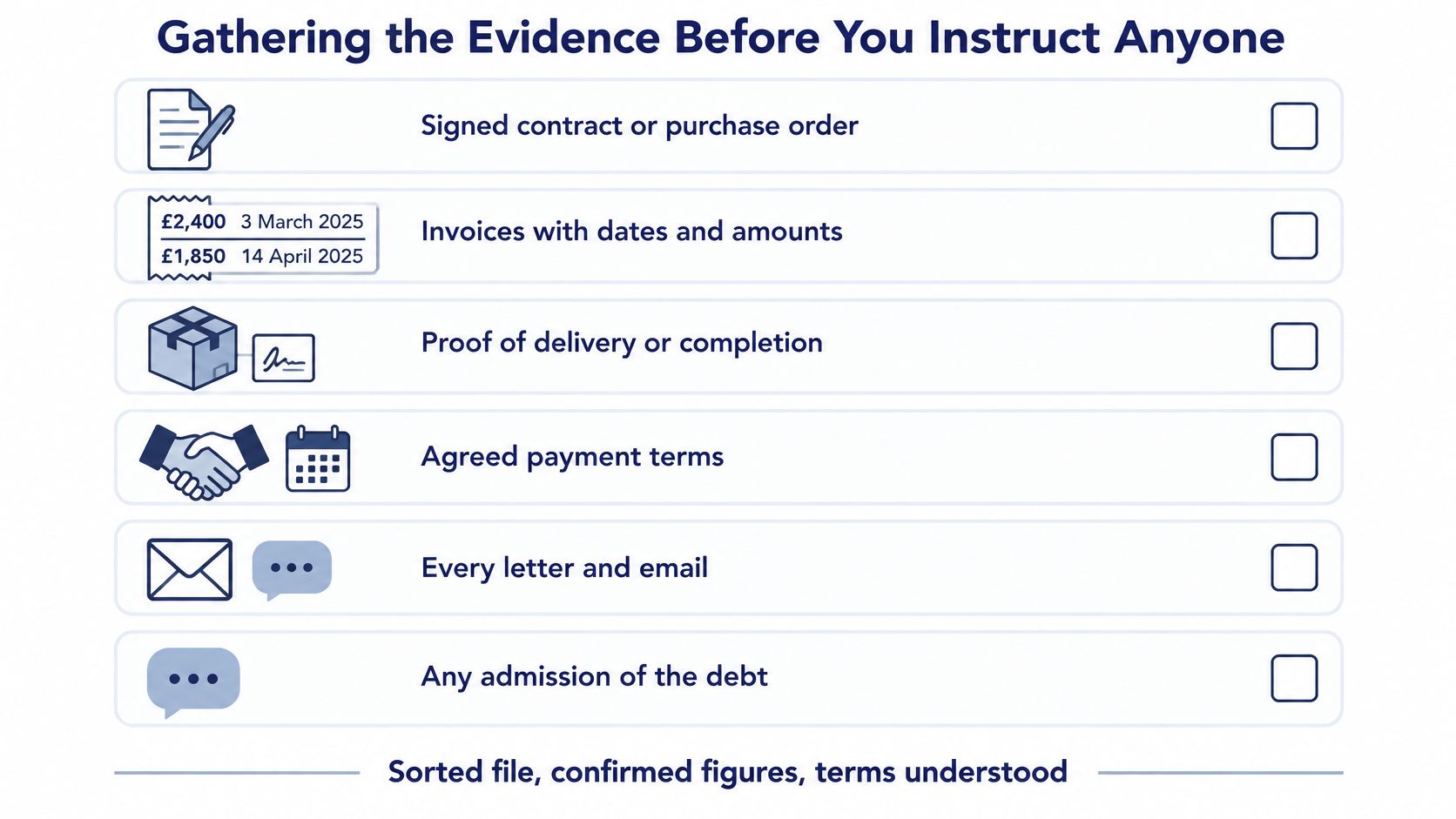
Signed contract or purchase order. It fixes the price, the payment terms and whether a contractual interest clause displaces the statutory rate.
Invoices with dates and amounts. The due date triggers statutory interest, so an undated invoice weakens the claim before it starts.
Proof of delivery or completion. A signature, delivery note or completion email ties the invoice to something you supplied.
Agreed payment terms. Thirty days, sixty days, or on completion. The date you can start charging interest depends on it.
Every letter and email. Acknowledgement and dispute both matter, because one can extend your clock and the other sends the file towards legal advice rather than tracing.
Payment history. Part-payments change what is owed and, in some cases, how long you have to pursue it.
The recast Late Payment Directive user guide confirms you can claim statutory interest on a qualifying commercial late payment without sending a reminder first, provided you can still show the payment is late and the regime applies. It also makes clear the regime covers business transactions for goods or services, and that a contractual rate can replace the statutory one.
Check the payment history before anyone drafts a claim. Guidance for debt advisers explains that an acknowledgement in writing, or a part-payment, made while the limitation period is running can restart the clock (Debt Relief Orders guidance for debt advisers). The same guidance notes a statute-barred debt doesn't meet the definition of a qualifying debt for a Debt Relief Order, so insolvency status belongs in the file as well.
Expect identity checks. We may carry out due diligence before starting services, which can require proof of your identity and confirmation of compliance with money laundering regulations, so have company details, registration number and identification ready when you instruct.
Here's the list to work through before the file leaves your desk.
If you want a benchmark for how quickly unpaid invoices slip past their terms, this breakdown of collection metrics for service businesses is worth reading before you set your own chase timetable.
Sort the file into three piles
Undisputed and contactable. Reminder, interest calculation, payment plan, then a claim if all three fail.
Disputed. Quality of goods or workmanship is a contract argument. Take legal advice before spending anything on tracing.
Undisputed with an unknown address. Tracing first. Every other step waits for a verified location.
What Interest and Fixed Compensation Add to a Claim
A debtor's balance should be presented as three separate numbers: principal, statutory interest and fixed compensation. Keep them distinct so the debtor can check the calculation and a court can see how the amount was reached. A single rounded total conceals whether the interest period or compensation band is correct.
Fixed compensation for recovery costs
Debt amount | Fixed compensation |
|---|---|
Below £1,000 | £40 |
£1,000 up to but not including £10,000 | £70 |
£10,000 or more | £100 |
Start with the unpaid principal. For a qualifying business-to-business debt, statutory interest runs at 8 percentage points above the Bank of England base rate, unless the contract provides its own rate. The GOV.UK guidance on charging interest on commercial debt gives an example: interest on £1,000 at 8.5% is £85 a year, or about 23p a day. Apply the rate to the overdue amount for the relevant period, rather than adding a full year's interest to a shorter delay.
Fixed compensation is added once statutory interest starts running. The bands above are set by the Late Payment of Commercial Debts (Interest) Act 1998. If the fixed sum does not cover reasonable recovery costs, the legislation allows a claim for the shortfall. Keep any such costs identifiable rather than folding them into the principal.
Checking the sum by hand
Calculate each line separately. A £4,800 invoice that is 90 days overdue at 8.5% carries about £100 in interest. It falls within the £70 compensation band, making the total claim roughly £4,970. Show the principal, interest and compensation as separate lines so the debtor can check the arithmetic and challenge a specific figure if necessary.
The statutory regime applies to qualifying business-to-business debts, not consumer debts. Do not add its interest or compensation to a private customer's balance. Check the contract for an agreed interest rate before using the statutory rate, and make sure the period used in your calculation matches how long the invoice has been overdue.
If pre-action letters have gone unanswered and you issue a claim, the amount claimed should match those three lines. Recheck the figures before filing: a disputed calculation can distract from the debt itself, while pursuing a shortfall that costs more to recover than it adds may not be worthwhile.
List every element separately. An unsupported total is harder for a debtor or court to check.
Why Finding the Debtor Comes First
A claim posted to an address the debtor left two years ago reaches nobody. It sits unanswered until default judgment is entered against someone who never knew it existed, and enforcement then fails at the door. That's why locating the person is the first real obstacle in any file, well ahead of the legal argument.
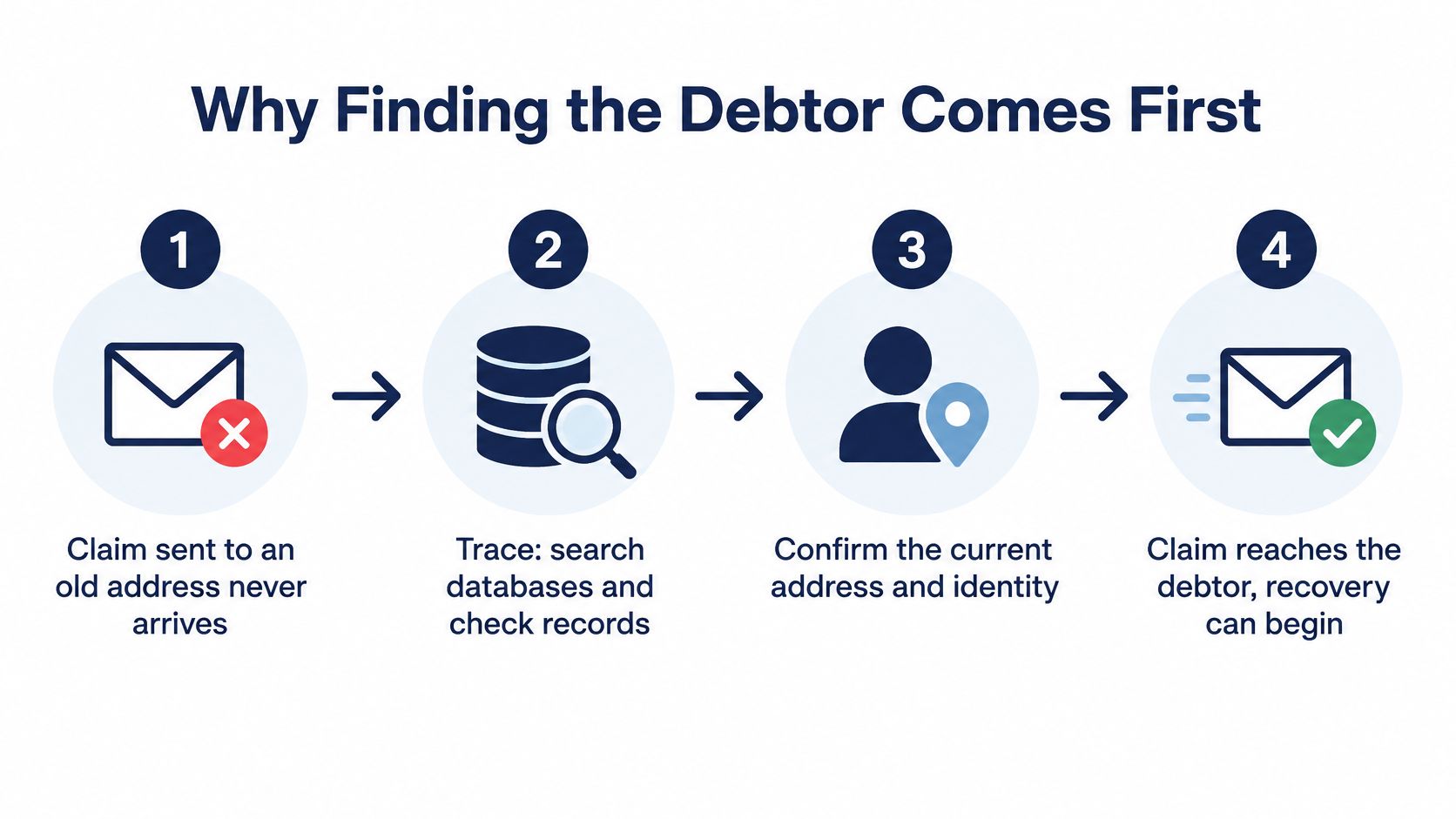
Trace work is methodical rather than dramatic. Debtor tracing uses numerous databases, field enquiries and investigative techniques to find current contact details for people who owe money. The output is an address or a telephone number you can act on, not a story about where someone might be.
Four steps a trace should follow
Confirm the full legal name and last known address. A middle name or company number separates two people who share a surname.
Run database and record checks. Electoral roll, credit header and other lawful sources narrow the field to a working address.
Verify the result against a second source. One hit is a lead. Two consistent hits give you something you can serve.
Record the outcome with a dated note. That note becomes evidence if the debtor later claims they were never contacted.
A positive trace has a precise meaning: the current residential address or other verified contact details have been identified and reasonably verified using lawful methods, and the fee falls due once those results are notified. It confirms where someone lives. It says nothing about whether they owe you a penny.
Mistaken identity is the expensive error. Two people share a name, a relative still uses the old address, and poor data travels fast. Enforcement agents reported receiving around 4 million warrants and court orders a year in 2022, while county court bailiffs took in more than 300,000 warrants of control and over 50,000 warrants of possession in 2023, according to the consultation on regulation of the debt enforcement sector. At that volume, one bad address doesn't just fail. It escalates.
A trace that returns nothing is still a result. It tells you to hold the file rather than buy a warrant that can't be executed.
Check the address on the original invoice against what you hold now. If it's stale, order the trace before issuing anything. Our Sentry Private Investigators tracing guide explains how an old address or a phone number can be worked back to a current one.
When Enforcement Pays and When It Stops Paying
A judgment confirms that a debt is legally owed. It does not make payment happen. Creditors who treat judgment as the finish line can be left with unenforced orders and legal costs that exceed the debt.

After judgment, each enforcement route depends on something specific. A warrant of control authorises bailiffs to seek goods, so it requires a current address and assets worth taking. Attachment of earnings needs a known employer. A charging order depends on the debtor owning property. A third-party debt order requires an identifiable bank or a customer who owes the debtor money. An information order can require the debtor to attend court and answer questions, but it may achieve little if they do not attend.
The decision tree after judgment
Start with two questions: where is the debtor, and what assets could meet the debt? These are separate problems. A verified address can help get paperwork to the right person, but it does not establish their income, property or bank balance. Locating the debtor and proving the debt are not the same as finding a practical route to payment.
The Civil Justice Statistics, January to March 2025 report records around 14,000 enforcement applications in Q1 2025. The figure gives a snapshot of applications, not a measure of how much creditors recovered. The decision to apply should turn on the debtor's circumstances and the likely cost of the route, rather than the existence of a judgment alone.
Public-sector recovery shows why an outstanding balance does not necessarily mean money is readily recoverable. The DWP Housing Benefit debt recovery statistics report that outstanding Housing Benefit overpayments in Great Britain stood at £1.5 billion at the start of the fourth quarter of financial year 2025. Local authorities identified £429 million, recovered £436 million and wrote off £82 million. Recoveries can exceed newly identified debt while a substantial stock remains, because some balances cannot be reached.
Use that distinction to set a stopping rule. For a dormant judgment against a former employee who has moved, a trace and financial information check may cost less than an application that sends enforcement to an empty address. A trace can identify contact details; it cannot prove that the debtor has assets available to satisfy the judgment. If you cannot identify a realistic recovery route, another application may add cost without improving the prospect of payment.
Enforcement is more likely to make commercial sense when there is a known employer, property held in the debtor's name, or an identifiable bank account. Check what is known before committing to an application, then compare the likely recovery with the cost and effort of that route.
Write down the expected recovery before applying. If it is less than the application cost, stop and explain the reason to the client. A judgment establishes the claim; it does not make an uneconomic enforcement step worthwhile.
Recovering Money From Vulnerable or Silent Debtors
A debtor who has stopped replying may be ill, recently bereaved, living with a disability, in temporary accommodation, unable to read English, or under another person's control of household finances. Silence alone does not prove avoidance. Pressing ahead on that assumption can make contact harder and payment less likely.
Screen for circumstances, not excuses. Illness, disability, bereavement, language barriers, homelessness, coercive control and difficulty using online systems are reasons to adjust how you communicate and consider whether escalation should wait.
A three-step vulnerability screen
Ask whether anything has changed. Raise the question early, calmly and without threat. A simple enquiry can identify circumstances that call for a different approach.
Offer a usable channel. Use post or telephone if the debtor cannot manage an online portal. Keeping communication accessible may restore contact.
Pause and signpost. If the debtor discloses vulnerability, hold further escalation and provide details of free debt advice in writing. Record when you did so.
Consumer-credit firms are expected to apply vulnerability guidance carefully, so treat any disclosed vulnerability as a reason to slow down and check the position before taking further action.
The Financial Lives 2024 key findings report that only 22% of adults classified as being in financial difficulty had used a debt-advice or debt-management service in the 12 months to May 2024. Around 3.5 million people had not used that support. Signposting can help, but it does not establish whether the debt is owed or whether the debtor can pay.
Keep tracing proportionate. A verified address and dated contact attempts can help establish where and when to communicate. Repeated visits when nobody answers, or asking neighbours and employers for a forwarding address, can create complaints without proving that the debtor can pay. Locating someone is not evidence of their means, and a new application may cost more than it can recover if there is no usable asset or income.
Firms billing for care or treatment often need earlier, gentler contact to improve patient payment collection. For any creditor, a plan the debtor can maintain is more useful than a judgment that produces no payment. If the person does engage, agree a realistic arrangement and keep a record of the terms.
Choosing a Debt Recovery Provider and Confirming the Terms
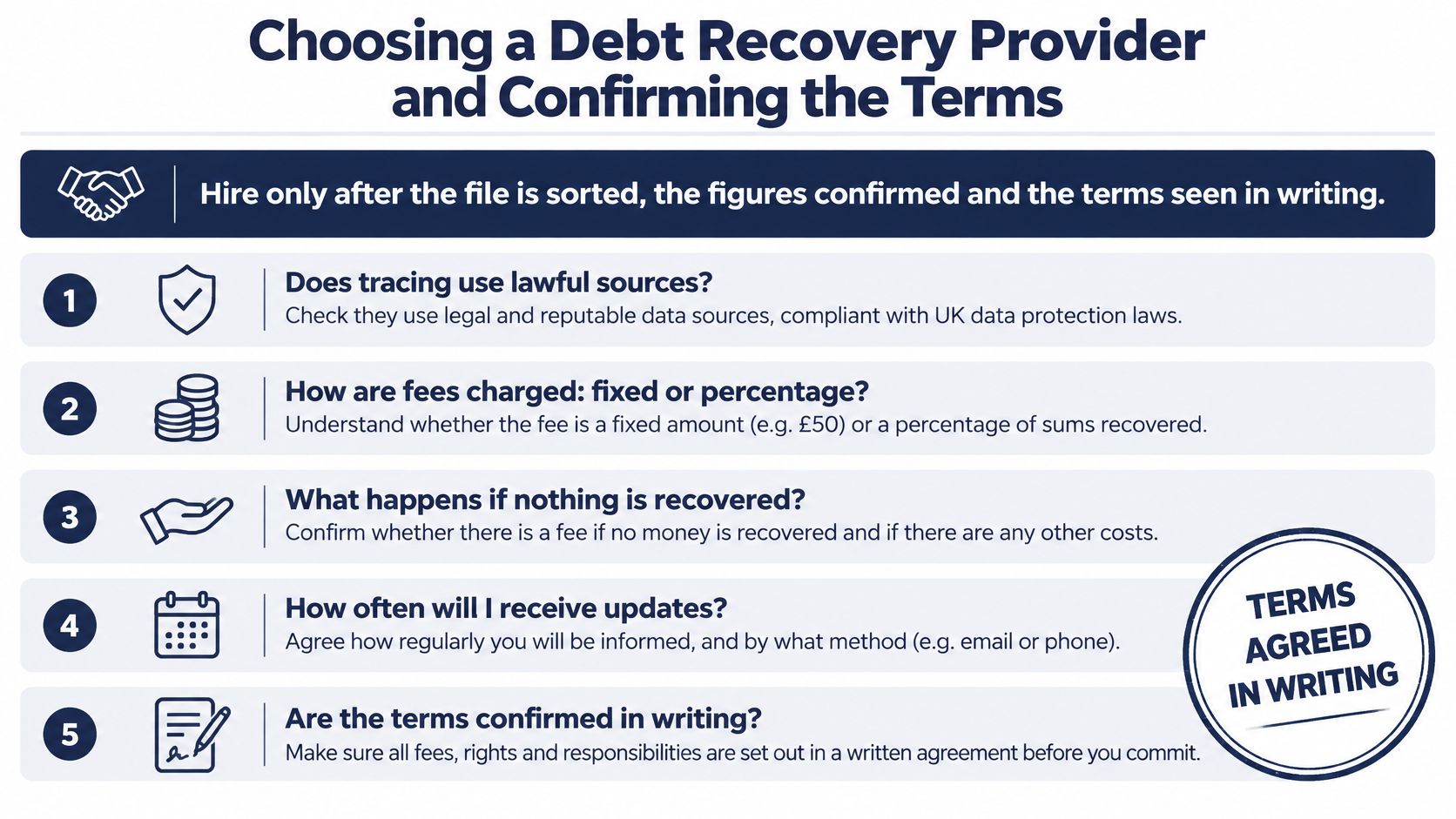
Hire a provider only after the file is sorted, the figures are confirmed and the terms are in writing. A firm handed an unsorted file will either charge you to sort it or chase the wrong balance, and neither outcome reflects well on the instruction.
Questions worth asking before you instruct
Does tracing use lawful multi-source methods, and what counts as a positive trace? People tracing runs on a no find, no fee basis, so get the definition in writing before work starts.
When does the fee become payable? It should fall due on notification of a verified result, not on the first database hit.
What's the fee basis, and does it cover debtor tracing as well as people tracing? Fixed fees and percentage-of-recovery fees behave very differently on a small balance.
Are the services agreed in writing before work starts? They must be agreed by both sides before any enquiry begins.
What identity and due diligence checks will you run on me? Expect a request for company details, registration number and identification.
Can you serve commercial notices? Breach of contract notices, debt recovery notifications and cessation requests often move a file faster than a claim.
What's the complaints route and regulatory status? Ask before you pay, not after something goes wrong.
Our UK tracing agents page sets out how a debtor trace is run and what lands on your desk at the end of it. For a second opinion on fee structures, Happy Billing's questions about fees, proof and contract terms is a sensible checklist to hold alongside your own.
Sentry Private Investigators Ltd offers a free initial consultation, which lets you test the fit before committing to anything. We're based in Birmingham and cover the West Midlands and the wider UK.
Gather the evidence list, sort the balances into undisputed, disputed and address-unknown, then book that consultation.
Sentry Private Investigators Ltd traces debtors across Birmingham, the West Midlands and the wider UK, using databases, field enquiries and investigative technique to return a verified address or contact detail you can act on, on a no find, no fee basis for people tracing. If your file is sorted and the only missing piece is where the debtor lives, that's the work we do. Visit Sentry Private Investigators Ltd to arrange a free consultation and find out what a trace can establish before you spend another penny on court applications.
