
Process Server Leicester: A Practical Guide

You've prepared the claim form, supporting documents and instructions for the next stage of proceedings. Then you realise the respondent's address may be outdated, the court deadline is approaching, and a failed attempt could leave the whole timetable exposed. In Leicester, where instructions may involve a city-centre address, a business premises or a location elsewhere in the county, document service needs more planning than just posting an envelope.
A professional process server provides a controlled service attempt, a clear record of what happened and evidence that can support the next procedural step. The practical objective is simple: serve the correct documents at a valid address, using an appropriate method, within the applicable deadline, and preserve proof that can be relied on later.
Why Timely Process Serving Matters in Leicester
A solicitor receives a sealed claim form with a defendant's address in Leicester. The hearing preparation is underway, but the claim can't progress safely until service has been completed. If the address is wrong or the attempt is poorly documented, the solicitor may need to investigate again, arrange another attendance and explain the delay to the client or court.
That's why a process server isn't merely a courier. The server forms part of the litigation support chain. The work may involve checking the supplied address, planning attendance, identifying the correct individual, recording the time and circumstances of delivery, and preparing a statement or certificate of service. Each part can affect whether the claimant can demonstrate that the procedural step was completed properly.
Practical rule: Speed only has value when the service method and evidence are legally appropriate.
The distinction matters in Leicester because the local market combines a substantial urban population with a wide surrounding county. Leicester had an estimated population of 388,348 in mid-2024, while Leicestershire reached 745,573 residents in 2024, according to the local court and legal-services overview at Leicester Crown Court and local legal information. Leicestershire Police covers Leicester, Leicestershire and Rutland across 979 square miles, serving more than 1.1 million people, as reported in the same source.
A process server Leicester instruction may therefore involve a flat near the city centre, a workplace on an industrial estate or a residential address in the wider county. Those locations create different practical problems. Parking, access controls, gated developments, changing work patterns and incomplete address information can all affect the first attempt.
Professional attendance reduces the risk of an informal or incomplete approach. A server can record whether the recipient was present, whether someone else accepted the documents, what was said, and why service was or wasn't completed. That record is more useful than a bare message saying that documents were “left at the address”.
The work also deserves to be understood alongside the wider role of a process server in court. A server doesn't decide the merits of the claim, but accurate service helps the legal team establish the procedural foundation on which the case depends. For a solicitor or private client facing a deadline, that risk control can be more important than choosing the cheapest delivery option.
Understanding the Legal Rules for Serving Documents
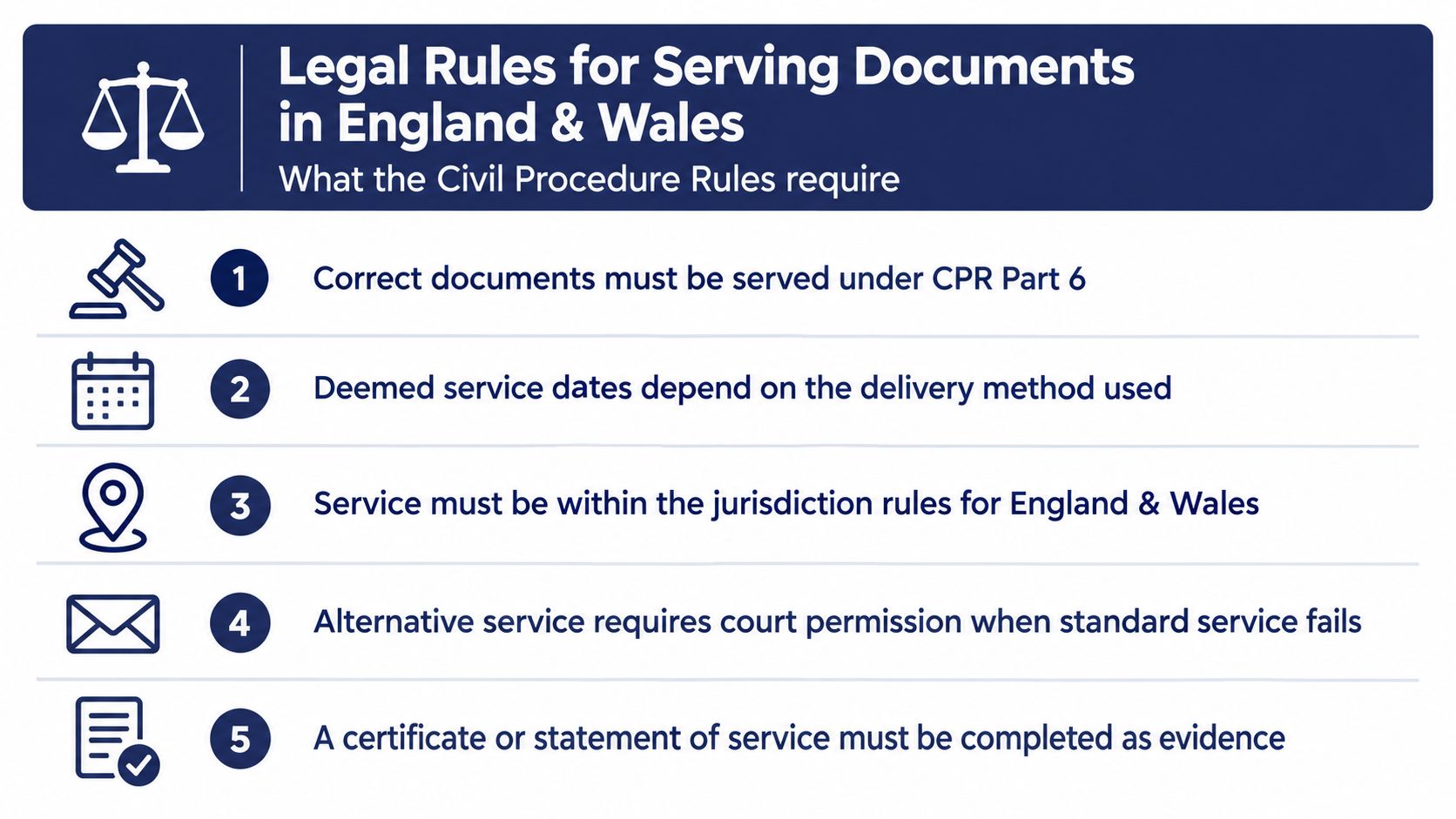
Civil document service in England and Wales is governed principally by Civil Procedure Rules Part 6. The correct approach depends on the document, the recipient, the address, the chosen delivery method and any agreement or court order affecting service. A process server should work from the actual procedural requirements, not from a generic promise of fast delivery.
Start with the deadline
A claim form will generally need to be served within four months of issue, a practical deadline highlighted in this overview of service of process in England and Wales. The period should be treated as a planning deadline, not as an invitation to wait. Address tracing, document checks and repeat attendance all take time, particularly when the recipient is difficult to locate or appears to be avoiding contact.
The time of day can also affect the deemed date of service. Under the rules and associated practice direction, personal service completed before 4:30 p.m. on a business day is generally effective on that same day. The governing provisions should be checked for the document and circumstances involved, because a different method can produce a different deemed service date.
A late instruction may still be manageable, but the server needs to know the true deadline immediately. “Urgent” isn't enough on its own. The enquiry should identify the issue date, the required service date, any hearing date and whether the court has imposed a particular direction.
Use a valid address for service
A last-known address isn't automatically a valid address for every purpose. Under CPR Part 6 provisions on service, a claim generally needs to be served within the jurisdiction and the serving party must use an address for service within that jurisdiction. Where the recipient has no solicitor, that address is normally their residence or place of business.
That requirement affects the investigation before attendance. A supplied address may be incomplete, connected to a former tenant or unsuitable for the intended method. A tracing exercise can help determine whether the information is still useful, but the legal team must decide the correct service strategy for the specific claim.
Match evidence to the method
The server's final report should explain what happened, rather than merely confirm that an attempt took place. It may record the address, date, time, identity checks, words used, recipient response, documents handed over and any relevant observations. Where document integrity is an issue, practical background on SendItFax on binding documents can also help legal teams think carefully about how documents are prepared and transmitted.
The safest instruction gives the server the documents, procedural information and client contact details before attendance. It also makes clear whether the client wants one attempt, a planned sequence of attempts or a trace followed by personal service.
Choosing the Right Method of Service
The delivery method should follow the procedural rules and the circumstances of the recipient. Personal service often provides the strongest practical evidence because the server can describe the attendance and the interaction directly. It may be the appropriate choice where the document or court direction requires personal delivery, or where the client needs a defensible record of an attempted handover.
Postal service can be suitable where the rules permit it and the address is reliable. It can be efficient, but it doesn't provide the same direct information about who received the documents or what happened at the property. Electronic transmission can be useful in the right case, but fax or email may depend on agreement, permission or a rule that authorises that method. The fact that a person has an email address doesn't, by itself, settle whether electronic service is valid.
The recognised methods include personal service, first-class post, delivery to a specified place such as a solicitor's office or a company's registered address, and fax or email where agreed or permitted. A useful explanation of these options appears in this guide to UK rules for process serving methods.
Service Method | Best Used For | Proof Level |
|---|---|---|
Personal service | Documents requiring direct attendance, uncertain recipients or cases where detailed evidence is important | Strong practical evidence from the server's attendance record |
First-class post | Permitted documents sent to a reliable address | Postal records and the applicable deemed-service rules |
Delivery to a specified place | A solicitor's office, company registered address or another place permitted by the rules | Evidence of delivery to the specified location |
Fax or email | Cases where the method is agreed or otherwise permitted | Transmission records, acknowledgements and supporting records |
Personal attendance versus convenience
Personal attendance costs more in time and logistics, especially when an address lies outside Leicester's central area. It can still be the more economical option if a disputed postal delivery would lead to further correspondence, a fresh application or another attempt.
Postal service is not automatically weak, and personal service isn't automatically valid. The document type and procedural direction remain decisive. The sensible question is not “Which method is fastest?” but “Which permitted method gives this case an adequate chance of valid service and reliable proof?”
What doesn't work well
Sending documents to an old address without checking its relevance creates avoidable uncertainty. Leaving papers somewhere without recording who accepted them, or relying on an electronic message without confirming that the method is allowed, can produce evidence that fails to answer the court's questions.
A professional process server can advise on the practical options, but the solicitor or claimant should confirm any legal interpretation required for the particular proceedings. Good service planning brings those two roles together, operational execution and procedural judgment.
Navigating Local Court Timelines and Delays
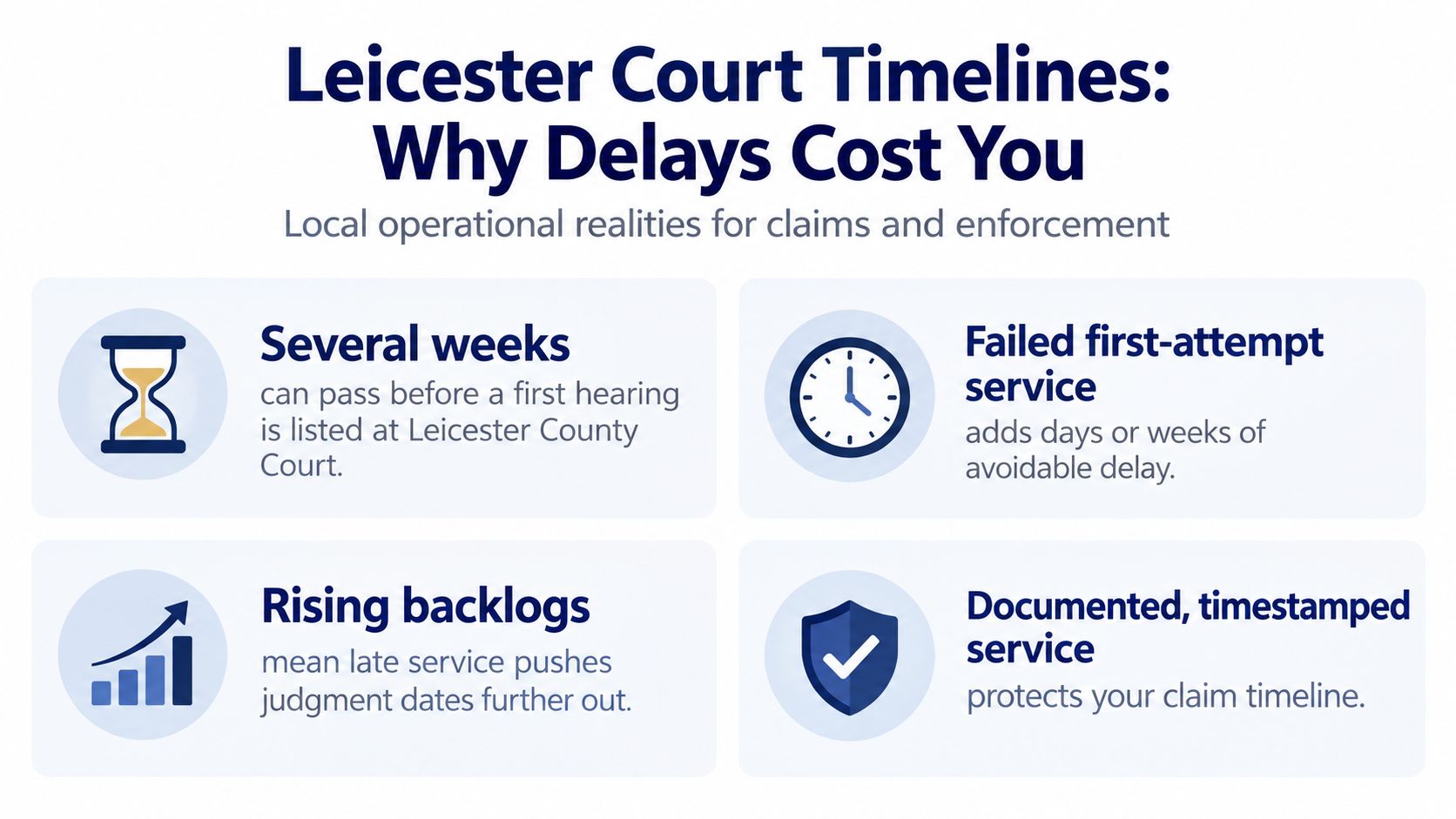
Court delay makes an avoidable service delay more serious. In the Leicestershire Police area, magistrates' court cases took an average of 26.1 weeks overall, including 16.1 weeks from offence to charge or case laid, 5 weeks from case laid to first hearing, and 5 weeks from first hearing to outcome, according to the Leicestershire case-length information.
Crown Court cases averaged 96.4 weeks overall in the same data, including 61.1 weeks to charge or case laid, 7.3 weeks to first hearing and 28 weeks from first hearing to outcome. Separately, the Ministry of Justice recorded ineffective Crown Court trials falling from 27% at the end of 2023 to 25% in September 2024, which still indicates material scheduling disruption even while an improvement was recorded.
Why the first attempt matters
A failed first attendance can push work into a later operational window. The recipient may work shifts, move between addresses or recognise an unfamiliar vehicle and avoid opening the door. If the process server doesn't receive enough information before attending, the first visit may establish very little.
A well-briefed server can plan around known working hours, likely access arrangements and the distinction between a residential and business address. If the first attempt fails, the report should support a decision about the next step. That may involve another attendance, further tracing, service at a workplace or an application concerning an alternative method, depending on the legal circumstances.
Operational reality: A fast attempt with no useful record can be less valuable than a carefully planned attempt that gives the legal team a clear next decision.
Local court destinations provide a practical anchor for instructions. GOV.UK lists Leicester Magistrates' Court at 15 Pocklingtons Walk, Leicester LE1 6BT, Leicester County and Family Court at Leicester LE1 6HG, and Leicester Crown Court at 90 Wellington Street, Leicester LE1 6HG, as shown in the official Leicester court listings. Those locations don't determine where a defendant must be served, but they help identify the local proceedings and court context connected to an instruction.
Urban and county logistics
Leicester's city core can offer short travel distances but complicated access. A server may need to deal with apartment reception areas, controlled entrances, student accommodation or commercial premises with limited public access. The wider county presents a different challenge, with longer routes between addresses and more dependence on accurate location information.
That mix makes local knowledge useful, but coverage matters too. The instructed firm should be able to handle a city attendance, a surrounding county address and a trace or re-service plan without losing continuity in the evidence.
The Importance of Proof and Tracing Services
A document isn't properly supported just because somebody says it was delivered. The legal team needs evidence that identifies what was served, where, when, how and on whom, together with the circumstances that make the account understandable to the court.
A statement or certificate of service is normally required as proof that documents have been served. In some situations, the evidence may need to be given by affidavit to be relied on in court proceedings, as explained by the Association of British Investigators guidance on process-serving evidence.
Delivery is only part of the assignment
A professional report should be clear enough for someone who wasn't present to understand the attendance. It may include the server's observations, the identity information used, the response at the address, the documents involved and any reason service couldn't be completed. If the recipient refused to take the papers, the server should record the relevant circumstances rather than treating refusal as an unexplained outcome.
Here where simple document dropping falls short. A photograph of a front door or a delivery notification may show that someone attended, but it may not establish that the right person was served under the correct method. The evidential value depends on the facts and the applicable rules.
Tracing before the deadline
Recipients can be difficult to locate for ordinary reasons, including relocation, inconsistent contact details or a change of workplace. Others may actively avoid service. In either situation, repeated attendance at an unverified address wastes the limited service window.
Tracing should be tied to the service objective. The investigator needs the recipient's full name, known addresses, associated businesses, telephone details, vehicle information where relevant and any other lawful intelligence the client can provide. The result should be assessed as a potential address for service, not treated as conclusive without considering the procedural requirements.
Using UK tracing agents alongside process serving can give the legal team a more coherent plan. The same instruction can move from address review to attendance and then to documented follow-up, rather than leaving the solicitor to coordinate separate providers with different reporting standards.
Evidence matters after the attendance has ended. A strong service file should help the legal team decide what to do next, not just confirm that a visit happened.
How to Instruct a Process Server in Leicester
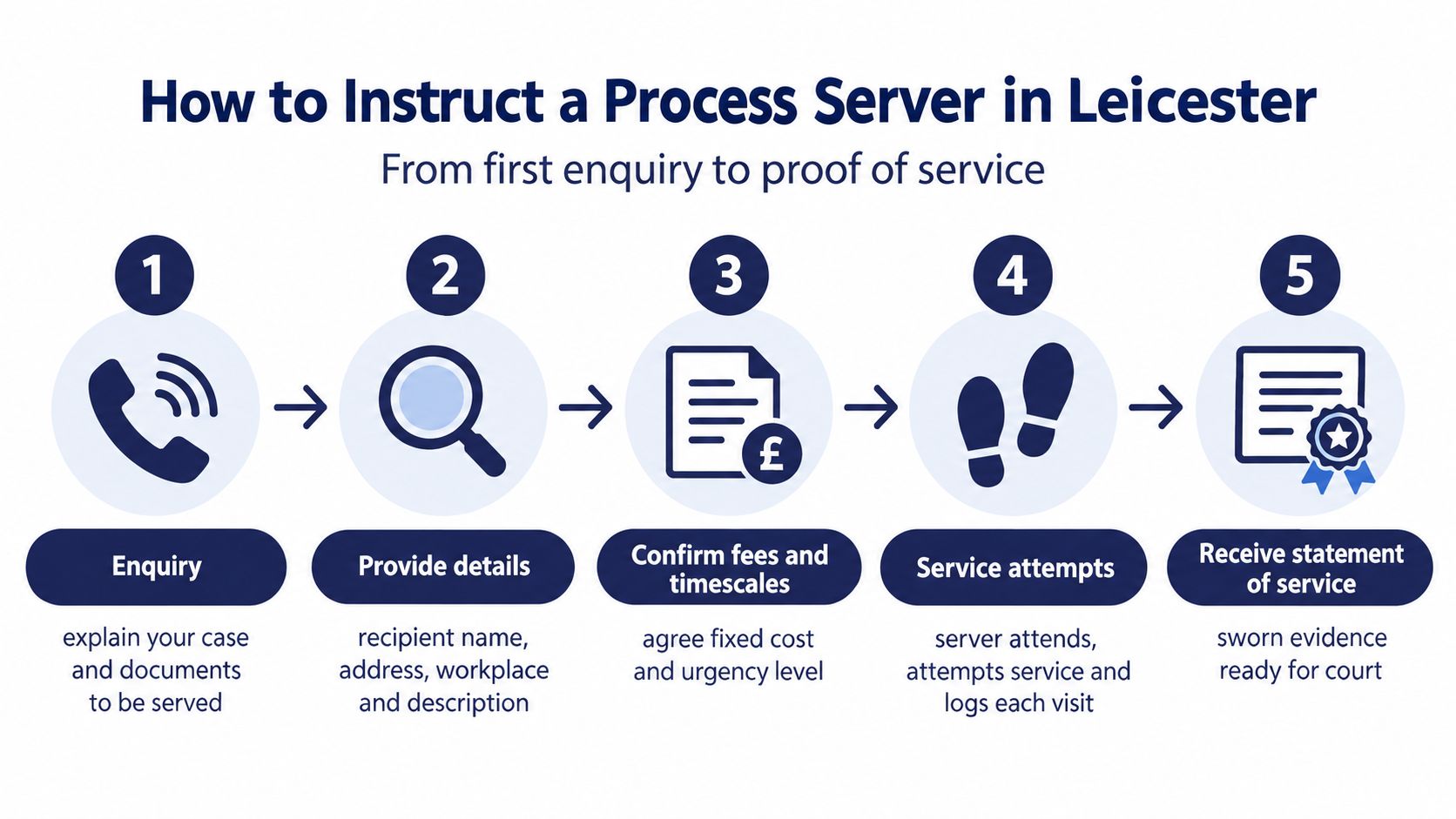
A good instruction begins before the first phone call. Gather the sealed documents, claim details, service deadline and every known fact about the recipient. Tell the provider whether the instruction is routine, urgent, sensitive or potentially confrontational.
Give the server useful information
Prepare the information in a form that can be checked quickly:
Documents and deadlines: State exactly what must be served, the issue date, the relevant deadline and any hearing or application date.
Address history: Supply the current address, former addresses, workplace, business details and access instructions. Don't assume that a last-known address is sufficient.
Identity details: Include the recipient's full name, photograph where lawfully available, age range, description, vehicle details and known routines.
Risk information: Disclose threats, previous confrontations, dogs, controlled access, safeguarding concerns or any reason the attendance needs additional planning.
Reporting requirements: Confirm whether you need a statement, certificate or affidavit, and ask how failed attempts and re-service recommendations will be recorded.
The more precise the briefing, the less time the server spends trying to establish basic facts at the address. It also allows the provider to tell you early if a trace, additional attendance or different method needs consideration.
Clarify urgency and cost
Urgent instructions should be explicit. A Leicester provider reports first attendance for non-urgent instructions within 3 working days, an average completion time of 2.2 working days, and urgent attendance with as little as 30 minutes' notice. These are supplier-reported figures, not statutory benchmarks, and the actual outcome depends on the address, recipient and documents, as explained on the provider's Leicester process server service page.
Ask what the quoted fee includes. A fixed fee may cover a defined number of attempts, while tracing, mileage, unusual access or additional attendances may be charged separately. You should also know when the provider will pause and seek instructions rather than continuing to incur costs.
A legal team managing several deadlines may also use a virtual legal assistant to organise document bundles, chronology and instruction notes before sending the service brief. That administrative preparation doesn't replace legal advice or physical attendance, but it can make the handover cleaner.
The following video gives a visual introduction to the practical process:
For broader investigative support, see the available Private investigator services. The relevant service should be selected according to the problem, whether that's process serving alone, address tracing before attendance or a wider investigation involving the same individual.
Securing Your Legal Position with Sentry Private Investigators
The difference between a weak and strong service instruction usually appears in the details. A weak instruction provides an old address and asks for a quick drop-off. A stronger one identifies the document, deadline, recipient, known locations, risks and required evidence before attendance begins.
For Leicester work, that preparation should account for both local geography and procedural pressure. A provider needs to manage city addresses, surrounding county locations, workplace attendance, address tracing and re-service decisions while maintaining a consistent file. The legal team then receives more than a delivery update. It receives a factual account that can inform the next procedural step.
Sentry Private Investigators Ltd provides process serving and wider investigative support for private clients, solicitors and businesses. Its work can sit alongside tracing, surveillance, background checks and other investigative requirements where serving documents reveals a broader need to locate, verify or understand a person's circumstances.
A practical standard for selection
Before instructing any provider, ask:
Who will attend? Confirm the provider's identity, coverage and experience with litigation-support instructions.
What will be recorded? Request a clear explanation of the attendance report and the evidence supplied after service.
What happens after failure? Establish whether the provider will recommend further attendance, tracing or a different approach.
How is urgency handled? Make sure the deadline is understood and that any rapid attendance depends on availability and location.
What is included in the fee? Separate standard attendance from tracing, repeat attempts and sworn evidence.
The right process server Leicester instruction protects more than a delivery date. It protects the quality of the evidence, gives the solicitor a reliable basis for the next decision and reduces the chance that an avoidable service problem will add to an already pressured court timetable.
Sentry Private Investigators Ltd offers discreet process serving in Leicester, with practical support for address tracing, attendance planning and evidence-led reporting. Visit Sentry Private Investigators Ltd to discuss the documents, deadline and recipient details with a professional investigator.