
Checking Work History in the UK: A Practical Guide

You're ready to make an offer, but the reference doesn't quite match the CV. The candidate describes a management role; the former employer confirms a different title and an earlier leaving date. You need to establish whether you're looking at an innocent discrepancy, an incomplete record or deliberate misrepresentation, without treating suspicion as proof.
Why Checking Work History Is Harder Than It Looks
Consider a Birmingham hiring manager comparing a polished application with a brief reference. The applicant says they managed a department, but the reference confirms employment as a supervisor. Both descriptions might be defensible, yet neither explains what responsibilities the person held.
A private client can face a similar problem when trying to evidence former employment for a legal matter. Knowing that someone worked somewhere isn't the same as having independently supported dates and a clear account of the source.

A limited reference isn't necessarily a warning
UK employers generally don't have to provide a reference unless a written agreement requires one or they operate in a regulated sector, such as financial services. When they do, it may be brief and must be fair and accurate, as explained in the government guidance on work references.
That creates an evidence problem, not an automatic credibility problem. A short reply may reflect the employer's policy rather than anything adverse about the applicant. Silence shouldn't be converted into a negative finding either.
Practical rule: Establish what a source can confirm before deciding what its silence means.
Keep different questions separate
The compliance environment has also developed considerably. Employer responsibilities to prevent illegal working have existed since 1997, the current right-to-work system took effect on 29 February 2008, and the Home Office online checking service has been available for eligible immigration statuses since 2019, according to the Home Office's account of the right-to-work scheme.
Those developments don't make an employment reference a legal eligibility check. A defensible enquiry should distinguish:
Employer verification, whether the organisation confirms the claimed employment.
Identity, whether the records concern the person being considered.
Work eligibility, whether the person can lawfully undertake the offered work.
Chronology, whether roles, dates and explanations fit together.
Checking work history means answering those questions through appropriate sources, not asking a referee to resolve everything in a reassuring phone call. The useful outcome is a supported account of what's established, what remains uncertain and whether that uncertainty matters.
The Standard Verification Sequence That Actually Works
Start with a defined scope. Identify the employment claims that matter to the role or dispute, then agree what evidence would reasonably establish them. Otherwise, an enquiry can collect plenty of paperwork without answering the client's actual question.
The following sequence keeps the work organised.
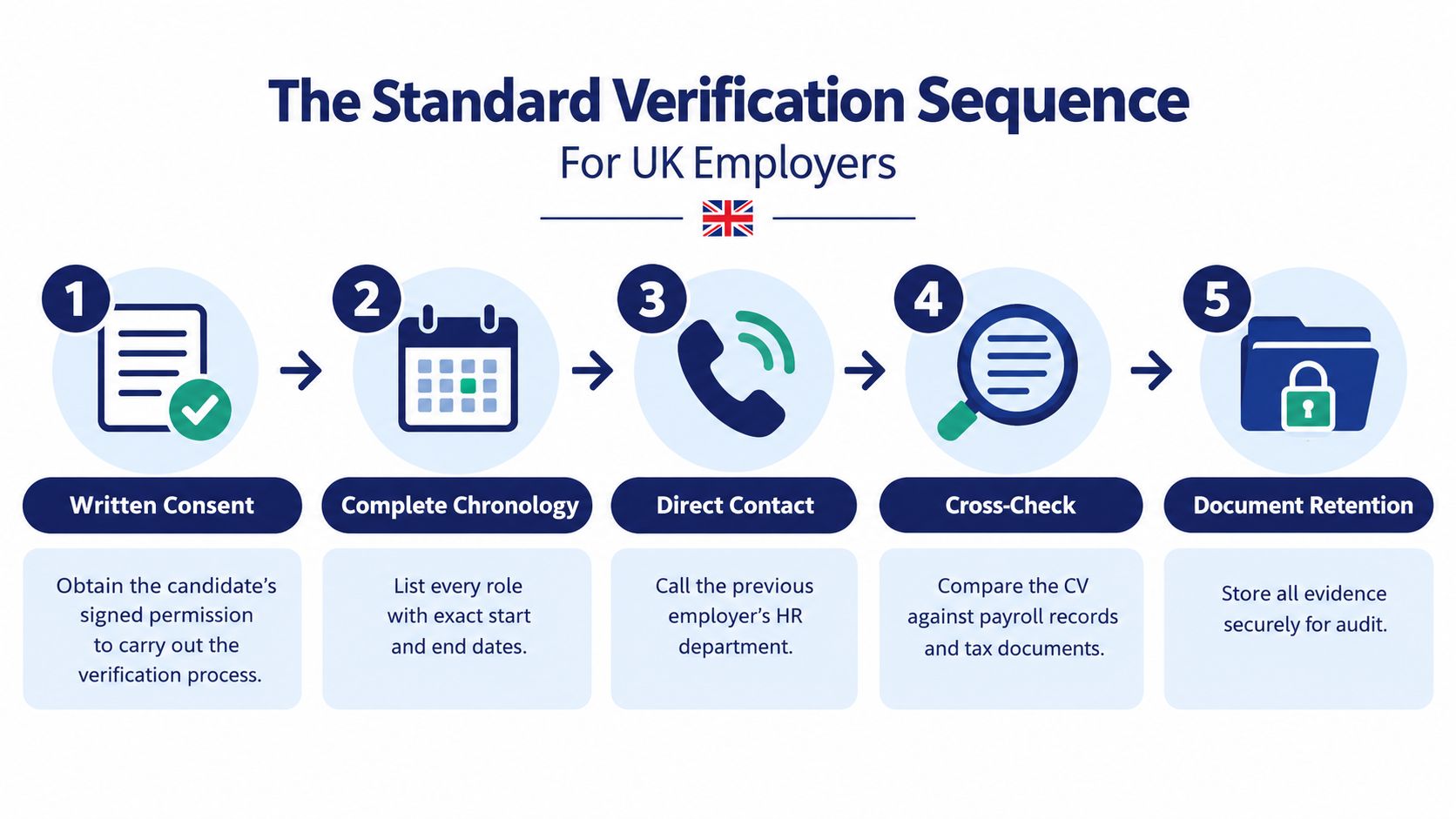
Obtain permission and a usable chronology
Request written authorisation and a complete employment chronology, including employer names, job titles, start and end dates, employment status and explanations for gaps. Ask the applicant to distinguish permanent employment, agency placements, contracting and self-employment.
Don't contact a current employer unexpectedly. Agree that contact expressly, because an otherwise routine enquiry could expose a confidential job search.
Identity discrepancies should be addressed through appropriate identity verification steps for businesses, rather than guessed away because names look similar.
Confirm facts through an independent route
Use independently sourced HR or payroll contact details. An applicant-supplied address is a starting point, not proof that the recipient represents the employer.
Ask precise questions. Request confirmation of dates, title and employment status. Ask about reasons for leaving only where relevant and within the employer's disclosure policy.
Corroborate important claims. Compare replies with appropriate payslips, contracts, P45 or P60 documents. Companies House records may help establish a company's identity or a directorship, but shouldn't be treated as an ordinary employee register.
Record the limits. Note when a source confirms dates but won't comment on responsibilities.
ACAS guidance on reference content distinguishes basic references confirming title and dates from detailed references addressing matters such as experience, skills and reasons for leaving. Frame requests accordingly rather than assuming every employer will provide a full assessment.
For high-risk roles, use an employer confirmation plus documentary or independent corroboration as a practical benchmark. That's a recommended evidence standard, not a universal statutory requirement.
Preserve the audit trail
Record who checked, when, the source used, the exact response, outstanding discrepancies and the decision rationale. Keep a source's words separate from the investigator's interpretation.
Timing deserves attention: 81% of employers in Home Office research reported checking right to work before contract signature and 80% before the employee started, according to its employer-awareness and compliance research. Those figures concern eligibility checks, not proof that the same employers verified every CV claim.
Right to Work as a Separate Compliance Lane
A convincing employment history doesn't establish permission to work. Equally, a successful right-to-work check doesn't establish that the applicant held the responsibilities described on their CV.
Treat eligibility as a prescribed compliance control. The employer must complete the appropriate check before employment begins, using a permitted route suitable for the individual's circumstances.
Right-to-Work Routes at a Glance
Route | How it works | Best for | Record to retain |
|---|---|---|---|
Manual document check | Examine original acceptable documents with the holder present | Applicants with documents eligible for this route | Clear copies and the check date |
Home Office online check | Use the official service and check that the result relates to the applicant | Applicants eligible for online verification | The dated online check result |
Approved digital verification service provider | Use the prescribed digital identity route | Eligible British and Irish citizens | Required verification output and the employer's associated check record |
These routes aren't interchangeable shortcuts. Use the Home Office employer's guide to right-to-work checks to establish the applicable requirements; the same guide explains that the maximum civil penalty increased from £20,000 to £60,000 per illegal worker in February 2024, alongside potential criminal consequences including imprisonment and an unlimited fine.
Home Office research cited earlier found that 57% of employers recalled the possibility of a criminal conviction involving imprisonment and an unlimited fine. Awareness, however, isn't evidence that a particular employer has completed a compliant check.
What the employer needs to do
For a manual check, obtain acceptable original documents and examine them with the holder present. Establish whether they appear genuine, haven't been tampered with, belong to that person and permit the offered work, then retain a clear, dated copy in line with the official employer's right-to-work checklist.
Where permission is time-limited, schedule the required follow-up before expiry. Don't leave that responsibility in an unassigned diary note.
Compliance benchmark: Aim for 100% completion of the prescribed check before successful applicants start, not retrospective correction after onboarding.
Keep eligibility records identifiable separately from employment references and chronology findings. Apply the process consistently to prospective workers, rather than targeting people because of their name, accent or perceived nationality. An investigator can help organise enquiries, but a general background report shouldn't be mistaken for completion of the employer's prescribed duties.
When a Clean Reference Is Not Enough
A positive reference is evidence of what its sender says. Its value depends on whether the sender is genuine, what they know and whether their confirmation withstands an independent check.
That distinction matters in remote and hybrid recruitment, where a credible-looking email can become the main point of contact with a supposed former employer. Presentation alone is a poor basis for trust.
Cifas reported in October 2025 that 19% of surveyed UK employees at companies with 1,000 or more staff said they or someone they knew had used fraudulent reference houses to cover employment gaps, while 30% considered such use justifiable in at least one scenario, as described in the EVH update covering fraudulent references. This isn't a finding that the same proportion of all applicants submit false references.
Test the source before judging the person
The checks below are prompts for enquiry, not grounds for automatic rejection.
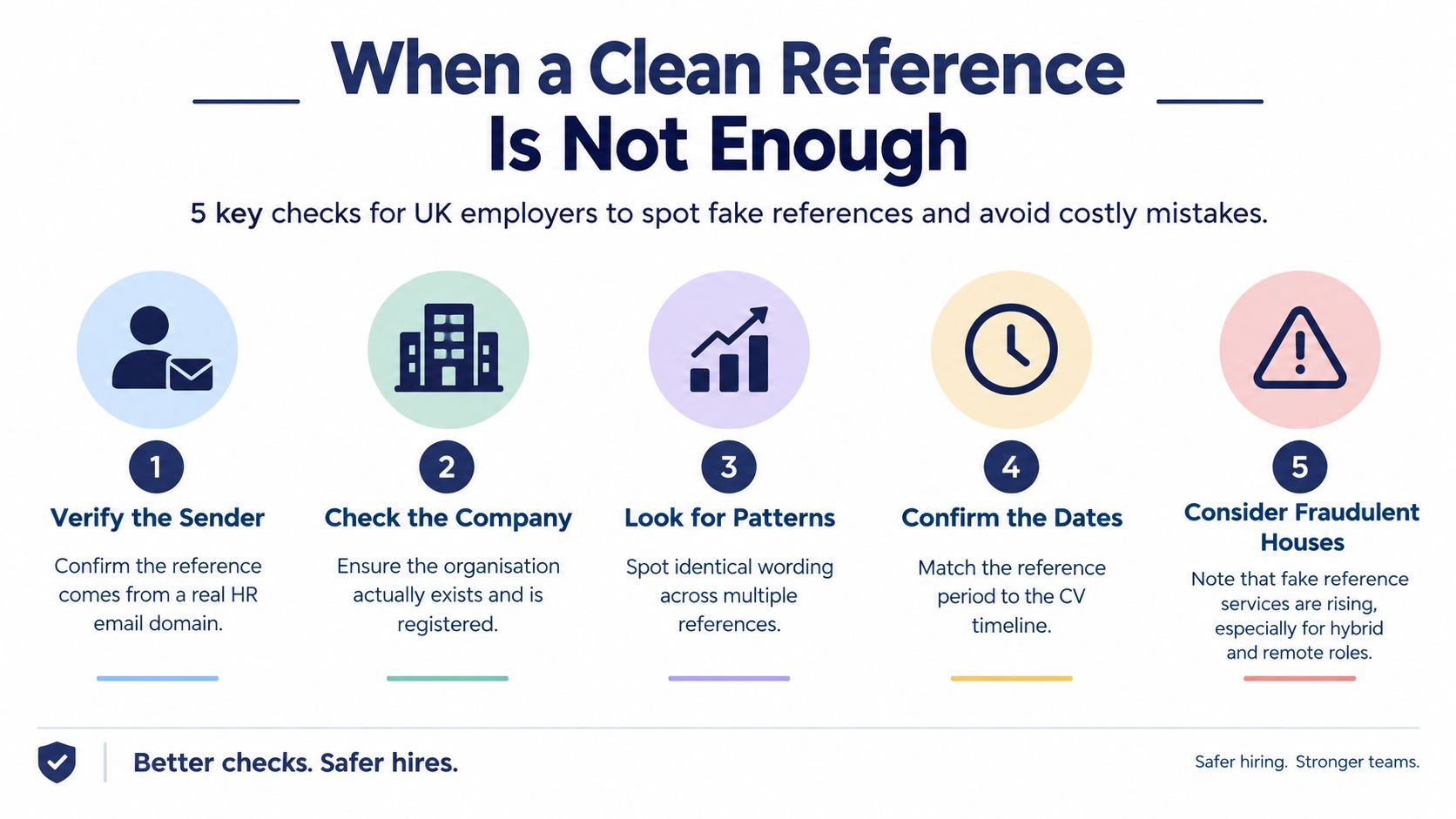
Begin by giving the candidate the precise discrepancy and an opportunity to explain it. Then compare the CV, application, reference and relevant publicly available professional information, remembering that several profiles may repeat the same self-reported claim.
Check the referee through an independently established company contact. Similar wording across references may justify a closer look, but standard templates can also produce identical language.
A discrepancy is a question to resolve, not a finding of dishonesty.
Escalate material inconsistencies
Automated screening flags need context. Mergers, payroll-provider changes, overseas employers, self-employment and legitimate career breaks can produce apparent mismatches without fabrication.
Resolve administrative differences. Ask whether a trading name, legal entity or payroll arrangement explains the mismatch.
Focus on relevant claims. A disputed qualification for responsibility deserves more attention than inconsistent punctuation in a job title.
Preserve competing explanations. Record the candidate's account alongside the evidence supporting or contradicting it.
Good judgement depends on understanding background check results, including the distinction between an unverified claim and a disproved one. Escalate when the remaining inconsistency could materially affect the hiring or legal decision, not because a screening system has highlighted it.
GDPR, Equality and the Limits of What References Can Say
An employment-history enquiry involves personal information. The practical question isn't whether information can be found, but whether collecting, sharing and retaining it is justified for the particular purpose.
Written permission helps define an authorised enquiry, but it shouldn't be treated as unrestricted permission to investigate someone's private life. Set the purpose and boundaries before contacting sources.
Ask for information you can justify
The Information Commissioner's Office confirms that a neutral reference may contain only job title and employment dates, and that workers may challenge information they believe is inaccurate or misleading in its guidance on using employment records.
That limited response can be entirely legitimate. It doesn't entitle the recipient to fill the gaps with assumptions about performance, conduct or reasons for departure.
Define necessity. Tie each request to the role, dispute or employment claim being examined.
Separate fact from allegation. Identify the source of adverse information and whether supporting evidence exists.
Restrict circulation. Share findings with people who need them for the agreed decision.
Plan retention. Decide how records will be protected and when they should be reviewed or removed.
A request for an entire personnel file is difficult to defend when the actual question concerns employment dates. Targeted enquiries are more proportionate and usually produce clearer answers.
Give people a fair opportunity to respond
Where a former employer provides damaging information, establish whether it is supported and relevant. The reference standards described earlier require accuracy and fairness; a confident tone doesn't make an allegation reliable.
Career-break enquiries need particular care. Ask for enough information to reconcile the chronology, not unnecessary details about health, caring responsibilities or other private circumstances.
Consistency matters too. Comparable discrepancies should receive comparable scrutiny, with any difference in treatment explained by the role or evidence rather than assumptions about the applicant.
For a wider investigation, document the UK GDPR basis, scope and safeguards with appropriate advice where necessary. A defensible report should show not only what was discovered, but why the enquiry was proportionate and how uncertainty was handled.
When to Bring in a Private Investigator
Outside help becomes proportionate when normal reference channels leave a material question unresolved. The reason to instruct an investigator is to answer that question independently, not to obtain a more intimidating version of an HR request.
Sentry's website provides a starting point for discussing the scope of an enquiry.

Decide what outside help must establish
Useful referral points include a suspected fabricated referee, an unexplained gap central to the appointment, or an overseas employer whose identity and records are difficult to establish through normal channels. Private clients may also need to evidence former employment for litigation or immigration purposes, while businesses may need to examine suspected misrepresentation.
Those situations don't automatically require a broad investigation. Sometimes a targeted employer enquiry is enough; sometimes the appropriate next step is legal advice rather than further information gathering.
A useful instruction should identify:
The disputed claim, including the documents already available.
The decision it affects, so the enquiry stays relevant.
Contact restrictions, particularly around current employers and sensitive third parties.
The required output, whether an HR record, a factual report for advisers or material intended for proceedings.
Sentry offers background check screening alongside wider private and corporate investigations. From its Birmingham base, it covers the West Midlands and wider UK locations including London, Leicester, Nottingham and Manchester.
Agree scope and reporting before work starts
A properly scoped enquiry should establish the authority for contact, applicable consent arrangements, lawful methods and reporting limits. The investigator should independently verify referee identity, test employment facts and distinguish confirmed findings from reasonable explanations and unresolved points.
For legal matters, agree the evidence requirements with the instructing solicitor. A factual report can support a decision, but nobody should promise that every record will be obtainable or every finding accepted in proceedings.
The accompanying video provides further context about the investigative service.
Ask what can realistically be checked, what depends on third-party cooperation and what would trigger further work. Clear boundaries protect the client's budget and the subject's privacy.
Putting It All Together and Next Steps
Before commissioning more enquiries, identify the unresolved question in plain language. “The dates differ” is a workable starting point; “something feels wrong” needs clarification before anyone collects more personal information.
Use this checklist to prepare the file:
Confirm written authorisation. Make sure the agreed scope and any contact restrictions are recorded.
Validate referees independently. Don't rely solely on details supplied with the application.
Keep compliance distinct. Record right-to-work completion separately from employment-history findings.
Resolve gaps proportionately. Seek an explanation and relevant corroboration rather than assuming concealment.
Keep a dated audit trail. Preserve source responses, outstanding issues and the reasons for the eventual decision.
Choose the next step according to the evidence problem. A basic HR confirmation may settle a title discrepancy. A background check may suit a wider set of disputed claims, while tracing agent or people tracing services may be relevant where locating a former contact is necessary and lawful.
The objective isn't a file with no unanswered questions. It's a decision that reflects the available evidence and acknowledges its limits. If the remaining uncertainty could affect an appointment, a dispute or a significant business decision, seek advice on a focused enquiry before committing to broader investigative work.
Sentry Private Investigators Ltd offers employment-history checks, background enquiries and tracing services for businesses and private clients. Visit Sentry Private Investigators Ltd to discuss the employment claim you need checked, the evidence you already hold and the most proportionate next step.