
Private Investigator Manchester: How to Hire Right

A partner's unexplained absences, an employee whose long-term sick leave doesn't seem to match what you've observed, or a witness who has moved without leaving a forwarding address can leave you with a serious question and little reliable evidence. A private investigator may help establish what's happening, but the value of the work depends on more than whether someone was followed or filmed. The evidence needs to be gathered lawfully, documented clearly and suited to the decision you need to make.
When People in Manchester Hire a Private Investigator
A business owner concerned about a suspicious absence needs more than a clip of an employee away from home. They may need a properly scoped investigation and a report that separates recorded observations from assumptions. A solicitor trying to locate a witness across Greater Manchester has a different need: reliable tracing and a clear account of the enquiries made.
Greater Manchester Police recorded 325,164 crimes in the 12 months to December 2024, a decrease of 28,269 offences, or 8%, compared with the preceding 12-month period. The total included 53,342 domestic-abuse crimes, 44,252 stalking-and-harassment offences, 17,950 vehicle offences, 11,323 residential burglaries and 3,990 personal robberies, according to Greater Manchester Police's crime update. The figures provide context for the range of issues that may prompt a request for lawful evidence gathering, tracing or risk assessment. They don't mean that a private investigator replaces the police, or that every incident calls for a private enquiry.

Evidence, not confrontation
A private investigator's job is to help answer a defined question through lawful, proportionate enquiries. That may involve recording observations, checking publicly available information or establishing a person's address. It isn't vigilantism, a shortcut to protected records or a way to compel someone to cooperate.
Fraud also affects individuals and organisations beyond a single city. The Office for National Statistics estimated 4.2 million fraud incidents in England and Wales in the year ending March 2025, up 31% from the previous year; this is national context, not a Manchester-specific rate (ONS crime statistics). For an employer, insurer or solicitor, the practical question is what evidence is needed and how it will be assessed.
Sentry Private Investigators Ltd is headquartered in Birmingham and operates across Manchester as well as other parts of the UK. This guide focuses on choosing a firm, understanding services and costs, and checking that an investigation is appropriate before you commit.
Services a Private Investigator in Manchester Provides
A professional enquiry should start with the problem you need to resolve, not a service label. The same concern can require different work depending on the evidence already available, the intended use of findings and the legal limits involved.
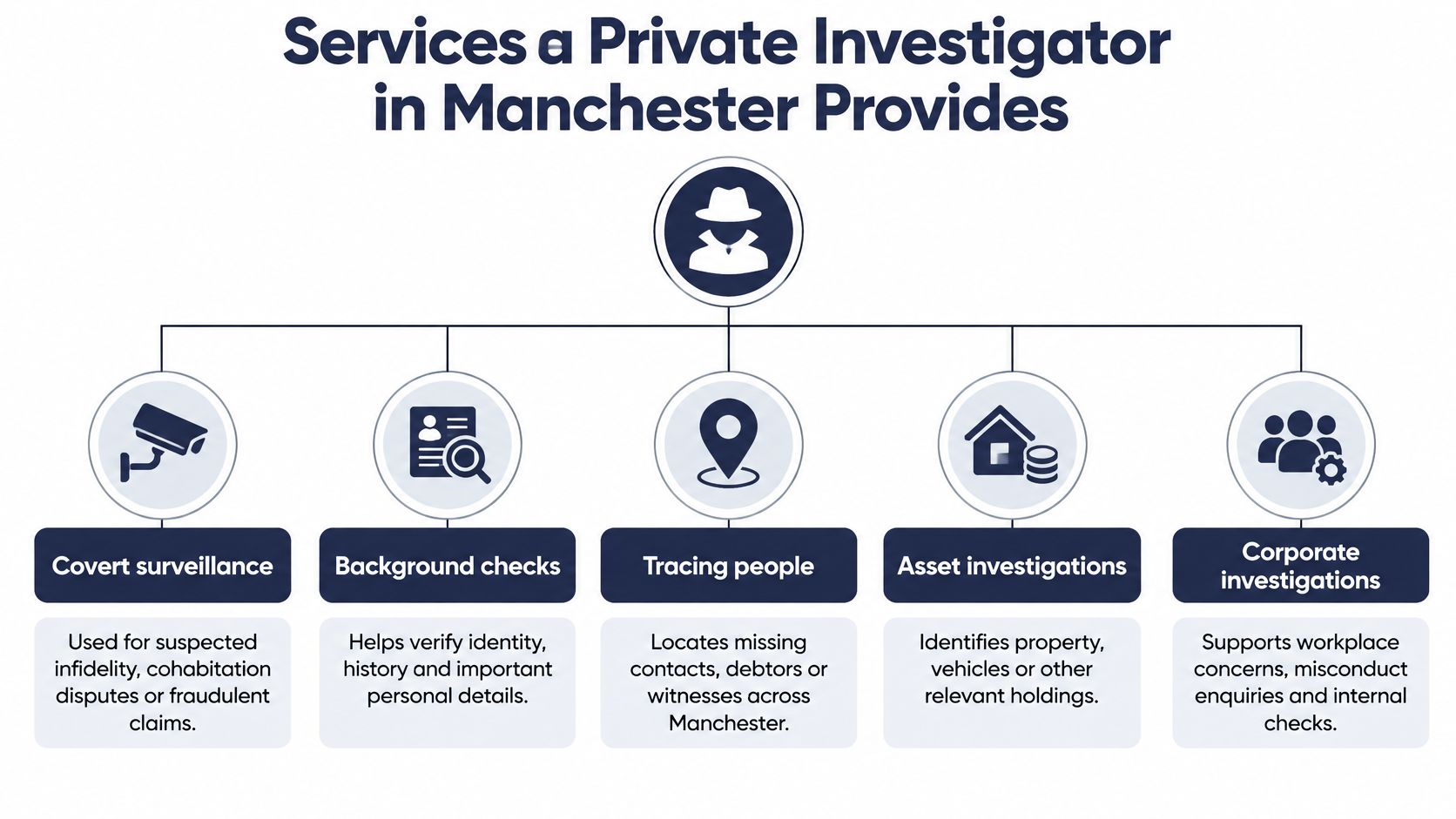
Match the enquiry to the question
Covert surveillance: A client concerned about suspected infidelity, a cohabitation dispute or a potentially fraudulent workplace injury claim may need documented observations. The investigator should agree what can be observed lawfully and what the work cannot prove.
TSCM bug sweeping: A home, office or vehicle can be checked for suspected listening devices, hidden cameras or GPS trackers. A sweep can help assess a security concern; it can't establish who placed a device without supporting evidence.
People tracing: A tracing enquiry can help locate a debtor, an estranged family member or a witness who has moved. Give the investigator reliable identifiers and explain why the person needs to be found.
Background checks: Checking a prospective partner, employee or supplier can help verify identity and relevant details. The scope should stay connected to a legitimate purpose, not turn into indiscriminate searching.
GPS vehicle tracking: Tracking is legally sensitive. A professional investigator should assess the authority, ownership, purpose and privacy implications before accepting an instruction, and should refuse unlawful requests.
Asset investigations and corporate enquiries: Businesses may need to establish relevant holdings, examine suspected misconduct or check a supplier relationship. The aim is to collect information that can be assessed by management or professional advisers.
National fraud figures reinforce why businesses may seek help with due diligence and internal concerns. In England and Wales, the ONS estimated around 3 million fraud incidents involved financial loss in the year ending March 2025 (ONS fraud overview). Those figures aren't specific to Manchester, but they underline why a company may want a clear record of what happened before deciding on employment, civil or insurance action.
For a useful overview of how publicly available online information can inform an enquiry, see how social media screening works. It's one possible research input, not proof that an allegation is true.
The scope and limits of each service matter more than a broad promise to investigate anything. Review Private investigator services to see how different enquiries can be approached.
How to Choose a Private Investigator in Manchester
Start by writing down the decision you need to make and the factual question that could help with it. “Find out what's going on” isn't a workable brief. “Establish whether the subject regularly attends this specified workplace during the relevant period” is closer, though the investigator still needs to assess whether the work is justified and proportionate.
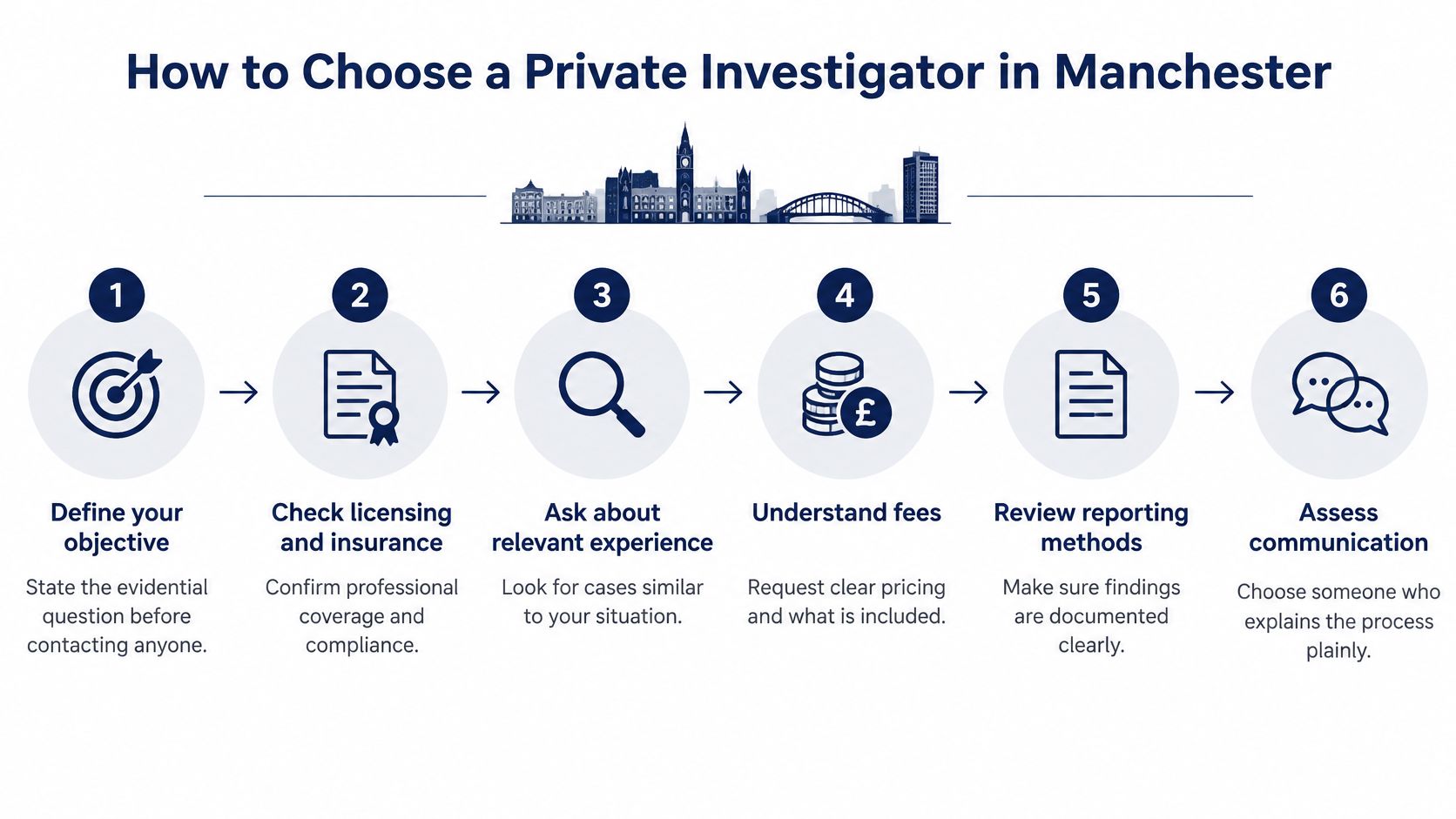
Ask for a process you can understand
Check the firm's company details, UK presence and relevant experience. Ask about professional indemnity insurance and whether the investigator can explain the proposed methods in plain English. Be cautious if the answer relies on claims of special access or powers.
Before agreeing to work, ask:
How will observations be logged? Look for contemporaneous records of times, locations and what was directly seen.
What will the report include? Clarify whether it will contain a chronology, supporting material, limitations and an explanation of how evidence was handled.
Who controls my information? Ask who can access personal data, how it is stored and how long it will be kept.
What if nothing is found? A sound agreement explains what the investigator will report when an assignment produces no relevant evidence.
What exactly am I paying for? Confirm the scope, likely expenses and deliverables in writing before work starts.
A professional should distinguish observation from interpretation. A video of someone entering a workplace may document an arrival. It doesn't, by itself, establish their job, income or motive.
Walk away from promises of certainty. No responsible investigator can guarantee what surveillance will capture or how a solicitor, employer, insurer or court will treat it.
Other warning signs include pressure to pay cash upfront, offers to access someone's phone or protected records without authority, and evasive answers about data protection. Ask for written terms and read them before authorising an enquiry. The GDPR terms in private investigator agreements should make the handling of personal information and the agreed work easier to understand, not harder.
What Private Investigator Costs in Manchester Depend On
There isn't a reliable flat price for every Manchester enquiry. A quote can change according to the time required, the number of operatives, equipment, travel, complexity and the standard of reporting needed. Ask what is included and what would trigger additional costs.
Cost Factor | Why It Changes the Price | What to Confirm Beforehand |
|---|---|---|
Time and scheduling | The work may require observation at particular times or across a changing schedule. | Which dates and hours are included, and how are overruns approved? |
Number of operatives | A complicated environment may need more than one investigator. | Why is each operative necessary for this assignment? |
Travel and location | Work across multiple locations can add travel and coordination. | Are travel expenses included or itemised separately? |
Equipment and method | The proposed method may involve specialised equipment or technical checks. | What will be used, and why is it relevant and lawful? |
Reporting and evidence handling | A detailed, organised report takes work beyond collecting footage. | What deliverables will you receive, and in what format? |
Price versus usable evidence
A low quote can be poor value if the brief is vague, the dates are badly chosen or the evidence isn't documented well enough for its intended use. The result may be repeated work, a disputed employment decision or material that a professional adviser can't assess confidently.
Keep costs under control by providing a precise written brief, sharing relevant dates and locations, and agreeing the deliverables in advance. Ask how the investigator will record unsuccessful attempts, too. Those details help you understand what the fee buys, even if the enquiry doesn't produce the evidence you hoped for.
Compare quotations on scope and reporting, not just the headline figure. A firm should explain and price the proposed work before asking you to commit. You can also review private investigator prices to understand the factors behind a quote.
Legal and Ethical Rules Your Investigator Must Follow
Private investigators don't have special legal powers. They must stay within the law, just like anyone else. A claim that an investigator can access a private account, obtain protected records or enter a property without permission is a serious warning sign.
A sound assignment has a defined purpose, a reason the work is necessary, and a method proportionate to the question. Investigators should keep clear records, protect original files and handle personal information securely. Where evidence might be used in civil or employment proceedings, a chronology and a witness statement should distinguish direct observations from interpretation.
Surveillance has limits
A technical pitfall is using enhanced optics to see into a private space where ordinary unaided eyesight could not reach. Official guidance treats this as potentially intrusive surveillance, which can create serious privacy and admissibility risks. Surveillance should focus on what can be observed lawfully from an appropriate position, not on pushing technical equipment beyond reasonable boundaries (RIPA policy guidance%20Policy%202024.pdf)).
Workplace monitoring calls for particular care. The Information Commissioner's Office says an employer must identify a lawful basis before monitoring workers. Covert monitoring is unlikely to be justified in ordinary circumstances. In exceptional cases involving suspected criminal activity or equivalent serious misconduct, the ICO says the employer should obtain senior-management authorisation, complete a Data Protection Impact Assessment, limit monitoring to what's necessary and stop when the investigation is complete. Covert audio or video monitoring shouldn't take place in areas where workers reasonably expect privacy, such as toilets or changing rooms (ICO guidance on monitoring workers).
Ask about retention before work starts. Agree who can access the material, how originals will be preserved, when it will be reviewed and how irrelevant material will be handled.
Even properly gathered evidence isn't automatically admissible or decisive. Ordinary evidence rules and disclosure duties still apply, and a solicitor or other adviser can assess how material may be used. A firm should explain those limits rather than promise an outcome. For a general point of comparison when checking how an online service presents privacy information, you can check the site's privacy practices. That doesn't replace reviewing your investigator's own terms and privacy arrangements.
Real Manchester Scenarios and When to Think Twice
A professional in Didsbury may want to establish whether a partner is living with someone else because it could affect a personal or legal dispute. The first discussion should clarify the factual question and whether surveillance is an appropriate, proportionate way to address it. An investigator shouldn't promise that observations will settle every issue between the parties.
At a Trafford Park business, an employer may suspect a workplace injury claim doesn't match the employee's activities. The employer needs to consider its obligations, define the suspected conduct and seek advice on the appropriate evidence and monitoring process before commissioning covert work.
A city-centre office preparing for a sensitive negotiation may request a TSCM inspection because staff have found something concerning or because the meeting involves confidential information. A sweep can check for suspected devices, but it can't identify a culprit without further evidence. A debtor who has moved between addresses in Salford may instead need a tracing enquiry based on reliable identifiers and a legitimate reason to locate them.
When an enquiry is really about safety
A request to track a partner's phone, fit a GPS device or conduct covert observation isn't automatically a legitimate investigation. It may signal stalking, coercive control or an immediate safeguarding concern. Police in England and Wales recorded 188,462 domestic-abuse-related stalking and harassment offences in the year ending March 2025, accounting for 23.1% of domestic-abuse-related crimes, according to the ONS report on domestic abuse prevalence and trends.
If someone fears that an investigation could alert an abusive person or expose their location, safety comes first. Preserve information only if it can be done safely, and contact police or a specialist support service where appropriate. A responsible investigator may decline the instruction and suggest a safer route instead of accepting work that could increase risk.
Speak to Sentry Private Investigators About Your Case
Before contacting a firm, write down what you need to establish, what information you already have and how you expect to use the findings. Then ask the investigator to explain the proposed method, legal boundaries, likely costs, reporting and handling of personal data. Those conversations can expose a poorly scoped instruction before it turns into repeated work or unusable material.
Sentry Private Investigators Ltd provides discreet investigative services for private and business clients, including surveillance, TSCM bug sweeping, tracing, background checks, GPS vehicle tracking and corporate investigations. The firm is based in Birmingham and operates across Manchester as part of its wider UK coverage. The appropriate service depends on the facts, the intended use of the evidence and whether the proposed work is lawful and proportionate.
A first conversation should be about your circumstances and the factual question, not pressure to purchase a particular service. Ask what the investigation can establish, what it can't, and how the findings will be recorded. If you're ready to discuss an enquiry, use the Sentry contact page to request a confidential, no-obligation conversation. Every enquiry is handled in strict confidence.
For discreet surveillance, tracing, TSCM checks and corporate enquiries across Manchester, Sentry Private Investigators Ltd can help you define the evidence you need and scope lawful work around it. Contact Sentry Private Investigators Ltd for a confidential, no-obligation discussion of your situation.