
What Is Vehicle Tracking and How It Works

Vehicle tracking uses a GNSS receiver plus a mobile link to turn time-stamped positions into a journey profile, and identifiable location history is personal data under UK GDPR and the Data Protection Act 2018.
But if a tracker shows where a car went, does it also prove who drove it, why they travelled or whether anyone had permission to monitor them? Those are separate questions. For anyone considering an investigation, understanding the difference is more useful than buying a device.
What Vehicle Tracking Actually Records
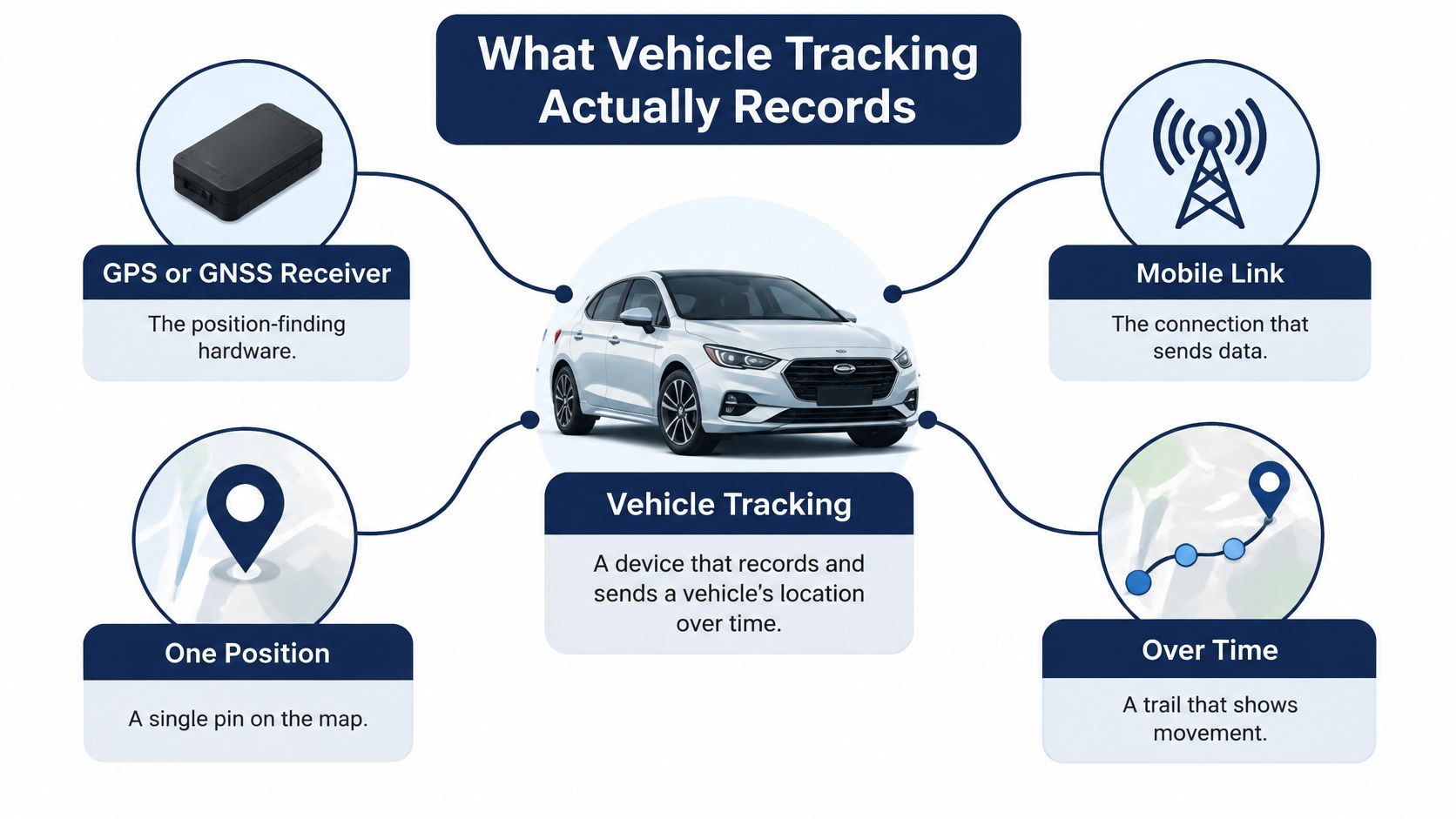
Vehicle tracking records movement over time. A receiver establishes a position, and a communications link sends that position to a platform where someone can review it. The useful information comes from connecting those records, rather than looking at an isolated dot.
A single position might place a vehicle near an industrial estate. A journey profile could show its arrival, the apparent length of its stop and its subsequent route. Depending on the equipment, records may also include speed or driving events.
What each vehicle record shows
Record | What it answers | What it does not show |
|---|---|---|
Single GPS position | Where the receiver was at one time | A route, a stop pattern or who was driving |
Journey profile | Route, stops, timing and sometimes speed over a period | Who authorised the journey or what happened inside the car |
DVLA keeper record | Which vehicle and which registered keeper | Live or historical movement |
Location-only tracker | Where the vehicle travelled | Conversations, images or activity in the cabin |
Audio or video device | Sound or pictures from inside or around the vehicle | A lawful substitute for a simple location log |
Read the rows as different kinds of information, not interchangeable evidence. A pin answers a location question. A journey supplies a sequence, while a keeper record connects a registration to an administrative record.
The Department for Transport's vehicle-licensing definitions explain that DVLA information comes from registration, keeper changes and vehicle licensing. It isn't a database of journeys.
The final rows distinguish movement records from recordings of people's behaviour. A location-only device doesn't tell you what passengers discussed, even if the map shows a lengthy stop.
Why a vehicle record can describe a person
Home stops, school runs and working patterns can identify someone indirectly. Once a journey can be connected to a driver, employee or household, treating it as information about an anonymous vehicle misses its real privacy implications.
As historical context, the Data Protection Act 1998 was enacted on 16 July 1998; the current principal framework is UK GDPR and the Data Protection Act 2018, as explained in DavidsonMorris's vehicle-tracking guidance.
That makes the answer to “what is vehicle tracking?” both technical and legal. It's a monitoring system, but it's also information processing. Paying for the car doesn't make every journey fair game.
Types of Vehicle Tracker and Their Power Needs
The power supply affects how a tracker can be used. A permanently connected device suits a different task from a self-contained unit that must be retrieved or recharged.
Choose the equipment around the legitimate purpose and intended reporting period, not around how small or discreet the hardware looks.
Common vehicle tracker types
Type | Power source | Typical use | Main limitation |
|---|---|---|---|
Hardwired GPS unit | Vehicle battery with backup cell | Fleet and theft-recovery monitoring | Needs professional fitting and a clear purpose |
Battery-powered GPS unit | Internal rechargeable or primary cell | Trailers, plant and vehicles without spare wiring | Battery life limits reporting period |
OBD-II plug-in unit | Vehicle diagnostic port | Fleet telematics and driving-event data | Easy for a driver to find and unplug |
Smartphone-based tracker | Handset battery and data | Personal or family use with consent | Requires the phone to travel with the vehicle and the user's consent |
Hardwired units suit an ongoing deployment, but fitting must be compatible with the vehicle's electrical system. Battery-powered devices avoid that connection, although their reporting settings and power supply constrain the deployment.
An OBD-II unit plugs into the diagnostic port. Compatible systems can add driving-event information, such as harsh braking or idling, but the connection is accessible and easily interrupted.
Phone-based tracking follows the handset, not independently the car. It requires the knowing consent of the person using the phone.
Selection rule: Establish who needs the information, for how long, and whether monitoring that vehicle is lawful before choosing the hardware.
How a GPS and GSM Tracker Builds a Journey
GPS and mobile communications do different jobs. GNSS, meaning global navigation satellite system, supplies positioning signals. GPS is a familiar example of a GNSS constellation.
The mobile connection carries the resulting records to someone who can use them. Receiving a satellite signal doesn't, by itself, send a vehicle's location to an investigator.
From satellite signal to journey history
Satellites broadcast timing signals. The receiver uses signals from the constellation to work out its position. The satellites aren't watching the vehicle or receiving its journey report.
The receiver calculates a position. The equipment in or on the vehicle produces a location record associated with a time. Position quality can change as the surroundings change.
A GSM or other mobile link sends the record onward. The communications unit transmits coordinates to a server. Some equipment also supports Wi-Fi, but its capabilities must be checked rather than assumed.
Software assembles the history. The platform displays points as a route and can analyse stops or generate alerts. A geofence is a virtual boundary used, for example, to flag a vehicle entering or leaving an agreed area.
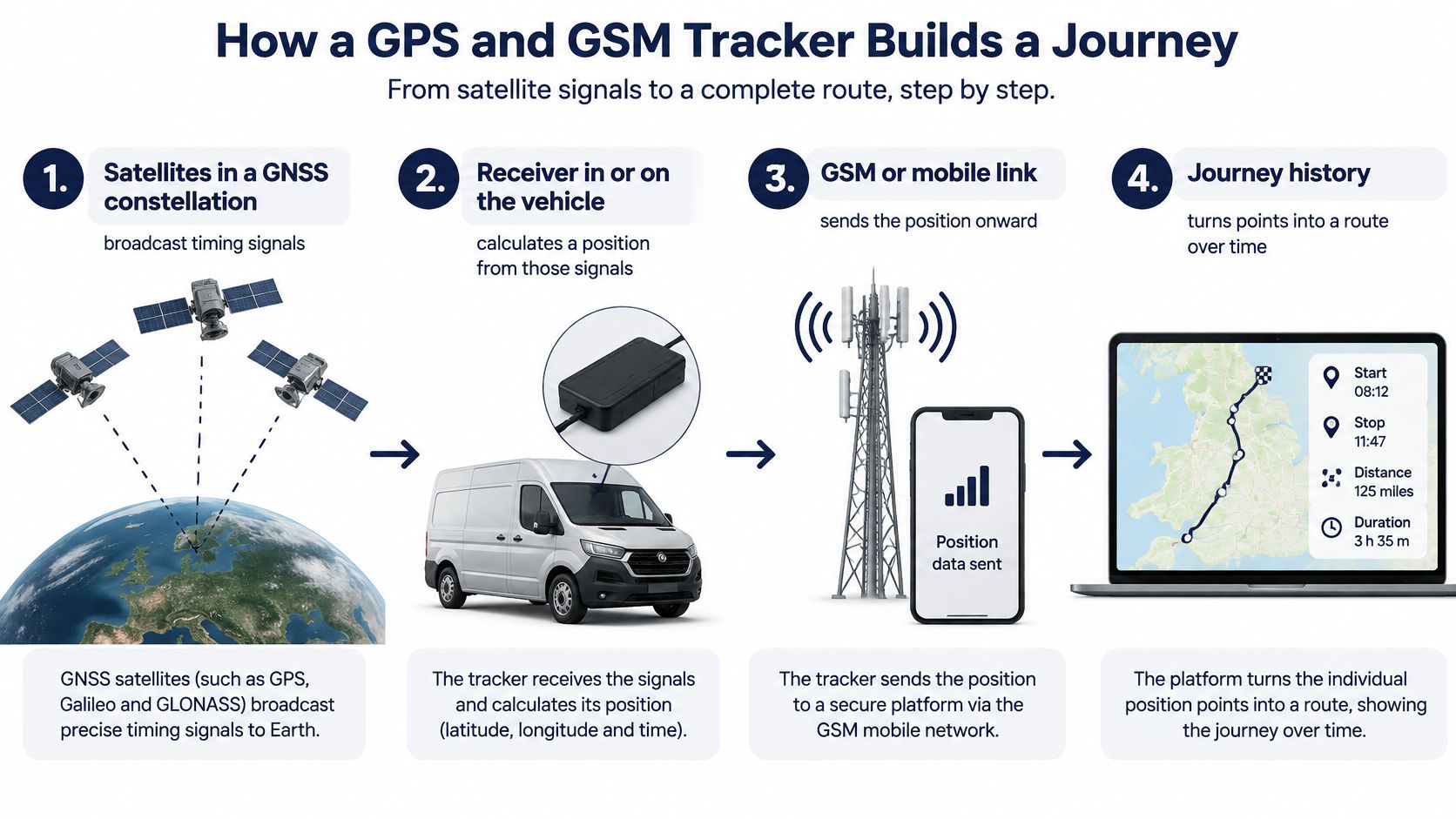
A postal analogy helps separate these roles. Satellite signals provide the addressing references, the tracker creates the letter, and the mobile network acts as the post carrying it to a desk. The software is where someone organises the delivered information into a readable account.
For a logistics-focused explanation of how journey updates become shipment visibility, there's more from Peak Transport. Shipment visibility and investigative evidence serve different purposes, even when both use location updates.
Why the plotted route needs interpretation
For 112-based in-vehicle systems, UK type-approval requirements specify horizontal error of no more than 15 metres at 95% probability under open sky, compared with up to 40 metres at 95% probability in urban-canyon conditions, according to the UK Government's space and transport insights report. These aren't universal accuracy guarantees for every commercial tracker.
Tall buildings can block signals or reflect them along indirect paths, known as multipath. The displayed position may jump or appear on a neighbouring road. Heavy foliage, severe weather and indoor or underground conditions can also impair positioning.
Read the timestamp, fix quality, sampling interval and communication gaps alongside the map. In a city-centre enquiry, ANPR records, CCTV, fuel receipts and witnesses can help test whether the plotted route supports the proposed conclusion.
Fleet Recovery and Investigation Uses
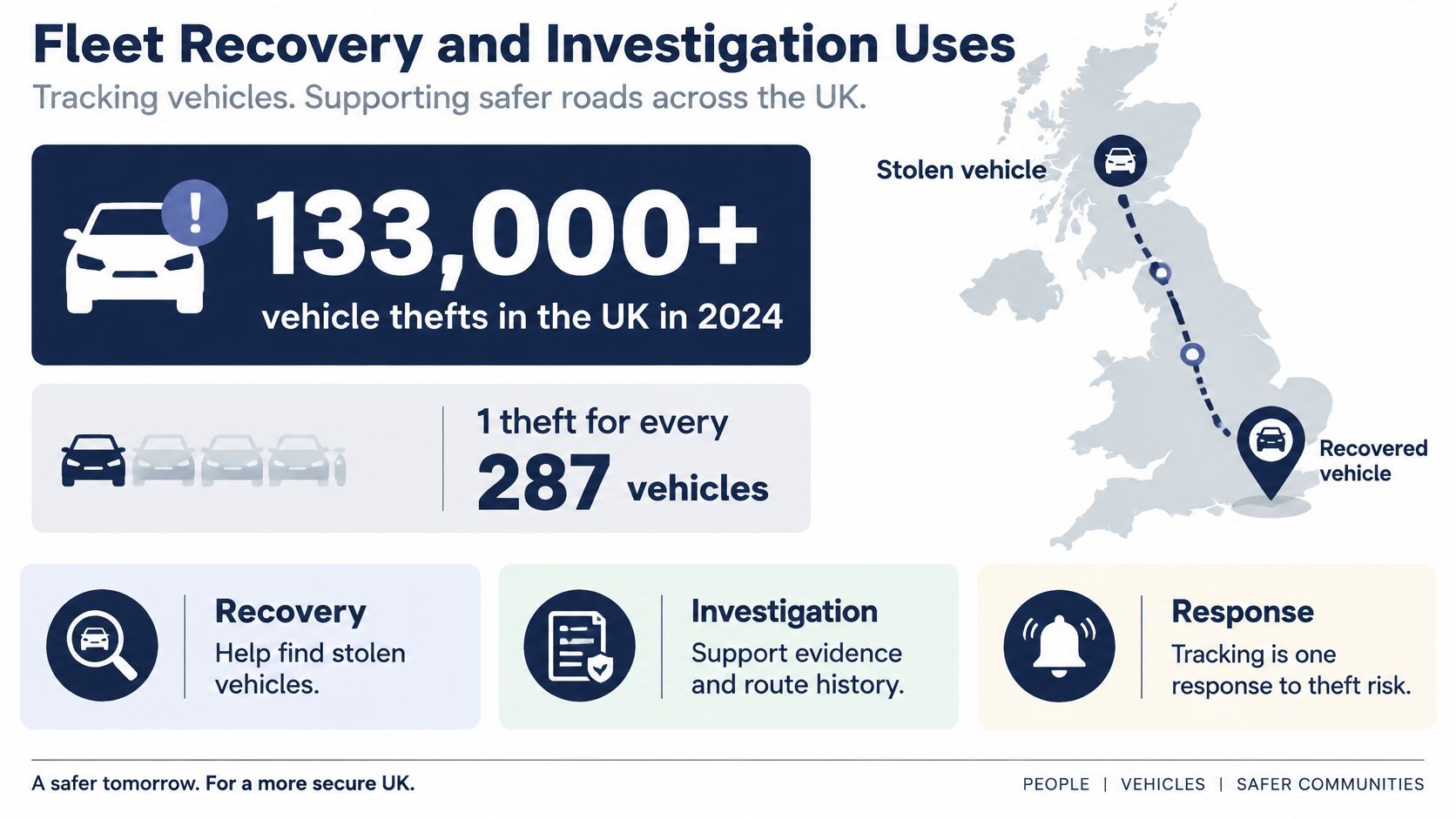
The UK recorded more than 133,000 vehicle thefts in 2024, equivalent to approximately one theft for every 287 vehicles, according to GoCompare's analysis of UK theft data reported by Car.co.uk. Tracking is one response to that risk, not a guarantee of recovery or identification.
Its usefulness changes with the task. A dispatcher needs operational information, a recovery team needs a usable location, and an investigator needs records that answer a defined question.
Fleet coordination and stolen-vehicle recovery
Consider a maintenance business allocating work across its vans. Movement records can help dispatch the nearest available vehicle, check whether a service visit occurred and reconcile mileage. Road-safety alerts can identify events that need review, but an alert alone doesn't explain the driver's circumstances.
Routine fleet administration also extends beyond a map. My Safety Manager discusses keeping trucks moving and compliance organized, a useful operational distinction from commissioning a targeted investigation.
After a theft, the immediate aim changes to finding the vehicle. A location can help police or a recovery network decide where to look, although a delayed or unavailable signal may limit its usefulness. Owners shouldn't treat a map position as an invitation to confront suspected offenders.
UK stolen-vehicle recovery company Tracker reported that, working with UK police, it recovered 55% more stolen cars in 2025 than in 2024, with recovered vehicles valued at £41.3 million. That describes its reported recovery activity, not a promise about another deployment.
Prevention, recovery and evidence are different jobs. Specify which job matters before deciding what information to collect.
Workplace and private enquiries
A workplace enquiry might concern suspected misuse of a company van, an absence pattern or a doubtful injury claim. The appropriate starting point is the particular allegation and relevant period, not an unrestricted search through an employee's movements.
Say a business believes its van is being used for unauthorised deliveries during working time. A route record could identify journeys requiring explanation. It wouldn't establish whether a manager had separately approved them, so the enquiry should also examine instructions and work records.
Private concerns require equally careful scoping. A vehicle associated with suspected cohabitation or infidelity may also be used by a spouse or another family member. The client's concern needs to be assessed separately from their ability to authorise monitoring.
For a prospective client, the practical question is therefore specific: what decision should the investigation support? A defined question helps determine whether movement information is relevant, whether another method would be less intrusive, and when collection should stop.
When Tracking Is Lawful and Who Must Be Told
The ICO gives a useful mixed-use company-car example: tracking for business reasons during working hours, with a driver-controlled option to disable it outside work. Its specific guidance on monitoring work vehicles says employers must inform workers and passengers, and that monitoring private journeys will rarely be justifiable.
The important distinction isn't company ownership versus private ownership. It's whether the organisation has a lawful, proportionate reason to collect the particular information.
Who must be told in common UK scenarios
Situation | Private life involved | Usual expectation | Main risk if ignored |
|---|---|---|---|
Company van tracked in working hours for routing and safety | No, if limited to work use | Tell workers and passengers and record the purpose | Monitoring that drifts into unrelated surveillance |
Mixed-use company car in the evening | Yes | A way to switch tracking off outside work | A track of home, family and medical visits |
Family or shared car used by someone other than the client | Often yes | Do not assume ownership equals permission to monitor the person | Unfair processing of another adult's movements |
These are starting points for assessment, not blanket permissions. Even an apparently work-only journey can reveal information unrelated to dispatch or safety, so access and use still need boundaries.
For a business, the controller decides why and how personal data is processed. A processor handles it on the controller's behalf and instructions; appointing a supplier doesn't remove the controller's responsibilities.
Document the purpose and handling
Before collection begins, identify the lawful basis and explain the monitoring in a clear policy. The ICO's workplace monitoring guidance also supports restricting access, securing information, reviewing necessity and deleting records when they're no longer required.
In practice, a defensible instruction should establish:
The question being investigated. Describe the suspected issue without assuming the allegation is true.
The collection boundaries. Identify relevant vehicles, periods and information, including arrangements for private use.
The authorised recipients. Decide who may view the live platform, receive exports or disclose findings.
The retention decision. Set a justified review and deletion approach rather than keeping reports indefinitely.
Exports deserve particular care. A restricted platform offers little protection if someone emails an unrestricted journey report to an unnecessary recipient.
The public-authority rules make another distinction: fitting a tracker to an authority's own vehicle isn't, by itself, property interference, while notifying staff makes covert use less likely, according to the Covert Surveillance and Property Interference Code of Practice. That is a context-specific point, not general permission for private surveillance.
A privately owned car still doesn't authorise continuous monitoring of a spouse, tenant or employee. Where another adult's private movements are involved, the justification needs scrutiny before installation, not after a complaint.
How Location Tracking Differs from Covert Surveillance
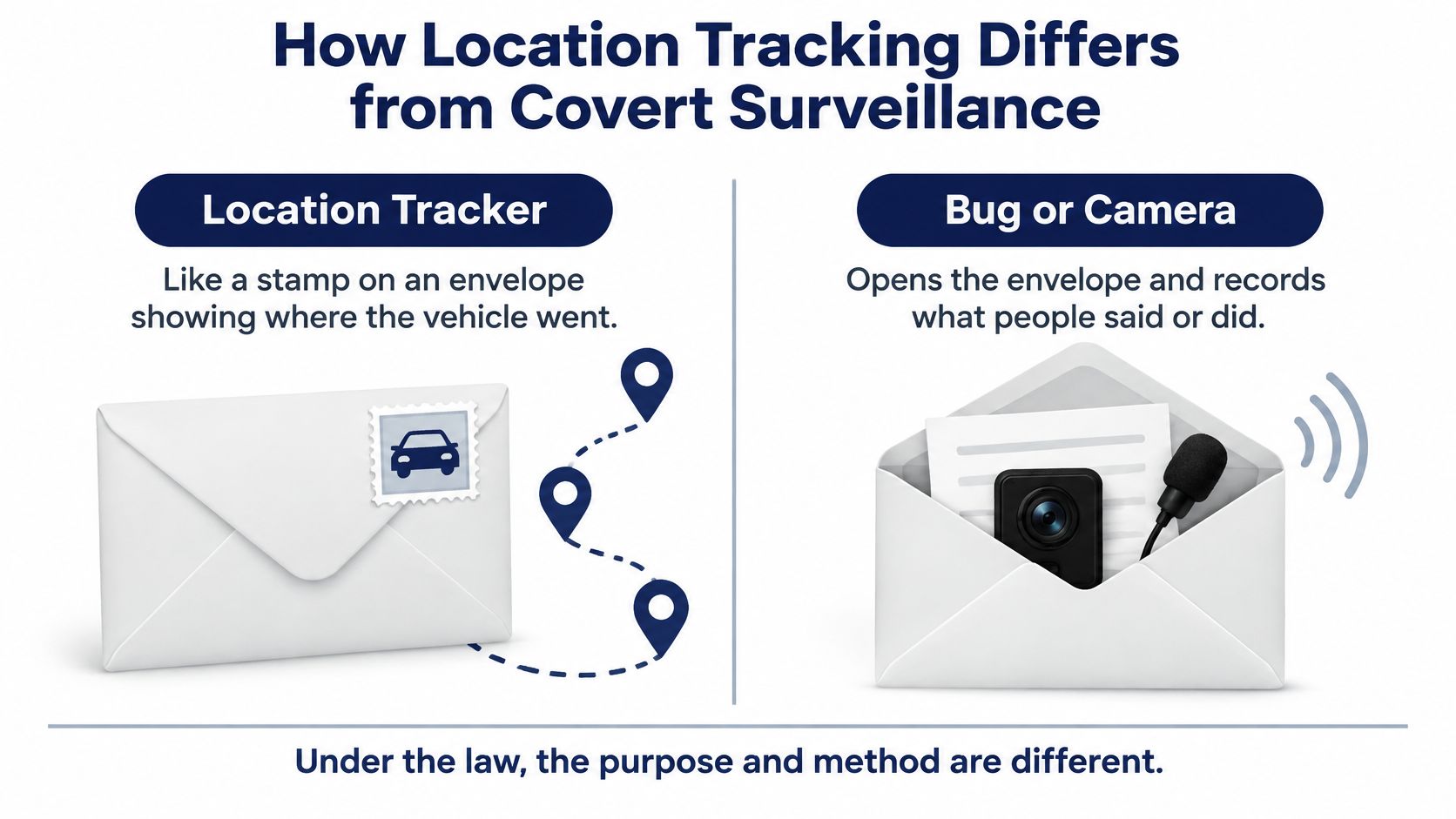
A location tracker is like a stamp on an envelope showing where it travelled. A microphone or camera opens the envelope and records what people said or did.
The comparison isn't perfect, because a route can itself reveal sensitive private information. It does explain why location-only tracking and recording life inside a vehicle require different assessments.
What the legal distinction means
Under the Regulation of Investigatory Powers Act 2000, covert surveillance is generally classified as intrusive where it concerns activity on residential premises or in a private vehicle and involves a person or surveillance device. The Act provides an important exception for a device designed or adapted principally to supply information about a vehicle's location.
That statutory distinction doesn't make every GPS deployment lawful. Nor should a private investigator or client treat the public-authority surveillance framework as a licence to monitor someone. Data protection, the circumstances of the deployment and other applicable legal obligations still require consideration.
A vehicle's normal use also matters. The explanatory notes on private vehicles describe use primarily for the private purposes of its owner or another person entitled to use it. Family, leisure and domestic use matter more than whose name appears on the finance agreement.
A professional assessment therefore starts with the vehicle's use and the device's actual capabilities. Equipment that also captures cabin audio or images shouldn't be described as merely a location logger.
If you suspect an unauthorised device
Unexplained wiring, an unfamiliar device or another person's apparent knowledge of your movements can justify further enquiry. None proves electronic surveillance on its own, and ordinary vehicle accessories can be mistaken for suspicious equipment.
Record the concern. Note what you noticed and when, without publicly sharing sensitive vehicle information.
Avoid unsafe interference. Don't disconnect unfamiliar wiring or dismantle equipment that could affect vehicle safety.
Consider a technical inspection. A vehicle TSCM assessment addresses suspected electronic monitoring rather than adding another tracker.
For the distinction between technical equipment and observation-based enquiries, consult Sentry Private Investigators' surveillance guide. The appropriate response depends on what may be happening, not merely on the general fear of being watched.
What a Track Can and Cannot Prove
A neat line on a map doesn't prove misconduct. A tracker may help establish a vehicle's whereabouts after it was taken, but it doesn't independently name the driver, establish permission for a journey or describe events before installation.
The wider theft picture also involves different problems. The Crime Survey for England and Wales estimated about 695,000 vehicle-related theft incidents in the year ending December 2024, while police recorded 364,208 vehicle-related theft offences, according to the Crime and Policing Bill serious crime factsheet. Theft of a vehicle, theft from it and interference aren't interchangeable events.
Test the report before drawing conclusions
Start with time. Establish whether timestamps are reliable, which time convention the export uses and whether missing samples leave an important interval unexplained. A line connecting recorded points doesn't demonstrate uninterrupted observation between them.
Then assess position and continuity. Drift, indoor or underground signal loss and communication interruptions can complicate a seemingly straightforward stop. Ask whether the record supports a particular premises or only the surrounding area.
Attribution is a separate issue. Shared vehicles and changes of driver mean that even a reliable vehicle location may not establish a particular person's presence. Suspected tampering also needs investigation rather than being treated automatically as evidence of guilt.
Preserve records and seek corroboration
Maintain a chain of custody for exports. Preserve the original report, record who obtained it and when, retain relevant settings or explanatory material, and keep annotations separate from the source file. Informally forwarded screenshots can strip away context.
The ICO's connected-transport report highlights an additional issue: PECR may apply where connected systems store information on, or access information from, terminal equipment, so consent or an applicable exemption may need consideration alongside data-protection requirements.
More location points won't replace a missing witness, CCTV image, message or payment record. Each independent item should test the interpretation, not merely repeat an assumption based on the map.
If your concern is an unexplained device rather than evidence collection you authorised, consider what to do about unwanted tracking before attempting to handle it.
What conclusion can these records reliably support, and what independent evidence is needed before anyone acts on it?
Choose Tracking or a Vehicle Sweep
Choose the next step according to the problem. If you need movement and timing information for a legitimate personal or legal question, an instructed tracking deployment may be appropriate once the authority and proportionality of monitoring have been assessed.
If you believe someone has already installed a tracker, microphone or camera, the relevant response is a vehicle technical surveillance countermeasures inspection. Adding monitoring equipment won't resolve that concern.
Match the instruction to the decision
Sentry Private Investigators Ltd's Vehicle GPS Tracking monitors movements and locations, providing detailed route and timing information for legal or personal verification. It can record movement over an extended period alongside wider surveillance enquiries, with fixed-rate deployments available from £349 per week. Our vehicle TSCM bug sweeps start from £349, and our TSCM work inspects homes, offices and vehicles for hidden listening devices, covert cameras, GPS trackers and other technical surveillance threats.
Before making an enquiry, prepare a short account of the circumstances:
Vehicle users. Identify everyone who normally drives or uses it.
Private journeys. Explain whether it's used outside work or shared within a household.
Required outcome. State what decision the report needs to support, or what makes you suspect unauthorised monitoring.
For inspection-related questions, our guide to legal considerations for bug sweeps provides further context. Keep any initial account factual and distinguish what you know from what you suspect.
With our head office in Birmingham and coverage across the UK, we welcome confidential enquiries from private clients, businesses and legal professionals. The right instruction starts with a clear question and an honest assessment of what the available method can establish.
Sentry Private Investigators Ltd offers discreet vehicle GPS tracking and TSCM inspections for clients who need movement evidence or help investigating suspected electronic surveillance. Visit Sentry Private Investigators Ltd to make a confidential enquiry, explaining who uses the vehicle, your concern and the decision you need to make.