
Private Detective Work in the UK: What It Involves

You've spotted an invoice that doesn't match the supplier's usual details, or your partner's unexplained late nights have left you unsure what to believe. You want answers, but you also need to know that getting them won't create a bigger problem.
Private detective work should reduce uncertainty without exposing you to unnecessary risk. The important question isn't how much an investigator promises to uncover. It's whether they can explain their methods, preserve what they find and give you a report you can use.
What Private Detective Work Really Involves
Say a finance manager notices that a familiar supplier's bank details have changed. The payment was approved, but nobody can find a clear record of who verified the change. An investigator's job is to establish what happened, not start with the assumption that an employee stole the money.
Private detective work is lawful, independent fact-finding for individuals, solicitors and businesses. It can involve checking records, interviewing willing witnesses, observing relevant activity and comparing accounts against documents. Much of the work is patient verification rather than dramatic confrontation.
What a working day looks like
A typical assignment might involve a records search in the morning, an agreed reference interview at midday, timed observation notes in the afternoon and report drafting afterwards. Not every case needs surveillance, and not every suspicion justifies collecting more personal information.
Professional organisation isn't new: the Association of British Investigators began in 1913, according to the historical evidence discussed in this dissertation on UK private-investigator licensing. However, a profession's history doesn't tell you whether a particular investigator can handle your case properly.
You're buying an answer supported by an explainable process, not confirmation of your suspicions.
Private investigators operate independently of the police. They have no special police arrest powers and can't compel someone to answer questions, disclose banking information or hand over private messages.
Clients receive three connected things: information, supporting evidence and a documented account of how it was obtained. A useful finding might confirm misconduct, rule it out or show that the available material doesn't support a firm conclusion. All are better than a confident accusation built on incomplete facts.
Case Types Private Detectives Handle Most Often
Choose the service by the problem you need resolved, rather than by the equipment you think an investigator should use. Tracking, tracing and surveillance answer different questions.
Common private detective case types
Case type | Typical method | Usually instructed by |
|---|---|---|
Infidelity investigation | Covert observation and lawful photographic or video records | Individuals |
Cohabitation investigation | Observation and records of living arrangements | Individuals and solicitors |
Vehicle GPS tracking | Tracker fitted to a vehicle the client owns or lawfully controls, subject to a legal assessment | Vehicle owners and fleet managers |
Debtor tracing | Database searches and address verification | Creditors and businesses |
People tracing | Open-source research and lawfully accessible records | Individuals and legal professionals |
Background checks | Identity and record checks under data-protection rules | Employers and private clients |
Process serving | Delivery of court documents with a written service record | Solicitors and litigants |
Bug sweeping (TSCM) | Physical and radio-frequency inspection of premises or vehicles | Individuals and businesses |
Corporate and workplace fraud | Records review, surveillance and statement taking | Businesses |
Employee absence or moonlighting | Surveillance and activity logs over a set period | Employers |
Match the method to the question
For relationship concerns, observation may establish where someone went and who accompanied them. It won't establish what they thought, prove the nature of every relationship or explain everything that happened indoors. Cohabitation enquiries similarly require an assessment of living arrangements, not a conclusion drawn from a single overnight visit.
For tracing, distinguish locating someone from investigating their behaviour. A creditor may need a verified address, while a solicitor may need to locate a witness. Our UK tracing agents page helps readers identify the appropriate enquiry without confusing tracing with ongoing monitoring.
Vehicle tracking also needs a clear purpose. Ownership or lawful control of a vehicle is a starting point for assessment, not blanket permission to monitor whoever drives it.
Documents and suspected devices need different expertise
Process serving isn't just handing over an envelope. In England and Wales, Civil Procedure Rule 6.3 permits methods including first-class post, leaving documents at specified addresses and personal service where required, so the applicable document, recipient and rule must be confirmed first.
Under the Family Procedure Rules on service, the party who prepared the documents is usually responsible for serving them unless another provision or direction applies. Instructions should identify every document, intended recipient and court deadline, with the instructing solicitor confirming the procedural route.
A bug sweep addresses a different concern: whether premises or a vehicle contain equipment that could compromise privacy. Technical surveillance countermeasures, or TSCM, combine physical inspection with appropriate technical checks. The Sentry guide to London bug sweeping explains that process in more detail.
If your problem spans different methods, say so during the initial discussion. A suspected fraudulent injury claim, for example, may require both activity observations and a careful comparison with the actual claim. Footage without that context can be misleading.
When Business Fraud Calls for an Investigator
A payment goes to a new bank account, an invoice has no matching purchase order, or an employee's account of an incident conflicts with the records. Escalate beyond an ordinary HR enquiry when suspected fraud involves a transaction trail, several employees, an outside supplier, or evidence that may support an insurance, civil or police referral. An attendance concern and suspected payment diversion call for different investigative plans.
The Home Office Economic Crime Survey 2024 found that 27% of UK businesses with employees experienced fraud attempts in the preceding twelve months, representing approximately 389,000 businesses. Its specified categories show where an initial review can begin.
UK business fraud categories and first investigative steps
Fraud category | Share of UK businesses with employees | First investigative step |
|---|---|---|
Fake-invoice fraud | 11% | Preserve the transaction audit trail and verify supplier identity |
Mandate fraud | 7% | Verify diverted payment details independently |
Investment fraud | 6% | Preserve investment communications and verify the counterparty's identity |
The Government's Fraud Strategy 2026–2029 reports an estimated 6.04 million fraud incidents against businesses with employees during the twelve months covered by its business survey. That figure counts incidents, not affected businesses.
Preserve before confronting
Secure the original invoice, approval history, payment instruction and relevant communications. Verify changed bank details through a trusted contact route, not a telephone number supplied in a suspicious message. Record what was preserved and when.
Preservation first: A confrontation can wait until the business has protected records that might otherwise be altered or deleted.
For cross-border administration, understanding required business filings offers background on business filings. It does not establish UK investigative or legal requirements.
An investigator establishes facts; HR advisers, solicitors, insurers and police make their respective decisions. Before instructing corporate private detectives, define the suspected event and how the findings may be used. The method and documentation matter more than promises to uncover everything: evidence collected without a clear purpose can be difficult to assess or use.
How an Investigation Runs From Brief to Report
A sound investigation starts with a decision you need to make. Whether you're considering legal action or trying to resolve a personal concern, the investigator needs a question that can be answered through evidence.
The process below shows how the work moves from an initial objective to a clear report.
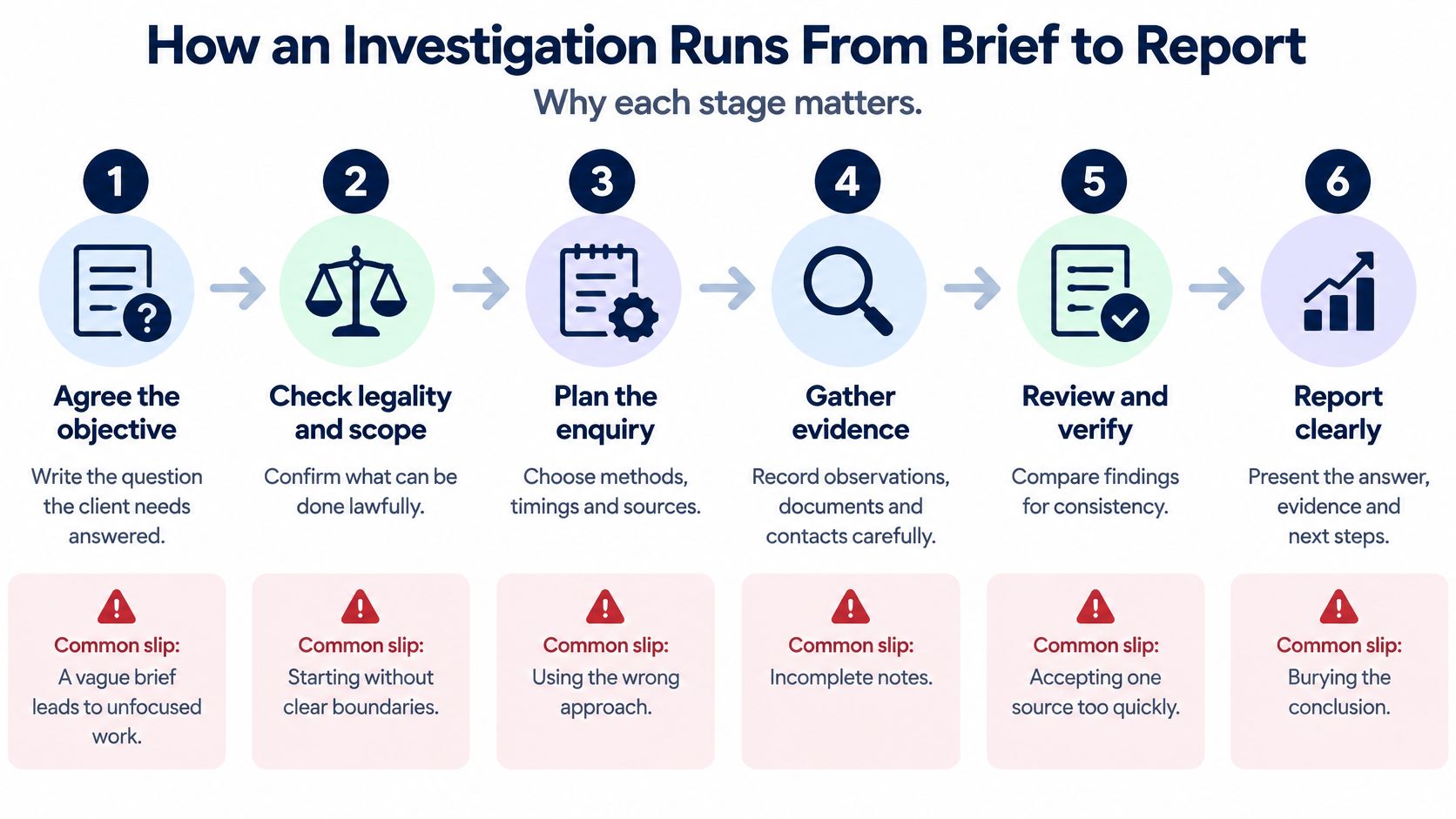
The practical workflow
Agree the objective. Write the question in plain English, such as whether a payment was redirected without approval. A vague instruction to find anything suspicious encourages unfocused collection and makes it difficult to decide when the work is complete.
Complete identity and due-diligence checks. We may require proof of a client's identity and undertake checks before accepting instructions, including compliance with money laundering regulations where applicable. Treating these checks as an inconvenience can delay the work or conceal a problem with the proposed instruction.
Assess lawfulness before deployment. Consider each proposed method separately, including access to records, observation locations and the handling of third-party information. The common mistake is assuming that a legitimate concern makes every investigative tactic acceptable.
Set the scope. Identify the relevant people, places, dates and observation window, along with a review point. Open-ended instructions make costs harder to control and encourage the collection of material that doesn't answer the question.
Gather and verify evidence. Use the authorised combination of records, observation and interviews, recording times, locations and source details as work proceeds. Don't accept an apparent match too quickly: an address, name or photographed vehicle may need independent confirmation.
Maintain an evidence log. Record who collected, copied, stored and reviewed each item, keeping originals separate from working copies where practical. A striking photograph with no reliable context is less useful than properly documented material whose origin can be explained.
Deliver an actionable report. Separate observed facts, information supplied by others and the investigator's assessment. State limitations and unresolved questions rather than burying them beneath a confident conclusion.
What the finished report should do
A reader who wasn't present should be able to follow the sequence of events. Dates, methods, sources, relevant supporting material and a clear summary allow a solicitor, manager or insurer to assess the findings without guessing how the investigator reached them.
For a workplace matter, the report should distinguish the fact-finding assignment from the employer's disciplinary decision. This US-focused legal discussion of navigating an internal workplace investigation provides comparative reading, but it shouldn't be treated as advice on UK employment procedure.
The report should also explain what remains unknown. An unsuccessful observation period doesn't prove that an event never happens, and an unanswered interview request isn't an admission. A defensible report explains the strength of the evidence, not just its contents.
Surveillance, Tracing and Background Checks Compared
A suspected pattern of behaviour, an uncertain address and a claim about someone's history call for different investigative methods. Surveillance records activity during a planned period; tracing seeks a current address or contact route; background checks verify specific details against available sources. A case may need more than one method, but each should answer a defined question.

Observation versus locating someone
Surveillance documents relevant activity within an agreed period. Investigators plan around known routines and record observations with times and locations. The limits matter: seeing someone carry a box does not establish its weight, ownership or contents, and a short recording cannot prove a complete pattern of behaviour.
Tracing uses open-source research and lawfully accessible records to identify a current address or contact route. A matching name is not enough. Shared names, old addresses and outdated online profiles can lead to the wrong person, so identifiers need to be cross-checked.
Verification with a defined purpose
Background checks can examine specific details such as identity, employment history, references and company directorships recorded at Companies House. The scope should match the decision at hand, rather than gather information just because it may be available. Sentry Private Investigators offers background check services for enquiries with a defined purpose.
Criminal-offence information requires particular care. The ICO's guidance on special-category and criminal-offence data explains controls under UK GDPR Article 10 and section 11(2) of the Data Protection Act 2018, including for information about alleged offences. A lawful purpose does not give blanket permission to obtain or disclose someone's criminal history.
For any method, the useful question is what the evidence can establish. Record the source of information and distinguish allegations from established facts. Cross-border asset enquiries need jurisdiction-specific legal advice; hidden asset discovery in Florida concerns a different legal setting and does not establish what can be accessed in the UK.
Legal and Ethical Limits on Investigative Work
More intrusive evidence isn't necessarily better evidence. Material obtained unlawfully can expose a client to complaints or legal proceedings, and may be challenged, discredited or excluded depending on the circumstances. No investigator should promise that a particular recording will automatically be accepted by a court.
The Government's explanation of the Regulation of Investigatory Powers Act 2000 concerns covert techniques used by public authorities, with authorisation requiring legality, necessity and proportionality. That framework doesn't give commercial investigators equivalent powers.
Conditions aren't blanket permissions
The table provides screening principles, not automatic legal clearance. Location, purpose, duration, recording methods and the people affected all matter.
Lawful position for common investigative activities
Activity | Generally lawful when | Main risk if missed |
|---|---|---|
Observing a person in public | Observation is from a lawful position, proportionate and not part of harassing or unjustifiably intrusive conduct | Harassment or a breach of privacy |
GPS tracker on a vehicle | The client owns or lawfully controls the vehicle, with a proportionate purpose and a lawful assessment of monitoring its users | Unlawful tracking of another person's vehicle or movements |
Recording conversations | A participant records, or valid consent is given, with separate consideration of privacy, use and disclosure | Unlawful interception or restrictions on using the evidence |
Accessing personal data | A lawful basis and any additional conditions apply, with handling under UK GDPR | Data-protection breach and an ICO complaint |
Bug sweep | The client owns the premises or vehicle, or has appropriate consent and authority to inspect | Interference with another person's property |
Covert workplace monitoring | Necessity is documented, senior authorisation is given and a DPIA is completed, alongside the other applicable safeguards | Privacy breach and weakened evidence |
Public visibility doesn't remove every privacy consideration. Equally, owning a car doesn't automatically justify recording every journey made by another person.
Workplace monitoring needs a narrower plan
The ICO's worker-monitoring guidance says covert monitoring is rarely justified, but may be appropriate where necessary to prevent or detect suspected criminal activity or gross misconduct. The employer should document why notification would prejudice detection, obtain senior authorisation, complete a data protection impact assessment and limit collection to a short, defined investigation.
Private areas such as toilets and changing rooms must remain off limits, and private communications generally shouldn't be captured. An external investigator's contract should require lawful collection methods.
The commissioning test: Can this evidence be obtained, stored, disclosed and relied upon without creating avoidable privacy, harassment or data-protection problems?
If a tactic fails that test, the answer should be a less intrusive alternative or a refusal, not a promise to be discreet enough to avoid detection.
Skills and Career Routes Into the Profession
The UK has historically operated without a compulsory private-investigator licensing regime. For clients, that means training, relevant experience and demonstrable working standards deserve more attention than an impressive job title.
A career might begin in policing, the military, insurance claims or legal support. Another investigator may enter through accredited training and supervised work as an assistant, learning how to identify people accurately, take useful notes and write balanced reports.
What licensing history means for clients
The Home Affairs Committee's examination of private investigators records the framework created by the Private Security Industry Act 2001, the establishment of the Security Industry Authority in 2003, and the fact that private-investigator licensing provisions remained uncommenced when the committee reported in 2012. Its discussion of registration under the Data Protection Act 1998 concerned a data-protection obligation, not a professional competence licence.
The Government subsequently announced proposed licensing requirements covering recognised training, identity checks and criminal-record vetting. Proposed penalties included fines and imprisonment, but an announced scheme shouldn't be confused with an operative licence.
Skills that affect the quality of your result
Careful observation. Record what happened without adding assumptions about motive.
Clear report writing. Make findings understandable to someone who wasn't present.
Discretion and judgement. Recognise when further collection would be unnecessary or disproportionate.
Interview technique. Ask neutral questions and distinguish direct knowledge from hearsay.
Data-protection knowledge. Understand which records can be accessed and how findings should be handled.
Resilience. Work patiently through inconvenient hours and uncertain outcomes without manufacturing certainty.
A former occupation can provide useful experience, but it doesn't replace these skills. We conduct all investigations through accredited and professional investigators. The meaningful test remains whether the investigator can demonstrate a disciplined method suited to the work you need.
Choosing a Private Detective You Can Trust
Choose a firm that can explain its lawful methods before it quotes for work. A confident promise tells you little about the quality of the investigation. A clear explanation of the objective, limits and reporting process gives you something concrete to assess.
Use the initial conversation to establish whether the firm understands your decision, not just whether it can deploy an investigator. You should leave knowing what the proposed work could establish and what it couldn't.
This checklist summarises useful points to consider.
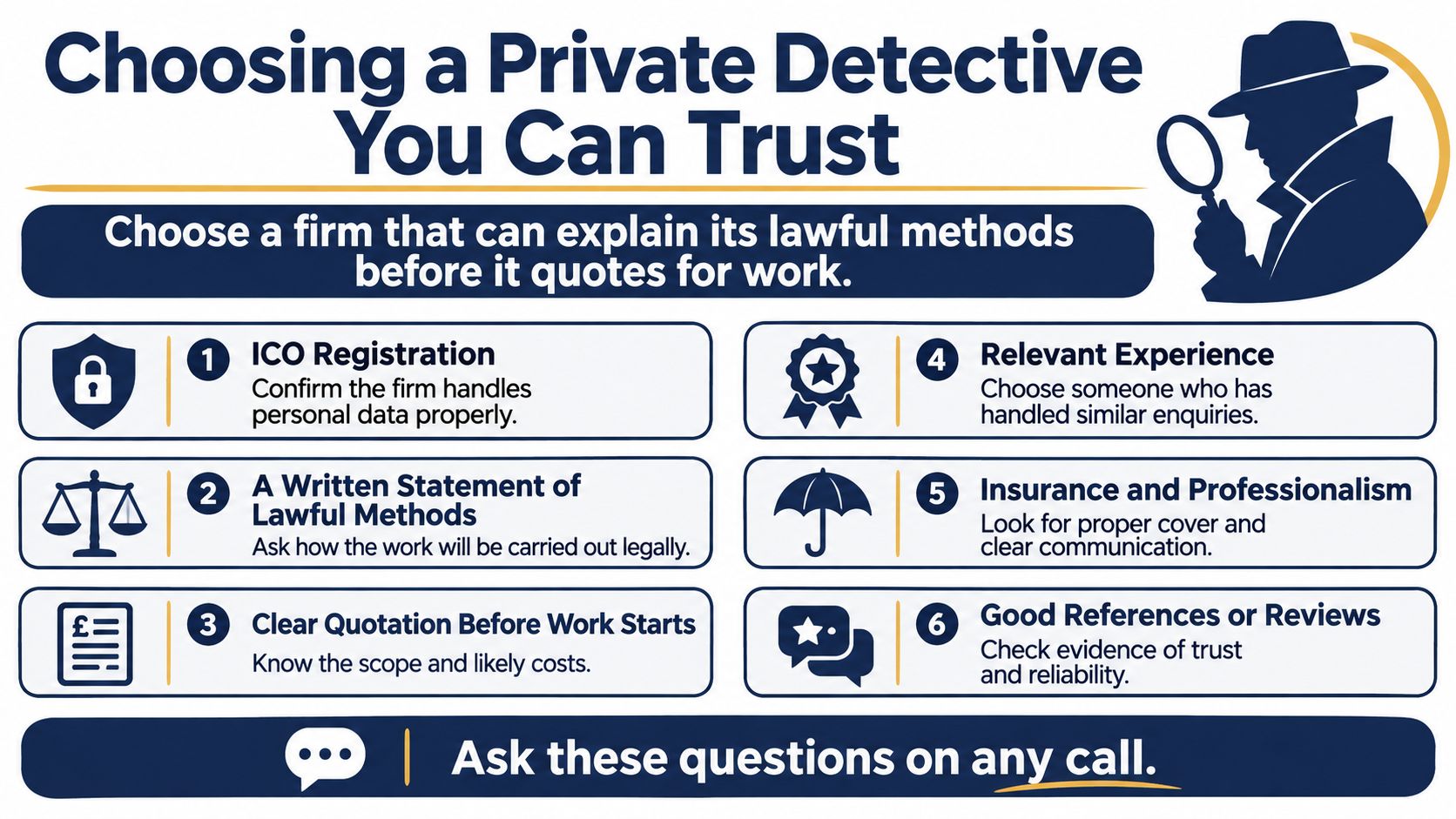
What to establish before committing
Data-protection accountability. Confirm the relevant ICO registration details and understand that registration isn't a guarantee of competence.
Written objective and scope. The instruction should identify the question, authorised work and boundaries. We agree services with the client before work begins.
Client checks. We may undertake due diligence and request identity documents before accepting an instruction. That helps establish who is commissioning the work and why.
Evidence and reporting. Establish what deliverables the proposed assignment includes, whether that means operational notes, photographs, records analysis or a written findings report.
Confidentiality terms. We treat clients' business affairs as confidential, with disclosure limited to necessary persons, carrying out instructions, public information or legal requirements.
Relevant credentials. Professional membership, such as membership of the Association of British Investigators, can be considered alongside training, experience and the proposed method. Don't assume membership without checking it.
Written fee basis. Our investigation costs reflect the service, case complexity and location. The quotation should make the agreed scope understandable rather than relying on a headline figure.
A useful first conversation
Sentry Private Investigators Ltd has its head office in Birmingham and serves clients across the UK. During a confidential consultation, you speak directly with an experienced investigator rather than trying to explain sensitive circumstances through a generic sales enquiry.
Initial consultations are free and provide a starting point for scoping the case. A productive discussion doesn't require you to have assembled a complete dossier. Bring the central concern, relevant dates, existing documents and any deadline that affects the decision.
Keep your account factual. Separate what you personally observed from what someone told you, and explain any previous attempts to resolve the matter. If a solicitor, insurer or HR adviser is already involved, say what evidence they need before further work is planned.
To prepare, write your objective in a sentence and gather the documents that support it. Call 0121 769 1626 to arrange a consultation and discuss an appropriate scope, rather than committing to a tactic before the question is clear.
Sentry Private Investigators Ltd offers discreet investigative services for individuals and businesses, with confidential consultations directly with an experienced investigator. Visit Sentry Private Investigators Ltd to explore the relevant service and book a free consultation, bringing your objective, key dates and available documents so the proposed work can be assessed properly.