
Protect Your Privacy With TSCM Protection: The Importance of TSCM Bug Sweeping

Updated: 3 days ago
Understanding TSCM Privacy Protection and Its Importance
Technical Surveillance Counter Measures (TSCM) privacy protection is a specialised service designed to detect and neutralise electronic eavesdropping devices. These devices, often called bugs, can be tiny microphones, cameras, GPS trackers, or other covert surveillance tools. They are used by malicious actors to spy on individuals or businesses, potentially leading to identity theft, corporate espionage, or personal harm.
In practice, TSCM protection covers far more than a single sweep of a living room. A proper assessment can include homes, offices, boardrooms, executive vehicles and the devices carried into them — phones, laptops and conferencing equipment. Hidden microphones are frequently found in everyday objects such as smoke detectors, power sockets and presentation equipment, while covert cameras and GPS trackers turn up in vehicles and meeting spaces.
For businesses, corporate TSCM protection directly reduces the risk of competitor intelligence gathering: leaked board meetings, photographed confidential documents, planted listening devices and vehicle tracking on senior staff. The commercial stakes are real. One market analysis valued the global TSCM sector at roughly US$720 million in 2025, projected to reach about US$1.52 billion by 2034 — a shift from informal security checks toward specialist counter-surveillance services. Insider risk compounds the hardware threat: Verizon's 2025 breach analysis examined 12,195 confirmed breaches and attributed 30% globally to insiders, which is why physical detection and behavioural awareness must work together per this summary of insider threat statistics.
Scenarios that commonly prompt a sweep include business owners and directors who suspect a departed employee or business partner may have planted something, and families going through disputes who want certainty about their homes and vehicles. When evaluating the top tscm services for corporate espionage protection, look for providers who combine technical skill with strict confidentiality.
Why is TSCM Privacy Protection Necessary?
Prevent information leaks: Sensitive conversations or business strategies can be stolen.
Protect personal safety: Surveillance can lead to stalking or harassment.
Maintain business integrity: Avoid corporate espionage and protect trade secrets.
Peace of mind: Knowing your space is secure reduces stress and anxiety.
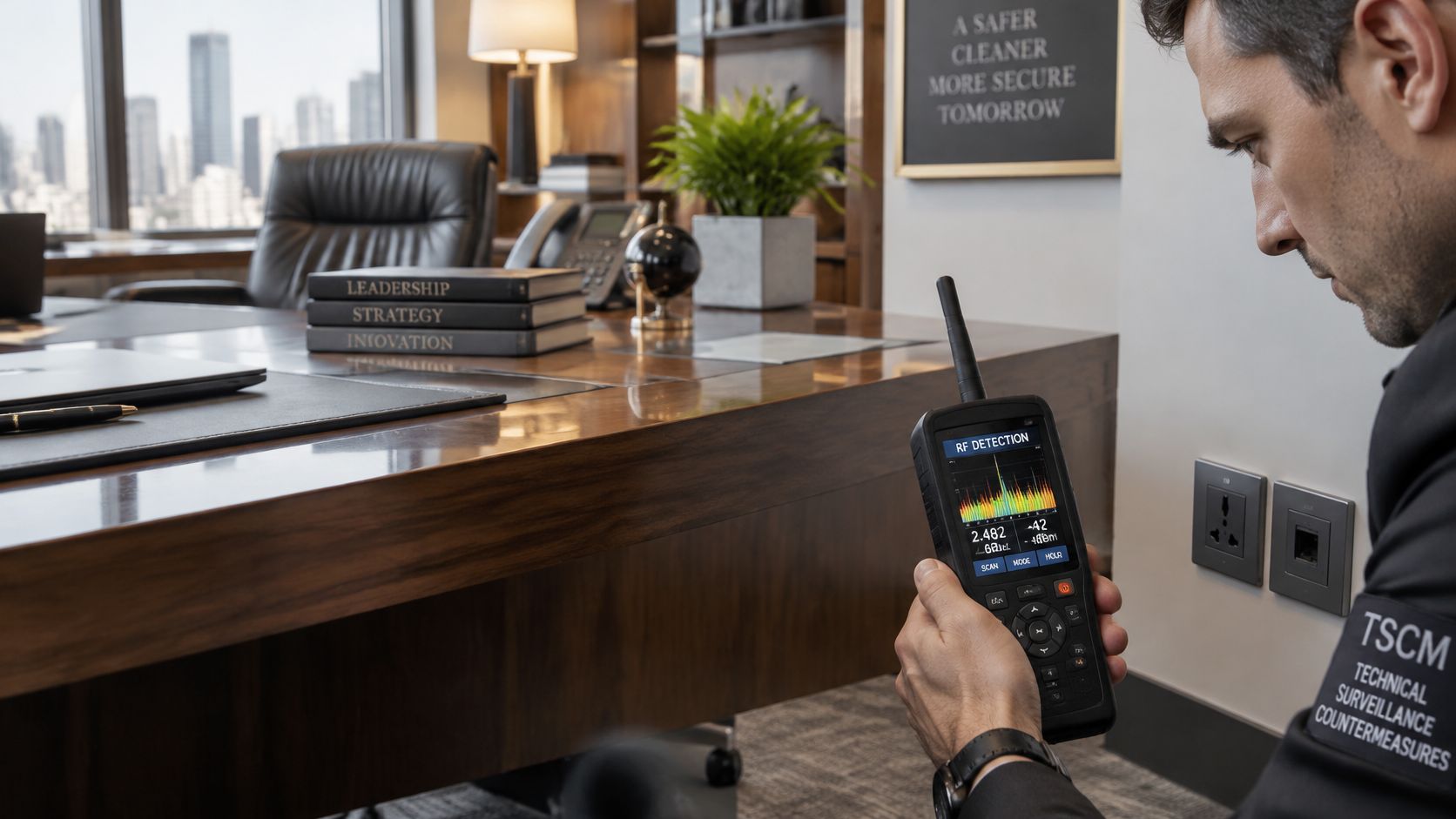
Professional conducting a bug sweep in an office
How We Assess TSCM Privacy Risks and Bug Sweeping Needs
Not every enquiry needs a full sweep. The initial assessment helps clarify whether surveillance, background checks or technical services will best address the client's concerns.
Signals that raise concern include confidential meeting details appearing elsewhere, phones behaving unusually after a business dispute, unfamiliar vehicles or trackers near company cars, and gift items or newly installed equipment of unknown origin. Where those signals are weak or the risk is mainly habit-based — for example, sensitive calls taken in open-plan areas — preventive advice is often the better first step. A full TSCM assessment is justified when access by a hostile party was possible and the potential loss is significant. Costs matter too: malicious-insider incidents average US$4.92 million per incident according to IBM's breach-cost research as compiled by BrightDefense, which is why early detection beats a costly aftermath. For authoritative guidance on managing radio-frequency threats, organisations should consult standards such as those published by the UK National Cyber Security Centre.
How TSCM Privacy Protection Works: Step-by-Step Process
The process of TSCM privacy protection is meticulous and requires specialised equipment and expertise. Here's how a typical bug sweep is conducted:
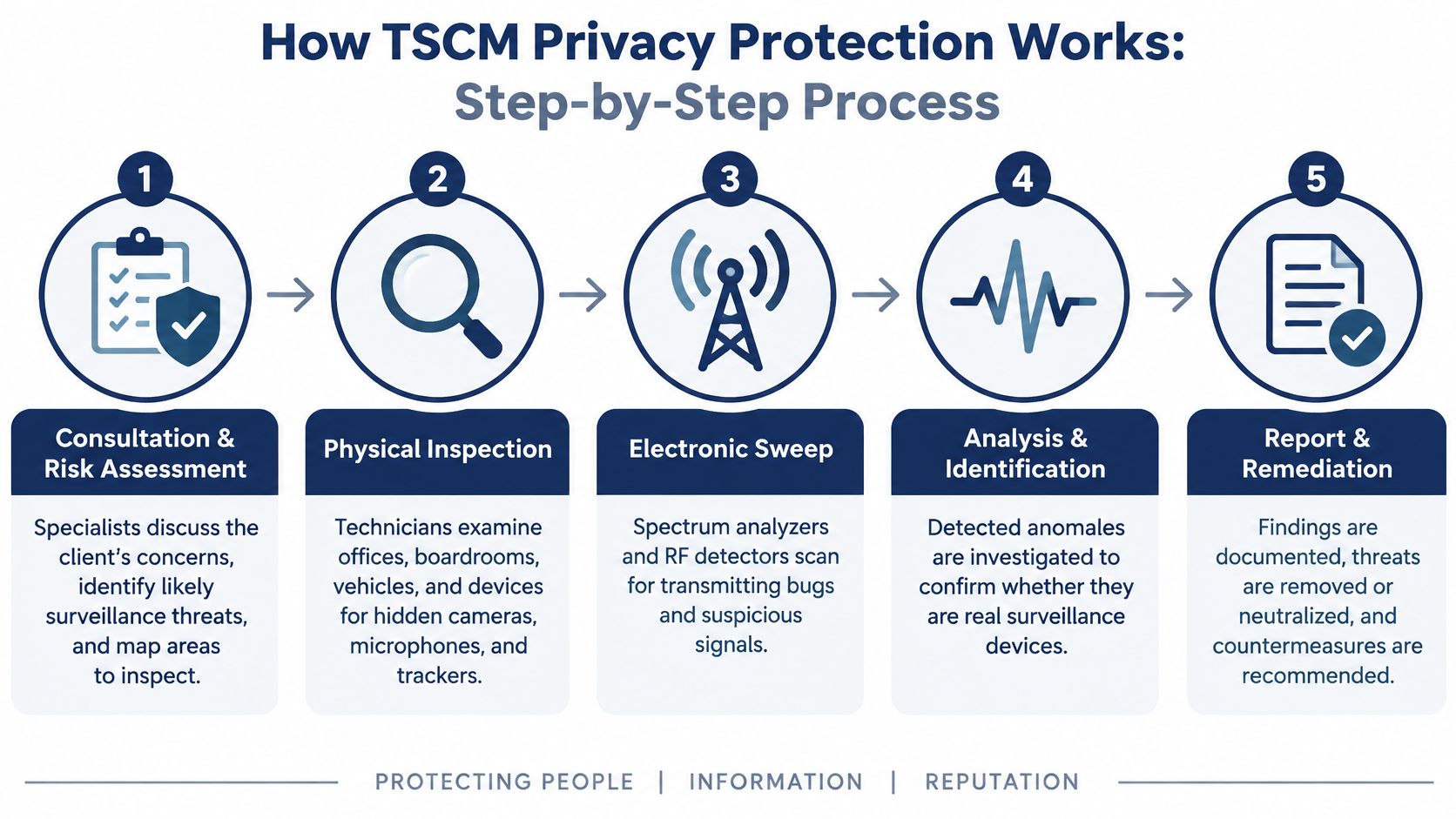
Initial Consultation and Risk Scoping: SPI gathers information about your concerns, property layout, who has had access, and any suspicious activity — this shapes where the sweep focuses.
Physical Inspection: A thorough visual check of rooms, furniture, electrical outlets, ceiling voids, and other potential hiding spots, prioritising areas where sensitive conversations happen.
RF Analysis: Spectrum analysers and RF detectors scan for wireless transmissions. This has limits: a device only shows on RF if it is transmitting at that moment, so analysis is combined with other methods.
Non-Linear Junction Detection: This technique identifies semiconductor components even when they are switched off or not transmitting — the standard method for finding a dormant recorder or camera in a boardroom wall or table.
Analysis and Reporting: All findings are documented; any devices found are safely removed or disabled and handled as evidence where needed.
Follow-up Hardening: Advice on preventing future surveillance, from access control to secure meeting practices.
For corporate clients, the final report should include what was searched, which instruments were used, what was and was not found, and specific remediation steps — a document that stands up if the matter later becomes legal. Every SPI engagement respects privacy, data protection and legal requirements throughout, and client materials are handled with discretion: personal data is stored securely and, when transferred, encrypted with a unique password sent to the recipient separately.
Boardroom Sweeps vs Domestic Sweeps
A boardroom or executive office assessment differs from a domestic sweep in three ways. First, the search priority is fixed points of discussion — the table itself, telephony and conferencing systems, presentation screens and power infrastructure — because those are where a plant will be placed. Second, RF interference is heavier: dense office electronics, neighbouring networks and building systems create noise that a home rarely has, so detection relies more on non-linear junction detection and physical search. Third, scheduled sweeps around sensitive periods such as negotiations or litigation can help maintain ongoing security rather than relying on a one-off visit.
Bug sweeping device scanning for hidden surveillance devices
Do Bug Sweepers Really Work?
Many people wonder if bug sweepers and TSCM services are effective. The answer is yes, but with some important considerations.
Effectiveness depends on:
Quality of equipment: Professional-grade tools can detect a wide range of devices, including those that are very small or cleverly concealed.
Expertise of the operator: Skilled technicians know where to look and how to interpret signals.
Type of surveillance device: Some bugs are passive and harder to detect, but advanced TSCM methods can still find them.
Environment: Complex environments with many electronic devices can create interference, requiring more detailed analysis.
For example, a business owner in London suspected corporate spying in his office. He conducted a search himself but was unable to locate any recording devices. He then hired TSCM experts at SPI, and the professional bug sweep revealed a hidden microphone inside a smoke detector, which the business owner missed even though he examined it. Removing the microphone prevented sensitive information from leaking to competitors.
Professional bug sweeping is a reliable way to uncover hidden surveillance, but it must be done by trained specialists using the right tools.
Practical Tips to Enhance Your Privacy Beyond Bug Sweeping
While TSCM privacy protection is highly effective, combining it with other security measures can further safeguard your privacy.
Limit access: Control who enters your property and monitor visitors.
Secure communications: Use encrypted phones and messaging apps.
Regular checks: Schedule periodic bug sweeps, especially after renovations or security breaches.
Physical security: Install locks, alarms, and CCTV to deter intruders.
Educate yourself: Learn about common surveillance tactics and stay vigilant.
For personal devices, privacy-focused tools can also help; for a look at how iPhone users weigh app availability against privacy, see this overview via Vault9.
For instance, a family concerned about privacy installed encrypted communication devices and combined this with regular TSCM bug sweeping. This layered approach significantly reduced their risk of being monitored.
Why Choose Professional TSCM Bug Sweeping Services?
Attempting to detect bugs yourself with consumer-grade devices is often ineffective and can lead to false alarms. A strong TSCM service has distinct, checkable components:
Threat assessment: A structured conversation about who could have had access and what would be worth stealing, before any instrument is switched on.
Physical inspection: Methodical search of concealment locations — not a walk-around glance.
RF scanning: Spectrum analysis calibrated for the environment, interpreted by an operator who understands interference.
Non-linear junction detection: The capability to find powered-down electronics, which consumer gadgets cannot do.
Reporting and confidentiality: A documented outcome delivered under strict protocols, with client information kept confidential and disclosed only where necessary.
Follow-up hardening: Concrete changes that reduce the chance of a repeat, not generic reassurance.
For decision-makers protecting offices, senior staff and sensitive meetings, look for a provider that treats corporate espionage protection as a process rather than a product: someone who asks hard questions about access and information flow, uses specialist detection equipment alongside physical inspection, and conducts investigations without signaling themselves to the people concerned. For those seeking reliable and discreet private investigation services, TSCM Bug Sweeping remains a core offering.
Taking the Next Step to Secure Your Privacy
If you suspect your privacy is at risk or want to be proactive, professional TSCM privacy protection is the best choice. Don't wait until sensitive information is compromised. Reach out to Sentry Private Investigators who can conduct a thorough bug sweep and help you regain control over your environment.
Remember, privacy is a right worth defending. With the right tools and expertise, you can protect yourself, your family, and your business from hidden surveillance threats. Make the call today and take the first step towards a safer, more secure future.
Frequently Asked Questions
Do bug sweepers really work?
Yes, when they are trained specialists using professional equipment. The combination of RF analysis, non-linear junction detection and a disciplined physical search finds both transmitting and dormant devices that consumer gadgets miss.
How often should a sweep be carried out?
Businesses with recurring sensitive meetings often schedule sweeps around key events such as negotiations, litigation or leadership changes. For most clients, an annual check plus a targeted sweep after any suspected incident is a sensible baseline.
Can my office or car be checked?
Both. Offices, boardrooms and vehicles can all be inspected, and vehicles are a common priority because they pass through many hands — servicing, parking, valeting — making them vulnerable to hidden devices.
Can my phone be checked during a sweep?
Yes. Mobile phones, tablets and laptops brought into a secure space can be examined for signs of compromise, unusual software behaviour or unauthorised modifications as part of a broader TSCM assessment.
What signs suggest covert surveillance?
Recurring patterns include confidential information reaching third parties, unfamiliar devices or wiring, unexplained vehicle activity near your property, and phones that behave oddly. Any one of these alone proves nothing, but two or more justify an assessment.
