
Commercial Due Diligence Services: A UK Guide

Updated: Aug 28
A supplier has offered unusually attractive terms. A smaller competitor is available at a price that looks difficult to ignore. Or a proposed joint-venture partner appears credible, but the information supplied by its directors is mostly narrative and sales material. Before money, reputation or contractual exposure changes hands, you need to know whether the business exists as represented, who really controls it, how it trades and what risks may sit behind the public story.
That's the practical purpose of commercial due diligence services. A proper UK investigation isn't a generic online company report. It combines Companies House and people with significant control checks, filing analysis, open-source research, proportionate enquiries and, where justified, discreet fieldwork. The result helps a business owner, solicitor, finance director or corporate executive decide what needs further legal, financial or operational investigation.
UK deal activity can be selective and concentrated. The Office for National Statistics recorded 352 M&A transactions involving a change in majority share ownership in Q1 2026, compared with 495 in Q4 2025, including 117 domestic deals. The same series recorded outward M&A value at £4.7 billion, an increase of £1.7 billion from the previous quarter, while the Competition and Markets Authority considered 902 merger cases across more than 40,000 globally announced deals during 2025 to 2026. These figures, reported in the Landmark commercial property trends report, underline why scrutiny can be intense even when the number of suitable targets is limited.
When a UK Business Needs Commercial Due Diligence
A director in Leicester receives a proposal from a supplier claiming national distribution capacity. The company has a polished website, a persuasive sales representative and a bank account ready for payment. The director's immediate concern isn't whether the website looks professional. It's whether the supplier has the people, premises, trading history and ownership structure needed to fulfil the contract.
The same issue arises in Birmingham when an owner considers acquiring a smaller competitor, or in London when a corporate executive is preparing to complete a strategic investment. A commercial investigation can test the story before the business commits funds, customer relationships or confidential information.
The people who commission this work
Commercial due diligence isn't reserved for large listed companies. Typical clients include:
SME owners: Checking a proposed joint-venture partner, distributor, franchisee or investor.
Solicitors: Obtaining verified background information for litigation, fraud allegations, asset questions or witness preparation.
Finance directors: Assessing a new supplier, overseas customer or intermediary before onboarding.
Corporate executives: Testing an acquisition target before completion, particularly where management information is incomplete.
Private investors: Establishing whether a promoter, director or company has the history it claims.
HMRC defines due diligence as the reasonable care used when entering business relationships or contracts, with checks designed to identify and manage risk in a transaction or supply chain. Its guidance says the checks should be proportionate and completed before entering a trade agreement, as explained in the HMRC due diligence manual.
The service is also useful when a solicitor needs more than a database extract. A search may reveal a company number and a current director, but an investigator can compare that information with historic filings, connected entities, public statements, trading premises and the conduct of associated individuals. For broader corporate work, business private investigations can place that enquiry alongside fraud, employee, partner and asset investigations.
Practical rule: A clean first impression is a reason to verify the counterparty, not a reason to stop checking.
Buyers researching wider transaction patterns may also find Visbanking M&A intelligence useful for market context. That type of intelligence can inform the commercial question, but it doesn't replace target-specific verification. By the end of an engagement, the client should understand what has been evidenced, what remains unverified and which issues belong with the accountant or solicitor.
What Commercial Due Diligence Services Actually Are
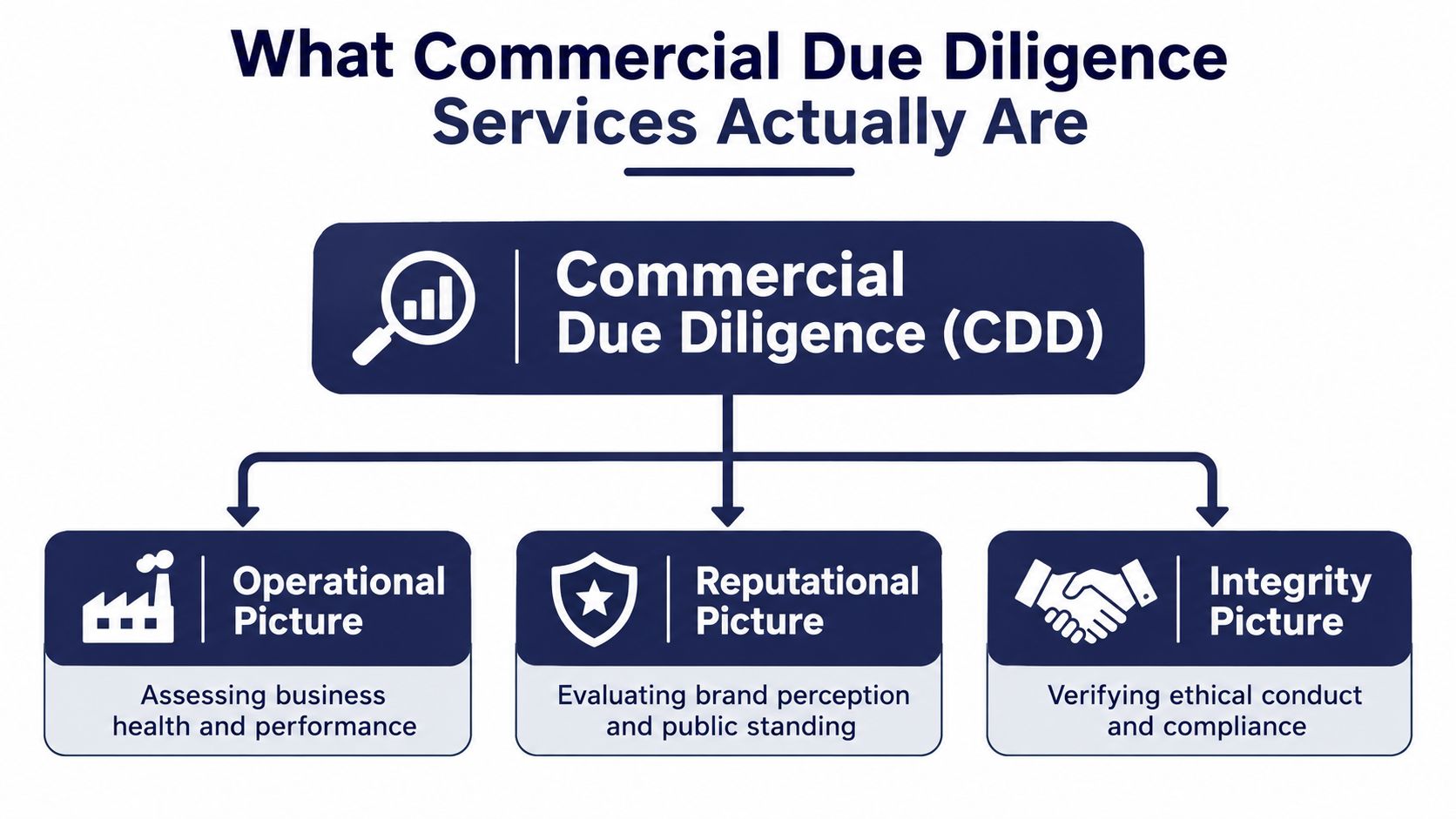
Commercial due diligence examines whether a person or business is commercially credible, operationally capable and sufficiently transparent for the proposed relationship. HMRC's approach is useful because it treats due diligence as a series of risk checks, not a single search. Companies House provides an important identity and control reference point, but it's only one part of the picture.
The work usually sits between three professional disciplines:
Commercial due diligence: Trading reality, ownership, reputation, counterparties, operational capacity and integrity.
Financial due diligence: Revenue quality, working capital, tax, earnings, debt and financial projections, normally handled by an accountant or corporate finance adviser.
Legal due diligence: Contracts, title, liabilities, employment issues, litigation exposure and regulatory obligations, normally handled by a solicitor.
A private investigator shouldn't present a registry search as an audit or give legal advice outside their competence. Their value lies in asking whether the information supplied by the target is consistent with independent evidence.
The questions a practitioner should answer
A focused engagement may investigate:
Who controls the company? The PSC register, historic filings and related entities can help map ownership and control.
Is the business active in the way it claims? Public records, trading addresses, premises checks and third-party information can test operational claims.
Does the management story hold together? Director history, previous companies, insolvency records, litigation references and adverse media may identify inconsistencies.
Are there integrity concerns? Sanctions screening, fraud indicators, regulatory history and unexplained relationships can require escalation.
What cannot be verified? A responsible report separates confirmed information from allegations, assumptions and gaps.
The Companies House framework matters because UK companies have been required to maintain and file a register of people with significant control since July 2016. HMRC's Know Your Customer guidance identifies Companies House as an identity-check source and treats a lack of listing as a risk indicator.
For HR and procurement teams, the vendor due diligence guide for HR teams offers useful context on how third-party checks can fit into broader organisational controls. For acquisition-specific work, Sentry's due diligence checks for UK acquisitions can help readers distinguish a targeted investigation from a generic business report.
Core Workstreams Inside a UK Due Diligence Engagement
A sound investigation normally starts with identity and control, then moves towards conduct, capability and physical reality. The order matters. There's little value in investigating a trading claim before confirming that the legal entity, directors and beneficial owners have been correctly identified.
Companies House data also has a timing issue. Its free company data product updates monthly within five working days of month-end, while the PSC snapshot updates daily, according to Company Chat's explanation of Companies House data. Practitioners may therefore combine monthly company information with daily PSC checks and live API lookups where ownership, director or filing changes are time-sensitive.
A practical investigation sequence
The central UK framework can be HMRC's FITTED model: Financial Health, Identity, Terms of contract, Transport, Existence of goods and Deal. The exact weighting depends on the assignment, but it stops an investigator from treating commercial due diligence as a reputation search alone.
Workstream | What It Checks | Primary UK Source |
|---|---|---|
Company and PSC review | Legal identity, directors, control, filing health and historic changes | Companies House and PSC register |
Adverse information | Public allegations, regulatory concerns, insolvency indicators and relevant disputes | Court information, regulator publications and reputable media |
Counterparty verification | Whether suppliers, customers and references are genuine and commercially connected | Public records, direct enquiries and supplied documents |
Assets and trading presence | Premises, equipment, goods, intellectual property indicators and operating footprint | Companies House, public registers, site research and field enquiries |
Contract and transaction review | Claimed terms, relationships, delivery arrangements and deal-specific risks | Client documents, HMRC FITTED framework and contract records |
Integrity assessment | Whether evidence supports the target's representations and risk profile | Cross-checked findings from all workstreams |
The investigator should record discrepancies rather than smooth them over. A dormant-looking address, repeated filing delays, unexplained director connections or a mismatch between claimed scale and observable activity may not prove wrongdoing. They do, however, give the client precise questions for management, counsel or the finance team.
When desk research isn't enough
Some assignments need local enquiries. A discreet visit may establish whether a business occupies its stated premises, whether signage and activity are consistent with its representation, or whether a claimed asset appears to exist. It must be lawful, proportionate and carefully documented.
Where ownership, residence or asset location is unclear, experienced UK tracing agents may be used within the agreed scope. International VAT verification may require a separate specialist tool, such as a service that can verify VAT across 31 countries, particularly where the target relies on overseas suppliers or customers.
A field enquiry shouldn't be ordered automatically. It costs more, can alert the subject and may add little where official records already answer the question. The best proposal explains why each method is necessary.
Legal and Ethical Boundaries UK Investigators Work Within
Commercial investigation is useful only when the evidence can be obtained and explained lawfully. A provider who promises unrestricted access to private records, confidential bank information or hacked communications isn't offering a stronger service. They're creating a problem for the client.
UK data-protection principles require investigators to identify a lawful basis, handle information fairly, minimise unnecessary collection and retain material appropriately. Legitimate interests may be relevant in commercial investigations, but it isn't a blanket permission. The investigator should document why the processing is necessary, what interest is being pursued and why the impact on the individual is proportionate.
What responsible practice looks like
A professional engagement should address:
Purpose limitation: Collect information for the agreed commercial question, not for unrelated curiosity.
Data minimisation: Obtain what's needed to assess the risk, rather than building an indiscriminate personal dossier.
Accuracy: Distinguish verified facts from allegations, outdated material and untested online claims.
Security: Control access to reports, source material and client instructions.
Retention: Keep information for a defined reason and period, subject to legal or evidential requirements.
Accountability: Maintain a documented Record of Processing Activities where required and explain the methodology.
Covert verification needs particular care. Surveillance, tracking and recording can engage privacy rights and the Regulation of Investigatory Powers Act 2000. A commercial investigator must consider necessity, proportionality, location, subject expectations and the purpose of any observation. A client's commercial urgency doesn't remove those obligations.

Where the professional boundary lies
An investigator can gather evidence, identify inconsistencies and report relevant findings. They shouldn't act as a solicitor by advising on the legal effect of a contract, and they shouldn't present financial analysis as an audit. Insolvency practitioners and lawyers have specialist statutory and professional roles that cannot be replaced by an investigation report.
A report obtained through unlawful means may be unusable in a dispute, regardless of how interesting the information appears.
Ask the provider about their lawful basis, privacy documentation, source evaluation, authorisation process and report security before work starts. Those questions protect the evidence chain and help the solicitor decide whether the material can support a wider case strategy.
What the Client Experience Looks Like From Start to Finish
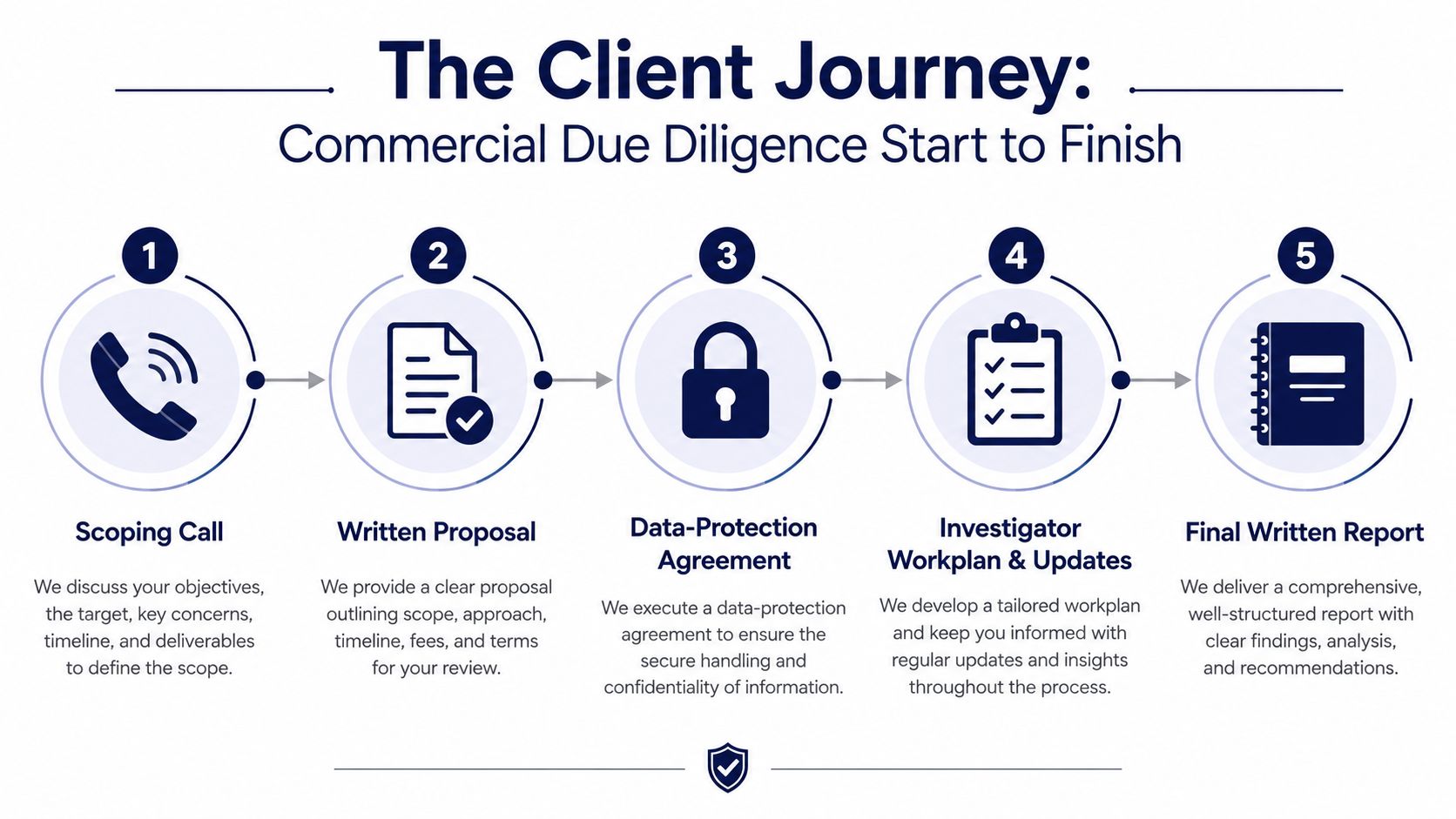
A well-run engagement begins with a conversation, not a payment link. The investigator needs to understand the proposed transaction, the target's legal name, the urgency, the specific concern and what decision the client must make. “Check this company” is too vague. “Verify the ownership, operating address and director history before we sign the distribution agreement” is workable.
The provider should then issue a written proposal setting out the scope, methods, deliverables, assumptions, exclusions and fee basis. It should also explain how personal data will be processed, who the client is responsible for authorising and how the final report will be delivered.
The usual checkpoints
Scoping call: Define the commercial decision, target entities, relevant individuals and deadlines.
Written proposal: Confirm the workplan, cost, reporting standard and any optional field enquiries.
Data-protection agreement: Record the lawful basis, instructions, confidentiality expectations and retention approach.
Investigator workplan: Complete registry, ownership, conduct, trading-presence and counterparty checks, with updates if a material issue changes the scope.
Final written report: Present findings, source references, limitations, risk observations and recommended questions for advisers.
A basic company-and-director check can often start and finish within about a week, depending on access to records and the complexity of the names involved. A full pre-acquisition package may take several weeks where it includes multiple entities, interviews, travel, foreign-language material or court-ready reporting.
Pricing varies for the same reason. A narrow desk review costs less than an investigation requiring depth field enquiries, travel, translation, asset work or evidence prepared for a contested matter. A provider should explain the difference between a fixed scope and work billed when new findings require authorisation.
The final report should be readable by a director and useful to a solicitor. It should identify what the investigator checked, when it was checked, where the information came from, what remains uncertain and whether further work is proportionate.
Choosing the Right Commercial Due Diligence Provider
An offshore database reseller can produce a fast-looking report, but speed doesn't establish accuracy. Automated tools often repeat registry information without testing whether the address is occupied, whether the director's claimed background is coherent or whether the commercial story matches observable activity.
A UK investigation firm should be able to answer practical questions before accepting instructions.
A provider scorecard
Company identity: Check that the provider is a verifiable UK-registered business with a clear trading address.
Named responsibility: Ask who will manage the case and who will write or quality-check the report.
Methodology: The investigator should explain which records will be searched, how conflicts will be assessed and when fieldwork may be recommended.
Data protection: Look for a clear privacy policy, an appropriate data-processing explanation and ICO registration where applicable.
Insurance: Ask whether professional indemnity cover is held and whether the proposed work falls within it.
Reporting sample: A redacted sample can show whether the firm separates facts, sources, analysis and limitations.
Escalation ability: Registry data should be capable of being followed by discreet local enquiries when the records don't answer the commercial question.
Sentry Private Investigators Ltd is one UK option that combines desk-based corporate enquiries with field investigations across Birmingham, Coventry, Wolverhampton, Worcester, Leicester, London and the wider UK. That model is materially different from a report seller whose service ends when an automated database returns a result.
The cheapest quote may exclude the exact work that makes the investigation useful. Compare scope, not just the headline fee. If two providers use the same words but one includes ownership mapping, source evaluation and a defined escalation route, the proposals aren't equivalent.
Common Misconceptions That Undermine Due Diligence
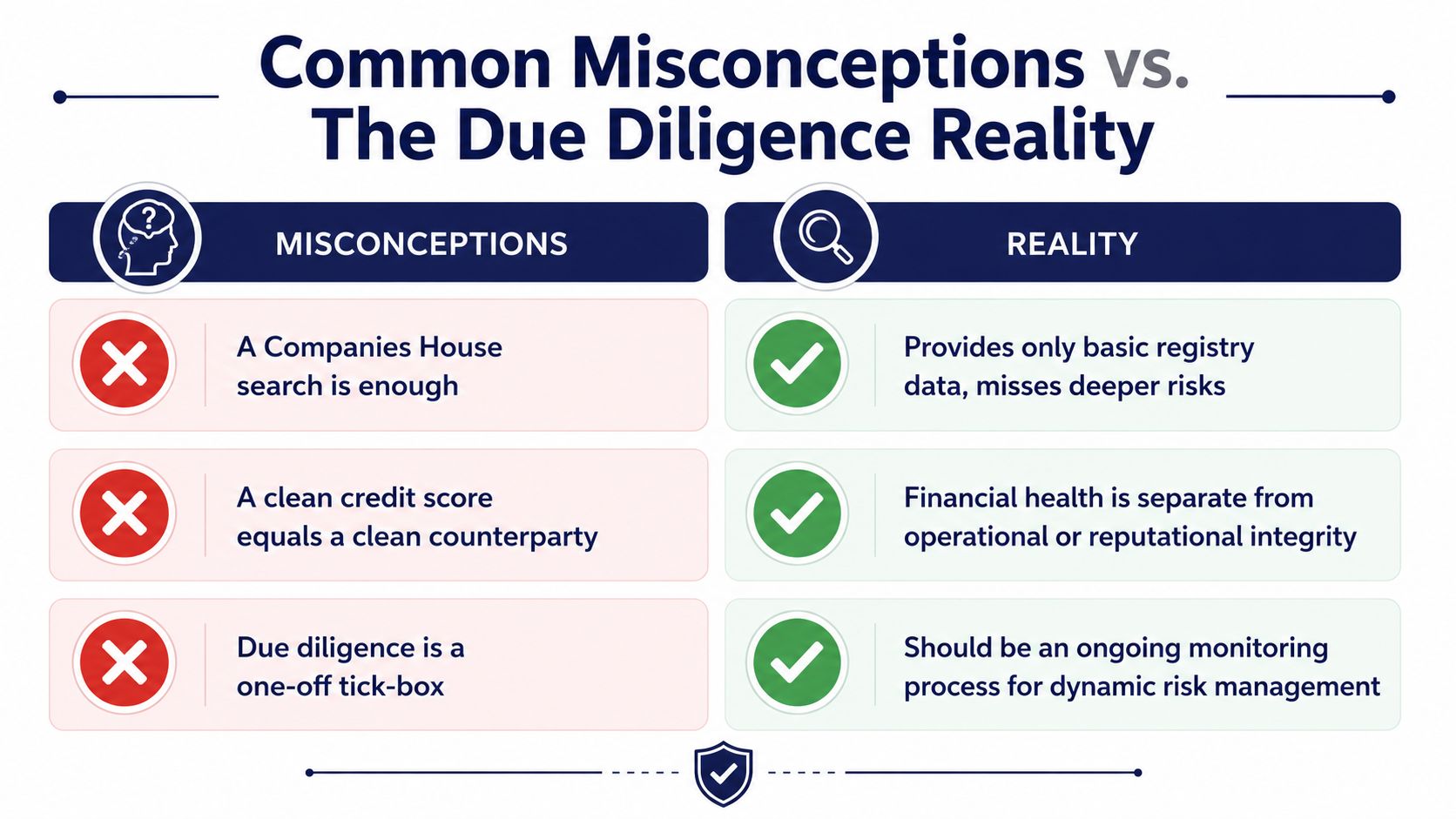
A Companies House search is a starting point, not a conclusion. The register can identify legal entities, directors, filings and PSC information, but it doesn't independently confirm every statement made by management, prove that a premises is active or reveal every informal commercial relationship.
The update cycle also matters. Company data is updated monthly within five working days of month-end, while PSC information is updated daily, so a practitioner needs to consider whether a static download is sufficient for a live ownership question. Historic filings and current lookups should be interpreted together rather than treated as interchangeable.
The assumptions that cause expensive mistakes
A clean credit score equals a clean counterparty. Credit information may help assess financial behaviour, but it doesn't answer whether the business has hidden control relationships, reputational exposure, weak systems or a misleading trading history. Financial health and commercial integrity are related, but they're not the same question.
Due diligence is a one-off tick-box. A transaction may be the trigger, yet supplier and partner risk can change after signing. The UK private equity market review from BDO reports that holding periods have risen to 5.3 years from 4.1 years in 2020, making longer-run resilience more relevant to investment decisions. A target that looks sound at completion may later face talent dependency, data-quality problems, regulatory change or AI-related disruption.
AI-generated reports are automatically reliable. AI can organise large volumes of material and help identify patterns, but it can't guarantee that an underlying source is accurate, current or relevant. State Street's UK outlook reports that 85% of UK respondents said GenAI-based tools can generate analysable insight from unstructured information, while HR-focused UK deal research found 66% identified data completeness, quality and integrity as their top due diligence challenge. Those findings, cited in BDO's UK private equity market review, support a cautious approach. Use technology to assist review, then have a practitioner verify the sources and context.
The right question isn't whether a report contains a lot of pages. It's whether the evidence helps you make a safer decision.
Practical Next Steps and Frequently Asked Questions
Start by writing the decision the investigation must support. Identify the legal entity, directors, PSCs, trading names, known addresses, transaction deadline and the concern that prompted the enquiry. Provide documents or claims supplied by the counterparty, because discrepancies between those materials and public records often shape the workplan.
Ask for a written scope before authorising work. Confirm confidentiality, data handling, expected updates, the final report format, any optional field enquiries and the process for approving additional costs.
Frequently asked questions
How quickly can an investigation start?A UK firm can often begin once the scope, identity information and data-protection terms are agreed. The completion time depends on entity complexity, the number of people involved, overseas material and whether discreet enquiries are needed.
What does the client need to provide?Usually the legal name, company number, trading names, relevant addresses, director or shareholder names, the proposed agreement and a clear explanation of the risk. The better the starting information, the less time is spent resolving basic identification issues.
Will the engagement remain confidential?Confidentiality should be addressed in the engagement terms, alongside lawful processing, access controls and report delivery. No responsible provider should promise secrecy that overrides legal obligations or a requirement to preserve evidence.
Can the report be used in a dispute?It may support a solicitor's case strategy if the methodology, sources, dates and limitations are clearly recorded. The investigator doesn't decide admissibility, and the client should obtain legal advice on how the material can be deployed.
If a supplier, partner, investor or acquisition target needs checking, seek a scoped proposal rather than a generic search result. Ask for the evidence, the limits and the next practical step.
Sentry Private Investigators Ltd provides discreet commercial due diligence, corporate investigations, background checks and tracing services across the UK. Visit Sentry Private Investigators Ltd to discuss the target, the decision deadline and the level of verification your situation requires.